
Written by: Eric, Foresight News
On the night of May 4, Beijing time, Pavel Durov, the founder of Telegram, suddenly tweeted that Telegram would replace the TON Foundation as the driving force of TON and become the largest validator of Ton. It is worth mentioning that Durov had only seven tweets mentioning TON throughout 2025, and this sudden announcement of "taking over" TON was indeed unexpected.
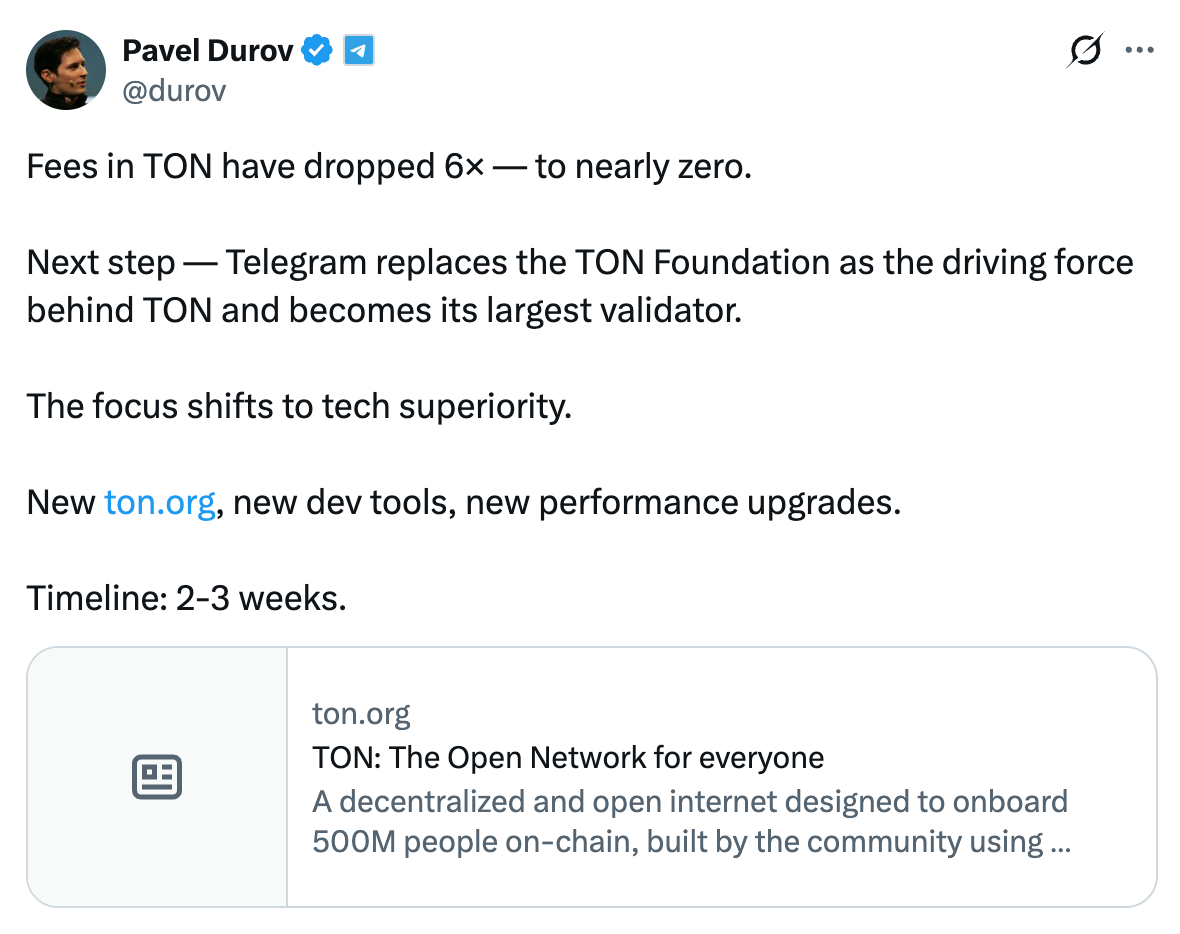
The ton.org website is currently under maintenance, with only one sentence on the page: ton.org is now controlled by MTONGA (Make TON Great Again).
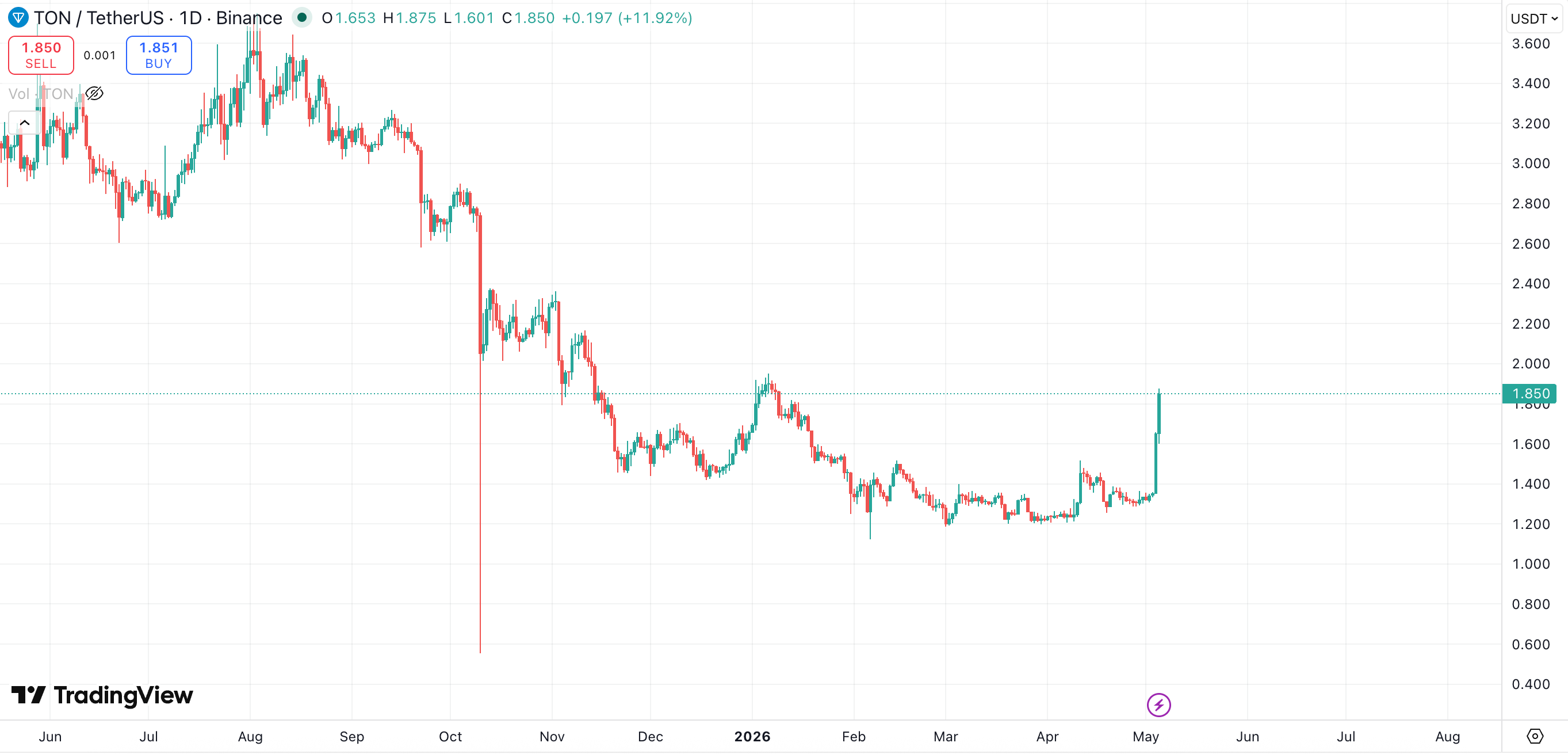
As a result, the price of TON rose from around $1.35 to $1.85 within two days, an increase of over 37%.
In 2020, the U.S. Securities and Exchange Commission accused Telegram Open Network of issuing the Gram token through an ICO in 2018 as unregistered securities. Telegram was forced to abandon the project, refund funds, and publicly announced its cessation of involvement in the project after open-sourcing the code. After that, two developers, Anatoliy Makosov and Kirill Emelyanenko, who met at a Telegram programming competition, took over the project, launching the community-driven project NewTON, inheriting the original TON code, maintaining nodes, and working on the testnet, gradually advancing the mainnet.
In 2021, the NewTON community upgraded the testnet to the mainnet and officially turned to the TON Foundation, which was registered as a non-profit organization in Switzerland in 2023, supported by community contributors.
Thus, it has been six years since Telegram was forced to abandon TON due to regulatory pressure to Telegram's founder actively announcing the investment of time and effort to promote TON's development. In these six years, TON has experienced a complete cycle of rise and fall.
In April 2022, just as the entire market was enveloped in confusion, the TONcoin Fund, backed by investors like Huobi Incubator, Kucoin Ventures, and MEXC Pioneer Fund, suddenly announced the launch of a $250 million ecological fund to support projects on Ton. Subsequently, the TON Foundation launched a $1 billion ecological fund to promote the development of the Ton ecosystem.
After that, the TON ecosystem experienced a small outbreak, gradually establishing infrastructure from domains to storage and DeFi, but it never generated much splash until the appearance of Telegram mini-games.
In fact, at the very beginning of TON's effort to establish an ecosystem, it began to establish a connection with Telegram, with both official and third-party projects launching Mini Apps for cryptocurrency transfers or payments on Telegram. The connection between the two gradually became tighter, and the mini-games elevated the level of their integration. Before this, a large number of on-chain games declined due to poor user experience, complex gameplay, and promotional difficulties, while mini-games on TON spread like a virus on Telegram, utilizing its hundreds of millions of users and implementing simple gameplay similar to "Candy Crush" and "Sheep-Go" to attract players.
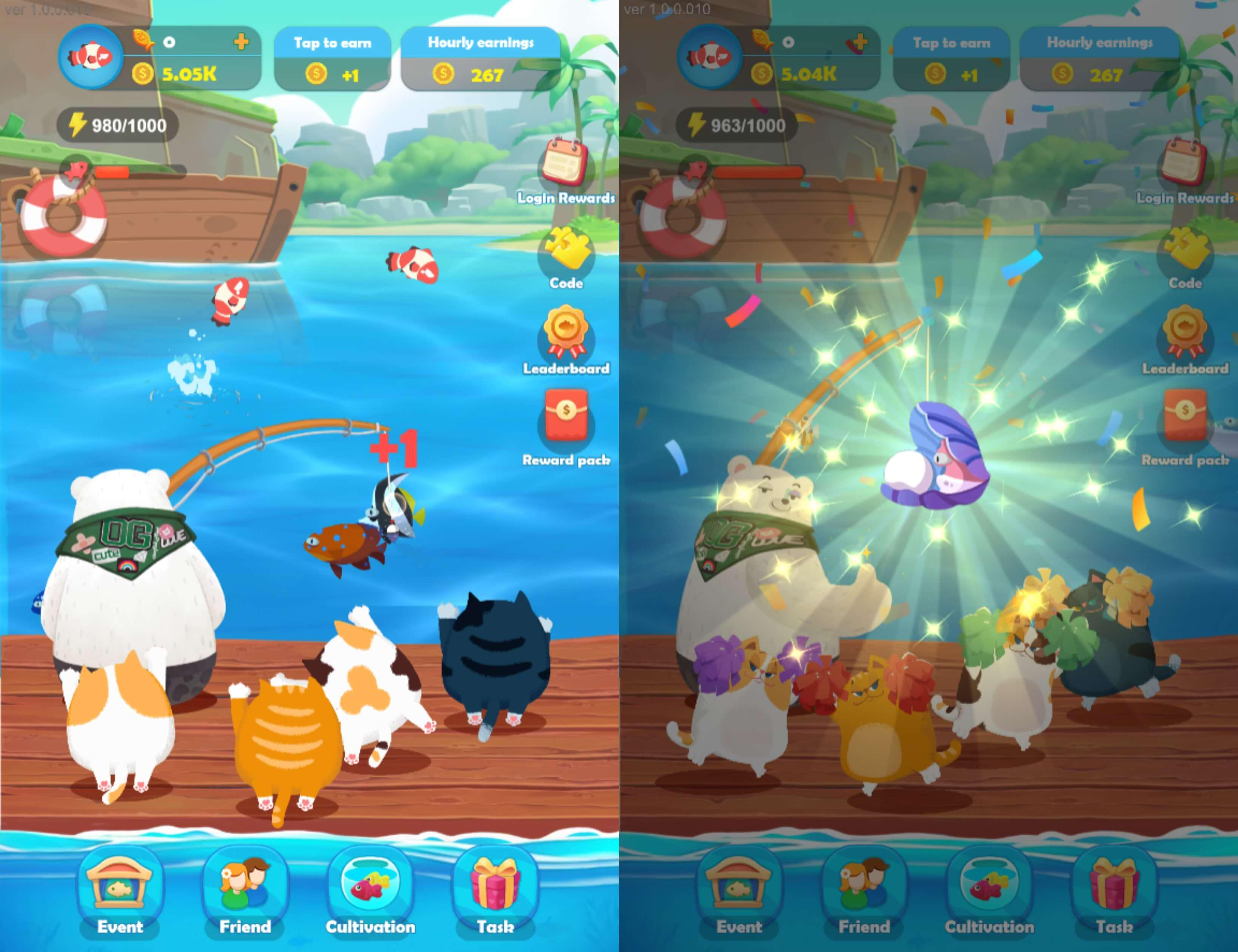
During the mini-game boom, many games developed by different teams could accumulate millions of users within a few days, with the hottest at that time being Tap-to-Earn games like Notcoin, where many game project tokens skyrocketed in a short time, creating a substantial wealth code. Meanwhile, the price of TON tokens also surpassed $8 by mid-2024, with a total market capitalization exceeding $26 billion.
However, this wind came quickly and left just as fast. As the popularity of mini-games gradually declined, TON was unable to put forth a second big move to maintain interest. Coupled with the founder being arrested by French authorities for failing to effectively control illegal activities on the platform, concern about TON's future led to a rapid decrease in on-chain enthusiasm, and almost overnight, it fell silent.
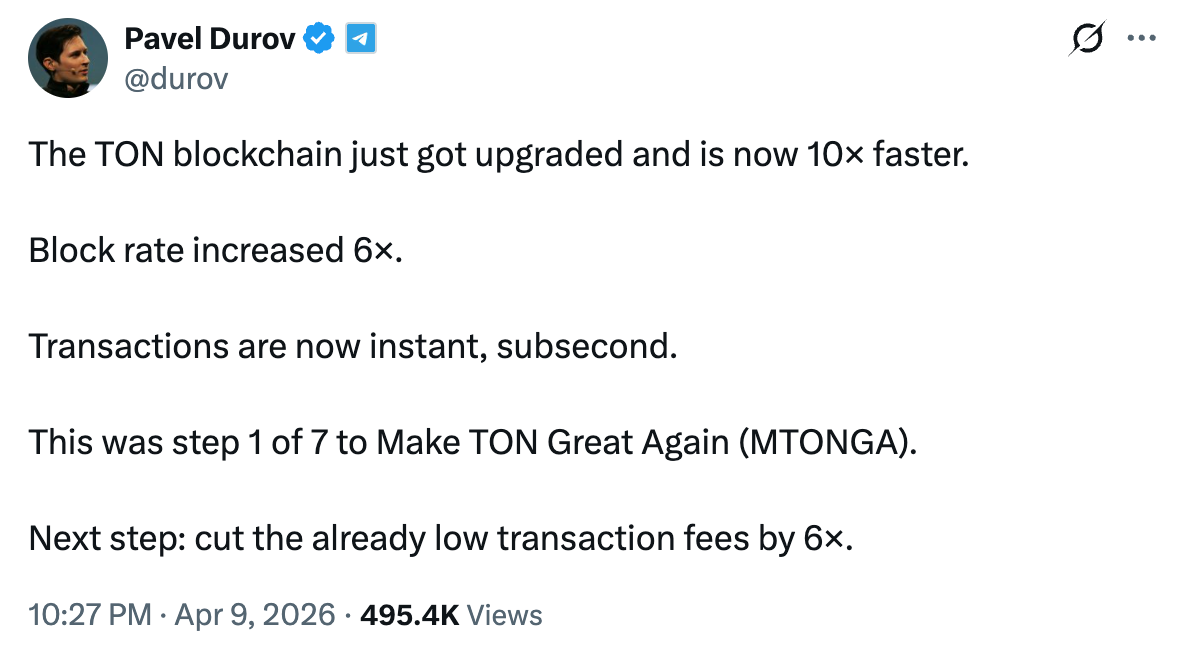
Recently, TON has re-entered the market's sight, once again due to Pavel Durov's tweet. On April 9, Pavel Durov announced that TON had completed an upgrade, with speed increased by 10 times and block generation efficiency improved by 6 times, allowing transactions to be completed in one second. However, this is only the first step in MTONGA's seven-step plan, and the next step will further reduce the already low transaction fees by 6 times.
The improvement in chain performance comes from the completion of the Catchain 2.0 consensus upgrade in April. The new consensus mechanism of TON introduces a "streaming layer" to push state updates instead of the previous polling mechanism, shortening block production time to approximately 400 milliseconds, and transaction finality confirmation requires approximately 1 second. The reduction in fees mentioned by Pavel Durov has already been completed, and as of early May, the basic fee for Ton has been reduced to approximately $0.0005.
In addition, TON underwent a round of optimization for Ton's infrastructure in the first quarter of this year, utilizing a brand new node implemented in Rust that significantly simplifies operations and maintenance, making it suitable for institutional-level and large-scale deployments, and enhancing security and modularity. The developer tools Builders Portal have also launched version 2.0, with version 3.0 expected to be released in the second quarter.
While there is no explicit mention of the ultimate goal of these changes, it is clear that Pavel Durov hopes to use Telegram as a traffic entry point, allowing TON to become a payment and interaction entry point that supports the development of Mini Apps and AI tools on Telegram. Especially in the field of AI, many "lobster masters" are currently choosing to use Telegram to control AI to execute tasks, and in the future, Telegram may not only be a tool for person-to-person communication but also an important tool for human-machine interaction, where supporting low-cost and high-frequency transactions is an essential infrastructure to realize these visions.
免责声明:本文章仅代表作者个人观点,不代表本平台的立场和观点。本文章仅供信息分享,不构成对任何人的任何投资建议。用户与作者之间的任何争议,与本平台无关。如网页中刊载的文章或图片涉及侵权,请提供相关的权利证明和身份证明发送邮件到support@aicoin.com,本平台相关工作人员将会进行核查。


