Since April 15, the TRON ecosystem's core DeFi infrastructure JUST successfully completed its third round of large-scale buyback and destruction of its native token JST, the market performance of JST has continued to strengthen and has shown remarkable trends, becoming one of the most关注ed assets in the recent cryptocurrency market.
According to data from the Binance trading platform, after the JST price hit a low of $0.057 on April 16, it began a steady upward climb, rising to around $0.085 on April 23. In just 7 trading days, it has accumulated a rise of approximately 49%, significantly outperforming most tokens in the cryptocurrency market during the same period. With this strong upward momentum against the trend, JST has successfully stood out, attracting widespread attention and discussion from global investors.
The impressive performance of JST is not accidental; under the currently severe circumstances of overall downward fluctuations in the cryptocurrency market and frequent security incidents in the DeFi lending sector, the JUST ecosystem has achieved a breakthrough against the trend with a series of positive developments, practicing long-termism with concrete actions, becoming the best example of long-termism in the DeFi field.
In fact, JST's market resilience has long been evident. As early as March this year, in the overall sluggish environment of the cryptocurrency market, JST repeatedly rose sharply against the trend in single days, demonstrating strong resistance to declines, which had attracted widespread market attention at that time. As April approached, the JUST ecosystem continuously released positive signals: on April 15, JST completed its third large-scale buyback as scheduled, with a single-round investment scale exceeding $21 million, further strengthening market confidence; shortly after, on April 27, JUST officially released the "JST 2026 Q1 Financial Report," clarifying the future funding expansion plan for JST buyback and destruction, injecting stronger momentum for JST's long-term deflation.
According to the report, once the execution of the first stage 1.0 version inventory funds is completed, the new rules for buyback and destruction will officially start, entering a new 2.0 upgrade phase, at which point the funding sources for buyback and destruction will achieve significant expansion based on the existing framework. Specifically, in addition to confirmed JustLend DAO sTRX staking income, SBM income, and net earnings exceeding $10 million generated by USDD, income from JustLend DAO's GasFree business, historical income from USDJ, etc., will also be gradually incorporated into the buyback and destruction funding system as planned.
This planning means that JUST will comprehensively upgrade the diversified buyback mechanism of JST, further broadening the sources of business funding for buyback and destruction. This move not only effectively transforms the development results of the JUST ecosystem, allowing the earnings generated by various business lines in the ecosystem to rationally feed back to the JST token level, but also is a firm return to global ecosystem co-builders—by continuously strengthening the value support for JST's deflation, boosting the confidence and participation of co-builders, ultimately opening up a broader space for JST's long-term value growth.
The effects of JST buyback and destruction are remarkable: three rounds accumulated investment of $60 million destroyed over 1.35 billion JST, the deflationary effect drives a significant increase in token price
Since the buyback and destruction plan was launched in October 2025, JST has efficiently completed three rounds of large-scale buybacks in just six months, with a total of 1.356 billion JST destroyed, accounting for approximately 13.70% of the total token supply, with a cumulative investment scale exceeding $60 million. Based on the recent market price of approximately $0.085, the total value of the JST tokens destroyed in the three rounds has surpassed $115 million, making JST's buyback and destruction a remarkable ecological development report.
According to previous regulations, the funding sources for JST buyback and destruction primarily relied on the two core pillar businesses of the JUST ecosystem: first is the existing income and new net income from the DeFi lending center JustLend DAO; second is the net income exceeding $10 million from the stablecoin USDD multi-chain ecosystem. Currently, USDD income has not yet reached the trigger conditions, and all funds for the executed third round of JST buyback and destruction came from JustLend DAO.
From the details of each round's buyback and destruction, the investment scale has shown a steady upward trend, and all operations are strictly executed on-chain by the decentralized governance organization Grants DAO. Users can easily check detailed data through channels such as the Transparency section on the JustLend DAO official website and the Grants DAO official pages. The details are as follows:
- First round buyback and destruction (October 2025): Approximately 559 million JST were destroyed in this round, accounting for 5.66% of the total supply, with an investment of about $17.72 million, initially activating the deflationary effect of JST.
- Second round buyback and destruction (January 2026): Approximately 525 million JST were destroyed in this round, accounting for 5.30% of the total supply, with the investment increasing to about $21 million, significantly exceeding expectations for the buyback scale.
- Third round buyback and destruction (April 15, 2026): Approximately 271 million JST were destroyed in this round, accounting for 2.74% of the total supply, with an investment of about $21.3 million, with a still slightly increasing investment scale.
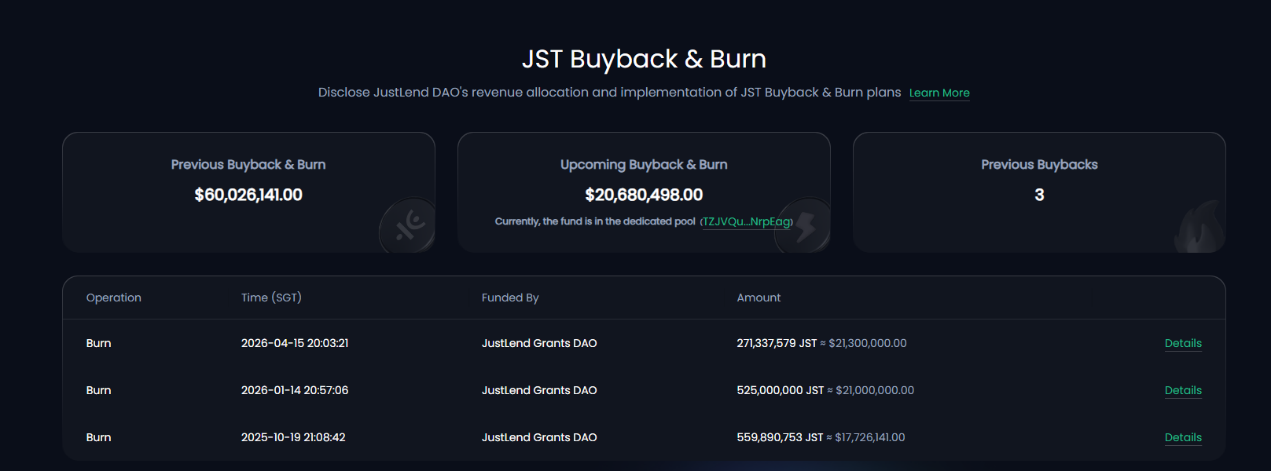
Compared to some market projects that have only invested tens of thousands of dollars for symbolic buyback and destruction at a marketing level, JST's buyback and destruction are deeply rooted in real business and profit models, highlighting three prominent advantages: First, the funding scale is substantial—cumulative investment exceeding $60 million over three rounds, with each round reaching tens of millions, representing real monetary investment, rejecting conceptual hype; second, the execution cycle is stable—strictly landing on time according to a quarterly rhythm, with no delays or interruptions, demonstrating a high degree of execution capability and sense of responsibility; third, the destruction effort is strong—each round's destruction is counted in hundreds of millions, with a cumulative destruction exceeding 1.35 billion JST, significantly reducing the token supply, truly pushing deflation from paper to reality. Each round's expanding scale of destruction and strong funding reserves highlight the solid foundation of JUST ecosystem and reinforce JST's long-term value base.
From a value logic perspective, the landing of each round of buyback and destruction fundamentally represents a substantial reduction in JST token supply. As one round after another progresses steadily, the total supply of JST tokens continues to shrink, the deflationary effect deepens, and the scarcity of the tokens becomes increasingly prominent. This enhancement in scarcity will directly translate into the market trading level, driving its price and overall market value to climb steadily.
The effectiveness of this value logic has been fully confirmed by JST's market trend. According to CoinGecko data, since the completion of the first round of buyback and destruction in October 2025, JST has continued to rise from a phase low of around $0.03, reaching a price of $0.084 by April 29, with a market value of about $720 million, ranking 83rd among global cryptocurrencies, a cumulative increase of over 170% in six months. Both the token price and market value have achieved a qualitative leap compared to before the buyback and destruction plan was launched, solidly validating the value of the deflation logic.
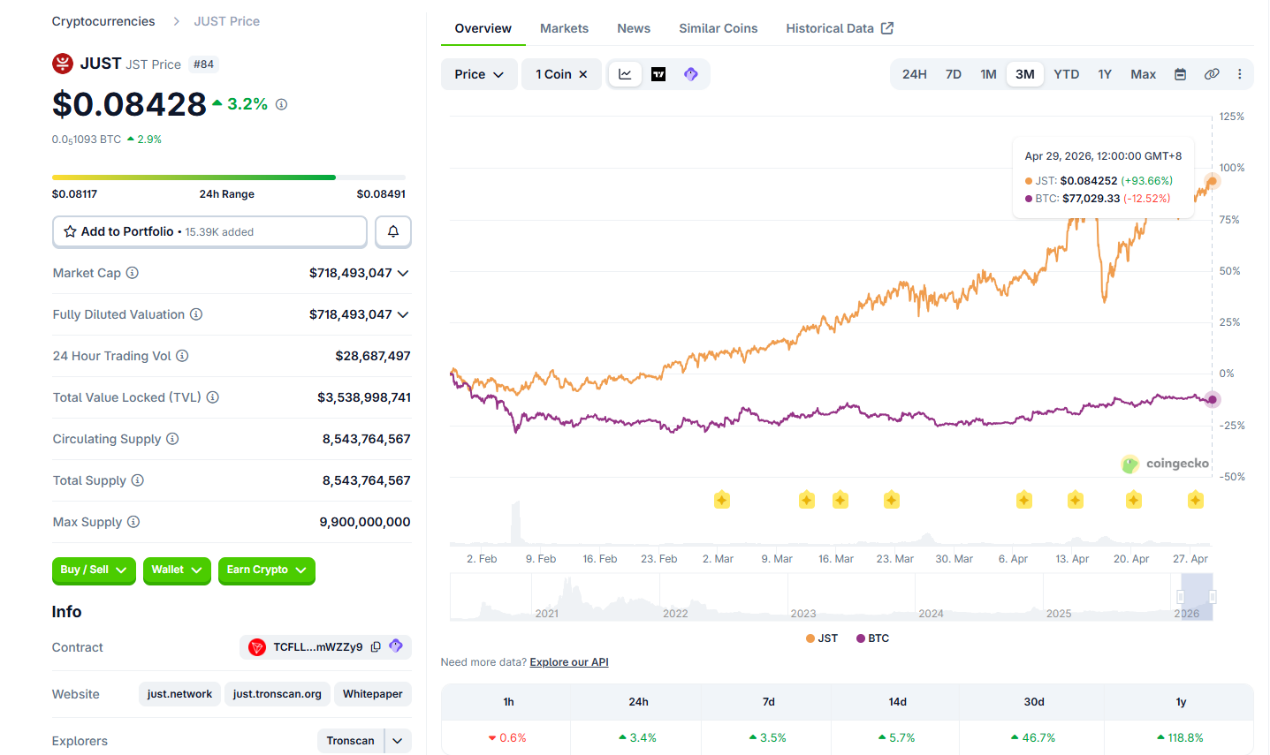
Particularly noteworthy is that JST's rise does not depend on the overall market trend but instead exhibits strong resilience and growth against the odds. In the first quarter of 2026, the global cryptocurrency market experienced significant declines, with most token prices generally retreating, while JST broke through against the trend, accelerating from an initial low of $0.04 to rise to $0.086 on April 12, setting a new phase high since 2022.
It is important to emphasize that JST's impressive price performance is not a transient phenomenon caused by short-term capital speculation but rather a rational recognition and firm endorsement of its deflationary value logic by the market. Through regular, large-scale token destruction, effectively reducing supply and increasing scarcity, this sustainable and verifiable value empowerment model has received dual recognition from capital and the market, solidifying a robust foundation for JST's long-term value growth, allowing it to maintain an upward development trend amidst fluctuations in the industry cycle.
JST buyback and destruction intensification: buyback mechanism is about to diversify and upgrade, funding sources are comprehensively expanded
After successfully completing three rounds of large-scale buybacks and destructions, the JST buyback and destruction has entered a normalization process. In the future, JST buyback and destruction will further intensify, fully upgrading from phase 1.0 to the new phase 2.0. Specifically, once the existing income from phase one (1.0) is executed, it will comprehensively upgrade to the 2.0 new phase, at which point the JUST ecosystem will continue to deepen the layout of buyback and destruction, diversifying the existing mechanism and broadly expanding funding sources, injecting stronger and more diverse capital dynamics for JST buybacks, thereby constructing a more robust and sustainable deflationary growth cycle, solidifying the deflationary foundation and long-term holding value of JST.
Looking back at the past buyback and destruction process, JustLend DAO can be seen as the absolute main force behind JST buyback and destruction. Previously, the more than $60 million cumulatively invested in three rounds of buyback and destruction came entirely from JustLend DAO's existing income and new net income, providing solid support for the smooth implementation of the buyback and destruction.
As the core financial infrastructure of the TRON ecosystem, JustLend DAO has established a DeFi product matrix that encompasses all scenarios such as SBM lending, sTRX liquid staking, Energy Rental, and GasFree smart wallets. With a mature product mechanism, a large user base, and a diverse and high-growth core business matrix, JustLend DAO has achieved consistent and stable profitability, not only solidifying its own development foundation but also continuously supplying "ammunition" for JST buyback and destruction.
Currently, the funding for JST buyback and destruction mainly relies on JustLend DAO's core business lines of SBM lending and sTRX liquid staking, with stable and strong funding supply. Specifically, according to the latest data from JustLend DAO's financial page on April 16, the platform's cumulative net income has exceeded $83.64 million, of which $80.75 million has been withdrawn, including $79.52 million contributed by sTRX and about $3.22 million contributed by SBM; of the withdrawn earnings, as much as $80.7 million has been used for JST buyback and destruction, including $60.02 million that has already been effectively destroyed, with an additional $20.68 million in existing income to be gradually put into future buyback and destruction operations over the next two quarters.
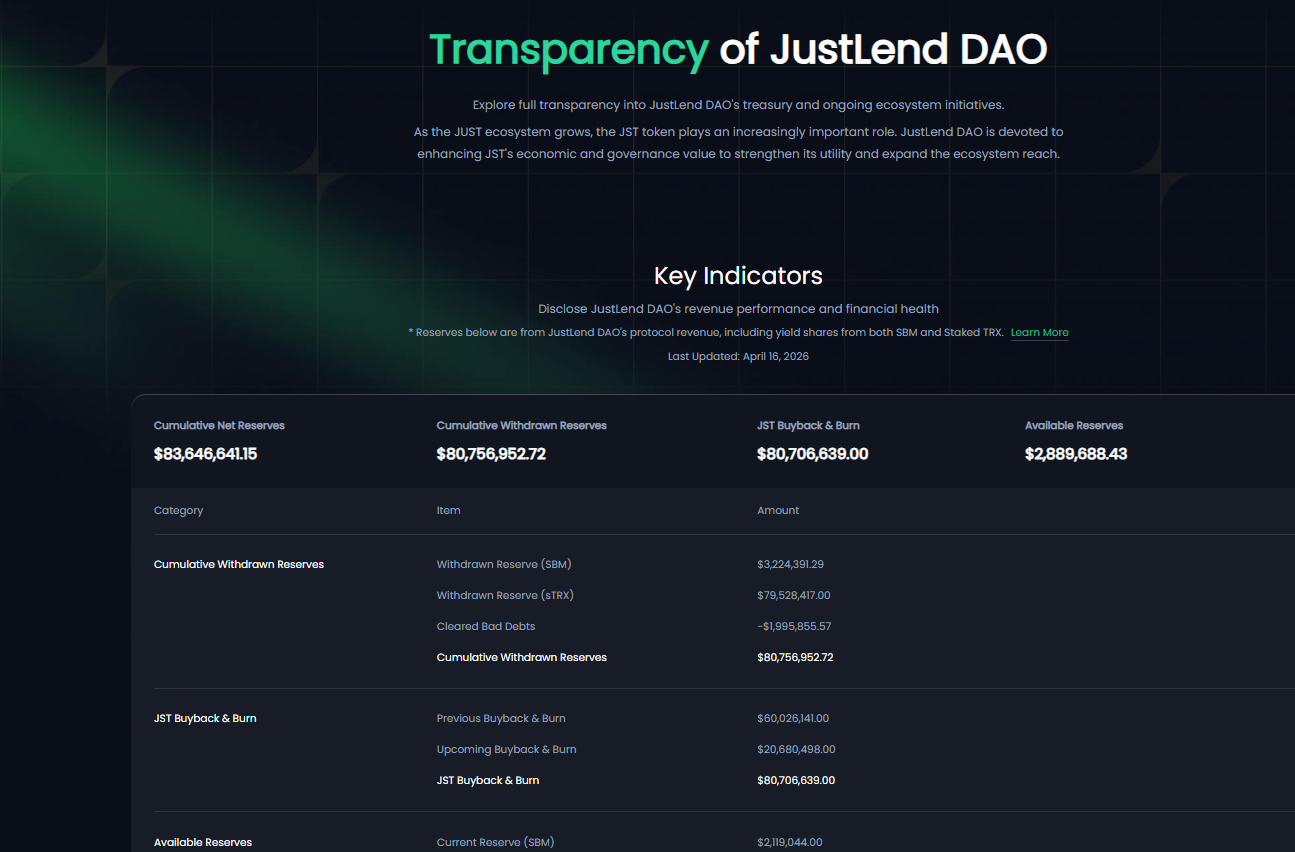
Based on this calculation, over the next two quarters, JustLend DAO's existing income alone can provide a guaranteed buyback funding of $10.34 million per quarter; combined with JustLend DAO's new net income added each quarter, the actual投入规模 for future buyback and destruction will only increase. This funding assurance has also been further confirmed in the official financial report—according to the forecast in the "JST 2026 Q1 Financial Report" released on April 27, it is estimated that the JST buyback and destruction in the second quarter of 2026 will be approximately $21.3 million, mainly sourced from sTRX income, SBM income, existing income, and excess reserves, with specific amounts to be executed flexibly according to actual operational conditions.
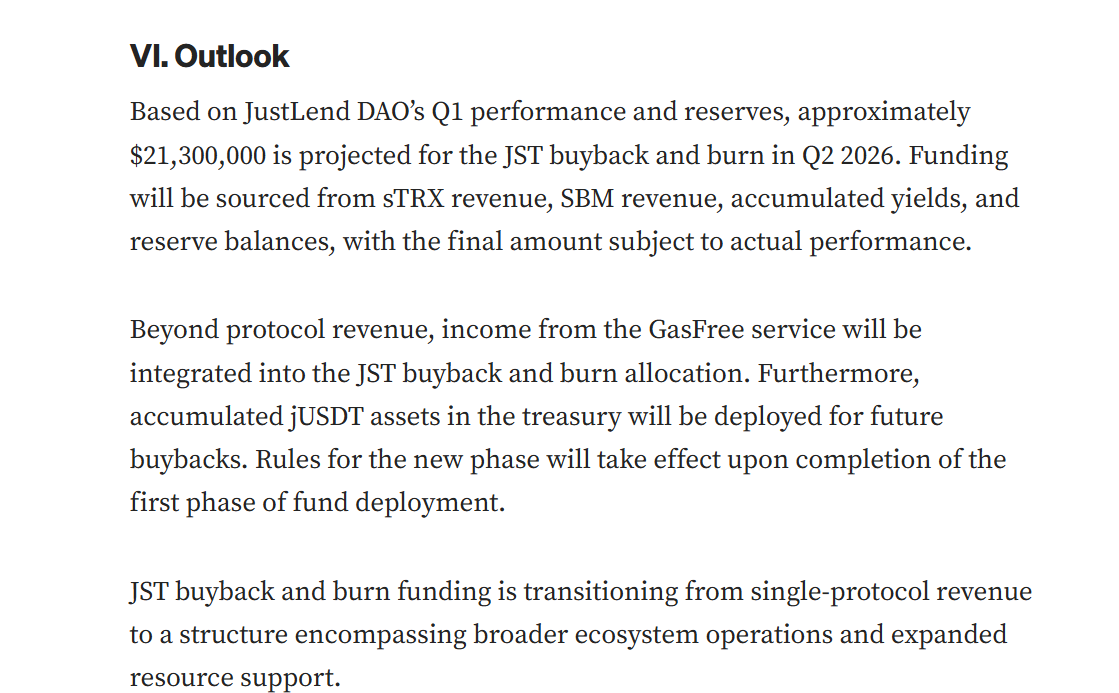
At the same time, the financial report also clearly stated the future strategic upgrade direction of the JST buyback and destruction mechanism: it will comprehensively promote the diversified evolution of mechanisms, achieving a systematic expansion of funding sources for buyback and destruction. According to the official plan, after the execution of the inventory funds in phase one (1.0 version) is completed, new rules will officially be implemented, moving into the JST buyback and destruction 2.0 upgrade phase:
Phase One (1.0 Inventory Execution Phase): During this phase, JST will continue to follow the current rules to routinely promote the buyback and destruction work, steadily implementing the established deflation plan.
Phase Two (2.0 Mechanism Upgrade Phase): After the existing funds in phase 1.0 are completed, the new buyback and destruction rules will be officially launched, and JST buyback and destruction will fully enter the new phase 2.0, with funding sources becoming more diverse and supply more resilient.
In the 2.0 new phase, JST buyback and destruction funding sources will be further expanded, building a multi-dimensional and multi-tiered funding support system: in addition to the existing JustLend DAO sTRX staking income, SBM business income, and portions of USDD ecosystem income exceeding $10 million, new channels will include income from JustLend DAO's GasFree business and historical revenue from the stablecoin USDJ.
According to the latest official data, the assets held by the JST treasury address are still valued at over $100 million, including 159 million sTRX, 990 million jUSDT, and 300 million JST, of which 300 million JST is a one-time allocation from JUST DAO, intended to support future community governance and long-term ecological activities, including 200 million JST for community governance proposals and 100 million JST for long-term ecological activities. A solid treasury reserve provides ample assurance for the continuous advancement of subsequent ecological construction.
In summary, the completed JST buyback and destruction is just the beginning of ecological value feedback and is still in the initial phase of exertion. With the gradual implementation of new rules for the diversified funding source framework in the future, the JST buyback mechanism will upgrade from currently relying solely on JustLend DAO's sTRX and SBM business surplus, to a comprehensive deflationary engine integrating the operational results of multiple core business lines of JustLend DAO and various resource reserves within the JUST ecosystem. This transformation will further strengthen JST's deflationary wheel, laying a firmer foundation for its long-term value solid uplift.
The development of the JUST ecosystem continuously feeds back to JST, and the long-term value space is expected to open further
Amidst increasingly fierce competition in the cryptocurrency market and intensified cyclical fluctuations in the industry, the JUST ecosystem remains committed to long-termism, grounded in real business, and upholding the core concept that "real money creates real deflation." Through sustainable value empowerment, it pushes the JST token from a "single value anchor" to an "ecosystem value center," ensuring the dividends of ecosystem development directly feed back to every JST holder, injecting strong momentum for long-term value growth and effectively rewarding the trust and support of global ecosystem co-builders.
Reflecting on the value evolution of JST, its value positioning and anchoring points have achieved a leap in quality. In the early development stage, JST functioned purely as the native governance token of the JUST ecosystem, mainly for basic rights functions such as ecological proposal voting and community governance voting, with a relatively single value dimension. Since the official launch of the large-scale buyback and destruction mechanism, JST's value logic has undergone a fundamental restructuring, deeply binding the token's value to the development of the JUST ecosystem in resonance, allowing real operating income from the ecosystem to feed back and empower JST's intrinsic value, completely breaking free from the limitations of being just a governance token.
In terms of application scenarios and ecological coverage, with the continuous expansion and deepening of the JUST ecosystem, a comprehensive DeFi ecological matrix centered on JustLend DAO has now emerged, covering the SBM lending market, sTRX liquid staking, energy leasing, GasFree smart services, and integrating diverse products like the stablecoin USDD and the cross-chain ecosystem JustCrypto. Leveraging a complete business ecosystem and a large user base, JST has also completed its identity upgrade, transitioning from a single governance carrier to a core value hub that integrates multiple businesses and scenarios, bearing the value accumulation and flow functions of the entire JUST ecosystem.
Looking ahead, as the sources of JST buyback and destruction funding continue to expand and the mechanism diversifies and upgrades, the JST deflationary value support system will gradually extend from initially relying solely on JustLend DAO's sTRX staking and SBM lending to encompass the synergistic empowerment of multiple core business lines within the JUST ecosystem, ultimately building a value system of "multi-pivot support and collaborative growth." This not only significantly enhances JST's ability to withstand market fluctuations but also amplifies the long-term growth space, laying a solid foundation for the steady rise in token value and the continuous operation of the deflationary wheel.
This structural transformation is highly recognized by industry professionals. Well-known KOL RichCoin pointed out that JST is entering a new stage, where the core change is not merely appreciation but a deep structural shift—from a token reliant on a single income to a value carrier driven by multiple ecosystems. This transformation is essentially a concentrated embodiment of ecological value: as profits from each of JUST's business segments continue to be released, JST will gradually become a direct value reflection of ecological growth, with every increment in ecological earnings transforming into solid support for JST's long-term value.
The rise in JST's value is fundamentally supported by the solid business layout and strong blood-generating capacity of the JUST ecosystem. As a one-stop DeFi solution within the TRON ecosystem, JUST manages a long-term leading position in asset scale within the TRON ecosystem. As of April 29, the official latest data shows that the total value locked (TVL) in the JUST ecosystem is approximately $11.4 billion, accounting for 42% of the total locked value in the entire TRON ecosystem ($27 billion), solidifying its position as an ecological leader and providing a strong basis for JST's value feedback.
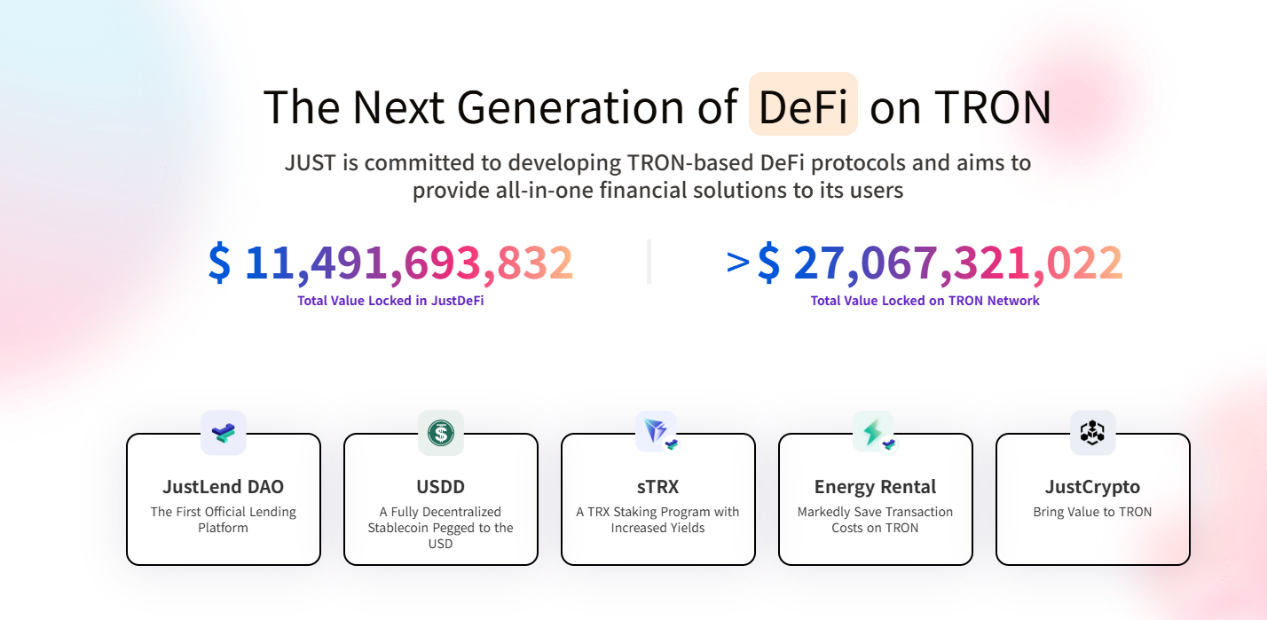
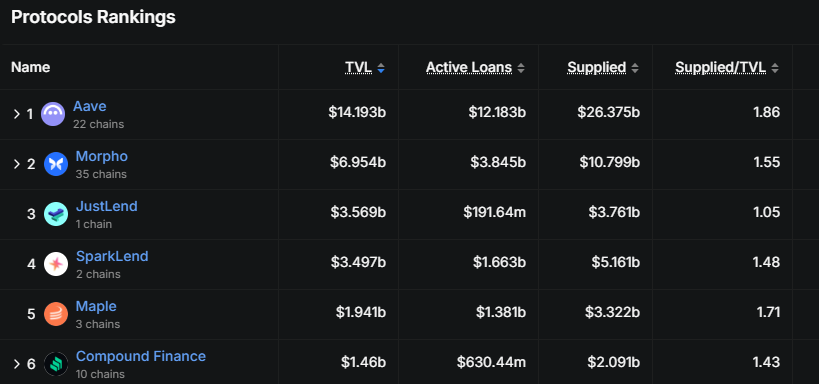
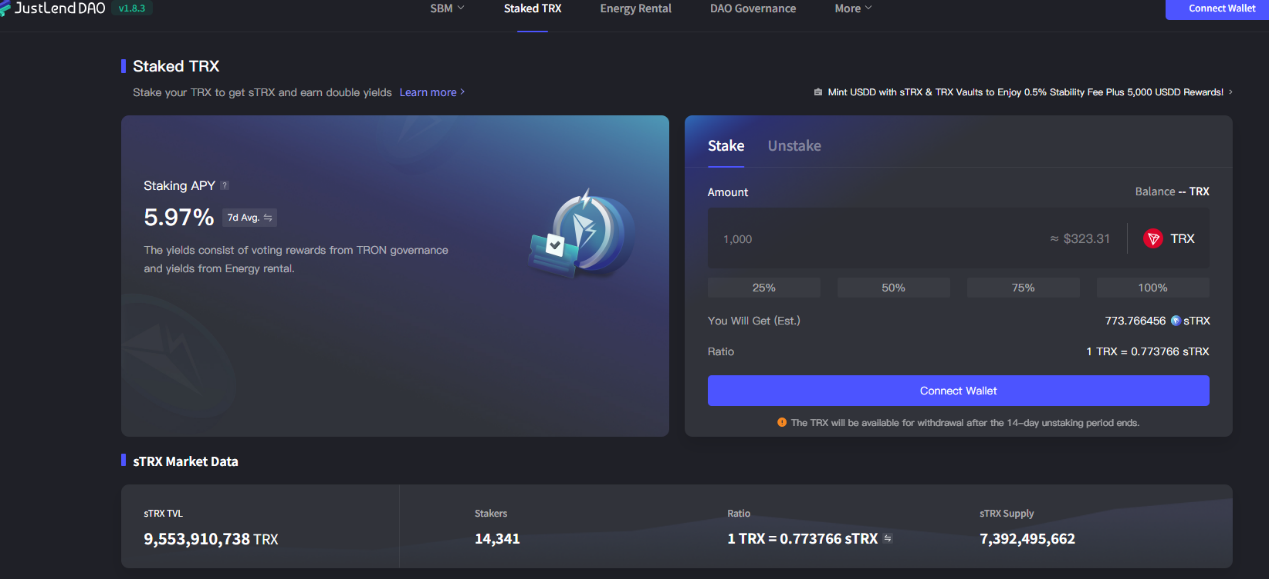
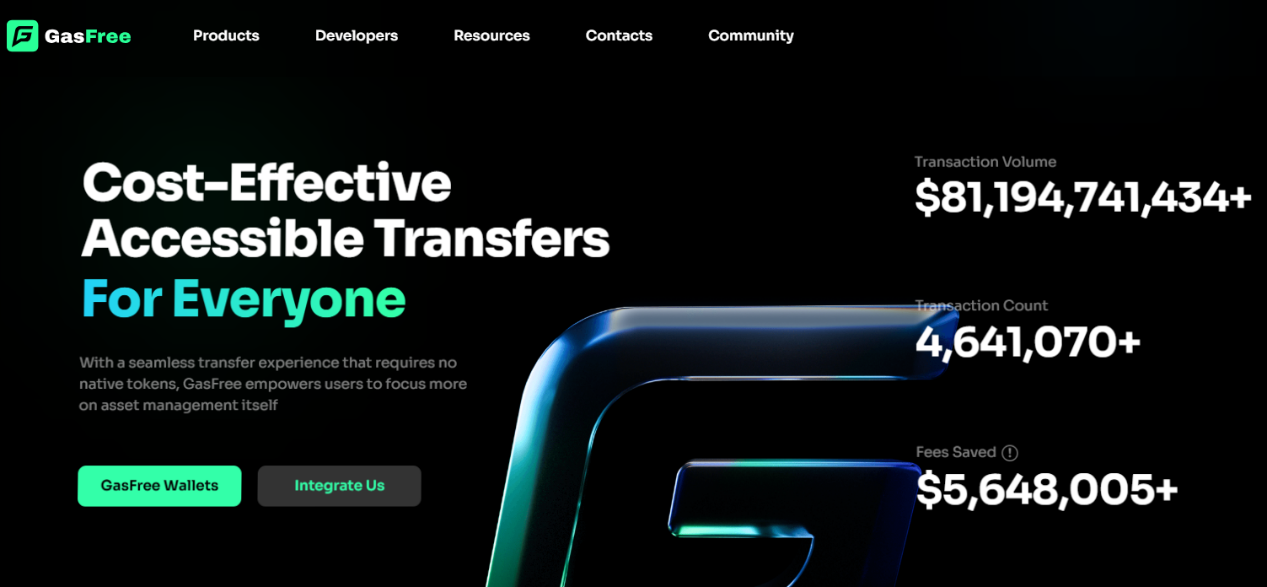
Among them, each core business of JustLend DAO is showing strong growth: according to DeFiLlama data, the TVL of JustLend DAO's SBM lending market is about $3.57 billion, consistently ranking among the top three in the global lending sector; the number of TRX staked in the Staked TRX liquid staking business has now exceeded 9.55 billion, valued over $3 billion, with staking figures continuing to accelerate; GasFree allows users to pay Gas fees with transfer tokens, effectively solving the pain point of needing to hold native underlying tokens for transactions, reducing the transaction cost to about 40% of traditional methods, with a cumulative transaction volume of $81.1 billion and 4.63 million transactions processed, saving users approximately $9.64 million.
As an important potential funding source for buyback and destruction, the stablecoin USDD has also entered a growth fast lane. In the first quarter of 2026, USDD income reached $6.3 million, a month-on-month increase of 66.6%, with cumulative income exceeding $13.9 million; according to the rules, USDD ecological income must first complete repayment of subsidies to the TRON DAO, and profits exceeding $10 million will be included in JST buyback and destruction reserves.
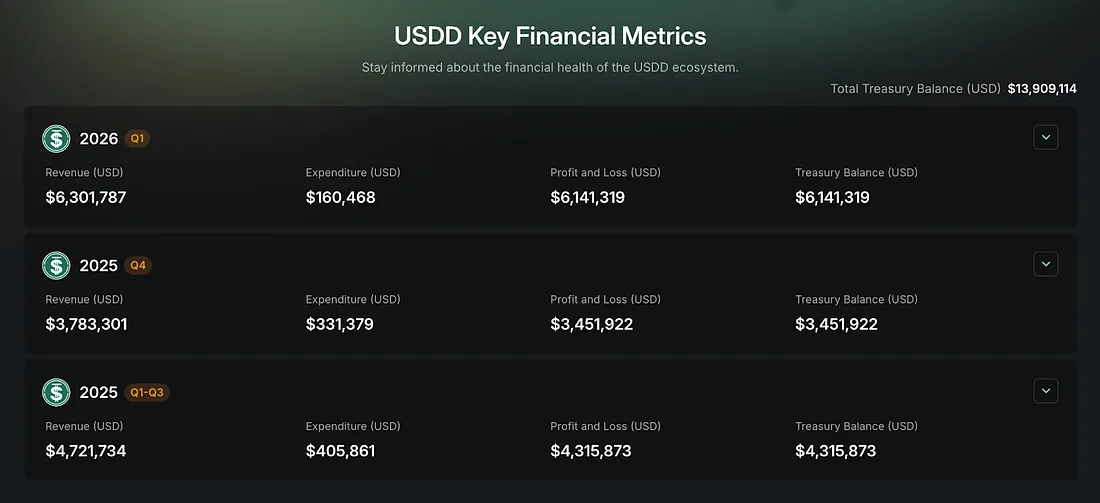
With the steady advancement and maturation of various businesses within the JUST ecosystem, JustLend DAO's SBM lending business and sTRX liquid staking continue to be profitable. The addition of new businesses such as GasFree, the value unlocking of the USDD multi-chain ecosystem, and the historical revenue accumulation from USDJ will all synergistically inject large-scale, stable real business funds into JST's buyback and destruction pool. This continuous "blood generation" capability provides JST with a sustainable deflationary power.
With the ecological strong ability to generate blood and solid fundamentals continuously empowering, the "ecological earnings → token destruction → value feedback" deflationary wheel of JST will turn faster and faster: the growth of ecological business profits drives an increase in buyback and destruction funding, large-scale buybacks and destruction continuously reduce JST token supply and enhance its scarcity, thereby driving up JST prices and enhancing its value; and the rise in JST's value will attract more users to participate in ecosystem construction and hold JST tokens, further driving ecological business expansion and profit growth, forming a virtuous cycle.
Looking ahead, as the new diversified buyback and destruction mechanism gradually takes shape, the deflationary effects will continue to deepen. Supported by solid ecological fundamentals, strong self-generating capabilities, and sustainable operational mechanisms, JST is expected to escape short-term fluctuations in the tumultuous cryptocurrency market cycle and forge a clear, long-term path of upward value. Its long-term value space is expected to continue to open up, not only bringing richer long-term returns to global ecosystem co-builders but also injecting new strong momentum into the high-quality development of the DeFi industry.
免责声明:本文章仅代表作者个人观点,不代表本平台的立场和观点。本文章仅供信息分享,不构成对任何人的任何投资建议。用户与作者之间的任何争议,与本平台无关。如网页中刊载的文章或图片涉及侵权,请提供相关的权利证明和身份证明发送邮件到support@aicoin.com,本平台相关工作人员将会进行核查。


