The "Bitcoin 2026" conference brings a moment of examination for the institutional era of Bitcoin, where law enforcement, ETF funds, corporate treasury assets, and on-chain self-custody concepts clash intensely.
Written by: Liam 'Akiba' Wright
Translated by: Saoirse, Foresight News
On April 27, 2026, the "Bitcoin 2026" conference officially opened at the Venetian Hotel, with the FBI director invited to participate in a special forum focusing on code, freedom of speech, and regulatory enforcement. This arrangement transforms this industry gathering into a practical test of Bitcoin's political attributes.
The forum titled "Code is Speech: Ending the Bitcoin Regulatory War" took place at 10:30 AM on the Satoshi Nakamoto stage, hosted by Paul Grewal, with U.S. Acting Attorney General Todd Blanche participating in person. Patel did not attend offline but participated in the roundtable discussion online.
Todd Blanche is the current Acting Attorney General of the United States, while also serving as the 40th Deputy Attorney General.
The symbolic significance of the attendees at this conference is self-evident: the "Bitcoin 2026" conference brings together law enforcement personnel, senior officials from the U.S. Department of Justice, regulatory officials, politicians, corporate CFOs, and leaders from the Wall Street digital asset industry in one discursive space. The origin of all this is a decentralized movement centered around peer-to-peer settlement and user self-custody.
Over the years, Bitcoin has gradually integrated deeply into various institutional systems, making it easy for outsiders to simplify the dissenting voices within the industry as mere emotional outbursts on social media. However, on a deeper level, a core issue related to the essence of the industry is now placed before everyone.
Now, Bitcoin has achieved the mainstream legitimacy that early practitioners have long dreamed of: gaining attention at the policy level, appearing on the balance sheets of publicly listed companies, compliant ETF launches, and being included in the U.S. National Strategic Reserve Asset Planning.
But the cost is equally significant: the mainstream discourse power regarding Bitcoin's popularity and development is now firmly held by various traditional institutions — the original intention behind Bitcoin's creation was to free itself from reliance on these intermediaries.
A Policy Victory That Rewrites the Industry Landscape
The core highlight of this conference is focused on the significant shift in regulatory enforcement logic.
In a memo released in April 2025, Blanche clearly stated that the U.S. Department of Justice is not a specialized regulatory agency for digital assets and prohibits prosecutors from indirectly implementing industry regulation through criminal prosecution. The document also requires that the focus of investigations related to digital assets must be on protecting investors and combating cryptocurrency-related criminal activities.
This memo officially disbanded the U.S. cryptocurrency enforcement task force.
The new regulatory tone lays the foundation for this conference's core theme of "embracing developers and fostering technological innovation." Blanche and Patel sent a clear signal at the "Bitcoin 2026" conference: the targets of regulatory action are crypto criminal activities, not developers and underlying code technology.
The shift in regulatory direction has already been observable. CryptoSlate previously reported that the U.S. government is broadly relaxing enforcement controls in the cryptocurrency sector, with the disbanding of the national-level cryptocurrency enforcement department being one of the key measures. The U.S. Securities and Exchange Commission has also adjusted its enforcement strategy, overturning previous regulatory guidelines and negating its own previous high-pressure regulatory approach.
In simple terms, the core attitude of the U.S. official stance is quite clear: developers creating neutral blockchain tools need not bear excessive legal risks; behaviors such as perpetrating fraud and money laundering using digital assets will remain primary targets for law enforcement.
This statement directly addresses Bitcoin's core demand since its inception. The Bitcoin white paper envisioned a peer-to-peer electronic cash system that allowed trading parties to bypass traditional financial institutions and conduct direct transactions. Rooted in this concept, the crypto community remains vigilant against traditional intermediaries re-entering the system, and this forum on code and freedom of speech confronted this core contradiction from a legal perspective.
In April 2026, a public letter from Coin Center to the U.S. SEC delineated the legal boundaries for speech protection regarding open-source software and neutral tools; meanwhile, behaviors such as asset custody, centralized control, and targeted commercial operations were classified under compliant regulation.
This also became the cornerstone for the U.S. regulatory authorities: if federal agencies can reduce the legal risks for developers and no longer confuse technical creators with illegal users, the Bitcoin industry can attain more lenient development space in the U.S.
But contradictions followed: if this lenient policy environment ultimately stems from a state power system that many crypto-native users distrust, then this victory will inevitably come at the cost of compromising the industry's philosophy. This Bitcoin conference laid bare this contradiction and disconnection for the public to see.
Even as regulation becomes more lenient toward developers, when official powers step onto Bitcoin's core stage, this reconciliation feels more like a state-led exchange of interests, making disputes and divergences unavoidable.
Institutionalization Has Become the Mainstream Path for Crypto Adoption
In 2025, the White House signed the "Strategic Bitcoin Reserve Executive Order," formally establishing the U.S. Bitcoin Strategic Reserve Program and Digital Asset Reserve Mechanism.
As of the time of writing, market data from CryptoSlate shows that the price of Bitcoin is approximately $76,258, with a total market cap close to $1.53 trillion. Participating in cryptocurrency investments through compliant channels has become an industry mainstream trend.
As of April 27, the net asset size of BlackRock's iShares Bitcoin Trust ETF is approximately $62.34 billion, and the total assets managed by Coinbase’s institutional business have surpassed $300 billion.
On the corporate front, Strategy Inc. announced on April 27 that it has once again increased its holdings by 3,273 Bitcoin, bringing its total Bitcoin holdings to 818,334.
Today, Bitcoin has already deeply penetrated into the reserve assets of publicly listed companies, compliant ETF products, institutional custody platforms, and national strategic policies. An industry gathering aimed at large-scale popularization naturally attracts all institutional players holding industry channels and resources to join.
Governments, law enforcement agencies, compliant ETFs, custodians, and corporate treasury assets represent the tangible progress of the industry but also harbor the hidden risk of diluting the principles of decentralization:
- The U.S. designates Bitcoin as a strategic reserve asset, granting official recognition to the industry, yet simultaneously undermining the core consensus of user sovereignty;
- The Department of Justice relaxes regulatory restrictions on developers, creating a friendly innovation environment, yet deeply involves law enforcement in the core of crypto culture;
- Compliant ETFs provide ordinary investors with low-threshold participation channels, yet gradually marginalize the original concept of holding independent private keys and peer-to-peer transactions;
- Leading custodians provide infrastructure for large institutions but concentrate asset control in the hands of centralized compliant intermediaries;
- Corporate large-scale holdings reinforce Bitcoin consensus but allow the voices of capital giants to gradually overshadow those of ordinary individual users.
Institutionalization addresses the realistic challenges of industry development but also causes Bitcoin to fall back into the centralization dependency it once sought to escape. This is the core source of controversy in the community: from the perspective of institutions, this is progress towards industry regulation; from the perspective of decentralization believers, this is a continuous deviation from the original intention.
From practical experience, the flip side of rising adoption is that fewer and fewer users choose to hold private keys or use on-chain direct settlements, with the public increasingly relying on regulated third-party platforms.
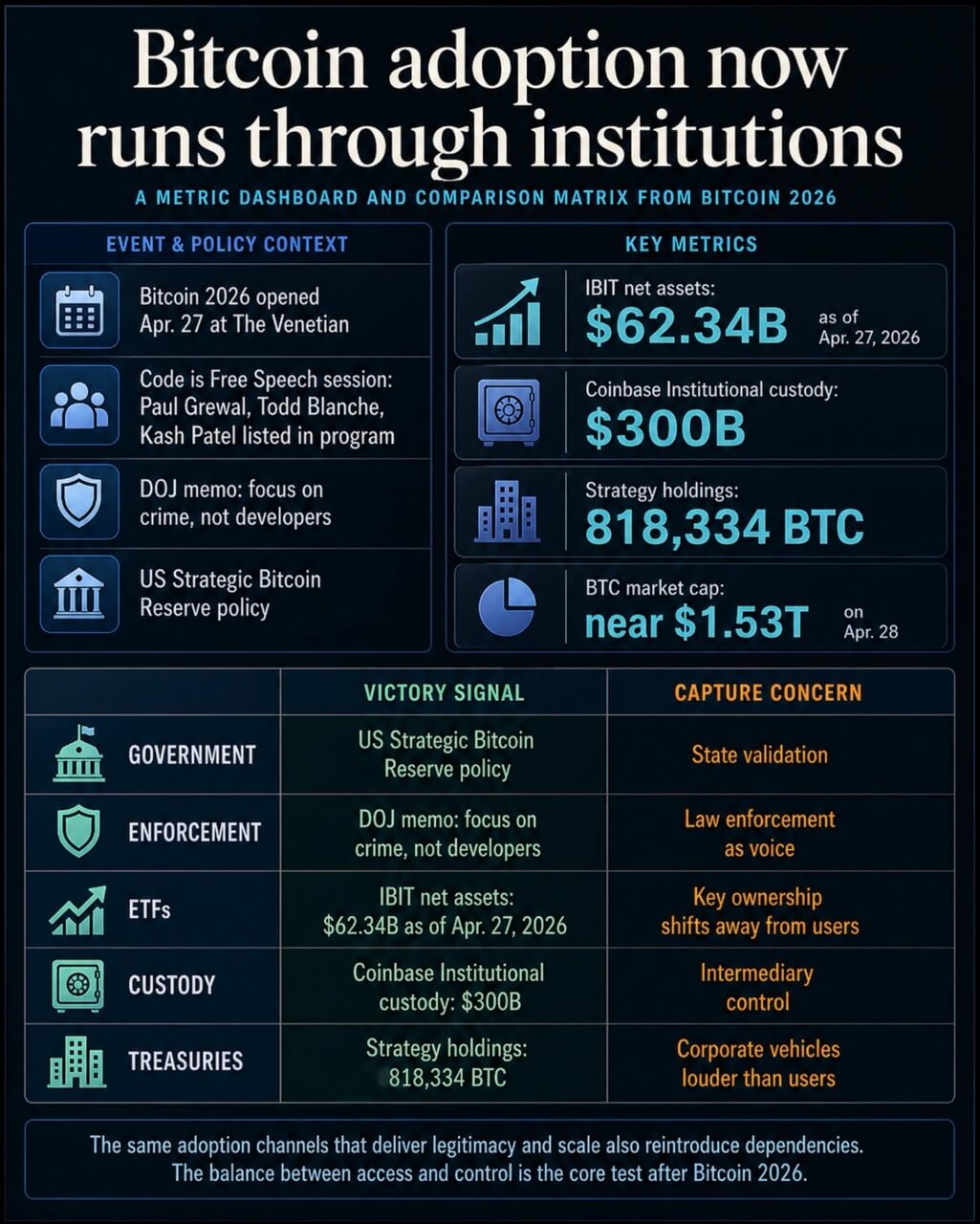
This image is a data dashboard released at the "Bitcoin 2026" conference, visually demonstrating the current mainstream and institutionalized state of Bitcoin, along with the dual contradictions of "victory" and "incorporation" behind it.
The Struggle for Discourse Power: Who Has the Right to Define Bitcoin?
This conference features an unprecedentedly diverse lineup of guests, including regulatory officials, U.S. politicians, Wall Street asset management giants, operators of corporate treasury assets, and crypto-native practitioners engaging in dialogue on the same stage.
This diverse lineup can be interpreted as powerful proof that Bitcoin has entirely won mainstream recognition, but it also signifies that the public narrative and industry culture surrounding Bitcoin are being repackaged and redefined by institutions with completely different interests and demands.
The protocol itself remains open and free, yet the public opinion and value narratives surrounding Bitcoin have already become centralized.
Two types of viewpoints on overseas social platforms openly express the community's concerns. Senior crypto-native users publicly criticize the conference's invitation to federal law enforcement officials; professionals in crypto fraud investigations firmly state that Bitcoin is gradually becoming the old system it originally sought to escape. Corporate financial reports, strong regulation, political endorsements, centralized custody, and the monopolization of mining giants... Various signs are viewed as signals of the industry deviating from its original intent.
A large number of community users echo these concerns; the core of this dispute is not merely whether a single guest attends or not, but rather the ownership of discourse power. When Bitcoin's most core industry stage is occupied by government officials, financial institutions, corporate capital, and politicians, the public perception of Bitcoin will ultimately diverge from its original slogans of "self-custody and decentralization."
The controversy surrounding self-custody that erupted around Michael Saylor in 2024 has already proven that, in the face of divergences in Bitcoin's development path, the industry will always experience intense disputes over discourse power.
However, from a realistic perspective, large-scale adoption inevitably relies on legal compliance, asset custody, open financial markets, and policy coordination. Today's Bitcoin has evolved into a super asset with a market capitalization of $1.5 trillion, far beyond the confines of a niche decentralized circle. The core proposition for the future is not about completely rejecting institutions, but rather how to prevent institutional channels from entirely monopolizing the definition of Bitcoin.
The Power Struggle Will Become the Next Ultimate Test
Since BlackRock submitted its Bitcoin ETF application in 2024, and subsequently, Bitcoin was included in U.S. campaign strategies, the identity split of Bitcoin has quietly taken root, and the "Bitcoin 2026" conference has utterly torn apart this rift.
Two opposing realities objectively exist simultaneously: government intervention has reduced policy uncertainty in the industry, ETFs and custodians have broadened participation thresholds, and corporate treasury assets have propelled Bitcoin to become a global mainstream reserve asset; these are undeniable developmental dividends.
However, the accompanying hidden dangers cannot be ignored: compliant products weaken users' control over their assets, large capital and enterprises dominate industry opinion, and political forces reshape the crypto narrative. Once labeled as "free from authoritative control," Bitcoin now has to actively embrace law enforcement and integrate into the mainstream order.
After the conference, the real test lies in control. Can the industry hold onto its core bottom line: insisting on user self-custody, open-source ecosystem development, and peer-to-peer direct settlements, allowing institutional development to be supplementary rather than dominant? Or will it allow adoption channels to become entirely dependent on ETFs, centralized custody, corporate capital, and policy cooperation, reducing decentralization to a marginal concept?
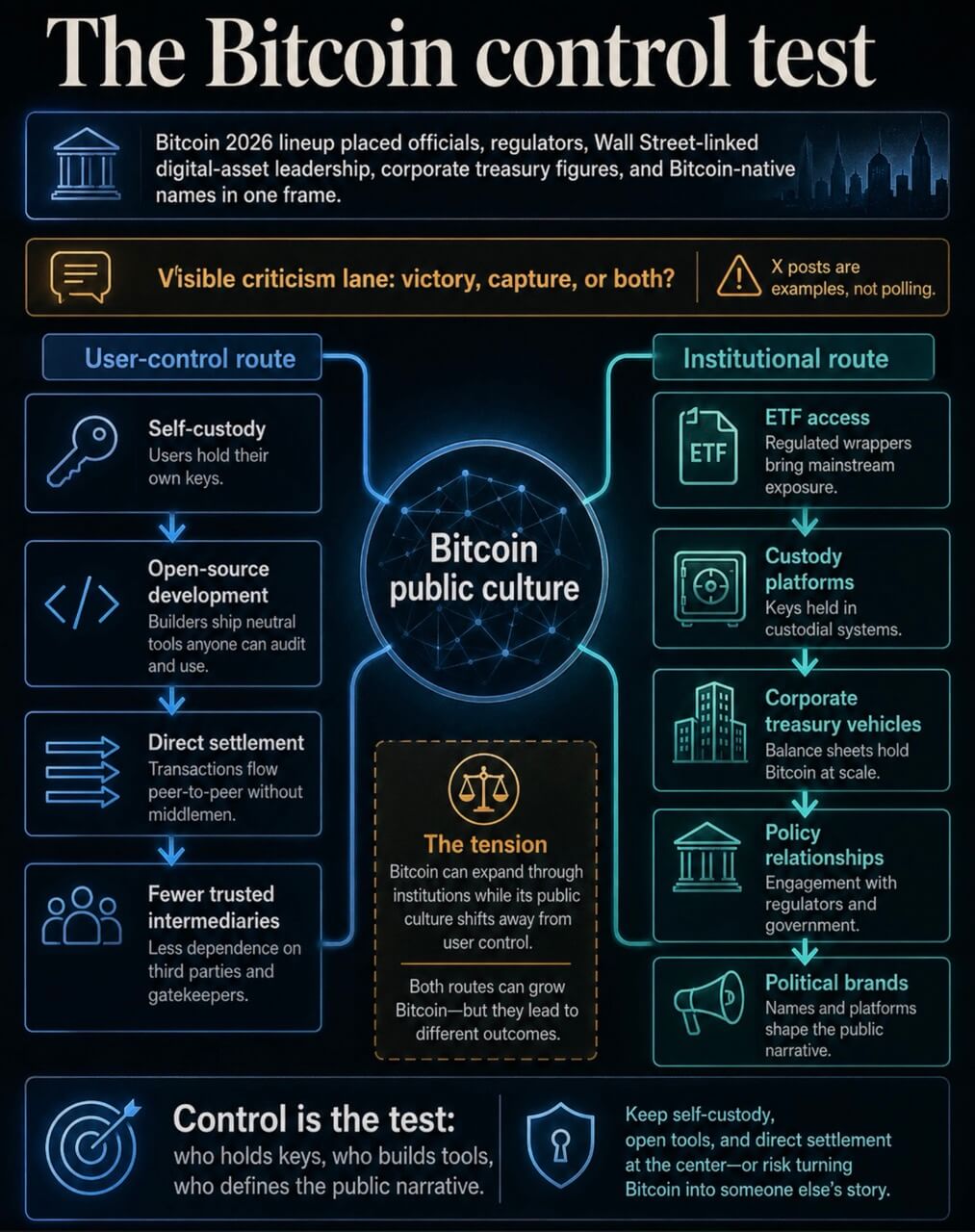
The "Bitcoin Control Test" aims to reveal the fundamental tension between the "user-native route" and the "institutional mainstream route" in Bitcoin's development.
On one side is the convenient compliant popularization, and on the other is the original freedom of decentralization belief. The tug-of-war between these two routes introduces an intrinsic contradiction to Bitcoin's success.
Those traditional institutions that Bitcoin users once strenuously avoided are now becoming the driving force and spokesperson for the industry as it moves into the mainstream. Some view it as the ultimate victory of industry maturation, while others see it as a warning light for the decentralized ideal.
The "Bitcoin 2026" conference clearly confirms: regardless of positions, everyone must confront this irreversible era of change.
免责声明:本文章仅代表作者个人观点,不代表本平台的立场和观点。本文章仅供信息分享,不构成对任何人的任何投资建议。用户与作者之间的任何争议,与本平台无关。如网页中刊载的文章或图片涉及侵权,请提供相关的权利证明和身份证明发送邮件到support@aicoin.com,本平台相关工作人员将会进行核查。


