
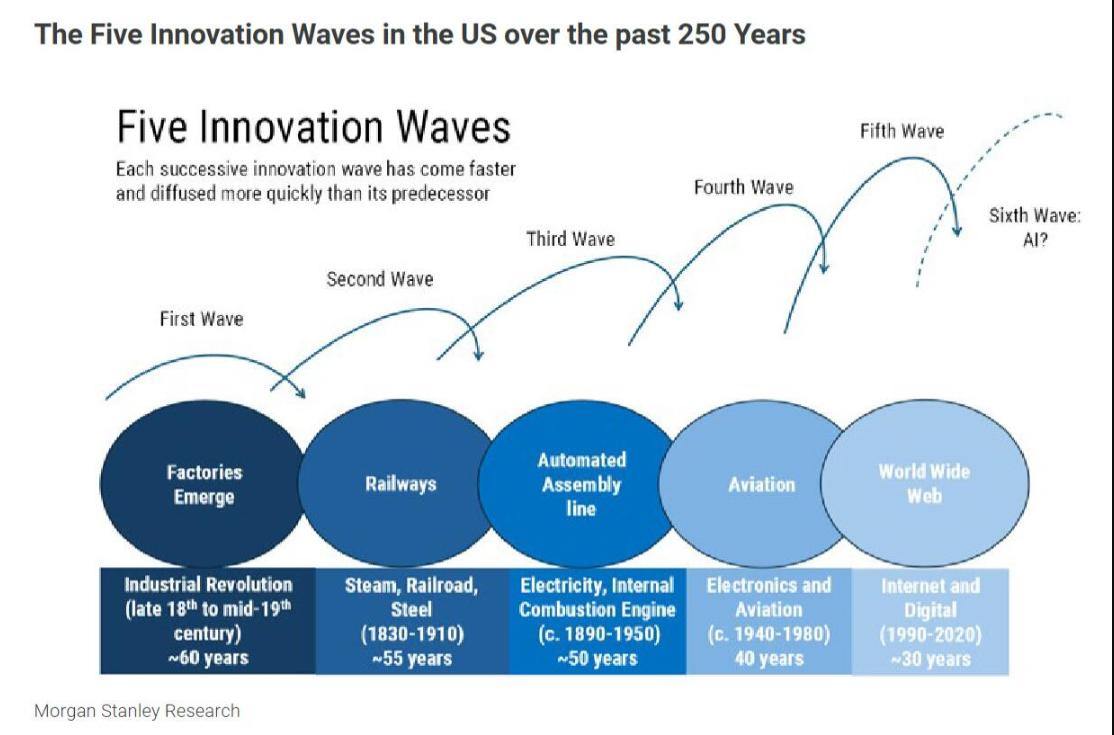
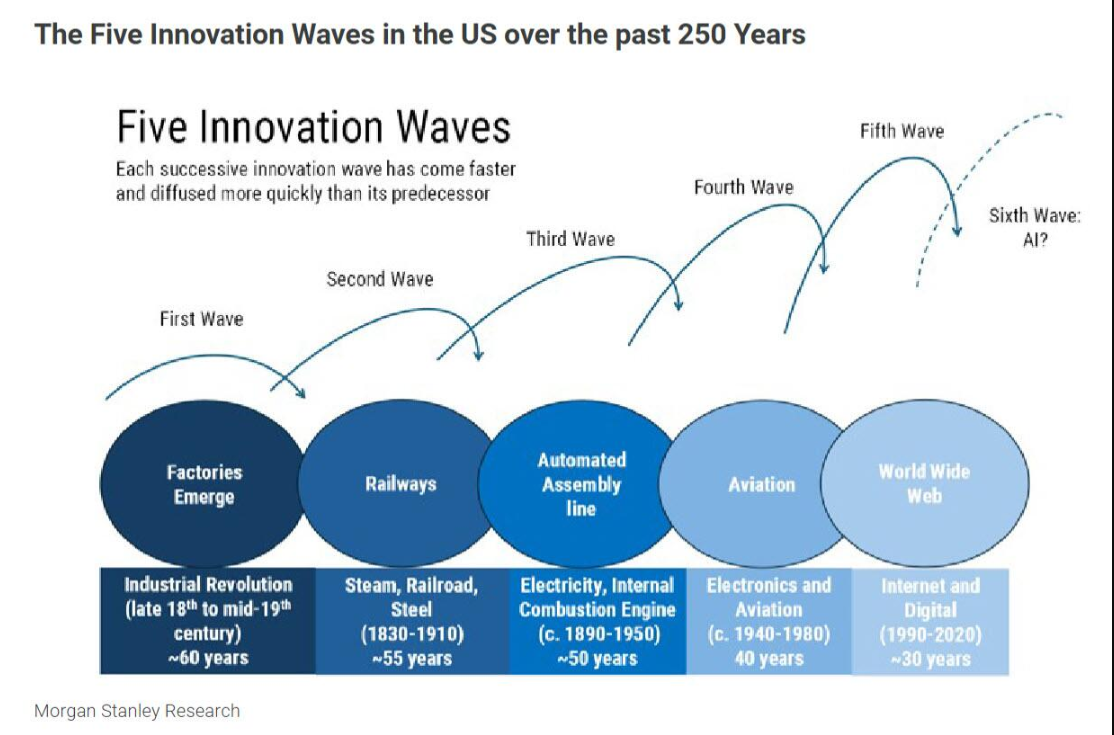
The latest research by Morgan Stanley's Chief Economist Seth B Carpenter provides a sobering insight into the anxiety surrounding AI issues. He positions artificial intelligence as the sixth major wave of innovation following mechanization, electrification, mass production, automation, and the IT revolution, and points out a core paradox: the speed of AI diffusion far exceeds that of any previous technological revolution, yet labor market indicators in major global economies are displaying "unusual stability".
From employment growth, unemployment rate to job vacancies and turnover rates, these core data points have not shown systematic divergence between high-exposure and low-exposure industries during the AI boom. Carpenter's research suggests that current evidence leans more towards supporting the assertion that "AI is an incrementer rather than a replacer".
Historical Reflection: Every Technological Panic Led to Opposite Outcomes
Looking back at each technological leap since the Industrial Revolution, every one has been accompanied by deep concerns over "machines replacing humans". The Luddites smashing weaving machines in the early 19th century, fears of automation in the 1960s, and concerns over the disappearance of white-collar jobs at the onset of the internet bubble in the 1990s have all ultimately proven to be overreactions by history.
Carpenter's research clarifies that these technologies indeed eliminated certain specific tasks and roles, but the more widespread impact was changing the composition of work rather than eliminating jobs entirely. Mechanization redirected agricultural labor to factories, electrification spawned a vast service industry, and the IT revolution created entirely new professions such as programmers and data analysts. After every technological leap, the total demand for labor not only did not shrink but instead expanded on a broader industrial base.
The author believes that a commonly overlooked cognitive misconception is that many people interpret AI as "doing the same output with fewer people," but the same mechanism also means that "the same number of people can create much more output". Mathematically, both statements are equivalent, but Morgan Stanley tends to view the latter as more likely to become a reality. This is driven by the total demand expansion effect brought about by rising productivity—when the costs of goods and services drop, consumers' real purchasing power increases, thus creating new demand, which in turn drives employment.
Empirical Data: Productivity Gains Driven by Output, Not Layoffs
In light of existing data, Carpenter believes there is reason to maintain cautious optimism. On the labor market level, indicators such as employment growth, unemployment rate, job vacancies, and turnover rates have not exhibited systematic divergence between AI high-exposure and low-exposure industries. The rising youth unemployment rate is often cited as evidence of AI's impact on employment, but if cyclical factors related to the overall slowdown in US recruitment are excluded, the excessive rise in the youth unemployment rate is only slightly above historical cyclical norms and does not constitute a structural anomaly.
In terms of productivity, the effects of AI have begun to manifest in the data. The labor productivity growth rate in high AI exposure industries is faster, but the key is that this growth primarily stems from accelerated output expansion, not from compressed working hours or reduced headcounts. This distinction is crucial—it indicates that AI is currently more playing the role of an "incrementer" rather than a "replacer". Companies are using AI tools to enhance the productivity of existing employees rather than directly laying them off.
Core Risk: Speed of Diffusion Compresses Adjustment Window
Despite reassuring early data, Carpenter clearly states that future trends remain highly uncertain. Unlike previous technological revolutions that unfolded slowly over decades, the rapid adoption of AI has significantly compressed the adjustment cycle, which is the most significant structural difference of this wave of innovation.
He presents a scenario worth warning about: if companies quickly realize the productivity gains brought by AI in the short term and this effect widely diffuses throughout the economy, unemployment rates may experience a spike akin to economic recession—at least until the labor market clears. This "flash-freeze" adjustment poses severe challenges to social stability and equity of distribution.
However, Carpenter also lists multiple buffering mechanisms: income growth driven by productivity will support overall demand; rising wealth effects will sustain consumption; new tasks and roles will arise within companies, absorbing displaced labor; the cyclical slowdown in employment and its resultant deflationary pressures will trigger monetary policy easing; and if monetary policy space is exhausted, fiscal policy's automatic stabilizers and discretionary tools could smooth income gaps during the transition period. He believes that the presence of these buffering mechanisms will make AI-driven unemployment shocks "smaller, shorter, and more manageable".
Infrastructure Bottlenecks: Over $3 Trillion in Capital Expenditure Yet to be Realized
Carpenter also points out that the actual speed of AI diffusion will be constrained by the pace of physical infrastructure development. Morgan Stanley strategists previously estimated that between 2025 and 2028, the total capital expenditure for data centers and related infrastructure will exceed $3 trillion, but currently deployed funds account for only about a quarter.
This implies that the greatest impact of AI on productivity and the labor market largely remains in the "future tense". The pace of infrastructure development will directly determine how quickly AI capabilities penetrate the real economy, subsequently affecting the timing of labor market adjustments. From chip manufacturing to data center construction, from grid upgrades to fiber-optic laying, these physical bottlenecks are becoming the "speed limiters" for AI realization.
Policy Response: Key Variable Determining Depth of Impact
The author believes that the depth and duration of AI's impact on the labor market will largely depend on the capacity for policy response. Historically, the adjustment pains brought on by technological revolutions have often been alleviated through reforms in the education system, enhancements in social security networks, and flexibility in labor markets. Currently, the challenge faced by governments is whether they can establish a sufficiently effective retraining system and social safety net before the accelerated penetration of AI.
From a global perspective, there are significant differences in the policy toolkits of different economies. Nordic countries with strong union negotiation mechanisms and proactive labor market policies may more easily achieve a smooth transition of "creative destruction." In contrast, economies with inadequate labor market protections and weak social security systems may face greater social friction.
Carpenter concludes that Morgan Stanley will continue to track the speed of AI diffusion, labor market evolution, and policy response trends. "History shows that productivity will ultimately prevail, but not everyone in society will benefit equally from it. Early evidence is encouraging, but the story is still being written." For investors, this means paying close attention to the capital expenditure rhythms across the AI supply chain, changes in corporate adoption rates, and the extent of national policy interventions in the labor market—these factors will collectively determine the ultimate economic impact of the AI revolution.
免责声明:本文章仅代表作者个人观点,不代表本平台的立场和观点。本文章仅供信息分享,不构成对任何人的任何投资建议。用户与作者之间的任何争议,与本平台无关。如网页中刊载的文章或图片涉及侵权,请提供相关的权利证明和身份证明发送邮件到support@aicoin.com,本平台相关工作人员将会进行核查。


