Author: Claude, Deep Tide TechFlow
Deep Tide Introduction: Intel's Q1 financial report crushed expectations, with revenue of $13.6 billion and adjusted EPS of $0.29 (expected $0.01), leading to a single-day spike in stock price of 24% to $82.57, the largest single-day increase since 1987, breaking the historical peak during the 2000 Internet bubble.
However, behind this frenzy, only 6 out of 34 Wall Street analysts have given a buy rating, with the consensus median target price around $55, over 30% lower than the current stock price. Has Intel, which has risen 250% in a year, truly turned the tide in the AI era, or is it merely a belief trade with pricing far exceeding fundamentals?
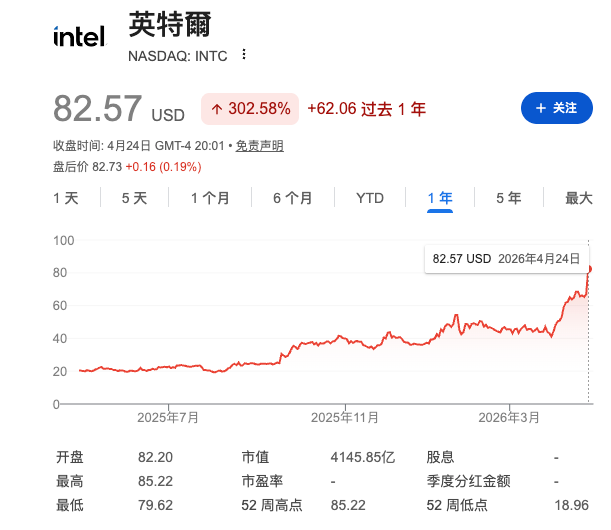
Intel presented one of the most dramatic financial reports in US stock history since the beginning of 2026.
On Friday, April 24, Intel's stock rose approximately 24% to $82.57, marking the largest single-day increase since 1987, with the stock price officially breaking the historical high from the 2000 Internet bubble. This is more than a 250% cumulative increase from the 52-week low of $18.25 in September 2024. The Philadelphia Semiconductor Index recorded its 18th consecutive increase that day, with AMD soaring about 14%, and NVIDIA closing up 4.3%, pushing its market value back above $5 trillion.
However, the extreme exuberance in stock price and the gap between Wall Street consensus is equally noteworthy.
Of the 34 analysts covering Intel, only 6 have given a buy rating, 24 maintain a hold, and 4 still recommend selling. The consensus median target price is around $55, indicating that most analysts believe this stock should be over 30% lower than the current price.
Q1 Overall Crush: Revenue Beats by Almost 10%, EPS Expected $0.01, Actually $0.29
According to CNBC, Intel's Q1 revenue was $13.58 billion, against Wall Street's expectation of $12.42 billion, beating by approximately 9.4%. The adjusted EPS was $0.29, while the consensus expectation was only $0.01 (some data sources showed $0.02), creating a gap of nearly 30 times. This marks Intel's sixth consecutive quarter of surpassing expectations.
Analyzing by business, the data center and AI sector is the largest engine, with revenue of $5.1 billion, a year-on-year increase of 22%, exceeding the expected $4.41 billion. Client computing business (PC chips) revenue was $7.7 billion, against an expectation of $7.1 billion. The adjusted gross margin increased from 39.2% in the same period last year to 41%.
Q2 guidance also significantly exceeded expectations: revenue guidance is $13.8 billion to $14.8 billion (median $14.3 billion), while Wall Street expected $13.07 billion; adjusted EPS guidance is $0.20, expected $0.09 to $0.10.
Intel CEO Lip-Bu Tan made a widely quoted statement during the earnings call: CPUs are re-establishing their position as an indispensable foundation in the AI era. His core argument is that AI is shifting from foundational model training to reasoning and agentic directions, which greatly increases demand for CPUs and foundry services, rather than relying solely on GPUs.
Benchmark/StoneX semiconductor senior analyst Cody Acree posed a sharp question in an interview with Sherwood News: If this upward potential is plausible, why was such a conservative guidance given in Q4? He pointed out that Intel had explicitly stated in the Q4 earnings call that wafer supply was "constrained," leading to a 17% drop in stock price that day.
Three Major Clients Validate Simultaneous Deployment: Terafab, Google, Irish Wafer Plant Buyback
Apart from the Q1 financial figures, what truly ignited market sentiment were three strategic transactions occurring almost simultaneously.
On April 7, Intel announced its entry into Elon Musk's Terafab project, becoming the major foundry partner for the chip manufacturing joint venture (which includes SpaceX, xAI, and Tesla). According to TechCrunch, Intel stated on the X platform that its capability to design, manufacture, and package ultra-high-performance chips will help Terafab achieve its goal of one petawatt computing capacity annually. Musk confirmed during Tesla's Q1 earnings call that Tesla plans to use Intel's next-generation 14A process to manufacture chips, stating that "when Terafab's capacity ramps up, the 14A should be quite mature."
This marks the first significant external client Intel's foundry business has secured after many years of waiting. Previously, Intel had been the only major client for its own 18A process, but external clients remained cautious despite the technology being in the same generation as TSMC's 2nm process.
At the same time, Intel announced a multi-year collaboration with Google, wherein Google pledged to deploy Intel's latest Xeon 6 processors in its cloud infrastructure for AI inference and other workloads. Additionally, Intel repurchased 49% of the Irish Fab 34 wafer plant from Apollo for $14.2 billion (originally sold for $11.2 billion in 2024), regaining 100% control. According to SEC filings, the repurchase funds came from cash reserves and a $6.5 billion bridge loan.
Analyst Camp Split: Roth Sees $100, BofA Maintains "Sell"
The rating changes following the earnings report showed a rare polarization.
In the bullish camp, Roth Capital raised Intel from Neutral to Buy, doubling its target price from $50 to $100, citing being "impressed" by CEO Lip-Bu Tan's ability to improve manufacturing efficiency and execution in CPU products. HSBC analyst Frank Lee was the first to upgrade to Buy before the earnings report (on April 21), raising the target price significantly from $50 to $95, which was the highest target price on Wall Street at the time. Lee's core argument is not the foundry business, but the growth opportunity in server CPUs that is not yet fully priced into the market: he expects Intel's server CPU shipments to grow year-on-year by about 20% in both 2026 and 2027, with average selling prices also expected to rise by about 20%. Citi and Evercore ISI also upgraded their ratings to equivalent buy after the earnings report.
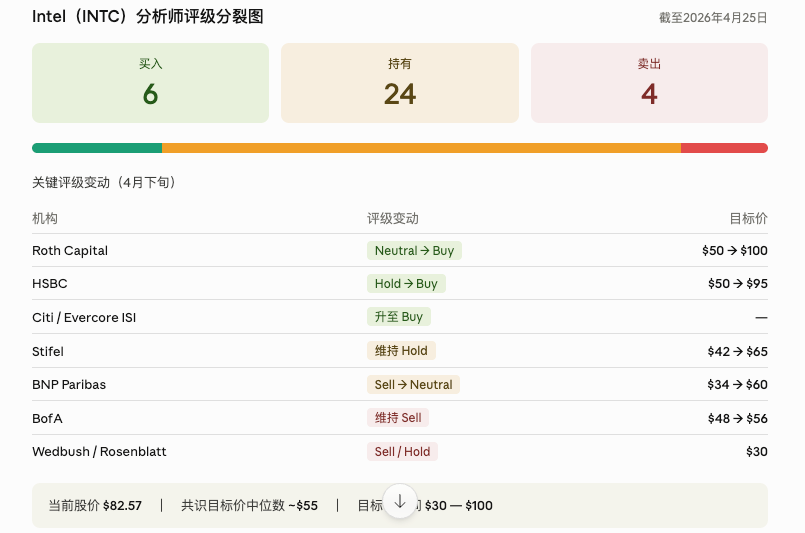
The bearish camp also holds a firm stance. According to TheStreet, Bank of America analyst Vivek Arya maintained an Underperform (Sell) rating, though raised the target price from $48 to $56, believing Intel's recovery has been fully priced in. He noted that reported gross margins still lag behind peers, the company continues to burn cash, the yields of 18A products are low, and Intel Foundry still needs to prove itself to external clients. Bank of America forecasts Intel's sales compound growth rate from 2025 to 2028 to be 10%-15%, well below the 30%-40% of peers. Target prices from Wedbush and Rosenblatt were even lower at $30, implying over a 60% downside from the current stock price.
Overall, according to Benzinga data, of the 34 covering analysts, only 6 have buy ratings, 24 hold, and 4 sell. The consensus median target price is around $55, with target prices ranging from $30 to $100. The current stock price of $82.57 has far exceeded the upper limits of most target prices.
117 Times Forward PE: The Valuation Cost of the Turning Story
The core of this division lies in valuation.
Intel currently has a forward PE ratio of about 117 to 150 times (varying by data source), while its five-year median PE is only 12 times. By GAAP standards, Intel has still been in a loss position over the past 12 months (TTM EPS of -$0.06), with a market cap of about $35.5 billion, which is 6.4 times its revenue. GuruFocus's GF Value estimates Intel's reasonable valuation at only $27, indicating that the current stock price is overvalued by more than 200%.
From another perspective, Intel's stock has risen over 105% year-to-date, with a roughly 284% increase over the past 12 months, and a single-day trading volume of 264 million shares on April 24, which is about 1.5 times the three-month average. The market's enthusiasm for this stock has far surpassed what current fundamentals can substantiate.
The bears' counterargument is equally strong: Intel's 18A process yield issues have not been resolved, and 14A is "not fully ready" (in Musk's own words), the foundry business does not yet have external customers contributing substantial income, and the company's free cash flow remains negative.
The semiconductor industry naturally has strong cyclicality, and how long the current AI demand boom can last is itself a question mark. Paying for a company with nearly 150 times forward PE that is still burning cash leaves almost no room for error.
This may be the fundamental reason only 6 out of 34 analysts dare to turn bullish: Intel's turnaround narrative is compelling enough, but the price paid for that narrative has become frightening enough.
免责声明:本文章仅代表作者个人观点,不代表本平台的立场和观点。本文章仅供信息分享,不构成对任何人的任何投资建议。用户与作者之间的任何争议,与本平台无关。如网页中刊载的文章或图片涉及侵权,请提供相关的权利证明和身份证明发送邮件到support@aicoin.com,本平台相关工作人员将会进行核查。


