Author: Claude, Deep Tide TechFlow
Deep Tide Introduction: Samsung Electronics' union organized the largest gathering in history at the Pyeongtaek plant with 40,000 people, demanding that 15% of operating profits be distributed as bonuses, roughly 580 million Korean won (about 400,000 US dollars) per person. Management’s counterproposal of a 10% scheme was rejected, and the union announced an 18-day strike starting May 21. Across the street, SK Hynix just reported the strongest quarterly results in history, with employees expecting an average annual bonus of 670 million won, making the wage gap for Samsung chip workers a trigger in the talent war.
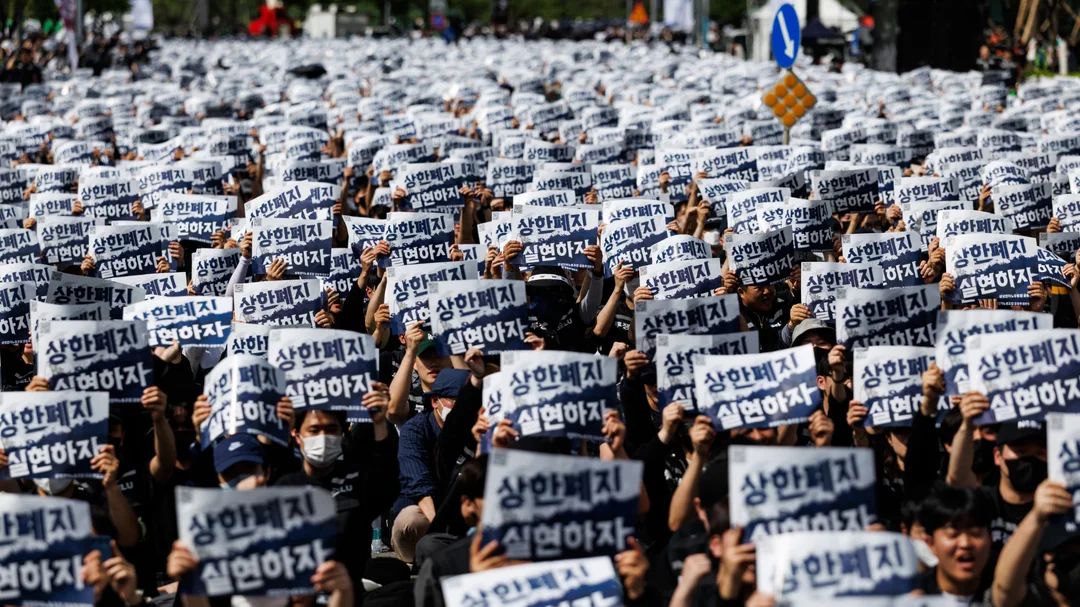
The AI chip craze has brought immense profits to South Korea's two major memory giants, but the contradiction over profit distribution is sharply erupting within Samsung Electronics.
On April 23, more than 30,000 members of Samsung Electronics' union flooded into the company’s main chip factory site in Pyeongtaek, South Korea, holding the largest labor rally in the company's history. The union claimed the number of participants was around 40,000. Reports from Reuters and TechCrunch indicated the union's core demand is to allocate 15% of operating profits to the performance bonus pool for chip department employees, abolishing the current 50% bonus cap and raising the base salary by 7%. Based on analysts' projections of Samsung's total operating profit of approximately 300 trillion won for 2026, a 15% allocation would mean a total bonus pool of about 45 trillion won, giving approximately 580 million won (about 400,000 US dollars) to each of the around 77,000 employees in the chip department.
Samsung management has not completely refused dialogue. According to reports from Korean media like ZDNet, the company proposed a 10% operating profit distribution plan, a 6.2% basic salary increase, and additional benefits like favorable housing loans, promising that total compensation for semiconductor department employees would exceed competitors'. The union rejected this offer.
18-Day Work Stoppage Could Disrupt Global Memory Chip Supply
If no agreement can be reached, the union has announced the initiation of a comprehensive strike for 18 days starting May 21, lasting until June 7. According to Euronews, the union estimates that the strike will cost the company more than 1 trillion won (about 720 million US dollars) per day.
Union President Choi Seung-ho shouted through a loudspeaker above a crane at the rally: “Let’s make salaries transparent, abolish the bonus cap!”
This strike action is unprecedented in Samsung Electronics' history. In 2024, Samsung workers initiated the company's first strike in 55 years, but it lasted only about three days, with limited impact on production.
This time, the union has made it clear that it will apply greater pressure. Samsung applied to the court last week to prohibit the union from engaging in what they claim are “illegal activities” during the strike.
According to Reuters, Park Ju-geun, head of the South Korean business analysis agency Leaders Index, predicts that the two sides may ultimately reach a compromise, as a prolonged strike could provoke public discontent, which would be unfavorable for the union. On the day of the rally, Samsung’s stock price increased by 3% to a historic high, suggesting that the market was not in panic mode, temporarily. However, across the street from the factory, some shareholders gathered to protest, accusing the union of “holding back” the company at a crucial moment.
SK Hynix's "Lottery Bonus" Stings Samsung Workers
The anger of Samsung's union largely stems from a direct comparison with SK Hynix.
On the same day as the rally, SK Hynix released its strongest quarterly report ever: Revenue of 52.58 trillion won, operating profit of 37.61 trillion won, and an operating margin of 72%, all record highs. According to a report by the Seoul Economic Daily on April 24, based on just the first quarter's performance, SK Hynix employees have already secured about 109 million won in bonuses. Based on analysts' predictions of the company's annual operating profit of 230 trillion won, plus its policy of “10% of operating profit as a bonus pool, with no cap”, the average annual bonus is expected to reach 670 million won (about 490,000 US dollars). South Korean media have referred to this as a “lottery bonus.”
SK Hynix eliminated the bonus cap in September 2025 and linked 10% of operating profit directly to employee performance. The company disbursed an average bonus of approximately 140 million won in 2025 and 70 million won in 2024. In contrast, Samsung did not issue any performance bonuses in 2024 due to losses in its chip department.
According to the Korea Herald, Samsung union chairman Choi Seung-ho revealed that about 200 employees have switched to SK Hynix in the past four months. The union’s own calculations show that under the same compensation system, Samsung chip department employees' bonuses are less than one-third of those at SK Hynix. This disparity has had a tangible effect during SK Hynix's recruitment presentations: according to the Seoul Economic Daily, recent recruitment presentations held at 11 universities attracted about 400 attendees, double the pre-registration number; even some ineligible four-year university graduates inquired about production positions.
AI Chip Supercycle, Workers Say "The Money Isn’t Ours"
The root of the conflict lies in the fact that Samsung is experiencing a historic profit explosion, but chip workers feel that the return does not match the profits.
Samsung Electronics' Q1 2026 earnings guidance released on April 7 indicates that the quarterly operating profit reached 57.2 trillion won (about 38.9 billion US dollars), an increase of 755% year-on-year, with revenue of 133 trillion won. This quarter's profit exceeds Samsung's entire operating profit for 2025 (43.6 trillion won). According to estimates cited by SamMobile, the semiconductor department contributed approximately 95% of the profits, with HBM high-bandwidth memory, server DDR5, and enterprise SSDs being the core drivers.
SK Hynix's performance is similarly impressive: Q1 revenue increased by 198% year-on-year, and operating profit doubled. The company's CFO, Kim Woo-hyun, stated during the earnings call that demand for HBM over the next three years has far exceeded supply capacity, with customers prioritizing securing supply volume over pricing, saying, “the strong pricing trend will continue.”
AI data centers currently consume about 70% of the world's high-end memory chip production capacity. DRAM contract prices have risen for 11 consecutive months, with the average price of standard PC DRAM reaching 13 US dollars in March 2026. Samsung and SK Hynix together control about 70% of the global DRAM market; both companies are significantly shifting production capacity towards more profitable AI storage products, further tightening the supply of traditional consumer-grade storage.
免责声明:本文章仅代表作者个人观点,不代表本平台的立场和观点。本文章仅供信息分享,不构成对任何人的任何投资建议。用户与作者之间的任何争议,与本平台无关。如网页中刊载的文章或图片涉及侵权,请提供相关的权利证明和身份证明发送邮件到support@aicoin.com,本平台相关工作人员将会进行核查。


