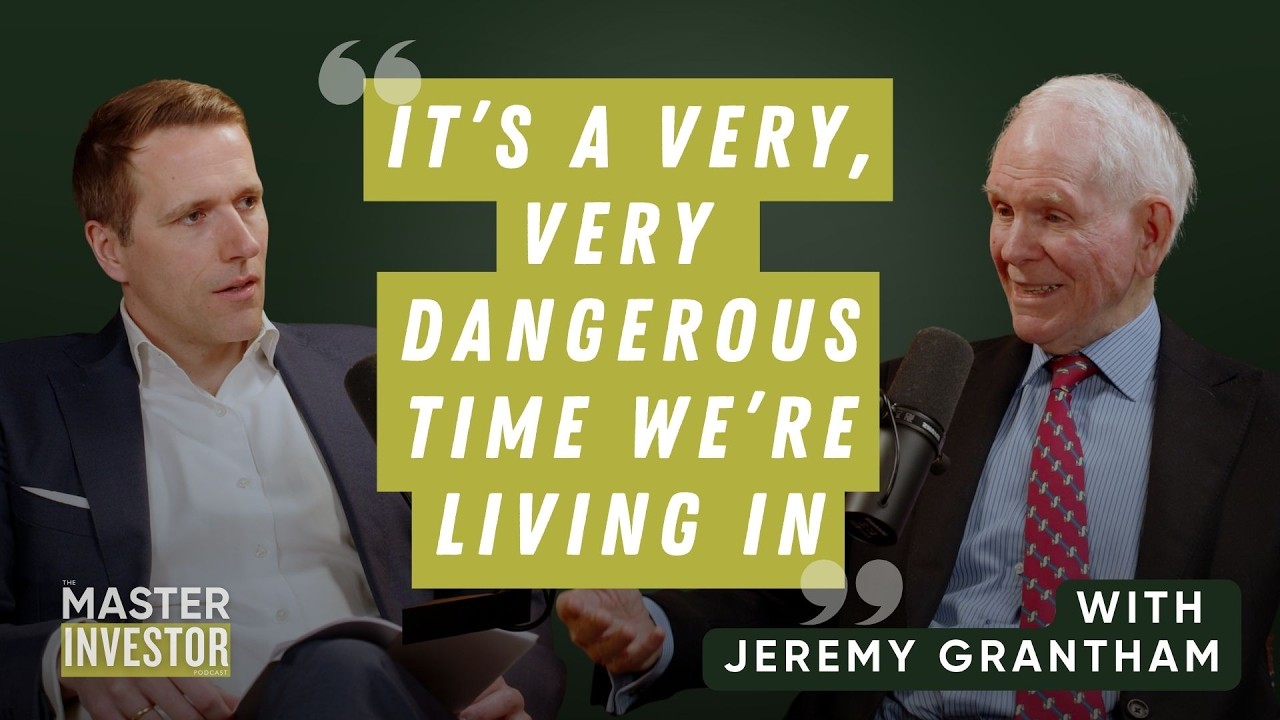
Source: "The Master Investor Podcast with Wilfred Frost"
Compiled by: Felix, PANews
Jeremy Grantham established and led the Boston investment firm Grantham Mayo Van Otterloo (GMO) for decades, managing assets that peaked at $150 billion. Throughout his nearly 60-year investment career, Jeremy has almost accurately predicted all major stock market bubbles over the past 60 years and the ensuing rebounds, achieving long-term excess returns.
Recently, Jeremy was a guest on "The Master Investor Podcast with Wilfred Frost," where he focused on today's market environment, assessing the impact of the war in Iran on oil prices, AI, meme stocks, and the "big seven," comparing it with the prosperous periods of the 1970s, 1999, 2007, and the post-COVID boom. PANews has organized the highlights of this conversation.
Host: Jeremy, welcome back to the podcast, it’s great to see you in person.
Jeremy: It’s great to be here. However, I must object to the word "predict" that you just mentioned. I am not predicting bubbles; I am merely pointing them out when they arrive. It would be convenient if I could foresee their arrival, but all I can do is wait for them to appear—and they seem to always be obvious. Then I can say: "Look, there it is."
Host: You mentioned in your book published this January, "The Making of a Permabear," that you are still a Yorkshireman. Every qualified Yorkshireman instinctively understands that "cheap is better than expensive," which gives you a knack for finding good value. You also talked about your "butterfly effect" thinking pattern, where thoughts and ideas flit around like butterflies in a garden, seemingly lacking focus. Can you explain why this is important for you as an investment thinker?
Jeremy: This could be considered a form of self-justification. I struggle to stay on a single topic for too long and tend to shift to another topic, which often frustrates my colleagues. But the key is that I am quite persistent. Observers of gardening will find that this is precisely how butterflies behave: you think they’ve flown away, but they may return to the same flower several times over a day or two. I find brainstorming should work in this manner. If you get too hung up on a topic, it only stiffens your thinking, like banging your head against the wall. The best approach is to circulate around and then return to the original topic, at which point your brain will be more open and perhaps you'll have an epiphany.
Host: You also wrote that working too hard can hinder thinking because one is too busy absorbing new data. Do investment professionals today spend too much time on Excel spreadsheets or AI modeling? What do you mean by "real thinking"?
Jeremy: Real thinking is not just typing numbers into spreadsheets. Real thinking is walking through Boston Common, or thinking in the shower, allowing the brain to function at a comfortable walking pace while considering where we currently stand? What's happening? What conclusions can we draw? In the past, when I arrived at the office, I usually already had two or three ideas (though my colleagues mostly thought these ideas were silly). I’m fortunate to have a colleague named Chris Darnell, who is the only person in the world who can convince me that an idea is stupid in 20 seconds. You really need this combination: someone who generates lots of absurd or superficial ideas, combined with a "idea crusher" who can spot fatal flaws at a glance and keep you moving. We will review 10 to 20 ideas before finding one worth pursuing.
Host: On this point, you wrote in your book: “Seeing the big picture is everything. One or two good ideas a year is enough.” Is this what contributes to your legendary investment status?
Jeremy: Yes, there have been many years when I didn’t have a single good idea. But if your level of thinking is high enough, like “Will small-cap stocks win this year?” you don’t need to guess too many times. Just knowing that small-cap stocks are gaining strength is enough to outperform the market for three or four years. As long as you get the big direction right, it’s really not hard.
Host: From a micro perspective, if I’m not mistaken, your real winning secret is essentially the dividend discount model, along with some adjustments you do. This is your core focus, right?
Jeremy: Yes, the dividend discount model is just a tool we use to measure the quality of other ideas; it gives us a ratio of the relative fair value of different stocks to test whether our intuition is correct. We have a dividend discount ratio for each stock. What is the fair value ratio? If it is 0.79, it indicates it is undervalued by 21%. If it is 1.12, it indicates it is overvalued by 12%. Then we add them up and find that all small-cap stocks, in total, are very cheap, and vice versa. It provides us with a measurement tool to test whether our intuition is correct. Very convenient.
Host: Here you clearly weigh value, which is more important than other factors like growth and momentum. I assume you also recognize the importance of those other factors.
Jeremy: No, I actually have a secret respect for anything effective, no matter how absurd it might be. Of course, momentum is a fairly simple inefficiency phenomenon. It really shouldn’t be effective. But it has been very useful throughout my entire investment career, and for a long time before that. And it remains effective in various forms now. It simply shows that things in motion tend to stay in motion for a period. The authors of "A Random Walk Down Wall Street" and other market efficiency theorists have claimed that price alone cannot provide any information. This statement is completely wrong. I believe the biggest inefficiency lies in the pricing of “quality.” High quality means less debt, higher returns, greater stability, and a lower bankruptcy probability. No matter how you torture the data, you cannot convince anyone that “quality” is a risk factor.
From an academic perspective, the lower the risk, the lower the return should be; but in fact, quality stocks always outperform the market. Due to the lower risk, they should, in theory, underperform by one percentage point each year, right? AAA-rated bonds yield about one percentage point less than B-rated bonds each year. Based on the same low-risk logic, AAA stocks should behave likewise. But they don't; they outperform the market by about 0.5% each year. Therefore, due to market inefficiency, there is approximately 1.5% free excess return each year. You gain the privilege of holding these quality large-cap stocks, a fact that academics have not discovered and endorsed over decades.
Host: Over time, has the market become more efficient? Has your work become more difficult?
Jeremy: As my career has progressed, I tend to focus on increasingly grand questions, moving from individual stocks to sectors to entire markets. If we talk about those absurd inefficiencies and bubbles, like meme stocks that surged six-fold within a year, the current market may be worse than it has ever been.
Host: Regarding your investment approach, you once mentioned: “Without experiencing painful losses ahead of time, we can never make big money. You need to have the confidence to hold onto positions when they are working against you and to increase weights when they become more attractive. Value gives you that confidence.” This must be very challenging.
Jeremy: It is indeed very challenging; you have to trust the data. If you want to capture those once-in-a-century super bubbles, you often have to first endure a commonplace bubble that occurs every 15 years. If you want to make big money, you have to watch the market go from "overpriced" to "extremely overpriced" to "wow, that’s ridiculous." Only at that turning point can you make big money. But before that, you will endure immense pain. For example, in 2000, the market fell 50%, while our portfolio achieved significant growth over three years.
Host: Many people say it’s impossible to time the market; I believe this holds true at the individual stock level, but I admire the bold positions you take.
Jeremy: No, I don’t think this is timing the market. I believe it's just exiting obviously overpriced stocks and consistently focusing on cheap stocks. Every time you buy a small-cap stock, someone might say: "Oh, you are timing that stock." Is that so? Or is it said that if you hold onto a cheap stock, eventually, you will always win in the long run? So, don’t hold your ground in an overvalued market unless you want to receive a heavy punch. Of course, during this time, others may outperform you, but in the long run, you will win.
Host: In the first nine years of founding GMO, you achieved an impressive annual excess return of 8%.
Jeremy: Compared to Buffett's longer time frame of achieving an excess return of 9%, our results only highlight how incredible Buffett truly is. Buffett has turned making money into a simple and enjoyable goal. Jack Bogle (the father of index funds) earned the medal for "doing the most useful thing in the investment world" for saving hundreds of millions of investors billions of dollars.
Host: Comparing historical bubbles, in 1999, clients complained to you due to your poor performance, and you said, "Value is off the charts, inflation-linked bond yields are at 4%, REITs are trading at a discount." Can you apply all this to today?
Jeremy: No. The 2000 situation was great because it gave you many safe havens. REITs were even selling below their construction costs. At the market peak, the S&P 500's yield dropped to 1.6%, a level not seen even in 1929. That was the situation. At the time, small-cap stocks were very cheap.
Then you look at other markets, like the 2007 housing bubble, with almost nowhere to hide. That was a risk bubble. All risky assets were overpriced. In 2008, there were no noticeably cheap assets. The current market is somewhere in between, more like 2000. Half the bubble periods offer superb alternatives; the other half do not. For this time, I remember saying early last year on a podcast that we had no bias against non-U.S. stocks. We wouldn’t touch the U.S. market, but valuations in other regions of the world—emerging markets, Europe, Australia, and Canada—are extremely reasonable.
Host: In 1999, many talked about the productivity and GDP boosts brought by the internet, just like people today discuss AI. Why is this bullish logic foolish?
Jeremy: There is no inherent relationship between high market prices in the past and future growth. In every bull market, people say the future must be bright; otherwise, market prices wouldn't be so high, but the reality is the opposite. If you ask what the three or four worst periods in history were, they are not randomly distributed; they immediately follow massive bubbles. The Great Depression came right after the well-known peak in 1929. Japan’s "lost decade" and "lost twenty years" followed remarkably the 65 times price-to-earnings ratio in 1989. There has never been a case in history where high price-to-earnings ratios meant higher profits, faster growth, or increased productivity. They truly herald the arrival of difficult times. If such a situation could arise, it is now.
Currently, we are getting everything wrong. We are doing our utmost to screw up the beautiful growth of post-war international trade with tariffs and trade wars. We are deliberately undermining geopolitical stability, destroying our relationships with countries like Russia and China. I am convinced that these relations have worsened at times on some side, but both sides have concurrently worsened, which feels distinctly unsettling. The billion-dollar losses from floods, droughts, and fires occur so frequently that they may erase 0.5% from global GDP each year, and the situation continues to deteriorate; then there is a declining population in certain countries, such as Japan, South Korea, and China, where the population is dropping like a rock, and this trend will continue to be visible. Thus, the world will have to get used to slower labor force growth.
Host: With the outbreak of the Iranian conflict and its obvious effects on oil prices and inflation, do you recall some challenges from the 1970s?
Jeremy: Yes, as a species, humans have a tendency to think optimistically. We are very good at wishful thinking. If you study the stock markets now and in the past, you will come to the conclusion that, given a little opportunity, we will generously interpret the future and talk about how good things will be. If economic data is poor, we say, "Great, this gives the Federal Reserve an excuse to cut rates," and the stock market rises. If economic growth is good, we say, "Great, profits will be high," and the stock market rises again. So the market is always looking for optimistic excuses and over-interpreting good news.
We tend to linearly extrapolate and continuously infer. For example, in the summer of 1929, the economy was doing well, and if one were to keep extrapolating, people would expect a ridiculously high price-to-earnings ratio. Then, in 2000, profit margins reached historical highs, with price-to-earnings ratios hitting 35 times, and stock prices even rising to four times book value. These phenomena are not complex, but most people fail to pay attention to the warnings. Why didn’t these warnings make the front page? Because it’s not a commercial strategy. Any major firm in finance has to keep telling you that everything is fine, then jump off the cliff with everyone else and make as much money as possible cleaning up afterwards. Goldman Sachs, JPMorgan, Morgan Stanley would never tell you to get out of the market because the pricing is already fearfully high. And they can all see the pricing is fearfully high. So don’t think the market is reasonably priced just because no professional has told you to sell; the reality is quite the opposite.
I often make an analogy: it’s like dropping a bag of feathers from a skyscraper in Miami during a hurricane; in the short term, you have absolutely no idea where those feathers will be blown. But you can be sure of one thing: eventually, every feather will fall to the ground. For me, "value" is equivalent to gravity. No matter how high you rise now, sooner or later, being expensive will cost you.
Host: You wrote in your book about the strangest conditions of a bubble bursting: “When the previous market leaders fall dramatically, while the blue-chip market continues to rise strongly.” This has happened in 1929, 1972, and 2000. Considering that over the past few months, MAG 7 (the big seven tech giants) have lost their upward momentum, but the rest of the market remains strong, would you add late 2025 or early 2026 to your list?
Jeremy: Perhaps I should add it. Although I hadn’t previously, I think I have been busy with my book tour. But I want to add 2021 to that list. Many speculative and unprofitable stocks began to decline after a strong performance post-COVID lows while the market continued to rise, leading to a 25% decline in the S&P 500 in 2022 and a 40% decline in MAG 7 stocks. But then ChatGPT appeared. Without the AI investment craze, we may have already been in a mild or moderate recession, with the market potentially down 40% or more.
Host: In March 2009, you published the famous "Reinvesting in Fear." How did you assess the time to enter when the market was in extreme panic?
Jeremy: That’s because I was familiar with the panic of 1974, the fear that put the market in "ultimate paralysis." In 2009, I advocated for making a plan—even a bad plan is better than paralysis. You must understand: Market turning points do not occur when people see "light at the end of the tunnel," but rather at moments when "everything seems completely dark, but just slightly less dark than the day before." While it did not reach the absolute valuations of 1974, it was, according to our dividend discount model, very cheap and destined to provide returns far above historical averages (with actual returns reaching 12%) over the next seven years.
Related reading: Dialogue with Bitwise Advisor: From K-shaped Economy to AI Taking Jobs, How Can Bitcoin Save Young People?
免责声明:本文章仅代表作者个人观点,不代表本平台的立场和观点。本文章仅供信息分享,不构成对任何人的任何投资建议。用户与作者之间的任何争议,与本平台无关。如网页中刊载的文章或图片涉及侵权,请提供相关的权利证明和身份证明发送邮件到support@aicoin.com,本平台相关工作人员将会进行核查。


