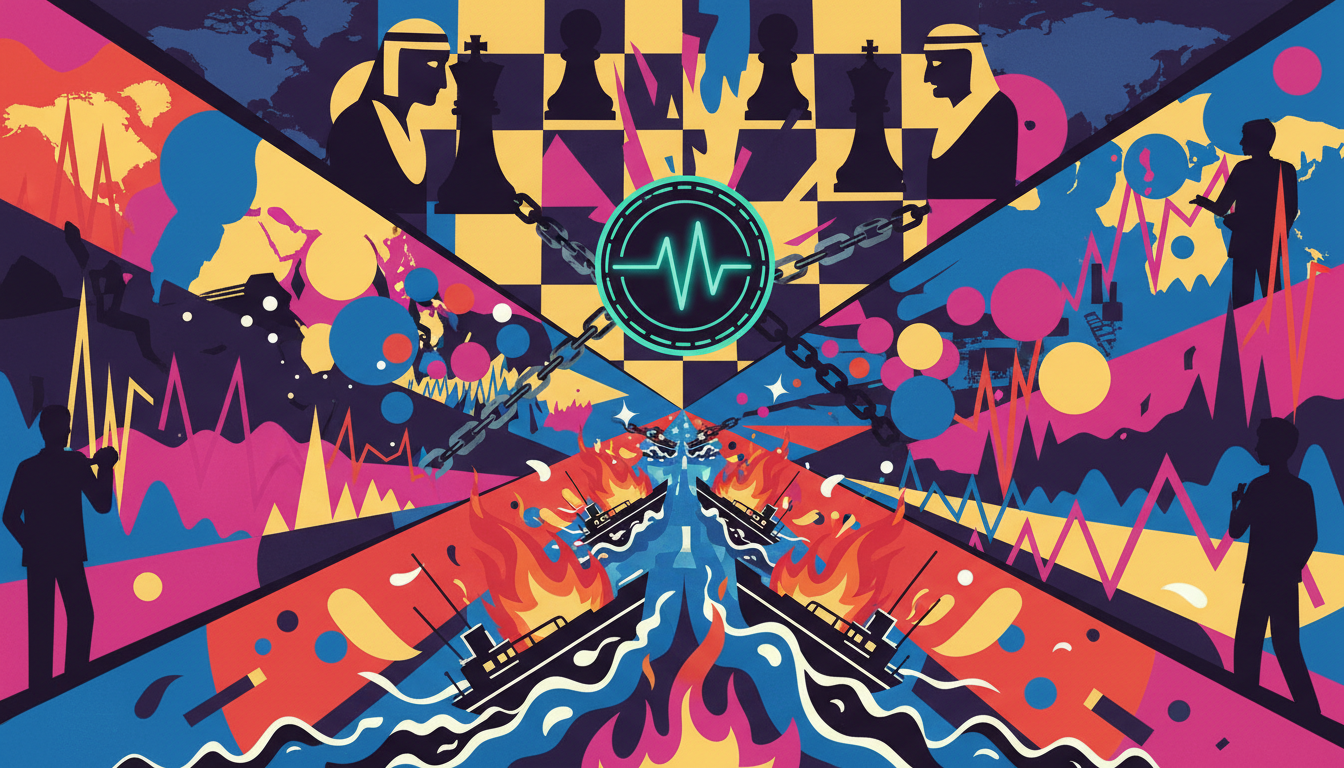
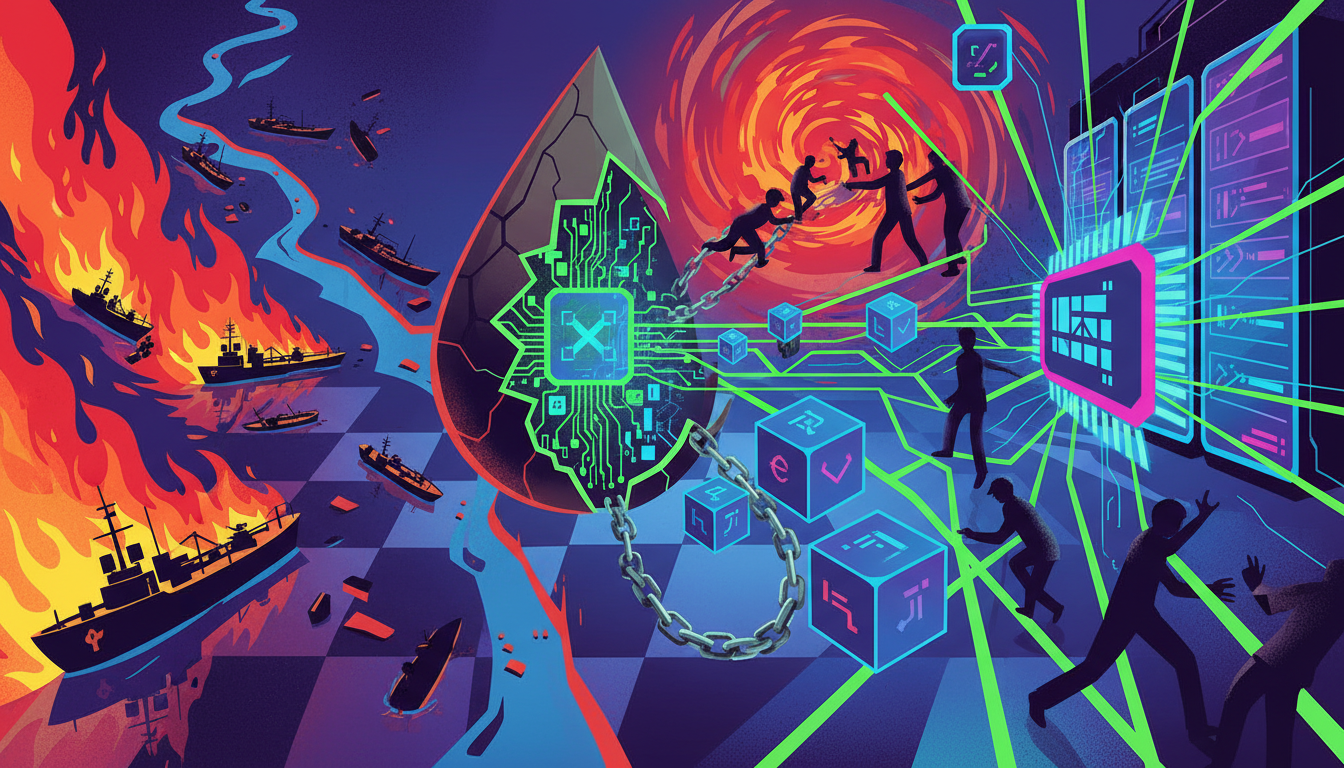
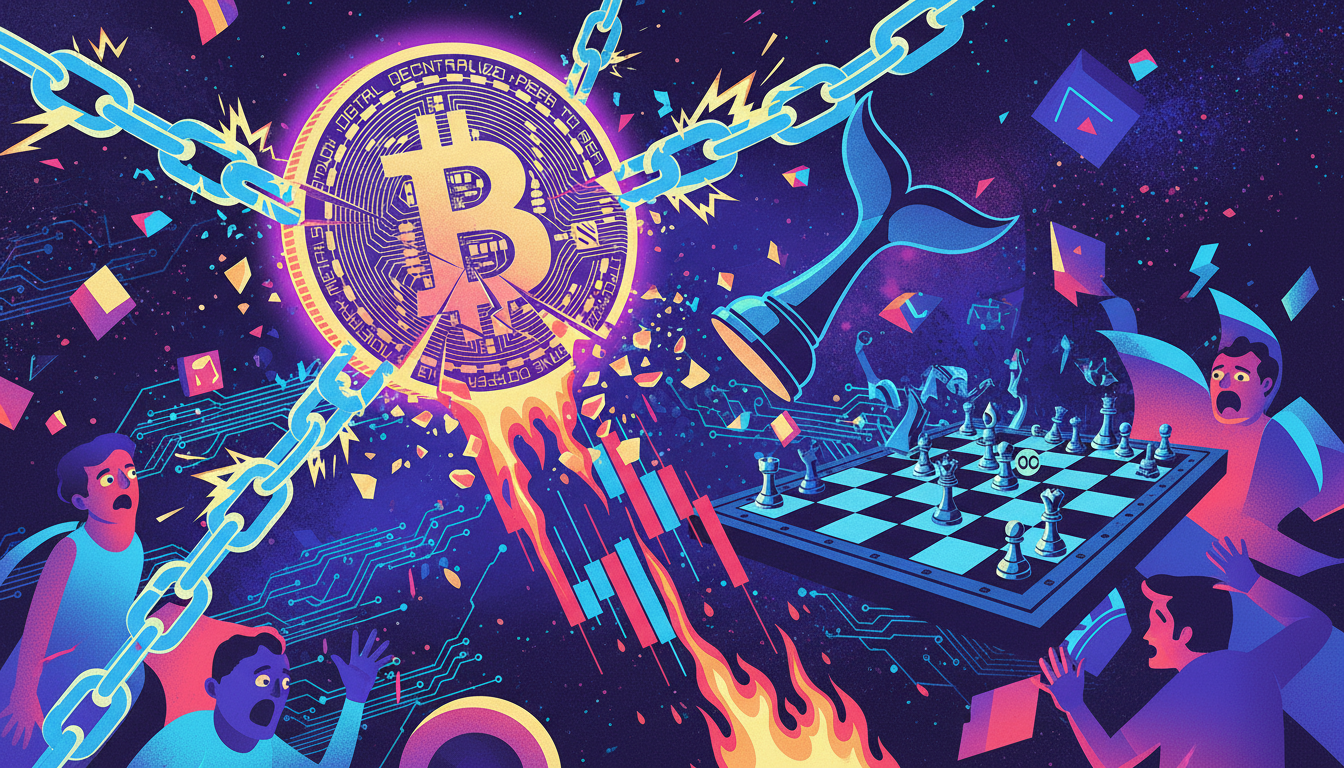
From April 17 to 18, Beijing time, the game between the US and Iran over the Strait of Hormuz suddenly accelerated: on one side, Iran publicly announced the "opening of the strait," while on the other side, the next day, the public AIS track showed that 10 tankers turned back collectively near Larak Island, directly contradicting the official statement in the timeline. The mismatch between verbal openness and actual obstruction of passage has once again brought market concerns about blockade risks and the stalemate in nuclear negotiations to the forefront, resulting in a rise in shipping insurance quotes, quickly warming expectations for rerouting and delayed deliveries. Against this backdrop, since February 5, the total market value of global cryptocurrencies has increased by approximately $430 billion, forming a sharp contrast with the typical linkage pathway of traditional safe-haven assets under geopolitical shocks—when oil price anxieties and shipping panic heat up, why does capital rush into the more volatile cryptocurrency assets, becoming the most notable question in this round of crisis.
The Dramatic Contrast Between Verbal Openness and Fleet Turnarounds
On April 17, Iran officially declared through official channels that the Strait of Hormuz would "remain open," emphasizing Iran's capability to ensure the safety of international energy transport routes, deliberately highlighting its role as a responsible major power and provider of regional stability. This statement, paired with diplomatic gestures of goodwill, aimed to weaken the "blockade" label to win space in the international discourse and potential sanctions game. However, a statement cannot replace real navigation tracks; what truly determines the direction of tanker movement is never the headlines, but risk pricing.
Less than 24 hours later, public AIS tracks and shipping agency reports revealed that at least 10 tankers collectively turned back near the waters of Larak Island, with originally planned fleets crossing the Hormuz opting to turn back; some redirected to waiting areas, others preparing to take longer routes. This highly synchronized turnaround behavior signifies that, in the comprehensive judgment of shipowners, captains, and insurance companies, the marginal risk of the strait route has significantly increased, standing in stark contrast to the external statement of "open strait." Ports and shipping routes have not been officially declared closed, but military signals, potential misjudgment risks, and slight adjustments in insurance clauses are enough to create a vast gray area between "navigable" and "willing to navigate."
The transition from surface "openness" to substantial "difficulty in passage" is the result of multiple decision-making misalignments. On one end, Iran emphasizes control and security assurances in diplomatic rhetoric to avoid being labeled as "deliberately strangling global energy arteries"; on the other end, the high-pressure vigilance of the military, the level of regional tension, and the public memory of blockades and seizures form a latent red line at sea. Shipowners and insurance companies evaluate this red line using the most conservative models—before the premiums are fully transmitted to the end-oil prices, they choose to reduce their exposure at the front lines of the conflict.
This misalignment has been further solidified by public statements from both the US and Iran. While Iranian officials emphasize the openness of the strait, they repeatedly blame external sanctions and blockades as "war against the Iranian people," shifting the responsibility to their adversaries; meanwhile, the US responds with more direct tough rhetoric, with Trump publicly stating that "the blockade will continue until the agreement is 100% complete," linking the timeline of sanctions and blockades to the nuclear agreement. Although the two narratives appear to overlap on the word "open," they in fact undermine each other: one side seeks to prove that it "hasn't closed the door," while the other proclaims, "the door won't truly open until we say so."
20% of the Global Oil Artery Tightened Repeatedly
The Strait of Hormuz handles approximately 20% of the world's maritime oil transit, making it one of the most fragile yet critical chokepoints in the global energy system. Since the escalation of tensions between Iran and the US, this maritime artery has repeatedly been used as a signal: not through formal announcements of blockades, but through seizures, threats, military exercises, inspections, and other means, repeatedly navigating the ambiguous territory of "not yet closed" and "may close at any time." With each crisis, the market's imagination of future supply stability is what gets repeatedly tightened.
Placing this incident of tankers turning back within this lengthy timeline makes it easier to understand its amplifying effect on pricing. The synchronous turnaround of 10 tankers will not immediately alter the global inventory curve but is sufficient to push up shipping insurance premiums and financing costs in advance. For ship owners, the premiums and additional terms for traversing the Strait of Hormuz rise, implying that the implicit logistics costs per barrel of oil increase; for traders and refineries, choosing longer routes directly extends port arrival times, increasing the number of days in transit, making it easier for the difference between spot and futures prices to be amplified by sentiment. Before any tangible supply shortages appear, the market has already begun to pay for "potential future blockades."
This pathway is not unfamiliar in history. In 2025, the Iranian Revolutionary Guard seized a British tanker, which did not lead to a complete shutdown of the Strait of Hormuz, but was sufficient to significantly raise the risk thresholds of shipping companies and insurers. Following that incident, multiple international underwriting agencies upgraded the risk categories of vessels entering those waters, which would automatically trigger higher premium tiers should the situation escalate. The collective turnaround of these 10 tankers can be seen as another instance of "systemic self-protection" under a higher threshold: market memories lead participants to choose to stay farther away at the onset of conflict, rather than testing the edges of the red line as in the past.
The US's public statement that "the blockade will continue until the agreement is 100% complete" psychologically extends what could originally be seen as "sporadic conflict" into a "potentially normalized institutional blockade." For traders and asset management institutions, the impact of this statement lies not in its legal validity, but in how it rewrites the expected timeline—from tactical disruptions lasting weeks or months to potential strategic frictions that could span several years. This expectation of a lasting blockade will quickly embed itself into long-term contracts and medium to long-term energy investment models, causing every ship turnaround and premium increase to be interpreted as another confirmation rather than an unexpected event under the "long-term shadow."
The Deadlock in Nuclear Negotiations: A Refusal Conveyed Through Pakistan
While maritime blockades and shipping risks are heating up, the negotiations between the US and Iran over nuclear issues have also entered a state of almost "procedural deadlock." Recent public information indicates that Iran has chosen to formally refuse US negotiation requests through Pakistan, rather than directly responding in bilateral or multilateral forums. This diplomatic route carries strong symbolic significance: first, it emphasizes its alliances and footholds in the regional landscape while using a third party to express its stance; second, it formally distances itself from direct communication with the US, avoiding interpretations that suggest capitulation under pressure.
In this process, Iranian officials have continually reinforced their verbal initiative. Deputy Foreign Minister Khatibzadeh publicly stated that "the era of colonialism must end," framing economic sanctions and maritime blockades as "new colonialism tools," trying to shift its position from "being sanctioned" to that of a symbolic subject of "anti-colonial struggle." Through this narrative reshaping, Iran packages the nuclear issue and the security of the strait into a larger historical context, providing legitimacy for domestic mobilization while also seeking to engage those in the international discourse who are already skeptical of the Western sanctioning system.
Correspondingly, the US sets the success criteria for negotiations at a very high threshold using the phrase "100% completion of the agreement." Literally, this means that in terms of the verifiability of the nuclear program, constraints on regional activities, and the pace of sanction relief, the US demands "complete satisfaction" before considering substantive easing. Iran, on the other hand, wishes to gradually exchange sanctions relief while retaining certain nuclear capabilities and regional influence. There exists a structural imbalance at the starting point—one side emphasizes "completely controllable" and "fully compliant," while the other hopes to prevent itself from being weakened to the point of being unable to retaliate.
In the absence of any credible confidential contacts or behind-the-scenes negotiation information, the only confirmed signals are the publicly available hard signals. Based on this limited information set, the most conservative judgment that can be made is that: negotiations have entered a long-term frozen state, rather than a short-term tactical tug-of-war. The meaning of freezing is not just to temporarily stay away from the negotiating table, but to solidify hardline positions as "baseline requirements" within each side's domestic political narrative, making any future compromise incur higher political costs. For the market, this freezing provides "political background noise" for the normalization of maritime blockades and sanctions, making every escalation in the situation easier to interpret as part of a long-term trend.
As Oil Price Anxiety Spreads, Funds Flow into Cryptocurrencies
Under the dual pressure of risks in Hormuz and the deadlock in nuclear negotiations, anxieties in the energy market and shipping chains are escalating; however, the flow of funds presents another picture. Research briefs show that since February 5, the global cryptocurrency market has added approximately $430 billion in market value, a growth not driven by a single asset but widely distributed among mainstream public chains, derivative platforms, and certain narrative sectors. In traditional asset pricing frameworks, geopolitical shocks often drive up crude oil and gold prices while suppressing the valuations of risk assets, leading investors to increase holdings in bonds and safe-haven commodities as hedges.
In this round of crisis, the upward movement in oil prices and shipping insurance aligns with textbook logic, but cryptocurrency has not faced synchronized pressure; instead, it has become the main receptacle for new capital. Existing studies have pointed out that the cryptocurrency market has recently shown a negative correlation with geopolitical risks—when traditional markets experience volatility due to war, sanctions, or blockade expectations, cryptocurrencies instead show as "alternative hedging tools" and "liquidity safe havens." As the Strait of Hormuz faces repeated tests, this correlation is being reexamined and even reinforced by the market.
A point to split is: this influx of funds does not come from the same type of participants or the same logic. Among institutional funds, some view cryptocurrency as a "parallel track" to hedge against risks associated with US dollar assets and traditional financial systems, using highly liquid tokens like Bitcoin to reduce exposure to a single sovereign credit amid volatility in treasury yields and rising uncertainties in the energy chain. Others purely consider cryptocurrency as a high beta asset, betting on earning excess returns using volatility before the liquidity environment entirely shifts toward tightening.
Retail behavior is even more diverse: some equate "geopolitical conflict + expectations of currency depreciation" with "buying any on-chain asset," treating cryptocurrency as an abstract "anti-system" target; others specifically chase concept coins and small-cap tokens tied to geopolitical narratives, attempting to arbitrage between news headlines and social media heat. The result is that every minor stir in the Strait of Hormuz is reflected not just in tanker tracks and insurance rates, but is also amplified in the on-chain candlestick charts, with this time, cryptocurrencies diverging from traditional safe-haven assets.
Claims of 90% of RAVE Liquidity Being Manipulated
In this context of inflows and heated narratives, some tokens have become vessels for emotional expression and speculative outbursts. There have been accusations in the market that "90% of RAVE liquidity is suspected of being manipulated"—this is currently just from a single source and lacks cross-verification from multiple institutions, hence it must be viewed as a high-risk, unverified piece of information and cannot be taken as an established fact. However, this accusation by itself is already sufficient to serve as a case study in understanding the current structural risks in cryptocurrency.
Under the macro noise brought by geopolitical shocks, some funds deliberately seek targets that have "big enough stories and few real constraints," shaping them into symbols: either as "war assets" or as "anti-sanction symbols," thus attracting short-term speculators who lack patience for complicated situations. Tokens like RAVE are often used as "amplifiers" in this process— the relatively concentrated liquidity pools and insufficient depth allow a small amount of capital to generate remarkable price swings on the surface, providing seemingly strong "price evidence" for the narratives.
The so-called liquidity fraud and depth disguise essentially reshape retail investors' risk perception: when the vast majority of trading volume may only be moving back and forth between a few addresses, ordinary traders see what appears to be "amplified real market sentiment." In an environment where geopolitical themes are continuously hyped, directly tying grand narratives like "Hormuz crisis," "blockade expectations," and "sanction counter-attacks" to highly leveraged, small-cap tokens creates a highly lethal risk combination—once sentiment reverses, the price pullbacks are often far greater than changes in the macro fundamentals themselves.
In the absence of multi-channel verification, the accusation that RAVE liquidity is "90% manipulated" cannot be extrapolated into more specific operational details and should not be automatically analogized to other projects. But it is enough to alert the market: when geopolitical narratives and on-chain speculation become deeply intertwined, both structural liquidity risks and emotional stampede risks are synchronously magnified. What truly needs attention is not the fate of a single symbolic token, but rather the patterns continuously replicated behind such cases—narrative primacy, followed by liquidity disguise, then extreme volatility writing the story into prices.
Pricing the Future Under the Shadow of Long-term Blockades
Integrating the above clues, the reversal of the "verbal openness, substantial obstruction" of the Strait of Hormuz, along with the nuclear negotiations being relayed through a third party's refusal and being publicly locked in a "100% completion" red line deadlock, collectively pushes what could have been seen as a short-term confrontation into the medium to long-term risk pricing dimension. The collective turnaround of the tankers and the symbolic handling of negotiation paths have made "blockade" evolve from a tactical option to one of the long-term scenarios that the market must take seriously.
In this script, energy chains, shipping chains, and cryptocurrency assets exhibit starkly different cycles and rhythm dislocations. Energy and shipping first perceive pressure at the spot and freight rate levels, with many links and slow adjustments, reflecting more as "cost escalations + uncertainty premiums"; traditional safe-haven assets absorb safe-haven buying during every escalation of the situation, with the magnitude and persistence depending on the resonance between conflict intensity and central bank policies. Cryptocurrencies tend to absorb sentiment and liquidity at a faster pace, whether benefiting as bearers of the hedging narrative or serving as vessels for speculative symbols, their price trajectories are closer to "sentiment leading, fundamentals lagging."
Looking ahead, the market broadly faces three viable directions to choose from: the first, negotiation breakthroughs. If, beyond public hardline stances, both sides restart substantive contact in some form, even just reaching a de-escalation mechanism on partial issues, it could quickly compress blockade premiums, causing oil prices and shipping insurance to drop, and cooling the heat of "war narrative coins" in cryptocurrencies, while mainstream assets return to pricing along macro and liquidity lines. The second, localized military escalation. Should substantial military friction occur near the Strait of Hormuz, even if limited in scale, it would be enough to push up crude oil and gold in the short term while suppressing stocks and some high-risk assets, with cryptocurrencies potentially seeing "intense volatility + structural differentiation": high liquidity leading assets and some hedging narrative targets benefiting, while small-cap concept coins are more prone to crash after surges. The third, low-intensity long-term blockades. Where there are no dramatic conflicts, but blockades and sanctions maintain a "can be tightened at any time" status, insurance premiums and rerouting costs solidifying at higher levels, energy investments and supply chain configurations have to be restructured under this shadow, while cryptocurrencies continuously absorb some funds disappointed with the traditional system under the narrative of "decentralization + cross-border flow."
In any scenario, for ordinary participants, the most crucial point is not to bet on which story to ride at the peak of sentiment, but to return to public data and their own risk exposures: identify which assets are genuinely exposed at the forefront of Hormuz and the nuclear negotiations, and which are merely swept along by social media sentiments; maintain caution regarding any manipulation allegations arising from single channels, and refuse to use heavy positions to "verify truth" in the absence of evidence. The surge of geopolitical narrative will not cease, but in each instance when the market is driven to excitement or panic, those who can persist in using data and risk controls to frame their decision boundaries will have a better chance of surviving longer alongside this repeatedly constricted global artery.
Join our community to discuss and grow stronger together!
Official Telegram community: https://t.me/aicoincn
AiCoin Chinese Twitter: https://x.com/AiCoinzh
OKX Benefits Group: https://aicoin.com/link/chat?cid=l61eM4owQ
Binance Benefits Group: https://aicoin.com/link/chat?cid=ynr7d1P6Z
免责声明:本文章仅代表作者个人观点,不代表本平台的立场和观点。本文章仅供信息分享,不构成对任何人的任何投资建议。用户与作者之间的任何争议,与本平台无关。如网页中刊载的文章或图片涉及侵权,请提供相关的权利证明和身份证明发送邮件到support@aicoin.com,本平台相关工作人员将会进行核查。