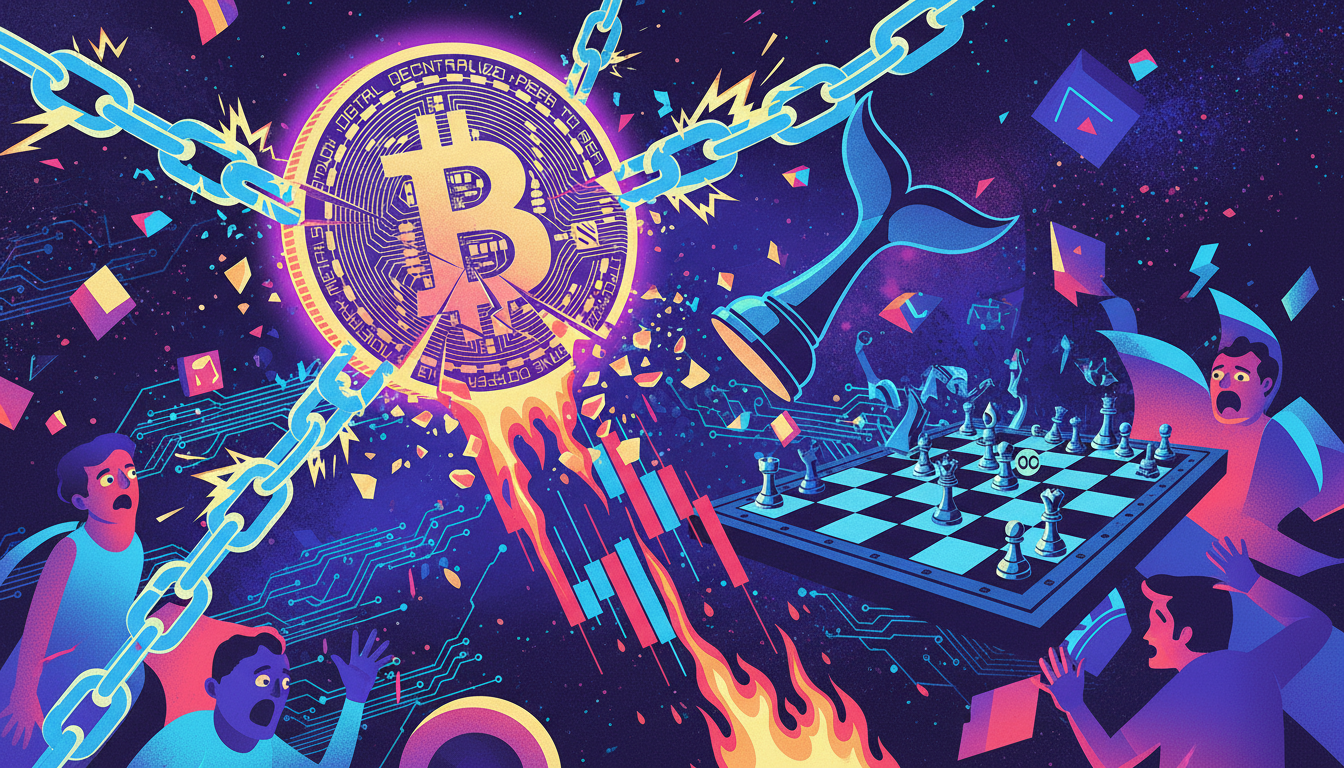
On April 18, 2026, East 8 Zone Time, the situation in the Middle East tightened again. Iranian officials, after several days of strong statements, openly threatened to block the Strait of Hormuz, which carries about 20% of the world's oil transport. Supreme Leader Khamenei even issued a written statement threatening to launch a "severe strike" on the United States and Israel, rapidly increasing the risk premium of this critical waterway. While this energy artery faced repeated "trigger pulls," global capital began to reassess new paths for hedging and arbitrage: on one hand, bets on Polymarket regarding a 30% chance of the Strait of Hormuz returning to normal by April 30, and on the other hand, Japan tightening regulations by incorporating crypto assets into the financial regulatory framework through the FIEA amendment. This, combined with the extreme concentration of 750 million RAVE tokens worth about $10.3 billion held by a single address, and Chinese AI company DeepSeek commencing its first round of external financing, which institutions describe as "completely unequitable currently," illustrates that multiple clues converge on the same main line—geopolitical conflict is reshaping the risk narrative of crypto assets and tech stocks, as the fear and greed of capital shift from tanker shipping routes to computing power rooms and on-chain ledgers.
Trigger Pulled on Hormuz: Pressure Transmission from Oil Prices to Coin Prices
On any global energy map, the Strait of Hormuz is a bold, highlighted presence—it carries about 20% of the world's oil transport and serves as the "main valve" for Middle Eastern oil exporters to deliver crude oil and natural gas. As the market starts to seriously imagine the extreme scenario of a "blockade": tankers being forced to reroute, loading capacity plummeting, insurance costs skyrocketing, each surge in oil futures pricing reflects the risk pricing of this passage's malfunction. The closer one gets to the boundary of this imagination, the variations in traditional energy assets' volatility increasingly resemble the chain reaction triggered by a gently pulled trigger.
Since April 18, 2026, Iranian officials are no longer satisfied with implicit hints; they have chosen to openly threaten to "block the Strait of Hormuz" to elevate their negotiating power. Supreme Leader Khamenei's wording of "launching a severe strike against the United States and Israel" escalates the situation to a higher level of confrontation. For energy trade reliant on this strait, such statements alone can alter market expectations without actually closing the waterway; mere threats of a "possible blockade at any moment" are sufficient to introduce new uncertain variables into the pricing models for crude oil, freight rates, and insurance premiums.
When oil prices are pushed up by capacity and geopolitical premiums, inflation expectations often rise in tandem, leading to the reassessment of interest rate paths, liquidity environments, and risk appetites. Historical experience shows that oil price shocks primarily hit the high-valuation assets most sensitive to interest rates: growth stocks, tech stocks, and high-beta crypto assets, which often experience "sell-offs for cash" pressures in the initial stages. On-chain, this pressure manifests through rapid contractions in long and short leverage, with frequent liquidations, as the implied volatility of crypto derivatives peaks before the chronic repricing of spot prices occurs.
However, on a longer time scale, each instance of geopolitical conflict and fiat currency credit anxiety adds weight to the narrative of assets like Bitcoin being "digital gold." When investors find traditional safe-haven assets—such as government bonds—struggling to maintain stability under high inflation and fiscal deficits, a portion of capital may shift towards asset reserves that do not rely on a single sovereign credit. In the short term, the crypto market may be inadvertently harmed amid liquidity squeezes, leading to price pressures; in the medium to long term, Bitcoin's and certain leading assets' attributes of "censorship resistance, cross-border movement, and self-custody" are instead reinforced in each geopolitical shock.
Prediction Market Bets at 30%: The Other Side of Geopolitical Risk Pricing
Beyond traditional media and official announcements, prediction markets like Polymarket are quantifying the risk of Hormuz in another way. According to data from a single source, the event bet on "the Strait of Hormuz returning to normal by April 30" on Polymarket has seen its probability price drop to about 30%. This means that, for traders participating in this market, the optimistic scenario of "the situation returning to normal within a month" has only about a 30% weighted possibility, while the remaining 70% is allocated to more pessimistic pathways of "continued blockade, ongoing tension, or further escalation."
It is important to emphasize that what prediction markets output is a subjectively weighted probability based on capital, rather than some objective probability that can be regarded as "truth." Behind Polymarket's price lies a mixture of pieces of intelligence, emotional outbursts, and strategic calculations: some participants may hold informational advantages regarding regional politics and shipping conditions, while others are merely hedging tail risks in traditional asset portfolios through betting. In the continual matching of prices, these dispersed judgments are compressed into a single number, which is neither an official assessment nor an academic model, but rather the average view of those willing to place a bet.
In contrast, the fluctuations in the traditional oil market are more reflected in the shapes of futures curves: near-month contracts widening their premium over far-month contracts reflect concerns about short-term supply tightness; the crypto derivatives market, however, may experience a rapid spike in implied volatility within hours of news breaking, with frequent liquidations of long and short leverage positions. There is a difference in sensitivity to the same geopolitical risk: the oil market is more direct and constrained by physical supply and demand, while the crypto market, under the amplification of sentiment, leverage, and liquidity structure, can exhibit extreme over-reactions to "probably occurring" imaginations.
Meanwhile, it is crucial to remind that the 30% probability from Polymarket itself comes from a single platform and a specific user group, which does not represent the consensus judgment of mainstream financial institutions or governments. For short-term traders, this number serves more as a reference signal: when market prices remain consistently lower or higher than personal judgments, whether there is sufficient informational advantage and risk tolerance to "bet against the price"; for risk managers, this provides a quantifiable parameter that can be embedded within scenario analysis, rather than being simply treated as a "conclusion."
$10.3 Billion RAVE Whale: How Single-Point Explosions Amplify Systemic Anxiety
Amid geopolitical risks dominating the macro narrative, another form of extreme imbalance lurks in on-chain microstructures. On-chain data points to a whale address holding about 750 million RAVE tokens, valued at approximately $10.3 billion, with a concentration ratio as high as 75%. This implies that out of every four RAVE tokens in circulation, three are actually held by the same address or controlled entity, while all other holders have to compete for pricing in the remaining 25% space.
This highly concentrated holding structure poses a natural threat to price formation mechanisms. First, if the whale chooses to sell off heavily during periods of thin liquidity, even if the scale is far smaller than its total position, it may be enough to penetrate the depth of pending orders, triggering a waterfall decline. Second, once the market becomes aware that "absolute control" exists within a single address, ordinary holders may perceive adverse signals and rush to escape at the same time, creating a liquidity panic reminiscent of a bank run, where prices plummet in a chain of sell-offs. This structural vulnerability is more of an endogenous institutional defect than a market risk.
When such single-point risks combine with the broader macro geopolitical tensions of the Strait of Hormuz and others, their shock effects are often magnified. External panic can accelerate the exposure of internal vulnerabilities: the overall mood of reduction induced by macro news can make assets already dominated by whales even harder to find buyers, leading to drastic price shocks triggered by minimal selling pressure. For investors, it is easy to misinterpret these price surges and crashes, which are essentially driven by "whale games," as being the "preference" or "rejection" of a certain macro story.
Moreover, RAVE is not an isolated case; many altcoins and long-tail assets exhibit similar "shadow leverage": implicit agreements between whales and market makers, the layering of off-chain pledging and OTC lending, and the more complex funding structures behind visible on-chain positions. When the macro narrative erupts, the operational modes of these assets more closely resemble games and bets rather than reflecting real supply and demand in the market. If retail investors overlook micro indicators such as concentration ratio and liquidity depth, focusing solely on macro headlines for decision-making, they may easily misjudge a localized exit by a whale as a "voting result" on a macro story.
Tokyo Tightening and Beijing Accelerating: The Discrepancy in Regulatory and AI Bubble Rhythms
Amid the geopolitical clouds in the Middle East and the whale battles on-chain, East Asia is participating in this round of global risk repricing in another manner. In Japan, the FIEA amendment has been officially passed, bringing crypto assets into the legal framework of financial instruments. The core significance of this move lies not in "new bans" but in clarifying the legal identity of crypto assets within the traditional financial system: they are no longer fringe products in gray areas but financial instruments subject to licensing, review, and information disclosure requirements. This "inclusion" itself represents a shift in regulatory posture.
With Japan's legislation in place, the trend of convergence among East Asia’s major economies regarding crypto regulation has become clearer: exchanges must adhere to stricter risk control and asset segregation requirements; token issuances will face clearer compliance reviews and information disclosure obligations; and compliant funds—whether from family offices or local institutions—now have clearer pathways and boundaries for allocating crypto assets. For project teams, the era of vague "token fundraising" has been compressed; for mature assets and leading platforms, this provides opportunities for deeper integration with traditional finance under licenses and regulatory shields.
In stark contrast to Japan's institutionalization process is the financing frenzy in China's AI sector. DeepSeek, a domestic AI company, has already started its first round of external financing, rated by institutions as "currently completely unequitable," not due to concerns over project quality, but because subscription demand far exceeds available shares, leaving ordinary funds struggling to secure positions. This scene vividly reflects that China's AI model arms race is at a heated stage, with capital pursuing the narrative of "computing power + models" spilling over from traditional tech stocks into primary markets and the gray areas of equity, convertible bonds, and structured products.
While one side sees crypto assets being incorporated into financial regulatory frameworks and required to "suit up," the other side sees AI projects constantly rising in valuation and expectations. East Asian capital is now seeking a new balance between "tech stocks + compliant coins." For institutions oriented toward stability and compliance, pairing some traditional tech stocks and AI concept stocks with crypto assets that have passed regulatory reviews allows them to share in the risk premium of technological innovation while avoiding the political and reputational risks of "non-compliance." This new combination reflects capital's attempts in a backdrop of geopolitical tension and regulatory tightening to find new solutions between safety and growth.
Capital Navigating Between Oil Routes and Computing Power: A Relay Station for Global Repricing
If we view the situations of the Strait of Hormuz, the RAVE whale, Japan's regulations, and DeepSeek's financing as four seemingly disparate events, collectively, they point to the same capital migration path. The Hormuz risk has raised the risk premiums of traditional energy and related assets, pressuring global asset portfolios in terms of inflation expectations and supply uncertainty; highly concentrated crypto assets like RAVE provide another "high-volatility betting table" on-chain, attracting some short-term funds with extremely high risk appetites that are insensitive to macro factors; the FIEA amendment in Japan indicates that compliance-friendly crypto assets are being absorbed into mainstream financial environments; and the AI frenzy represented by the heat of DeepSeek's financing provides capital with a direction that has a higher technological leverage and a more positive narrative.
Following this thread, one can see a rhythm and stratification of some funds migrating from traditional assets impacted by geopolitical shocks to crypto and AI sectors: the most agile ones are hedge funds and high-net-worth individuals navigating globally, swiftly switching exposure between oil markets, currency markets, crypto derivatives, and tech stocks; next are regional institutions and family offices, which, under the constraints of regulatory and compliance frameworks, gradually increase allocations to a "tech stocks + compliant coins" mix while cautiously observing the performance links between AI and major crypto assets; finally, retail investors, often entering at peaks of sentiment driven by news headlines, bearing the amplified volatility and costs of information lag.
At the macro narrative level, concepts like "de-dollarization" and "digital asset sovereignty" further amplify the symbolic significance of this migration. For institutions, these narratives are viewed more as part of the justification for asset allocations: increasing holdings of certain non-dollar-denominated assets and attempting to hedge some fiat risks with BTC or other compliant digital assets are marginal adjustments within existing frameworks; for retail investors, however, these often signal the heralding of a "new order," with betting practices skewed towards concentrated investments in a single sector or token, mistakenly believing that simply getting the direction right allows them to disregard valuation and risks.
Overall, this moment appears less like a simple “capital flight” or the “starting point of a new bull market,” but rather a window period of global risk repricing. Geopolitical conflicts, regulatory tightening, and technological fervor simultaneously impact asset prices, prompting markets to reassess risk premiums, liquidity costs, and growth expectations. The oil tankers in the Strait of Hormuz, the legislative texts on Tokyo's financial street, the capital market in Beijing chasing AI, and the private key controlling the $10.3 billion RAVE, all constitute a multi-dimensional coordinate system for this round of repricing.
Before the Next Missile Test, How Many Defensive Lines Can the Market Withdraw?
In this intertwining narrative, the crypto market displays a contradictory state: on one hand, under the dual pressures of geopolitical tension and regulatory tightening, leveraged funds and speculative sentiment could be ignited by external shocks at any moment, their inherent vulnerabilities magnified through on-chain liquidations, flash crashes, and liquidity vacuums; on the other hand, the gradual improvement of compliance frameworks, the opening of institutional allocation pathways, and resonance with narratives related to AI provide top tier assets with unprecedented institutional buffers and long-term imaginative space, creating a layer of "resilience foundation."
For individual investors, in the short term, what they should be most cautious about is not abstract "black swans," but rather the excessive control of single assets by a very small number of addresses and the excessive crowding in a single sector driven by emotions. Once geopolitical events trigger an abrupt drop in overall risk appetite, these already structurally imbalanced assets will become the priority points for liquidation. The structure of RAVE, with a concentration of up to 75%, is merely the tip of the iceberg; the real risk lies in how much off-chain pledging, OTC lending, and structured products are layered atop these visibly concentrated positions.
In the medium to long term, the improvement of compliance frameworks in places like Japan delineates clear boundaries for "crypto assets that can be legally held by institutions"; the financing frenzy for Chinese AI companies like DeepSeek indicates that the technological narrative still holds significant appeal in East Asian capital markets. If these two forces can establish stable interactions within the next few years—such as the combination of AI infrastructure, computing power networks, and compliant crypto assets—they will likely lay a more solid foundation for the next round of the crypto cycle, rather than relying solely on liquidity floods and narrative bubbles.
On the operational level, instead of attempting to bet on the specific timing of the next missile test, it is better to build one's risk radar from more quantifiable dimensions:
● First, continuously monitor the liquidity and concentration of target assets, avoiding viewing assets with excessive concentration and deep reliance on a single address or market maker as long-term investment targets.
● Second, track policy developments in major regulatory jurisdictions—especially East Asia and Europe and America—in the direction of crypto and AI, identifying which assets are being pushed from "gray areas" towards "compliance pools," as they often possess longer life cycles and deeper capital pools.
● Third, relate macro hedging sentiment to crypto market volatility in observation: when oil prices, interest rates, and prediction market risk pricing rise in unison, cautiously control leverage and concentration, viewing crypto assets as a part of the entire asset portfolio rather than isolated "casino chips."
Before the next missile test, what truly allows the market to withdraw several steps of defensive lines is not the price space of a particular coin but rather the room investors have left for position management, information filtering, and risk cognition.
Join our community to discuss together and become stronger!
Official Telegram community: https://t.me/aicoincn
AiCoin Chinese Twitter: https://x.com/AiCoinzh
OKX Benefits Group: https://aicoin.com/link/chat?cid=l61eM4owQ
Binance Benefits Group: https://aicoin.com/link/chat?cid=ynr7d1P6Z
免责声明:本文章仅代表作者个人观点,不代表本平台的立场和观点。本文章仅供信息分享,不构成对任何人的任何投资建议。用户与作者之间的任何争议,与本平台无关。如网页中刊载的文章或图片涉及侵权,请提供相关的权利证明和身份证明发送邮件到support@aicoin.com,本平台相关工作人员将会进行核查。