Author: Thejaswini M A
Translated by: Deep Tide TechFlow
Deep Tide Introduction: Six major Wall Street institutions including Fidelity, Euronext, and Tradeweb have begun to publish market data directly on the blockchain through Pyth, accessible for free by any developer. This breaks the monopoly model of data intermediaries like Bloomberg that has lasted for 44 years—no longer needing to sign a two-year contract, no longer needing to pay $27,000 annually, no longer needing a proprietary keyboard. More importantly, this is the prerequisite for RWA (Real World Assets) to truly scale in DeFi: data must be on-chain before the assets.
In 1981, Michael Bloomberg was fired by Salomon Brothers. He was 39 years old, had worked there for 15 years, and left with a $10 million severance package, deeply dissatisfied with how Wall Street handled information. His reaction to being fired was, by any reasonable standard, crazy: he started showing up at Merrill Lynch's office every morning with coffee, wandering the halls, handing coffee to strangers and explaining that he was going to build a computer that knew everything. Traders accepted the coffee, but were not so sure about that computer.
Forty-four years later, each of those computers costs $27,000 per year. There are 350,000 computers worldwide, and Bloomberg earns approximately $10 billion a year from this business. Its entire structural genius lies in the fact that it inserted itself between organizations that owned data and those who needed data, charging tolls for everything it handled. Data was never Bloomberg's—it belonged to Merrill, Goldman Sachs, every trading firm on Wall Street. Bloomberg just built a toll booth, convincing everyone to believe that the toll booth was the destination, then raising prices every year, because what could you do, call your broker back?
This model has withstood every technological change over forty years because no one could come up with a better distribution mechanism. Until last Wednesday.
On April 9th, six institutions that filled data into the toll booth began publishing data elsewhere: Euronext, Fidelity, Tradeweb, OTC Markets Group, Singapore Exchange's foreign exchange division, and Exchange Data International, directly publishing on-chain through Pyth's new data market, accessible to any developer on the blockchain. You don't need a contract, you don't need a two-year minimum commitment, you don't need a proprietary keyboard with a yellow-green button.
Remember this: the interesting thing about building a monopoly on someone else's data is that those others will eventually notice.
The financial data industry is worth approximately $30 billion annually and is one of the least discussed monopolies in the world, possibly because the only ones paying attention are those already paying for it.
Bloomberg controls about 33% of the global financial data market, generating over $10 billion in revenue annually from its terminal business alone. Refinitiv, now acquired by the London Stock Exchange Group for $27 billion, holds about 20% market share. ICE Data Services reports market data revenues of $2.8 billion. Next are FactSet, S&P Global, Morningstar, and some regional players serving niche markets. The top four providers together control the vast majority of the flow of financial data from producing institutions to demand companies.
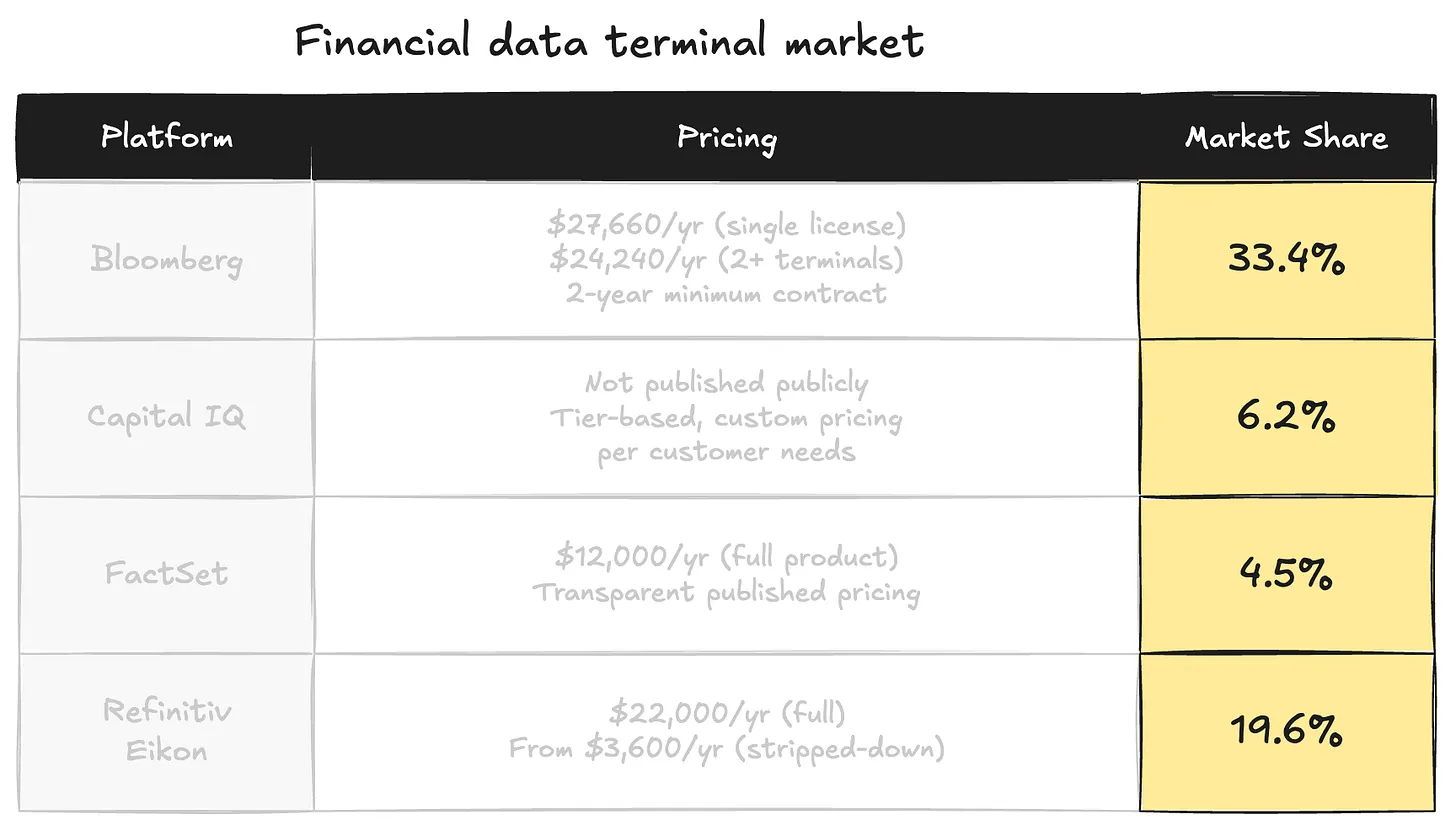
All these companies have the same model. Institutions like exchanges, trading companies, banks, and asset management companies generate pricing data as a byproduct of their work. They sell or license that data to vendors. Vendors package and standardize the data, add analytical tools, and then sell it to everyone else at a significant markup, signing long-term contracts and using proprietary access methods to make switching painful. Bloomberg subscriptions lock you in for two years. Cancelling early means paying 50% of the remaining contract value. And everything about the Bloomberg experience is designed to make leaving feel harder than staying. The keyboard is different. The data formats are different. Even the messaging system that half of Wall Street uses to communicate runs on Bloomberg, which means switching terminals also means giving up your contact list.
This practice has lasted for forty years because vendors solved a real difficult problem: obtaining data from hundreds of sources, cleaning and standardizing it, and delivering it with low latency through global infrastructure. Bloomberg earned its position.
But the blockchain is a better distribution mechanism. Perhaps not applicable to everything and not yet fully scalable. But for the specific issue of connecting institutions that own data with developers who want to build with that data, a publicly accessible infrastructure on a programmable chain is structurally superior to a proprietary terminal with a two-year contract. By turning data into switch-free APIs, it provides permissionless, self-service access for any developer on any chain. This is what Pyth is doing.
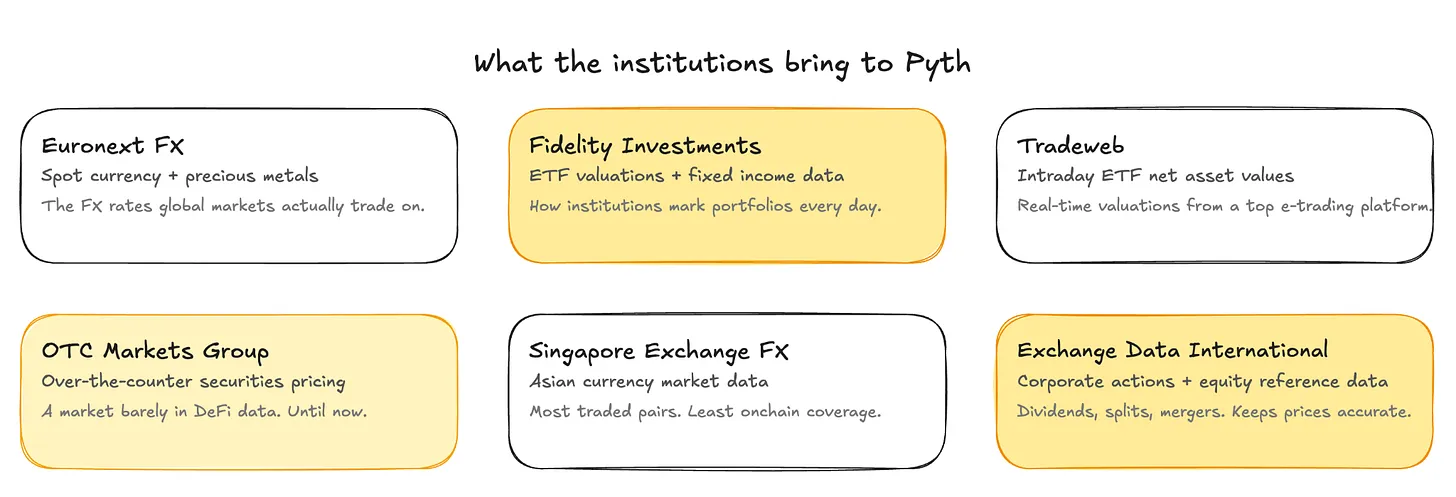
Euronext, Exchange Data International, Fidelity Investments, OTC Markets Group, Singapore Exchange's foreign exchange division, and Tradeweb are beginning to publish their proprietary market data directly on-chain through Pyth's new data market.
Euronext Forex: Spot currency and precious metals. The forex rates used for real transactions in the global market.
Fidelity: ETF valuations and fixed income data. Data used by institutions daily to mark the market prices for their portfolios.
Tradeweb: Intraday ETF pricing. Real-time valuations from one of the largest electronic trading platforms.
OTC Markets Group: Over-the-counter securities. A market that is nearly nonexistent in today's DeFi data.
Singapore Exchange Forex: Asian currency pairs. The largest trading volume but the least coverage on-chain for forex markets.
These six institutions together cover a large portion of asset classes that DeFi has never been able to reliably build, because the data feeding these assets isn't institutional-grade.
Why data must come before assets
Everyone in the crypto circle has been talking about the wave of tokenization for two years: tokenization of government bonds, tokenization of bonds, tokenization of stocks. The entire discussion assumes that the difficult part is putting assets on-chain.
But the difficult part is the data. Before you can trade tokenized government bonds in DeFi protocols, you need to know what they are worth right now, accurate to the second, with the same precision that Goldman Sachs would use to price that instrument on its trading desk. Before you can build lending protocols around real-world assets, you need a continuously running price source from institutions that are actually making markets, rather than scraping from websites and updating every few minutes.
DeFi protocols require accurate real-time traditional financial data to do derivatives, loans, and structured products, but have historically relied on limited or slow data sources. That’s why DeFi has mainly been about cryptocurrency to cryptocurrency since its inception. The data feeding these products is not sufficiently reliable, fast, or from institutions with enough credibility in compliance dialogue.
Pyth Pro is the institutional subscription tier that Pyth will launch in September 2025, providing 1 millisecond latency price sources on over 2,200 instruments. Polymarket integrated Pyth Pro in April 2026 to settle new markets for traditional assets including major stock indices, commodities, and US stocks, replacing manual or exchange-specific data with standardized data sourced from over 125 trading firms. Hyperliquid now runs perpetual contracts for oil and gold with Pyth's price sources. The quality of data is reaching a level where serious financial products can be built on it without apology.
The wave of tokenization needs this layer to operate at scale. Without reliable fixed income price sources, you cannot build reliable fixed income products on-chain.
The Oracle Wars
The initial oracle problem in cryptocurrency is simple: smart contracts live on-chain, prices live off-chain. Something needs to connect the two. Chainlink has dominated the oracle landscape for most of DeFi's history, solving this problem by running a large independent node network that pulls prices from third-party sources (exchanges, aggregators, data APIs) and submits them on-chain. Many independent sources, many independent nodes, reasonable decentralization, acceptable latency.
Pyth from the beginning took a different approach by going directly to the institutions that are actually trading. Now over 120 institutions publish data through Pyth, including global exchanges, trading firms, and market makers. Jane Street does not describe the Bitcoin price to Pyth but becomes a publisher. The data comes from the source, not from someone describing the source.
This is faster, more accurate, and more directly tied to real market activity than aggregating price sources. From a structural perspective, it is also more centralized: a smaller club of publishers who all know each other and validate their data. Pyth has staking and slashing mechanisms to create economic incentives around accuracy. But a better way to frame it is that Pyth has chosen speed and data quality over maximizing decentralization. For institutional finance, this may be the right trade-off.
The Cost of Centralization
Pyth was created with significant involvement from Jump Crypto, an organization that played a pivotal role in events in 2022 that most in the crypto circle are reluctant to revisit. The publisher network is a small club where institutions basically know each other and validate data among themselves. Staking and slashing mechanisms create economic incentives for accuracy, but Pyth is both faster and higher quality than what came before and more centralized than the marketing might suggest. You are not replacing a monopoly with a commons. You are replacing one centralized system that happens to be running on blockchain with another centralized system.

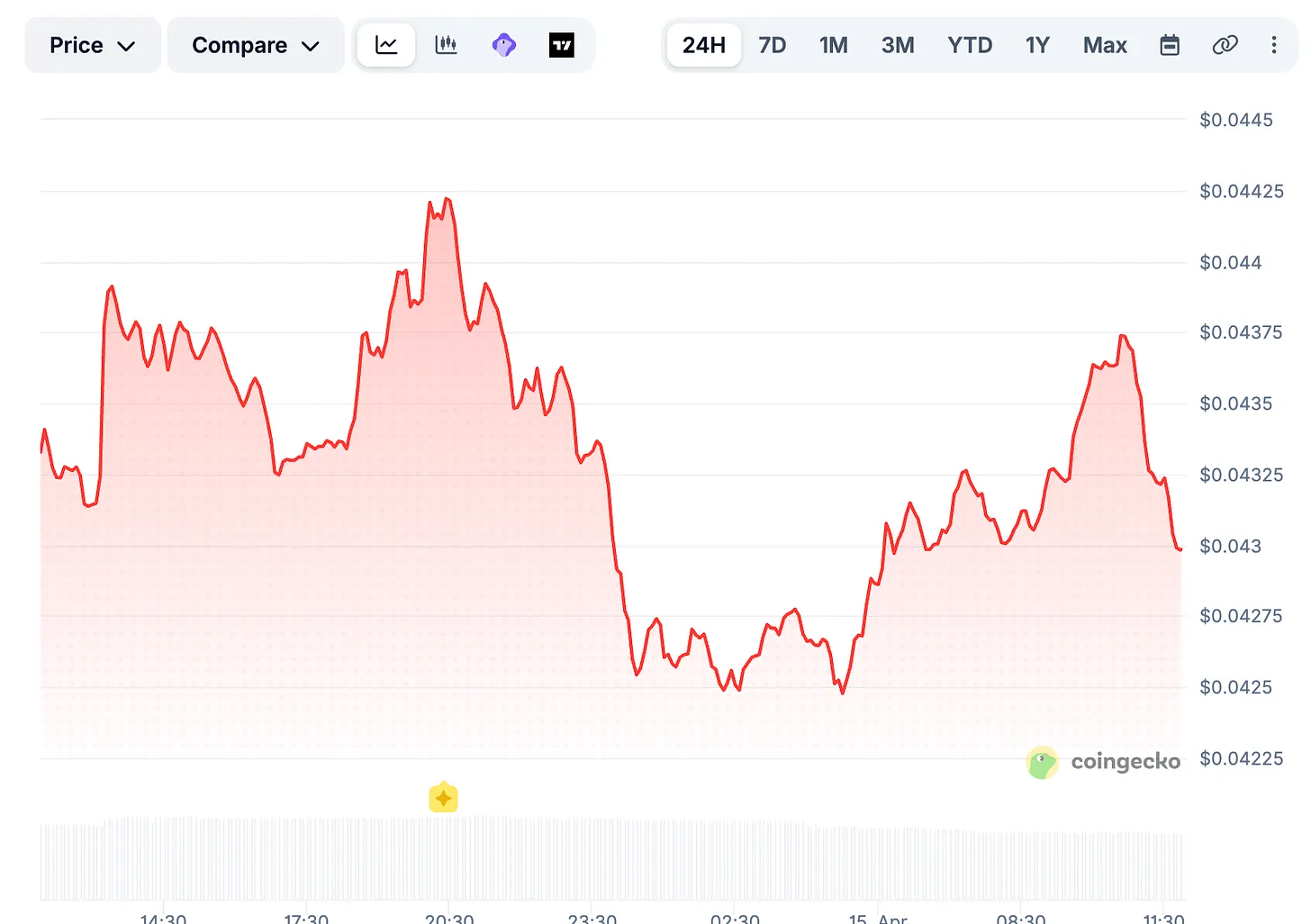
The PYTH token reached an all-time high of $1.20 in March 2024, currently trading at about $0.046, down approximately 96% from the peak. The obvious reason is: using data from Pyth does not require holding or purchasing PYTH. The network can grow significantly while the token stays within a range, which is a known issue, and Pyth's reserve plan is attempting to address this by allocating a portion of protocol revenue for public market buybacks of PYTH.
The End of the Toll Booth
Getting data from the producing institutions to the desks of those who need it requires hardware, proprietary networks, sales relationships, and ongoing support. Bloomberg solved all of these and charged accordingly. Data producers had no alternative distribution mechanisms, so they sold data to intermediaries, who kept the profits. The blockchain eliminates that specific friction. Not analysis, not workflows, not keyboards. Just the part where someone has to move data from one place to another and charge for that privilege.
But Bloomberg sells workflows. Terminals, keyboards, messaging systems, analytics, support teams. Traders build entire careers around it. Pyth sells none of that. It is a data layer plugged into protocols. The only overlapping aspect is the underlying data itself, and that part just moved.
This is important because if Fidelity publishes its ETF valuations on-chain, any developer anywhere can read that data, without negotiating a licensing agreement, without paying $32,000 yearly, without waiting for vendors to standardize formats. Data becomes programmable infrastructure rather than a proprietary product. Institutions retain control over what they publish and retain attribution rights. The work of intermediaries—moving data from source to user—becomes unnecessary.
These six institutions are choosing Pyth as their primary distribution channel, which is a commitment different from pilot programs. Pilot programs can be shut down when the advocates move jobs. Primary distribution channels become operational dependencies.
Tokenized bonds, tokenized stocks, tokenized everything. Most of these are still months or years away from meaningful scale. But the raw materials that make products of real-world assets possible in DeFi are now accessible without contracts, without terminals, and without two-year minimum commitments.
Michael Bloomberg spent months in the halls of Merrill Lynch handing out free coffee because the data he needed was locked up in institutions that had no reason to give it to him. He built an entire business on that friction.
Toll booths do not disappear overnight. Every monopoly in data distribution ends in the same way. Not with battles, not with laws, not with revolutions. Mainly, it ends when someone somewhere asks why they should pay for what they already have.
免责声明:本文章仅代表作者个人观点,不代表本平台的立场和观点。本文章仅供信息分享,不构成对任何人的任何投资建议。用户与作者之间的任何争议,与本平台无关。如网页中刊载的文章或图片涉及侵权,请提供相关的权利证明和身份证明发送邮件到support@aicoin.com,本平台相关工作人员将会进行核查。


