Author: Claude, Deep Tide TechFlow
Deep Tide Introduction: Kalshi CEO Tarek Mansour publicly stated at the Semafor Global Economy Summit that he expects the U.S. Department of Justice to file criminal charges against insider trading in prediction markets, stating "It's a federal crime." This prediction market giant, valued at $22 billion and with weekly trading volumes exceeding $1 billion, has initiated 200 investigations into insider trading in the past year. Amidst at least 8 regulatory bills looming in Congress and a chaotic landscape where three states are facing federal lawsuits, Kalshi is trying to distance itself from its competitor Polymarket by actively embracing enforcement.
As one of the biggest players in the prediction market, Kalshi's CEO is publicly inviting federal prosecutors to take action against violators on its platform.
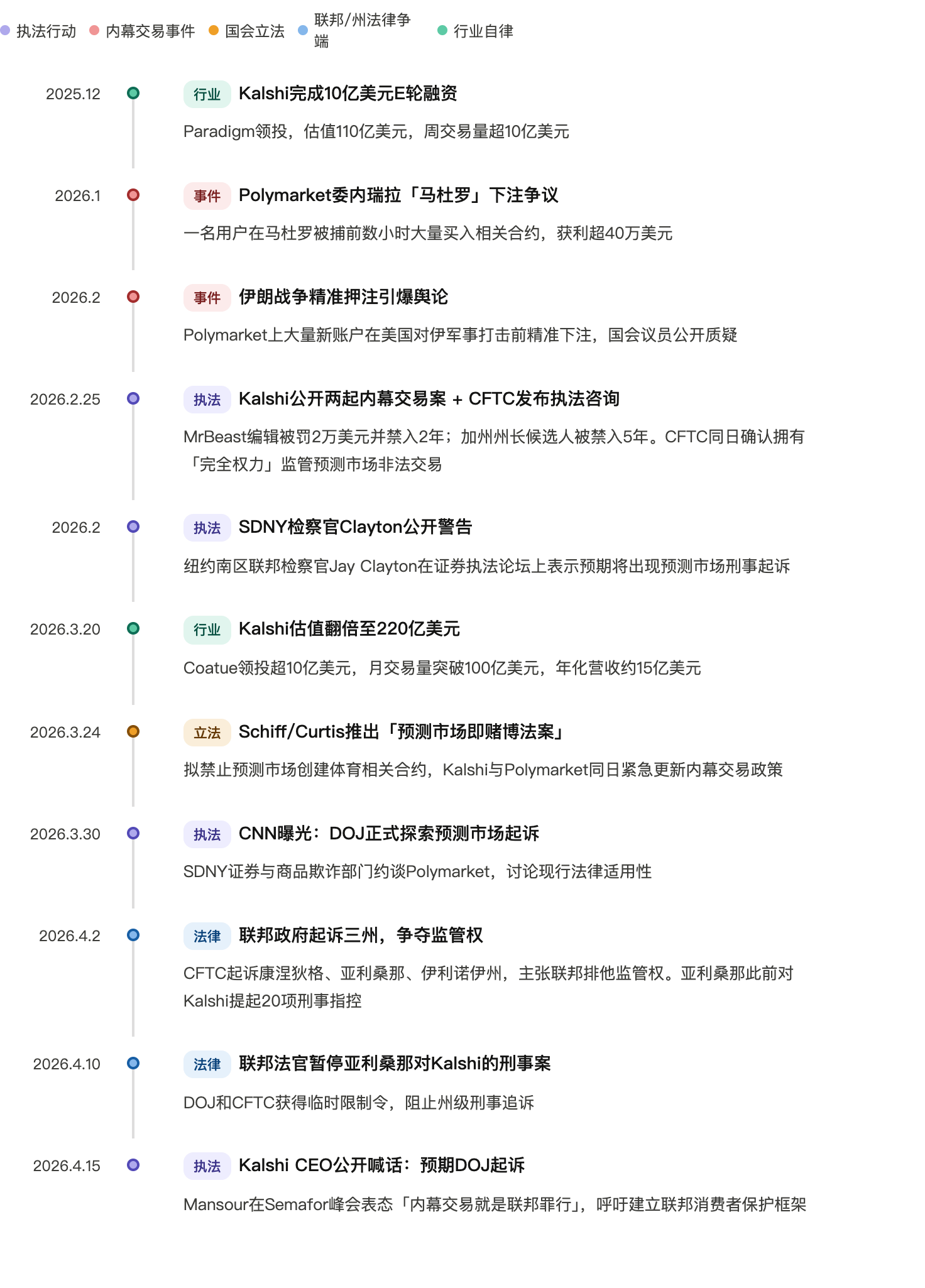
According to a report by Semafor on April 15, Kalshi CEO Tarek Mansour stated at the Semafor Global Economy Summit that insider trading in prediction markets "is now a federal crime," and he anticipates the Department of Justice will bring criminal charges in some cases. He also called for a federal-level consumer protection framework to replace the current patchwork of state regulations.
This statement comes at a time when the prediction market industry is facing multiple attacks: Congressional legislation, state government lawsuits, DOJ investigations, and a series of insider trading scandals, while Kalshi and Polymarket, both valued at over $20 billion, are responding to this regulatory storm with entirely different strategies.
Mansour openly declares: “Insider trading is a federal crime”
Mansour's wording is quite straightforward. He stated at the summit: "If you are engaging in insider trading on Kalshi, it will at some point become a federal crime. It is a federal crime. I truly expect the Department of Justice will prosecute some of these cases."
He added that Kalshi has the authority to impose a range of penalties on violators, from fines to criminal referral, and the company has publicly disclosed some cases, "with more to come."
Mansour simultaneously criticized the current state-level regulation of prediction markets in the U.S. He pointed out that among the 34 states that have legalized sports betting, only one state prohibits marketing to problem gamblers, and this "patchwork" of state-level regulation "has failed." He advocates for a unified consumer protection framework established by the federal government.
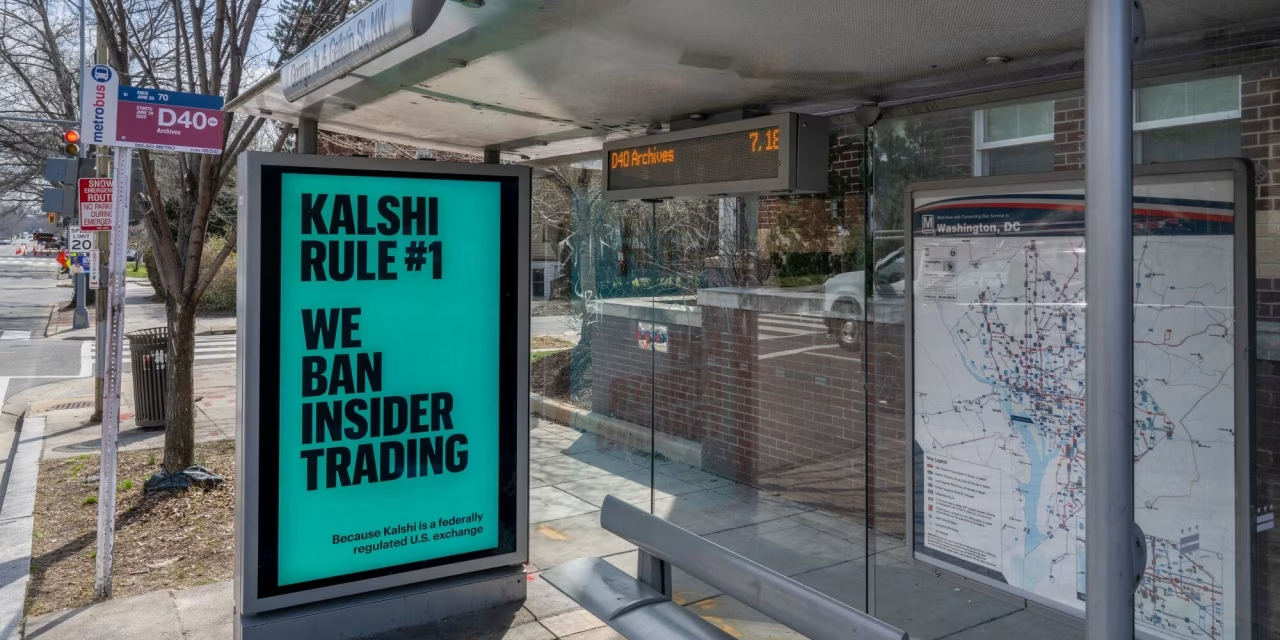
The timing of this statement is quite strategic. On the same day that Mansour spoke, reportedly, both Kalshi and Polymarket were ramping up lobbying efforts in Washington, according to CNBC. According to OpenSecrets data, the two companies are set to spend nearly $1 million on federal lobbying combined by 2025. Kalshi has placed large outdoor advertisements in Washington, D.C., which directly state "We prohibit insider trading," "We don't do death markets," and "We operate within the legal framework of the U.S."
The DOJ is already taking action: New York Southern District Prosecutors meet with Polymarket
Mansour's statement did not come out of nowhere. According to an exclusive report by CNN on March 30, the head of the Securities and Commodities Fraud Department of the U.S. Attorney's Office for the Southern District of New York recently met with a representative from Polymarket to discuss how current laws apply to potential misconduct in prediction markets.
Jay Clayton, the federal prosecutor for the Southern District of New York, had already signaled clearly during a securities enforcement forum in February. When asked whether he anticipates criminal prosecutions related to prediction markets, Clayton answered affirmatively, stating "you won't be exempt from fraud charges just because it's a prediction market."
A spokesperson for the New York Southern District Attorney's Office, Nicholas Biase, stated in a statement to CNN that the office had made it clear to market participants that several laws, including insider trading laws, anti-money laundering laws, anti-manipulation laws, and various fraud laws, apply to a wide range of activities observed in prediction markets.
However, the prospects for prosecution still come with legal uncertainties. Aitan Goelman, a former CFTC enforcement director and now a criminal defense attorney, told CNN that prosecutors not only need to prove that traders were trading while holding significant non-public information, but they must also demonstrate that their actions violated some trust or fiduciary duty, "and all of this is untested legal territory."
200 investigations, MrBeast's employee fined: Kalshi's law enforcement record
Kalshi has indeed taken the lead in enforcement against insider trading. According to the company’s disclosure on February 25, Kalshi has initiated 200 insider trading investigations over the past year, freezing a large number of marked accounts, with over 12 becoming active cases.
Two cases that were made public on the same day drew widespread attention. The first involved YouTube's top creator MrBeast's video editor, Artem Kaptur. Kalshi's investigation found that Kaptur traded approximately $4,000 on markets related to the MrBeast channel, achieving "nearly perfect trading success rates" on low-probability contracts, statistically constituting an anomaly. Kalshi concluded that Kaptur, as an editor, may have been exposed to significant non-public information relevant to his trades and imposed a fine of $20,397.58 (including $5,397.58 in profit recovery and a $15,000 penalty) and suspended his platform privileges for two years.
The second case involved a gubernatorial candidate from California trading about $200 on his own election market and posting a trading video on social media. Kalshi fined him $2,246.36 and banned him for five years.
The CFTC (Commodity Futures Trading Commission) issued an enforcement advisory regarding prediction markets on the same day, confirming that it "has full authority to regulate" illegal trading behaviors on registered exchanges and warned that trading with insider information could violate Section 6(c)(1) of the Commodity Exchange Act and CFTC Rule 180.1(a)(1) and (3).
Bets on Venezuela, Iran wars: Polymarket in the crosshairs
In contrast to Kalshi's proactive "invite prosecution" stance, the controversies faced by Polymarket are more concentrated.
The most explosive case occurred this January. According to reports from PBS, CNN, and other media, a Polymarket user bought a large number of relevant contracts just hours before Venezuelan President Maduro was captured by U.S. forces, ultimately profiting over $400,000. Following this, there were again large amounts of precisely timed trades from newly opened accounts on Polymarket around the time of U.S. military actions against Iran in February.
Additionally, reports indicated by Fortune show that an insider from KPMG placed bets on companies audited by the auditing giant using Polymarket.
These controversies are particularly unfavorable for Polymarket, as their U.S. site is not fully operational, and the most controversial markets related to Venezuela and Iran occurred among overseas users, complicating federal prosecutions due to cross-border trading.
Under pressure, Polymarket announced on March 24 that it would revise platform rules to explicitly prohibit users from trading contracts where they may hold confidential information or that could influence the outcome of events. Kalshi also announced on the same day preemptively banning politicians from trading on their own elections and sports personnel from trading in events they participate in.
Behind the $22 billion valuation: Kalshi's survival logic
Mansour’s choice to proactively speak to the Department of Justice is essentially a carefully calculated positioning strategy.
Kalshi completed a financing round led by Coatue Management of over $1 billion in March 2026, doubling its valuation from $11 billion to $22 billion. According to Sacra data, the company's annualized revenue run rate has reached about $1.5 billion, with weekly trading volumes exceeding $1 billion and monthly trading volume surpassing $10 billion in February. Kalshi operates as a compliant exchange approved by the CFTC, which is its most core differentiated advantage from Polymarket.
However, risks are rapidly accumulating. Arizona has brought 20 criminal charges against Kalshi, Nevada has imposed an operational ban, and over 20 lawsuits are ongoing. Institutions like Point72 and Balyasny have prohibited employees from trading on prediction markets.
Against this backdrop, Mansour's "invite prosecution" strategy logic is easy to understand: if insider trading cannot be effectively curbed, ordinary users will lose confidence in their participation, and the liquidity that prediction markets rely on will dry up. For a platform with weekly trading volumes exceeding $1 billion, the trust infrastructure is more important than any single trade.
Discussions on Hacker News reflect deeper doubts. HN user tptacek pointed out the internal logical contradiction of this industry: if the value of prediction markets lies in aggregating private information to improve predictive accuracy, then insider trading should be a feature rather than a flaw; but if they are actually unregulated gambling venues, then insider trading is like peeking at an opponent's cards in poker. "You can see how these companies handle insider trading issues to understand what they think the essence of their own platforms is."
Donald Trump Jr., son of President Trump, has invested in Polymarket through his venture capital fund and is also a strategic advisor to Kalshi. This political connection adds complexity to this game.
免责声明:本文章仅代表作者个人观点,不代表本平台的立场和观点。本文章仅供信息分享,不构成对任何人的任何投资建议。用户与作者之间的任何争议,与本平台无关。如网页中刊载的文章或图片涉及侵权,请提供相关的权利证明和身份证明发送邮件到support@aicoin.com,本平台相关工作人员将会进行核查。


