Author: Vaidik Mandloi
Source: thetokendispatch
Translation: Plain Language Blockchain
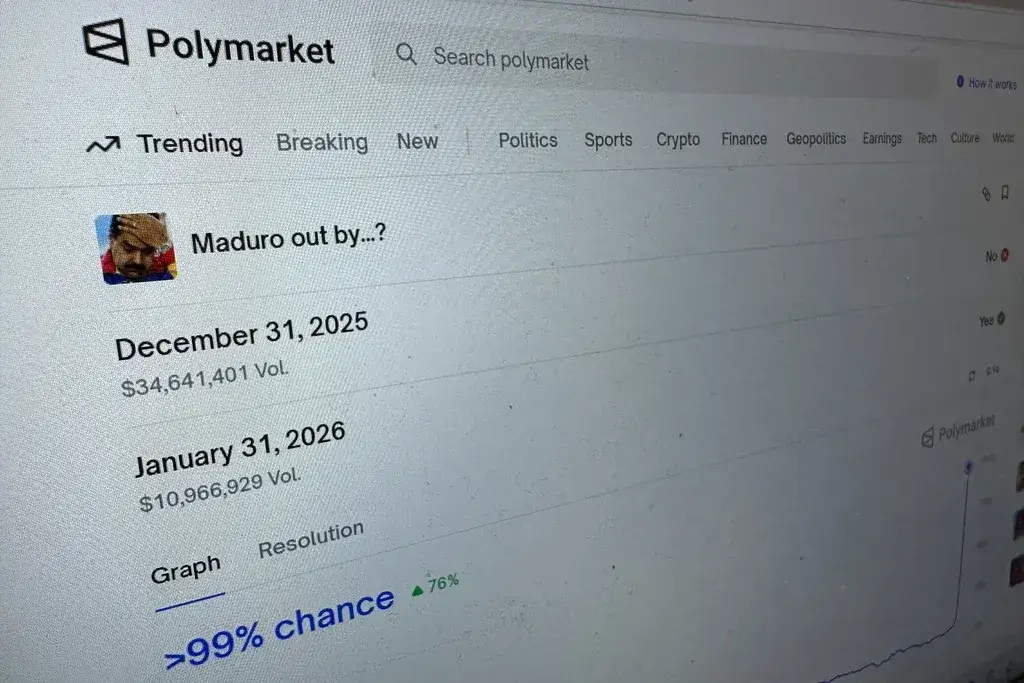
In January 2026, an anonymous trader placed a series of bets on the cryptocurrency trading platform Polymarket, wagering that Venezuelan President Nicolás Maduro would be captured. The total wager was approximately $34,000. A few days later, U.S. special forces executed the capture operation, and this trader cashed in over $400,000 in bets. The Secretary of State later confirmed that the operation was too sensitive to require congressional notification. Just think, the U.S. Congress, which is responsible for authorizing military actions, was completely unaware. The American public also had no idea. However, someone sitting behind the screen of a cryptocurrency betting platform had enough information and put real money on the line. And their prediction came true.
This has become a common saying in today’s prediction market industry. As Polymarket CEO Shane Copland puts it, it is called the "truth machine." The argument is that because traders have a vested interest, their collective betting reflects the future of the world more accurately than any opinion poll, expert, or commentator (who bear no consequences for being wrong). It's fair to say that Polymarket's odds are the closest thing to the truth you can find.
This claim seems to work. Prediction markets are no longer a niche corner of the internet where only a few gamblers play for thrills. A recent analysis of a dataset of 364 TikTok videos mentioning prediction markets found that 68% of the videos were unrelated to trading. People are not gambling; they are quoting odds from these platforms in political debates, much as they used to quote polls. Polymarket appeared in about 70% of these videos. A 22-year-old TikTok user, when posting political videos, even used odds from the cryptocurrency betting platform to predict the outcome in the real world, and a significant number of people agreed with this.
This is incredible. Two years ago, you could hardly believe this would happen. But one question that nobody is seriously considering is: Are these probabilities really worthy of such trust?
So I want to ask: How accurate are these markets? What happens when the odds start to influence the events they are supposed to predict? What will the future look like when the entire world treats betting odds as truth?
How do we score prediction markets?Before analyzing the data, we first need to understand how to measure whether a prediction market is effective. Most people have never considered this question, and if overlooked, all the marketing hype from Polymarket and Kalshi is just that—hype.
There is a scoring method called the Brier score. Meteorologist Glenn Brier proposed this method in 1950 to assess the quality of weather forecasts, as weather forecasters were (and still are) among the first professions to take probability predictions seriously for a living. The method is very simple. Suppose you predict a 90% chance of rain tomorrow, and it indeed rains. That's a good prediction; your Brier score is low. Now suppose you predict a 90% chance of rain tomorrow, but it turns out to be clear skies. That's a poor prediction; your Brier score is high. A Brier score of 0 means your prediction was completely correct. A score of 0.25 means your prediction was as good as a coin toss. Any score above 0.25 means you did worse than random guessing.
Why is this important? Because when Polymarket tells you their market predicts Trump has a 60% chance of winning, and he ultimately wins, that sounds amazing in headlines, but statistically, a single correct prediction doesn’t mean much. You need to evaluate the market's complete historical record across thousands of questions. That’s where the Brier score comes in. It is the only honest way to assess whether these markets are genuinely good at predicting election outcomes.
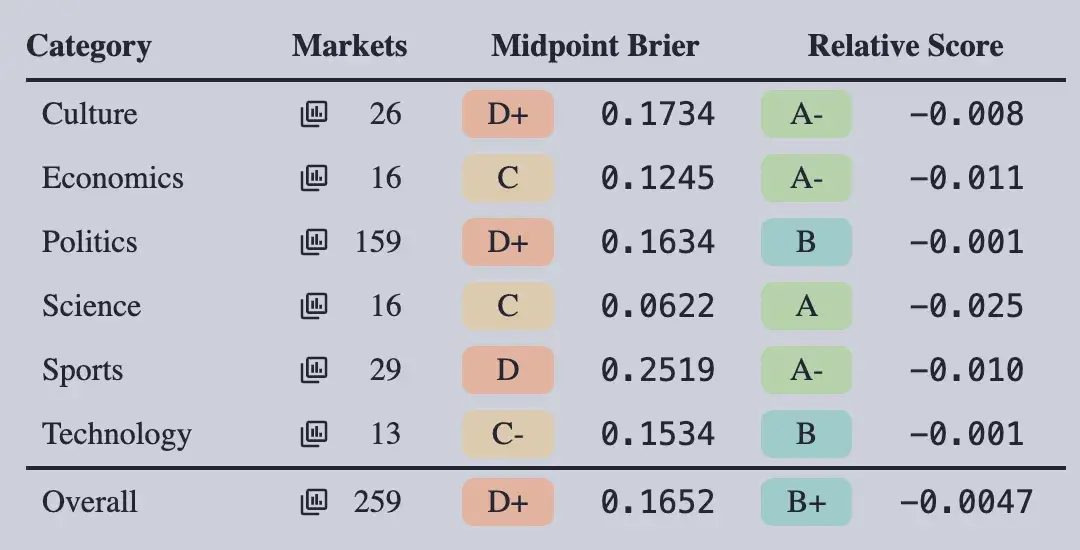
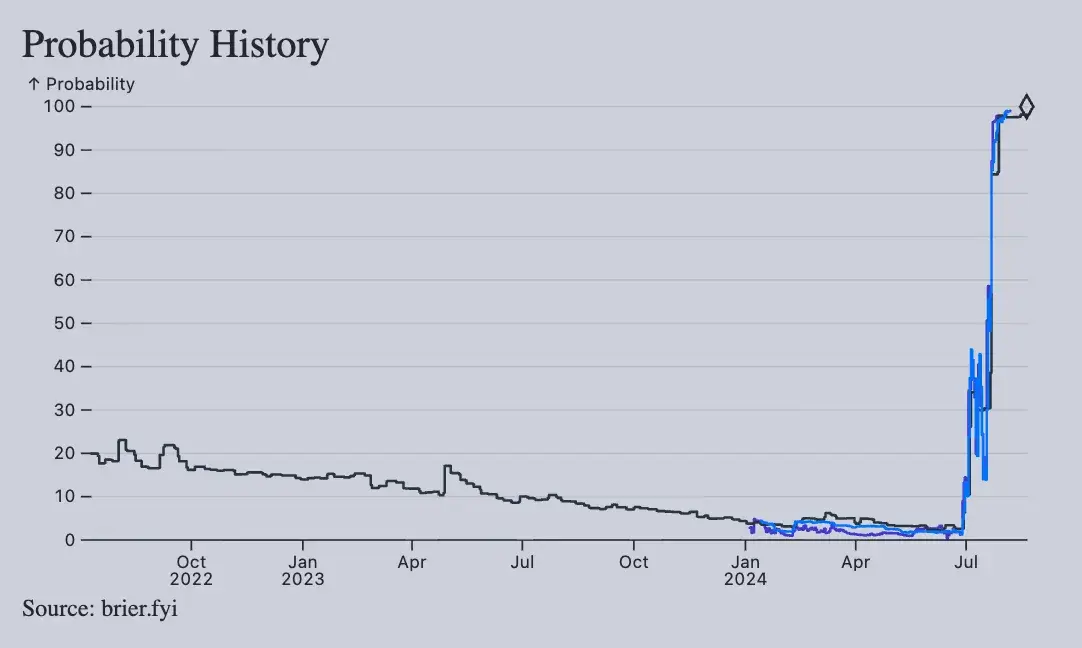
A website called Brier.fyi is doing just that. They have analyzed over 84,000 questions across Polymarket, Kalshi, Manifold, and Metaculus platforms. Polymarket's overall Brier score is 0.047. That is indeed a pretty good score. In simple terms, imagine a predictor saying, "I am 90% sure this will happen," and they succeed at that accuracy every time.
 Source: Brier.fyi
But here's where it gets interesting: the claim of the "truth machine" starts to crumble.
The score of 0.044 is the average of all products listed on Polymarket. In this case, the average plays a crucial role. If you break down the scores based on what people actually bet, you'll find the scores are highly fluctuating.
Science and economics? Polymarket scores an A. The market is based on CPI data, Fed rate decisions, and GDP data. These markets perform well because traders often have some financial knowledge, the data is verifiable, and institutional investors with real money understand the relevant fields.
Politics? B+. That’s still decent, mainly supported by the massive market of presidential elections where billions of dollars flow in. Culture and technology? Much worse. Really much worse.
Then there’s sports. The combined score of all sports prediction markets across platforms is just 0.325, which is a D-. To put this into perspective, the probability of flipping a coin is 0.25. Sports prediction markets, overall, perform worse than just flipping a coin to predict each issue. Think about that.
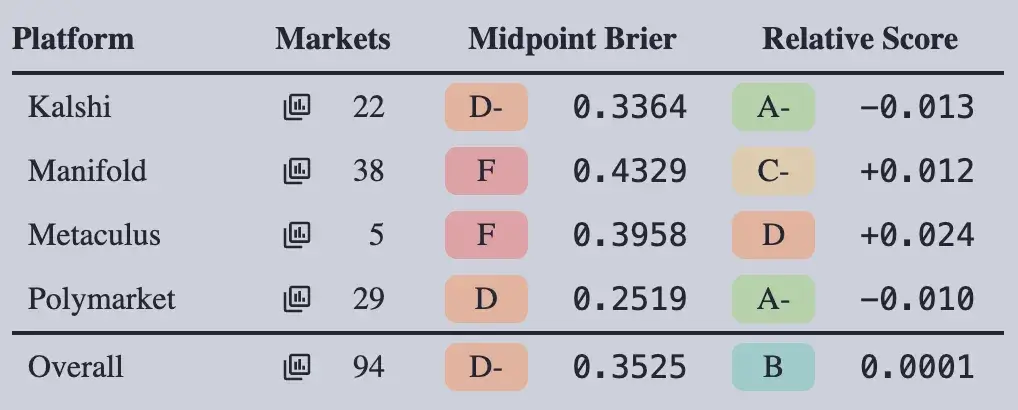
The category that attracts the most casual bettors, and which Kalshi has been actively expanding (Kalshi's trading volume was once about 90% concentrated in sports betting), is a category that has proven unreliable.
Now, looking at the various markets, that’s where the story gets even more interesting.
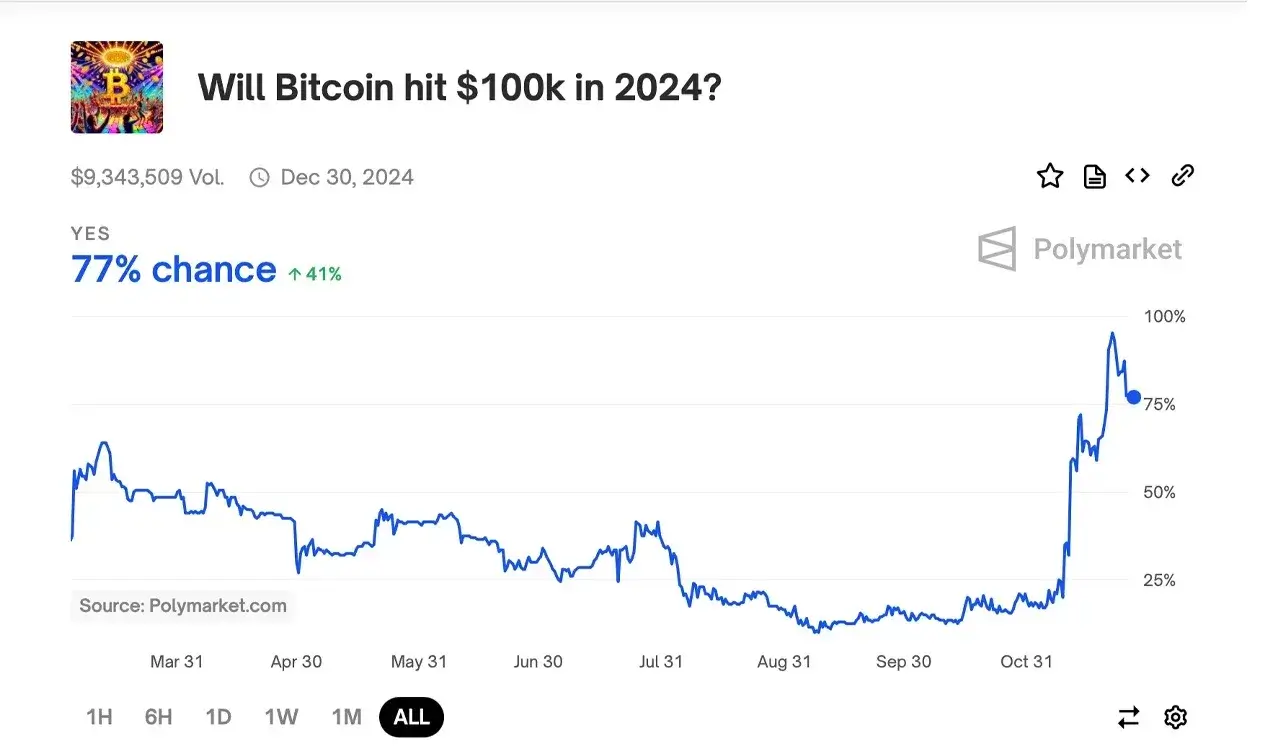
Polymarket once launched a market asking whether Bitcoin would reach $100,000 by January 2025. Bitcoin ultimately did reach $100,000. The market's prediction was correct, but for much of the time, it incorrectly assessed the probability, remaining in a low-confidence state for months, only surging to near certain levels in the final stages. Its Brier score was 0.4909, which is an F. Remember, after 0.25 (which is equivalent to the probability of flipping a coin), you'd be better off simply guessing randomly. And the Brier score for this market was nearly double that value.
The market trend regarding Kamala Harris winning the 2024 Democratic presidential nomination was even crazier. She ultimately won the nomination, and the market once again predicted the outcome correctly, which is quite ironic. But the Brier index was just 0.9098. This number is absolutely terrible, and it cannot be overstated. The market confidently predicted incorrectly for so long that even its eventual correct outcome did not save it. If you relied on this market for decision-making, you would have been misled throughout the entire campaign cycle until the final result was settled.
Now let's talk about the other side of the story, because it's not a simple narrative. The 2024 U.S. presidential election was a true victory for prediction markets. All mainstream polls at the time suggested a tightly contested race, but Polymarket predicted that Trump’s support rate was around 60%. A study from Vanderbilt University used a Bayesian time series model to compare Polymarket's predictive prices to national poll results from seven swing states. The results showed that Polymarket was significantly more accurate across the board.
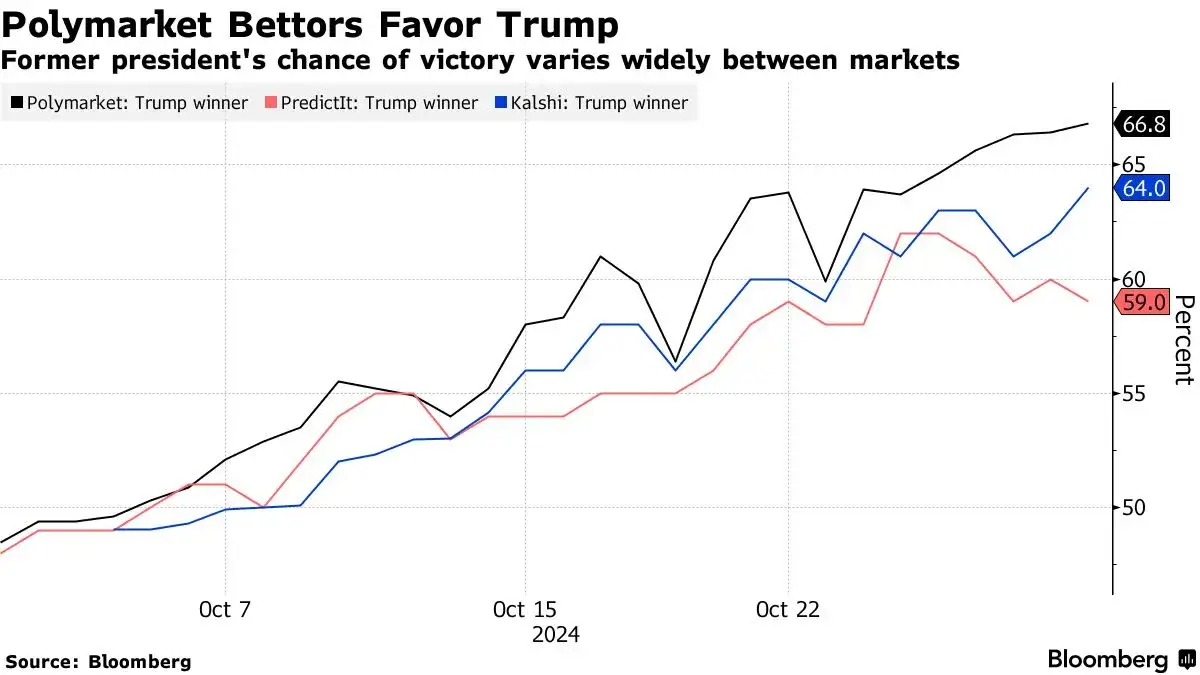
So what does this indicate? Prediction markets excel in election forecasting. Especially in the largest and most liquid elections, where billions of dollars, tens of thousands of traders, and broad public attention converge on the same question, the predicted results often outperform polls.
But the problem is that election predictions may only account for 2% of the trading volume listed on these platforms. Polymarket's market for the 2024 presidential election alone generated over $3.6 billion in trading volume, with the number of independent traders reaching 63,000 per month. When looking at congressional elections, state-level referendums, or any issues in the culture, technology, or sports sectors, the bid-ask spreads on contracts can skyrocket to 20% to 100% of the midpoint price. The spreads on legislative and crisis-related markets can even approach 100%. Such large spreads indicate that the markets know almost nothing. It’s merely two people making completely opposite guesses on the same issue, with both sides having little financial backing.
When fate begins to write the story
If the accuracy issue were confined to the internal ecosystem of prediction markets, it could be controlled. Traders betting on bad markets would lose money and learn from it, and the system would improve over time. That’s how all financial markets have operated for a hundred years. But the problem is, the odds are no longer signals within the traders; they have become information publicly available to everyone.
In the past 18 months, major news outlets in the U.S. have incorporated prediction market data into political reporting. The Wall Street Journal has signed a formal agreement with Polymarket to present Polymarket’s betting data in its news reports. CNN started displaying Kalshi’s odds on screen during election night coverage. CNBC has adopted a similar practice. By December 2024, even Substack announced a direct partnership with Polymarket, allowing newsletter writers to directly embed real-time market data into their articles.
That is how the odds ended up on TikTok. These numbers traveled from Polymarket to The Wall Street Journal, to cable news, then to Twitter, and finally to TikTok. When ordinary users see these odds, they have been disseminated through enough authoritative channels that people feel they are facts. What people are accepting are numbers that have been “cleaned up” by mainstream media.
This is where the root of the prediction market issue lies: Once the odds are disseminated as news, they begin to influence the events they are supposed to predict. This phenomenon has a specialized name, called endogeneity in economics. Simply put, it means the measurement results affect the objects being measured.
Let me give you a specific example. Coinbase CEO Brian Armstrong was participating in an earnings call. He learned that Polymarket was executing a contract that specified whether he would mention certain phrases during the call. Therefore, he modified the wording he originally intended to use. The market should have been able to predict what he would say. However, his understanding of the market movements changed his final remarks.
Now, let’s amplify this dynamic to the election level. During the 2024 U.S. presidential election, a French trader nicknamed “Theo” (described by the media as a “Polymarket whale”) bet on Trump winning and ultimately profited over $85 million. This was not a lucky gambler. He commissioned a private poll that was independent of all public national polls, which showed that Trump's actual performance significantly exceeded the levels reflected in public polling.
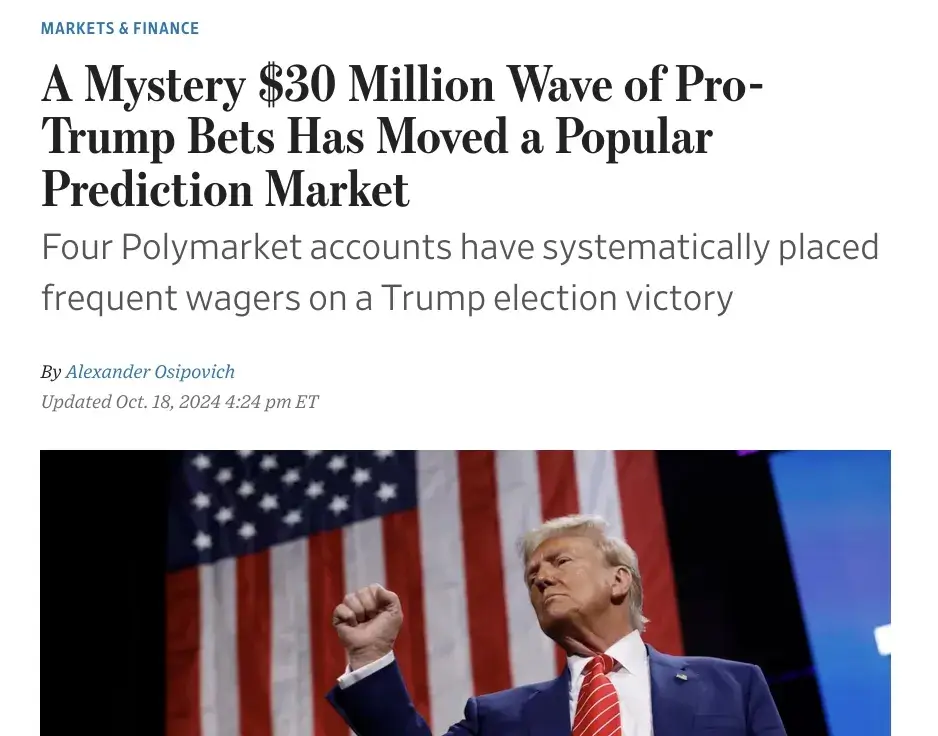
As a result, his bets drove up trading prices across multiple platforms, which were then reported by the media I just mentioned, including The Wall Street Journal, CNN, and political commentators across major platforms. While polls indicated a tight race, market predictions leaned towards Trump. This single narrative influenced how millions viewed the race in the final weeks. Commentators debated whether the "smart money" had information that the polls did not capture. Voters accepted this narrative, ultimately leading to Trump's victory.
I am not claiming that Theo changed the election outcome. That assertion is too far-fetched, and I cannot verify it. What I truly want to say is that anyone who cares about this matter should be concerned: a trader armed with private poll data inaccessible to others was able to influence the price movements of Polymarket, which The Wall Street Journal and CNN then packaged as the collective wisdom of the market. An effective prediction market should aggregate a wealth of information from many participants into a clear signal. What happened in 2024 is that an individual’s exclusive polling data was sanitized through Polymarket and re-disseminated as if it represented the consensus of thousands of traders.
If a trader can do this with $85 million, think about what those with real money and power would do.
In February 2026, Israeli authorities charged at least two individuals with using classified military intelligence to gamble on the Polymarket platform. They placed bets on contracts related to military operations before they were publicly disclosed, with potential gains of about $100,000. These individuals had security clearances and used information not accessible to the public for days to place wartime bets. This is the first case of its kind in the world, confirming that prediction markets are fast enough, liquid enough, and anonymous enough to be used to monetize confidential information in real time.
The trade mentioned at the beginning of this article regarding Maduro? The model is identical. Someone placed a bet before the secret military operation occurred and ended up winning over $400,000. Whoever it was had either inside information or was one of the luckiest guessers in political gambling history. We may never know.
What happens when everyone believes the odds?
Median questions on the Polymarket platform get answered within four days. The average response time is 19 days, but a few long-term trading markets can skew the average. Most questions on the platform relate to market trends this week.
This indicates that these markets aren’t making any meaningful long-term predictions about the future. They are merely pricing in recent situations. Will the vote pass on Friday? What will this person say tomorrow? Will the numbers released on Wednesday be higher or lower than expected? This information is useful. But it is entirely different from what the advocates of prediction markets refer to as the "truth machine." The term "truth machine" typically implies that markets can tell you what the world will look like six months, a year, or even five years from now. But the data suggests that it can’t do that at all. Not even close.
99% of prediction market trading volume coalesces in the final hours before an event is about to conclude. Funds flood in during the last few hours when the outcome is nearly decided. Moreover, these markets have greater liquidity gaps. By the end of 2025, the total weekly trading volume on Polymarket and Kalshi is expected to reach approximately $2.5 billion. That sounds amazing, right? But the clearing volume of the U.S. options market alone is about $760 billion per day.
Prediction markets make up only 0.05% of that. The entire prediction market industry, regardless of which platform, which contract, or which category, is insignificant compared to the markets actually used for decision-making by institutions.
The situation is this: prediction markets are only suited for a very specific kind of question: binary, high-stakes, short-term events involving millions of dollars. But this is just a small fraction of the multitude of questions these platforms actually provide. For the remaining 98% of questions, the prices are unreliable, liquidity is nearly nonexistent, and the outcomes resemble Twitter polls more than financial instruments.
They are establishing the default probability source for everything. Just like you open a Bloomberg terminal to check stock prices, their vision is for you to open Polymarket to check probabilities. Their strategy is that once enough media, newsrooms, financial analysts, and government researchers rely on this data source, regardless of whether the data is accurate, this product will become irreplaceable.
I think this will work. And I think this should concern everyone.
Because the issue is not whether prediction markets are useful. The answer is yes. For elections, significant economic data, and a few highly publicized events, they consistently outperform other alternatives. That is a fact and it is crucial. The concern is what happens when the entire information ecosystem starts treating these market outputs as truth, even for the 98% of questions that the market cannot predict at all?
Economist Robin Hanson has advocated for prediction markets for decades. He describes prediction markets as systems that compel people to put their money where their beliefs are. In his model, the final price will be the best current estimate of the truth. But the model assumes markets are liquid, participants are diverse, and they are hard to manipulate. However, our existing markets are dominated by a few "whales" concentrated in two areas (elections and sports), accounting for about 80% of total trading volume. The remaining 20% of trading volume is dispersed across thousands of contracts, where a few thousand dollars can make prices fluctuate by double digits.
These are tools for generating attention. They function when the world is watching; they fail when there is no attention. The more people believe they are truth-generating tools, the more power those capable of influencing prices will hold. And those capable of influencing prices are not a broad base of informed ordinary citizens but a small group of wealthy traders holding private polling data and, in at least two confirmed cases, classified intelligence.
The most dangerous aspect of prediction markets is not that they will go wrong, but that they are always able to perfectly predict critical issues at just the right time, earning a trust that they do not inherently possess. And that trust is gradually being integrated into the world’s information processing mechanisms. The Wall Street Journal published predictive data, CNN aired related content, and TikTok shared these figures. In the end, a trader with enough capital will determine the meaning of these numbers.
This is the reality of the truth machine. A system that produces numbers, while the world decides to call it truth.
Article link: https://www.hellobtc.com/kp/du/04/6287.html
Source: https://www.thetokendispatch.com/p/polymarket-is-not-a-truth-machine
免责声明:本文章仅代表作者个人观点,不代表本平台的立场和观点。本文章仅供信息分享,不构成对任何人的任何投资建议。用户与作者之间的任何争议,与本平台无关。如网页中刊载的文章或图片涉及侵权,请提供相关的权利证明和身份证明发送邮件到support@aicoin.com,本平台相关工作人员将会进行核查。


