Author: Garrett
Translation: Deep Tide TechFlow
Deep Tide Guide: After the U.S.-Iran negotiations broke down, Trump announced that the U.S. Navy would blockade the Strait of Hormuz, reclaiming what Iran had operated for six weeks as the "most expensive toll booth in the world." This was the first proactive move by Washington since the war began, but author Garrett believes that economic blockade will not force Iran to yield; instead, it will compress diplomatic space and elevate the risk of escalation. The article dissects the tactical logic of the blockade and four possible trajectories, highlighting the pricing of tail risks.
Trump has taken Hormuz.
Not through a peace agreement, not by reopening the strait. Quite the opposite, he has closed the strait.
On Sunday night, after 21 hours of unsuccessful negotiations in Islamabad, Trump posted on Truth Social:
"Effective immediately, the U.S. Navy will initiate blockade procedures against all vessels attempting to enter or exit the Strait of Hormuz."
U.S. Central Command confirmed: it goes into effect at 10 a.m. Eastern Time on Monday. Covering all Iranian ports. All countries. Without exception.
The world's most important energy chokepoint has just changed hands. For the past six weeks, Hormuz was Iran's weapon. Tehran charged $2 million for each passing vessel, let friends through and blocked enemies, earning $139 million a day in oil revenues while plunging neighboring countries' exports by 80%.
Now, the U.S. Navy controls this chokepoint.
This is Trump's most clever tactical move in this war. But it is almost certain not to work.
Weapons Handed Over
There is a concept that can accurately explain what has just happened: chokepoint effect. Whoever controls key nodes in the global network has coercive power over all who depend on that node.
Before the war, the U.S. was the "guardian" of Hormuz. Since World War II, the U.S. Navy kept the strait open, allowing oil to flow and the global economy to function. This role has been the pillar of American governance. Southeast Asian countries trust Washington's freedom of navigation patrols in the South China Sea, and Gulf monarchies invest their sovereign wealth in U.S. bonds, all because of this.
On February 28, Iran flipped the script. The moment U.S. and Israeli warplanes bombed Iranian territory, Tehran closed the strait. Selectively closed. Strategically closed. Turned a 21-mile waterway into the world's most expensive toll road.
For six weeks, Iran controlled this chokepoint. Iran held the coercive power.
Trump just took it back.
This is much smarter than occupying Khark Island. The oil shipments seized could theoretically be sold on the open market, directly cutting off Tehran’s revenue source. The script is clear: blockade, intercept, squeeze.
On paper, the logic is very clean. Iran is earning more money during wartime than before the war, while neighbors are bleeding, and the only way to reverse Iran’s economic advantage is to take away this weapon.
So Trump did just that.
Why This Move is Smart
Fairly speaking, two points make this move tactically brilliant.
First, it reverses Iran’s economic calculations.
Before the blockade, Iran exported 1.7 million barrels of oil daily. Based on wartime inflated oil prices, this brought in $139 million a day, more than before the war. Iraq’s exports dropped 80%. Saudi Arabia redirected all exports to a near-full pipeline. Iran is the only oil-producing country in the Gulf making money during this war.
If the blockade is effectively enforced, this revenue goes directly to zero.
Second, it's cheaper than an invasion.
Occupying Khark Island (the hub of Iranian oil exports) would require ground forces stationed on enemy territory, exposed to the range of all Iranian missiles. Maritime blockades can maintain distance. The U.S. has already deployed three carrier strike groups and more than 18 missile destroyers in the combat zone. The infrastructure is in place.
So, where is the problem?
Hold on.
A Real Shift
Before discussing the issues, let’s digest what has happened on a tactical level.
For the past six weeks, the U.S. has been passively responding. When Iran closed Hormuz, the U.S. called for negotiations. When Iran set crossing fees, the U.S. complained. Iran chose who could pass and who could not, with the U.S. spectating. The ceasefire was defined by Iran, with Pakistan chosen as the venue, and Teheran setting the ten-point offer.
The blockade broke this pattern. Since February 28, Washington set the terms of engagement for the first time, rather than responding to Tehran.
This is more important than it seems.
Controlling the chokepoint is not just about who has ships on the water. The key is who is perceived as controlling the situation. For six weeks, every shipping company, every insurer, every oil trader's risk pricing revolved around one assumption: Iran decided who could pass through Hormuz. Starting at 10 a.m. Eastern Time on Monday, this pricing anchor flipped. Now it's up to the U.S.
Will the blockade leak? It will, but that’s almost a secondary issue. What matters is the recalibration of the narrative. Markets, allies, and adversaries will adjust their behaviors based on who holds the initiative. And now, for the first time since this war began, Washington holds the initiative.
It’s worth pondering: over the past six weeks, the U.S. appeared as a superpower waging an uncontrollable war. Every TACO cycle (extreme threat, last-minute retreat, hollow "ceasefire") reinforced the impression that Trump was improvising. The blockade is the first move that looks like a "strategy" rather than a "reaction." The U.S. is leading the pace instead of following it.
This is important. In a conflict where perception and missiles similarly influence escalation dynamics, "who holds the initiative" itself becomes a variable that can move markets. It changes how allies hedge, alters Beijing’s calculus, and shifts internal Iranian faction debates about the next steps.
But regaining the initiative does not equal winning. And the cost of regaining the initiative this time may be greater than the move itself.
Why It Won't Work
The matter comes down to this: the premise of the blockade is that economic pressure can force Iran back to the negotiating table. It won’t.
Iran has a population of 88 million, a battle-hardened Revolutionary Guard, capabilities close to the nuclear threshold, and a network of proxies from Lebanon to Yemen to Iraq. This is not a regime that will be crushed by economic pressure.
Four reasons.
1. Iran Will Not Surrender; It Will Escalate
Bloomberg Economics released an assessment within hours of the announcement. Their judgment: Iran will view the blockade as an act of war. A two-week ceasefire is practically dead. Hardliners in the Revolutionary Guard will "not be able to resist" attacking American warships in the strait.
Statements from the Revolutionary Guard itself confirm this: any military vessel approaching Hormuz on "any pretext" will be considered a violation of the ceasefire and "will be treated severely."
Supreme Leader Khamenei posted on Telegram: "Iran will definitely advance the management of the Strait of Hormuz to a new stage."
This is not the language of a regime that is about to surrender.
2. China Will Not Allow Iran to Collapse
China imports 80% of Iran’s oil. Beijing has no interest in watching its primary alternative crude supplier get economically strangled by the U.S. Navy. Bloomberg Economics pointed out the obvious: China can use its dominance in the rare earth supply chain as leverage.
China just helped facilitate a ceasefire and has invested $270 billion in the Middle East. The last thing it wants is for Trump to decide who can get oil and who cannot.
Our judgment: China will find ways to keep Iranian oil flowing. Shadow fleets, ship-to-ship transfers, and overland routes through Pakistan and Turkey. This is how every round of Iranian sanctions has played out. The blockade makes operations harder, but not impossible.
3. The Blockade Itself Has Loopholes
If you closely examine Central Command's statement, the escape hatch is right there:
"Central Command forces will not impede the freedom of navigation for vessels transiting from non-Iranian ports through the Strait of Hormuz."
This means, a Chinese oil tanker departing from Omani ports, crossing Hormuz on the way to Shanghai? No interception. The U.S. only blocks Iranian ports, not the strait itself. This distinction is significant. Iranian-associated vessels flying convenient flags, loading at non-Iranian docks, transshipping through third-party ports: workarounds exist.
Most countries' oil export infrastructures are centralized and exposed. Iran's is decentralized, and it has six weeks of experience operating gray market oil transactions.
4. The Escalation Ladder is Bidirectional
This is the part that should keep you awake at night.
If the blockade really harms Iran's revenue, Tehran has options far beyond Hormuz.
The Red Sea. Iran's Houthi proxies in Yemen have already proven their capacity to disrupt the Bab el Mandeb Strait, the chokepoint at the southern end of the Red Sea. In 2023-24, Houthi attacks have forced global shipping to reroute around Africa. Bloomberg Economics warns: "The blockade could trigger Houthi actions against the Bab el Mandeb Strait." Saudi Arabia has just reopened its Red Sea export pipeline. The timing is unfortunate.
Gulf Infrastructure. Iran has previously attacked energy infrastructure in the region. The 2019 drone strikes on Abqaiq took out half of Saudi production capacity, costing just a fraction of Patriot interceptors. If Iran decides that "no one sells oil," the tools are cheap and mature.
Nuclear Breakthrough. This is precisely why negotiations broke down. Vance stated that Iran refused to commit to not pursuing nuclear weapons. If Iran determines that an economic strangulation is coming regardless, the incentive to sprint toward nuclear weapons will only be stronger.
The logic is cold but clear: a regime forced into a corner, with nothing to lose, will not negotiate; it will escalate.
Paradox
Here’s the interesting point for the market.
The purpose of the blockade is to accelerate the end of the war by squeezing Iran's economy. But the most likely effect is precisely the opposite: it prolongs the war by eliminating Iran's negotiating incentives.
Before the blockade, Iran had leverage (Hormuz) and income (oil exports). It was in a position to negotiate, with things to trade.
After the blockade, Iran lost income without gaining anything. Hormuz is no longer a condition Iran can offer. The only things left for Iran to negotiate are its nuclear program and the network of proxies. Tehran will not voluntarily give up either of these.
Diplomatic space has shrunk, not expanded.
There’s another deeper paradox. Blocking Hormuz means that the U.S. has just violated a principle it has defended for 80 years.
To put it bluntly: if the U.S. can close Hormuz when it serves its own interests, what can stop the PLA Navy from pushing another step further in the South China Sea? What can stop anyone?
The U.S. did not fail to keep Hormuz open. The U.S. chose to close it. This is a different matter. And the precedent it sets is worse.
The U.S. used to be the lock. Now the U.S. has become the key. Once you show the world that the guardian of maritime routes is willing to weaponize them, you cannot take it back.
Four Scenarios for Oil Prices
We don’t make predictions. We prepare. Here’s the decision matrix.
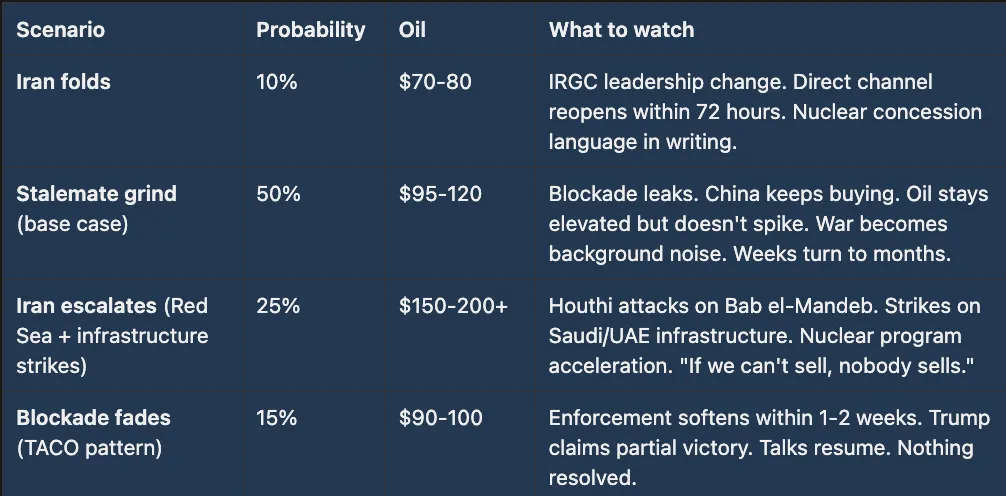
Figure: Decision matrix of four scenarios, with the vertical axis indicating the intensity of the blockade enforcement and the horizontal axis indicating Iran’s response.
Chart Interpretation: The author charted four scenarios along the two dimensions of "whether the blockade effectively tightens" and "whether Iran escalates":
- Scenario 1 (Blockade Effective + Iran Concedes): Iran's economy collapses, returns to the negotiating table; lowest probability.
- Scenario 2 (Blockade Leaks + Iran Does Not Escalate): Baseline scenario. China maintains the lifeline of the Iranian economy; the blockade turns into a chronic war of attrition, oil prices remain at $95-120.
- Scenario 3 (Blockade Tightens + Iran Escalates): Tail risk, probability about 25%. Revolutionary Guard attacks U.S. warships or Houthi forces blockade the Bab el Mandeb Strait, conflict fully expands, oil prices soar, market impact is 3-5 times that of the baseline scenario.
- Scenario 4 (Blockade Leaks + Iran Escalates): The blockade is virtually ineffective but Iran still chooses revenge; situation spirals out of control without economic logic to support it, belongs to a chaos scenario.
Our baseline scenario: Scenario 2, a stalemate of war of attrition.
Iran will not yield because it cannot. Surrendering on nuclear and Hormuz issues equates to regime termination. China maintains the economic lifeline through workarounds. The blockade becomes another layer of pressure rather than a fatal blow. Oil prices maintain in the $95-120 range. The war continues to grind.
But for positions, the key is here: Scenario 3 is a tail event with a 25% probability, and the market impact is 3-5 times that of the baseline scenario. This asymmetry is the reason we continue to go long on oil, gold, and defense stocks. The tail's expected value is greater than the baseline's expected value.
This Week's Focus
Monday at 10 a.m. Eastern Time: Blockade goes into effect. First 24 hours of enforcement data. How many vessels were turned back? Will China test the boundaries?
Iran's Response: Revolutionary Guard statements say any close approaches violate the ceasefire. Pay attention to tests involving drones or missiles. Firing the first shot at American vessels = acceleration of Scenario 3.
Oil Market Opening: Sunday night’s Brent futures. The size of the gap tells you the market's confidence in the blockade.
China’s Moves: Will Beijing issue a public statement? Will it send navy escorts for tankers? The timeline for the activation of shadow fleets is a key variable.
IMF Spring Meetings (April 13-18): Finance ministers gather in Washington. The corridor conversations are more important than the communiques. Are they coordinating responses, or going it alone?
Bottom Line
Trump just made the smartest move in this war. He took away Iran’s weapon and turned it back on Iran.
But clever does not equal effective.
The effectiveness of the blockade relies on Iran yielding under economic pressure, accepting U.S. conditions, abandoning nuclear ambitions, and reopening Hormuz on Washington's timetable.
Iran will not yield. It has proxies in four countries, a plan close to the nuclear threshold, a population of 88 million formed through revolution, and a Beijing that will not sit idly by while it is choked.
The most likely outcome: the blockade becomes another chapter in a war without a clean conclusion. Oil prices stay high. The chain reactions continue. The world adjusts to a new normal, the country that established the global shipping order is now the one disrupting it.
This is not a stable equilibrium. Certain things will break first: provocations from the Revolutionary Guard, China's escort fleets, U.S. ground forces entering the fray, Trump's policy adjustments, an unexpected second round of negotiations. The blockade is a move, not the endgame. And every move in this war has ignited the next round of escalation faster than the last.
The market has priced in the blockade. But it has not yet priced in what comes after the blockade.
免责声明:本文章仅代表作者个人观点,不代表本平台的立场和观点。本文章仅供信息分享,不构成对任何人的任何投资建议。用户与作者之间的任何争议,与本平台无关。如网页中刊载的文章或图片涉及侵权,请提供相关的权利证明和身份证明发送邮件到support@aicoin.com,本平台相关工作人员将会进行核查。


