Author: Catrina
Translated by: Jiahua, ChainCatcher
Crypto venture capital is at a turning point. In the last three cycles, token exits have been the main drivers of excess returns, but now it is undergoing a significant reset. The definition of token value is being rewritten in real-time, yet a standardized assessment framework for the industry has yet to emerge.
What exactly is happening?
This time, the structure of the crypto market is being simultaneously shaken by multiple unprecedented forces, completely overturning:
1. The emergence of HYPE has awakened the token market, proving that token prices can have real revenue support, with over 97% of its nine to ten-figure revenues generated on-chain.
This has demystified the governance tokens that rely solely on narrative and have hollow fundamentals—think of those L1s and "governance tokens" that mainly existed to avoid the ambiguity of securities laws (which render direct income distribution impractical). HYPE reset market expectations almost overnight: today, revenues are under stricter scrutiny and have become fundamental bargaining chips for entry.
2. The backlash against other token projects
By 2025, if you have on-chain revenue, you will be considered a security; post-HYPE, if you ask most hedge funds, they will tell you that if you do not have on-chain revenue, you will go to zero. This has put most projects, especially non-DeFi ones, in a dilemma where they can only hastily adapt.
3. PUMP has brought about an astonishing supply shock to the system.
The meme coin frenzy has led to a supply explosion, fundamentally disrupting the market structure through diversion of attention and liquidity. On Solana alone, the number of newly generated tokens surged from about 2-4 thousand per year to 40-50 thousand at peak. This has essentially divided an already stagnant liquidity cake into roughly one-twentieth. Similarly seeking excess returns, the attention and funds of the same group of buyers have shifted toward hyping meme coins instead of holding altcoins.
4. Retail speculative funds are accelerating their diversion.
Prediction markets, perpetual stocks (perps), and leveraged ETFs are now directly competing for the same pool of funds that would have flowed into altcoins. Meanwhile, the maturation of tokenized technologies has made leveraged trading of blue-chip stocks possible, as these stocks are not subject to the same zero-risk exposure as most altcoins, and are much more strictly regulated, offering lower information disadvantage risks.
As a result, the lifecycle of tokens has been significantly compressed: the time from peak to trough has sharply shortened, and the willingness of retail investors to "hold" tokens has plummeted, replaced by faster capital rotations.
Every VC is asking themselves and their peers some big questions
1. Are we underwriting equity, tokens, or a combination of both?
The biggest challenge here is that we lack a new best practice manual for value accumulation in token projects—even the most successful projects like Aave continue to face disputes between DAO and equity.
2. What are the best practices for on-chain value accumulation?
The most common is token buybacks, but that does not mean it is the right approach. We have long opposed the prevailing trend of token buybacks: it is toxic and puts founders with real income in a dilemma.
This motivation is completely misguided: stock buybacks occur after a company has completed investments in growth, whereas crypto buybacks are increasingly being compelled to occur immediately due to retail/public perception (which is entirely fickle and irrational).
You might burn through a $10 million that could have been used for reinvestment, and the next day that value could evaporate due to a random market maker being liquidated.
Public companies conduct buybacks when their stocks are undervalued. In contrast, token buybacks often occur at local peaks, as they are preempted at various stages.
Especially if you are a B2B business generating off-chain income, this is akin to engaging in futile efforts. In my view, when your revenue is below $20 million, there is absolutely no reason to conduct buybacks just to please retail, instead of reinvesting the funds into growth.
I really like this report from fourpillars, which shows that buybacks reaching up to ten figures are almost useless in helping projects set long-term price floors.
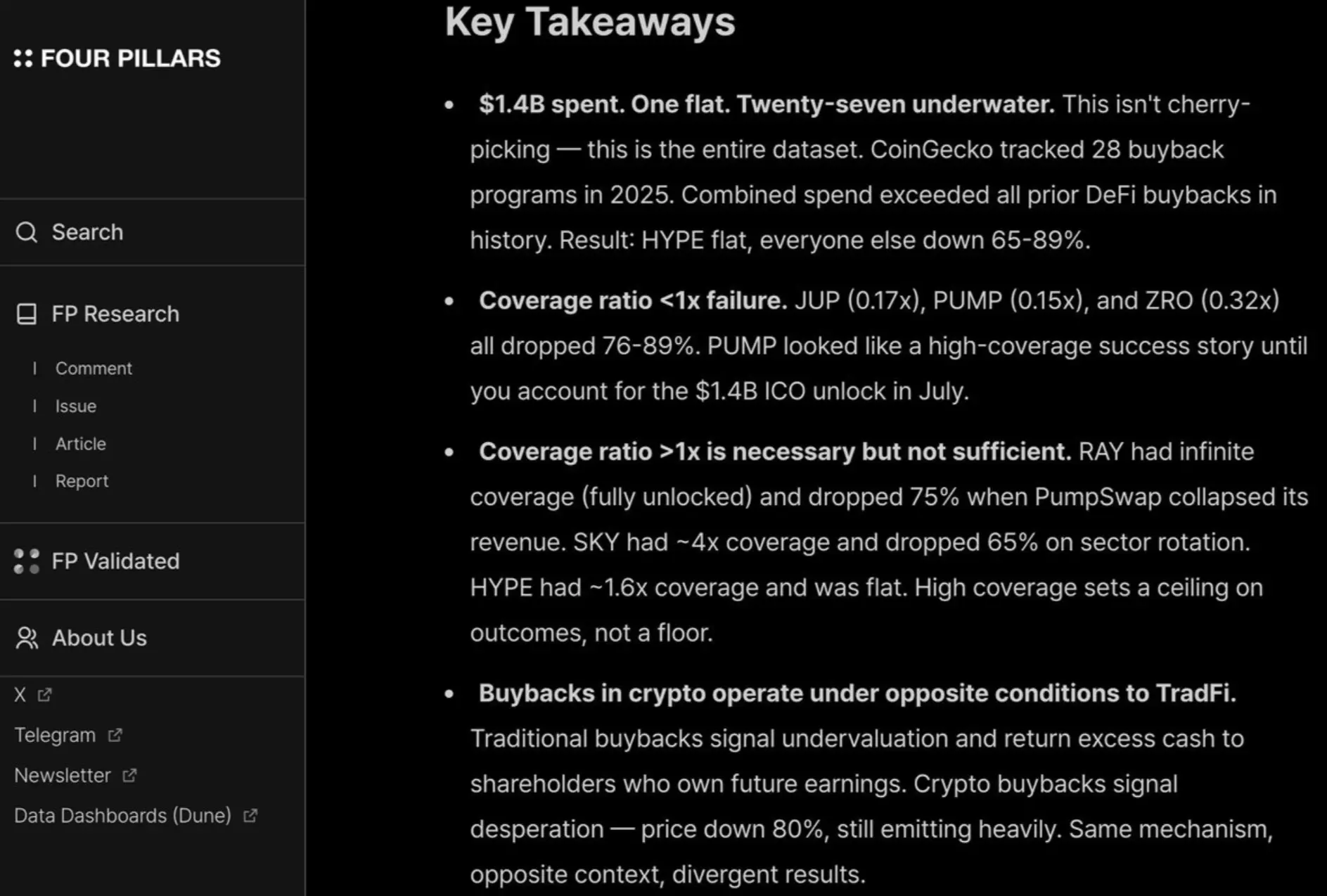
Moreover, to satisfy retail and hedge funds, you must conduct buybacks in a continuous and transparent manner like HYPE. Any action that fails to do so will be punished, just like PUMP’s price-to-earnings ratio (based on fully diluted valuations) is only 6 times, because the public "does not trust" them—even though they have actually burned through $1.4 billion in income that could have gone into the treasury.
Here is further reading material on "mechanisms for on-chain value accumulation that work without burning cash."
3. Will the "crypto premium" completely disappear?
This means that in the future, all projects will be valued based on multiples similar to public stocks (approximately 2 to 30 times revenue). Take a moment to think about what this implies—if true, we would see the prices of most L1 public chains drop by more than 95% from now, with exceptions like TRON, HYPE, and other revenue-generating DeFi projects. This is even without factoring in token attribution.
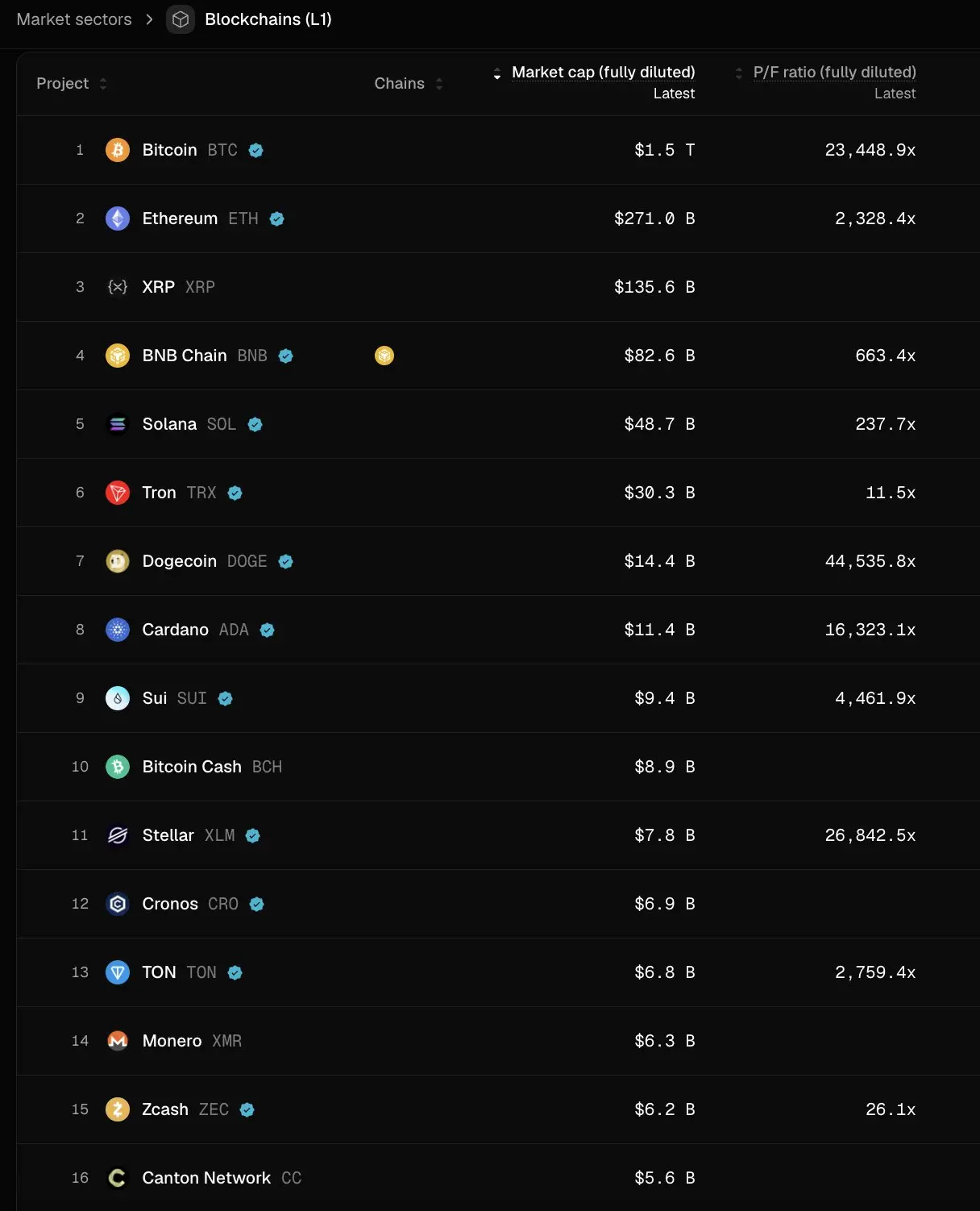
Personally, I do not believe this will be the case—HYPE has set an incredibly exceptional expectation, making many investors impatient with "first-day revenue/user traction" from early-stage startups. For continuous innovations like payment and DeFi companies, yes, this is a reasonable expectation.
But disruptive innovation takes time to build, launch, and grow before exponential revenue growth can come.
In the past two cycles, we have been overly patient and blindly optimistic about so-called "disruptive technologies"—new L1 public chains, Flashbots/MEV esoteric concepts have all absorbed investment up to the 8th-9th round, and now have swung too far, only willing to support DeFi projects.
The pendulum will swing back. While evaluating DeFi projects based on "quantitative" fundamentals is indeed a net positive for industry maturation, for non-DeFi categories, "qualitative" fundamentals also need to be considered: culture, technological innovation, disruptive concepts, safety, decentralization, brand equity, and industry connectivity. These traits will not simply be reflected in TVL and on-chain buybacks.
What should we do now?
The return expectations for token projects have been significantly compressed, while equity businesses have not experienced a similar degree of decline. This divergence is particularly evident in early and growth-stage projects.
Early investors have become much more price-sensitive when underwriting projects that may exit via tokens. Meanwhile, appetite for equity businesses has increased, especially in a favorable merger and acquisition environment. This is entirely different from the situation in 2022-2024, when token exits were the preferred liquidity path, based on the underlying assumption that token valuation premiums would persist.
Later-stage investors, those with the strongest brand equity and added value in the crypto-native context, are increasingly moving away from purely "crypto-native" transactions. Instead, they are turning to support more "Web2.5" companies, whose underwriting is anchored by revenue traction.
This has pushed them into unfamiliar territory, directly competing against institutions like Ribbit and Founders Fund—these institutions have deeper backgrounds in traditional fintech, stronger portfolio synergies, and better visibility into early deal flow outside of crypto.
The crypto VC space is entering a period of value validation. The right to survive depends on VCs finding their own PMF (product-market fit) among founders, where "product" is a combination of capital, brand recognition, and added value.
For the best deals, VCs need to sell themselves to founders to win the right to enter the capitalization structure, especially in recent years where some of the most successful cases hardly need institutional capital (like Axiom), or do not need it at all (like HYPE). If capital is the only thing VCs can provide, they will almost certainly be eliminated.
Those qualified to remain in this game need to be very clear about what they can offer in terms of brand recognition (which motivates the best founders to engage from the start) and added value (which ultimately determines their right to win deals).
免责声明:本文章仅代表作者个人观点,不代表本平台的立场和观点。本文章仅供信息分享,不构成对任何人的任何投资建议。用户与作者之间的任何争议,与本平台无关。如网页中刊载的文章或图片涉及侵权,请提供相关的权利证明和身份证明发送邮件到support@aicoin.com,本平台相关工作人员将会进行核查。


