Author: CoinGecko
Translation: Deep Tide TechFlow
Deep Tide Guide: CoinGecko has released the 2026 Spot CEX report, covering the world's 12 major centralized exchanges. The report reveals several key facts: USDT and USDC account for nearly 98% of stablecoin trading pairs; only 32% of newly listed tokens outperform their issuance price in the short term, almost all suffer losses after 12 months; total reserves of exchanges have increased from $152.1 billion to $225.4 billion; funds are flowing from institutional platforms like Coinbase to retail-driven exchanges such as Bitget and MEXC.
Since the birth of the cryptocurrency market, centralized exchanges (CEX) have been the core entry point for retail and institutional liquidity. In 2025 alone, the top 12 CEX handled nearly $21 trillion in spot trading volume. As the industry matures, the focus of the market is shifting: the sustainability of spot trading activity and the health of the underlying reserves supporting these massive trades.
The competitive landscape of CEX is changing. USDT and USDC dominate trading pairs, and the performance of new coins upon listing remains a major challenge. By 2026, the total reserves of the top 12 CEX reached $225.4 billion, with funds migrating from institutional giants to high turnover, retail-driven platforms.
Here are the four core findings of the report. The complete report is 21 pages long and is recommended for download and reading.
1. USDT and USDC account for 66.6% of trading pairs, stablecoins almost monopolize spot trading
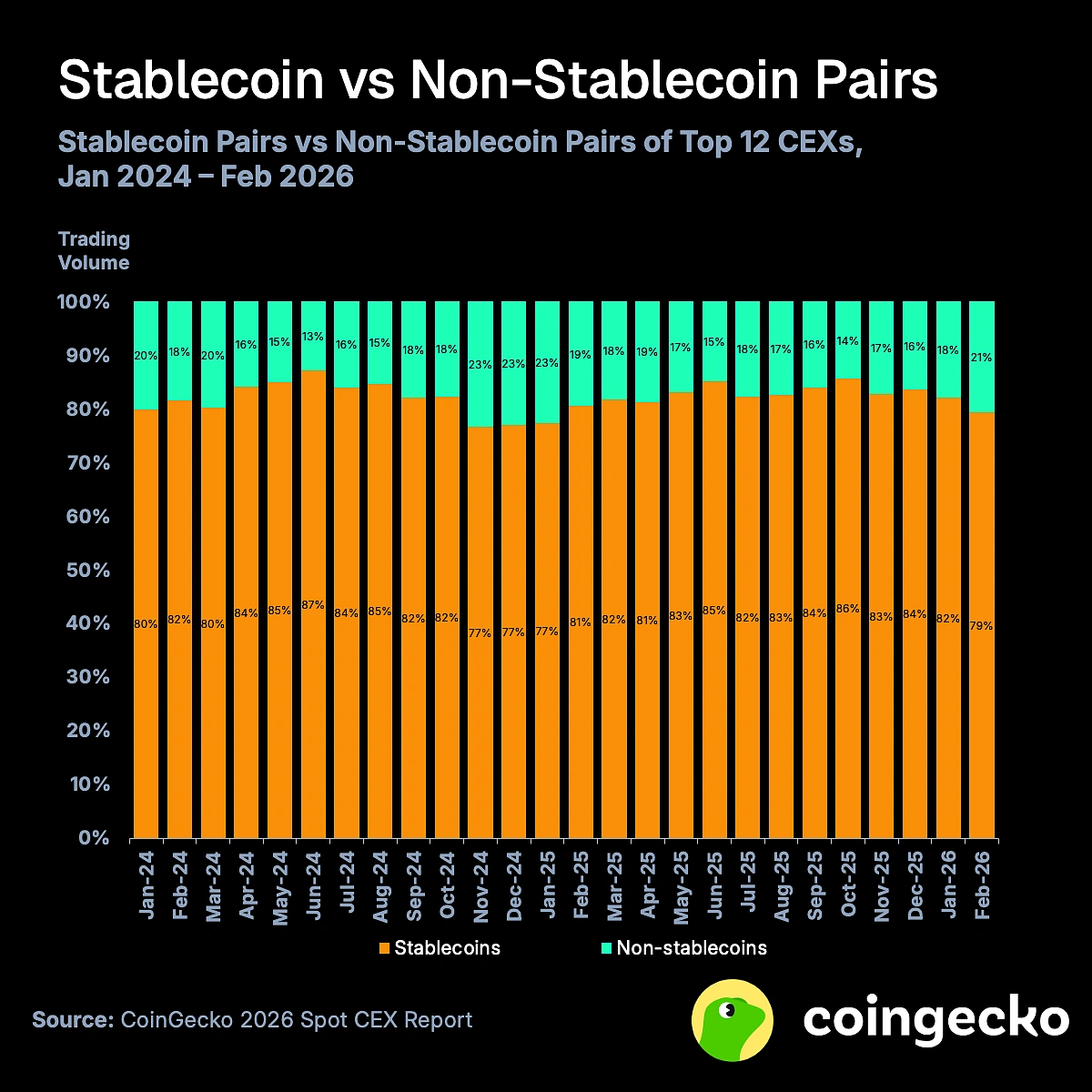
Chart: Proportion of stablecoin and non-stablecoin trading pairs among the top 12 CEX
On the top 12 CEX, the vast majority of spot trading volume is completed through stablecoin trading pairs like USDT and USDC.
Specifically, among 9,870 stablecoin trading pairs, there are 9,646 trading pairs with USDT or USDC, accounting for 97.7%. There are 4,615 non-stablecoin trading pairs, making up 31.9% of the total 14,485 trading pairs.
However, the number of trading pairs does not correlate directly with trading volume. The trading volume proportion of non-stablecoin trading pairs peaked at 23% in November 2024.
2. New coins hit their peak upon listing: only 32% record short-term gains, nearly all collapse after 12 months
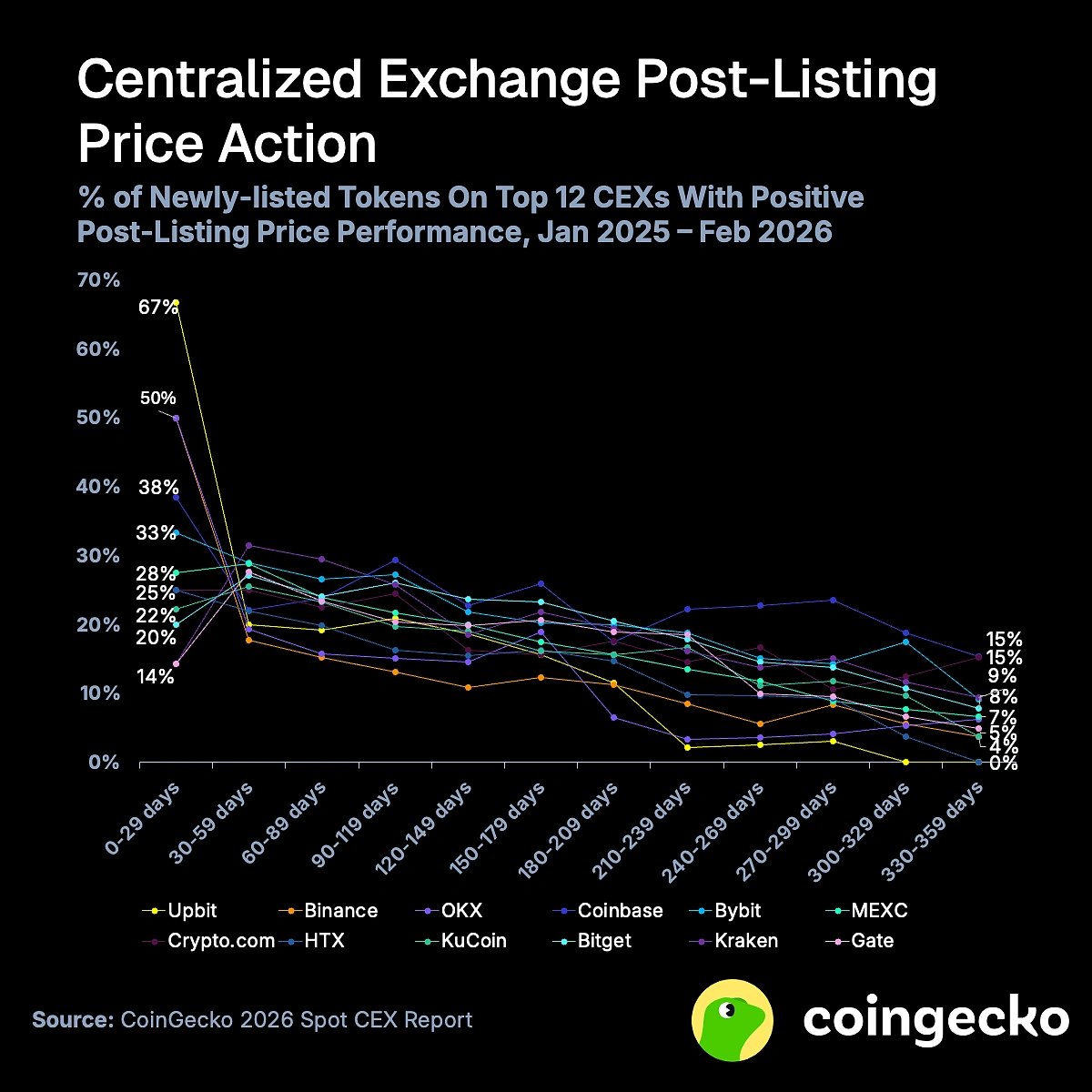
Chart: Price performance of newly listed tokens on the top 12 CEX
Among the top exchanges, Upbit had the best short-term performance for new coins, with 67% of new coins remaining profitable 30 days after listing. However, Upbit had the fewest new coin listings. Following Upbit are Binance and OKX, with a 30-day positive return rate of 50% each.
The performance of exchanges in the 0-29 days after listing varies greatly, but the gap quickly narrows after 30 days. On average, only 25% of tokens remain profitable 30-59 days post-listing.
Over a longer period, the performance of exchanges tends to decline linearly. The only exception is Coinbase, which experienced a wave of "recovery" with its listed tokens after six months.
At the 12-month mark, less than 10% of tokens listed by most top exchanges are still above their issuance price. The data from Upbit is particularly dramatic: starting strong, but dropping quickly, all newly listed tokens fell below their issuance price between days 300-329.
3. Total reserves of the top 12 CEX increased from $152.1 billion to $225.4 billion, with Binance doubling its lead
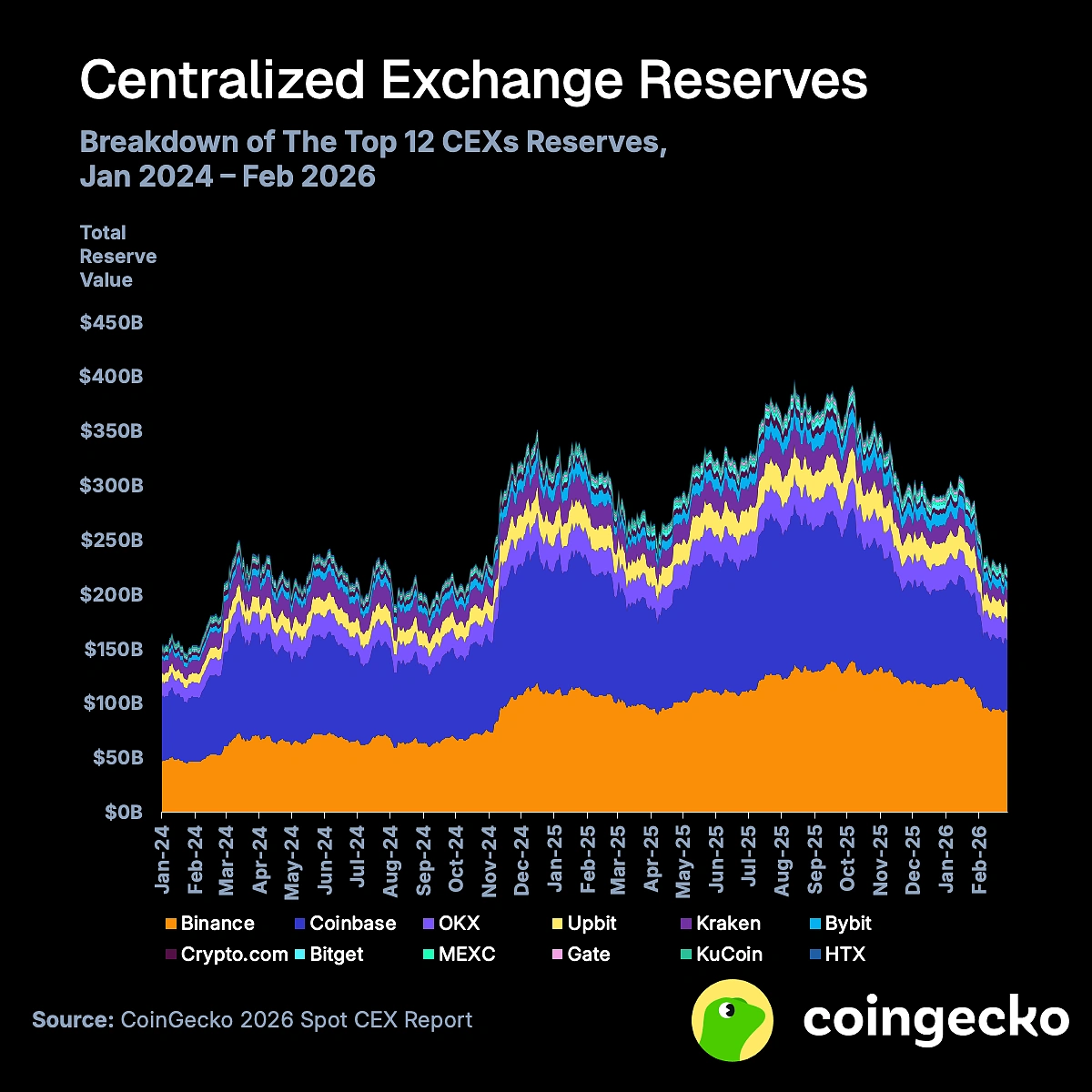
Chart: Changes in the value of reserve assets of the top 12 CEX (2024-2026)
Although the price rise of BTC and ETH has boosted the reserve value of most exchanges, price volatility and stricter regulation are driving users to shift funds from large exchanges to other platforms.
From early 2024 to the end of February 2026, the total underlying asset value of the 12 major CEX grew by an average of 69.6%, from $152.1 billion to $225.4 billion.
Among them, eight exchanges reported net reserve growth, with Binance leading by a large margin. Its reserves doubled from $46.7 billion to $93.4 billion in two years.
In terms of BTC reserves, Coinbase ranks first with over 800,000 BTC, followed closely by Binance with 669,000 BTC. However, Coinbase experienced net outflows of 20% and 41% in its BTC and ETH reserves, respectively.
A significant portion of these outflows has gone to smaller exchanges like Bitget and MEXC. The reserve values of both skyrocketed by 262.0% and 274.6%, respectively.
4. Retail-driven exchanges have a fund turnover rate far exceeding that of institutional ones, with MEXC's turnover rate being 20 times that of Coinbase
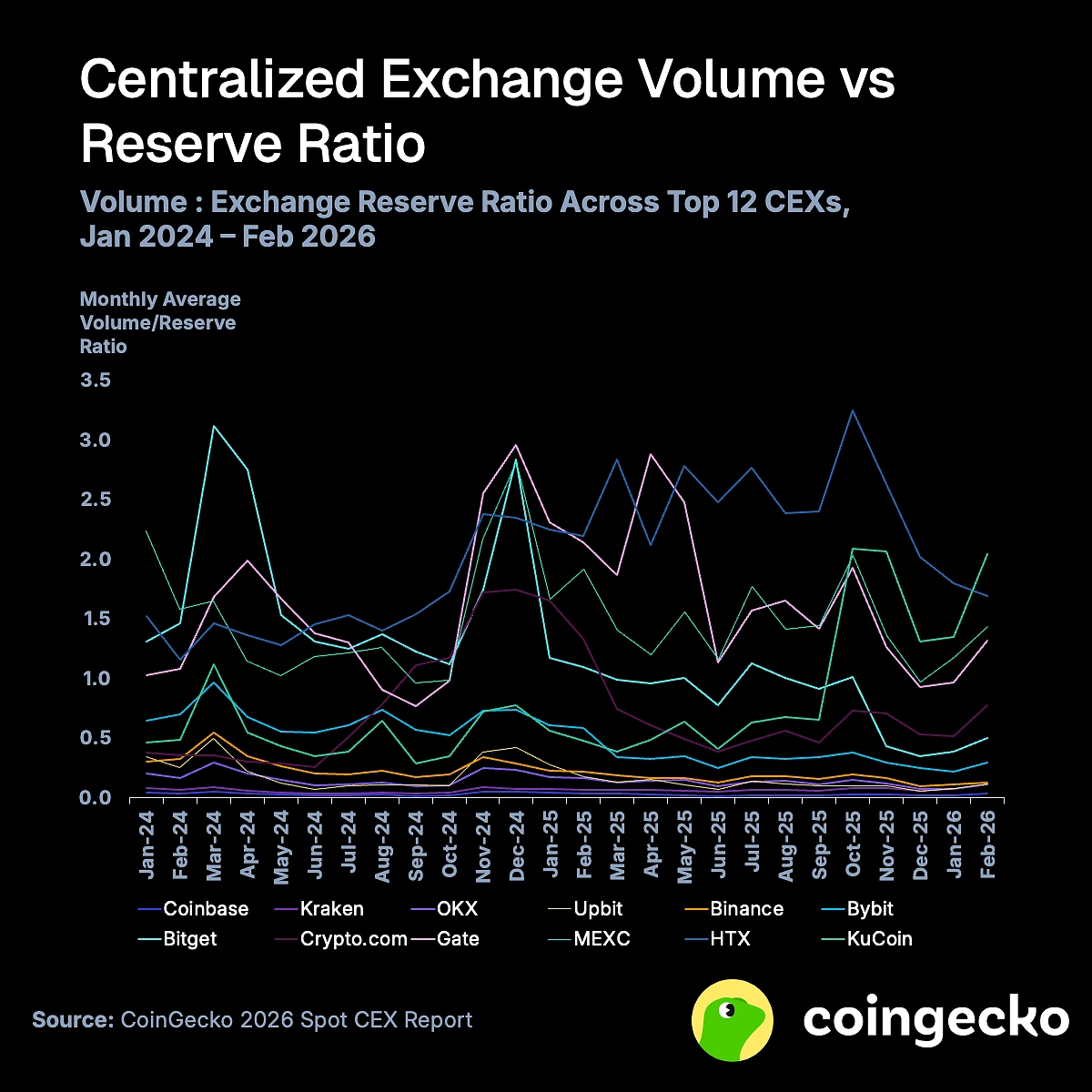
Chart: Comparison of trading volume to reserve ratios among the top 12 CEX
While CEX holds a large amount of cryptocurrency asset reserves, the efficiency of fund utilization varies greatly among platforms.
Exchanges with higher compliance, such as Coinbase, Binance, and Kraken, have a Volume to Reserve Ratio of about 0.1. This may be because their customers are primarily institutions, using the platform more for custody instead of frequent trading.
Bybit and Bitget maintain both high trading volumes and considerable deposit sizes, with average ratios of 0.3 and 0.5 from January 2024 to February 2026.
Exchanges with smaller reserves, such as MEXC, HTX, and KuCoin, have asset turnover rates between 1.44 and 2.04. This means that users' trading volumes far exceed the reserves held by the exchanges, leading to rapid fund circulation on the platforms.
免责声明:本文章仅代表作者个人观点,不代表本平台的立场和观点。本文章仅供信息分享,不构成对任何人的任何投资建议。用户与作者之间的任何争议,与本平台无关。如网页中刊载的文章或图片涉及侵权,请提供相关的权利证明和身份证明发送邮件到support@aicoin.com,本平台相关工作人员将会进行核查。


