Author: Claude, Deep Tide TechFlow
Deep Tide Guide: Anthropic made a dual move this week: on April 4th, it cut off subscription access for 135,000 OpenClaw instances, and on April 8th, it launched its cloud-based Agent hosting service Managed Agents.
Putting these two steps together, it is clear that there is a shift from selling model APIs to selling Agent operational infrastructure. Anthropic, with an ARR just surpassing $30 billion, is redefining the game rules for AI Agents using pricing power and platform lock-in effects.
Anthropic took two actions within a week, and when viewed together, the intention is so clear that it almost needs no interpretation.
On April 4th, Anthropic officially cut off the access of Claude Pro and Max subscription users to use the quota through third-party Agent frameworks like OpenClaw, forcing 135,000 active instances overnight to switch to pay-per-use or API pricing. Four days later, on April 8th, Anthropic released the public beta of Claude Managed Agents, providing a full suite of cloud-hosted infrastructure from sandbox execution, state management to multi-Agent coordination.
Closing one door while opening another. The anger from the open-source community is understandable, but from a business logic perspective, these two moves serve the same goal: Anthropic no longer wants to just be a model supplier; it wants to be the infrastructure platform of the Agent era.
Banning OpenClaw, $20 buffet ends
The popularity of OpenClaw goes without saying.
Previously, users ran Agents through Claude's $20 monthly subscription quota, but the problem lies in the economics. A single heavy user can consume computing resources costing between $1,000 to $5,000 a day, which evidently increases Anthropic's burden.
According to VentureBeat, Boris Cherny, head of Anthropic Claude Code, announced this change on the X platform, stating that the subscription plans "were never designed for the usage patterns of third-party tools" and that the company needs to "prioritize serving customers who use its own products and APIs."
The timeline makes this matter even more nuanced.
In January of this year, Anthropic opposed the trademark of Clawdbot. On February 14th, Steinberger announced his joining OpenAI, to which Sam Altman publicly welcomed him. On February 20th, Anthropic updated its terms of service to explicitly prohibit the use of OAuth tokens for third-party tools. On April 3rd, Semafor reported that Anthropic was building its own competitor to OpenClaw, and Chief Business Officer Paul Smith admitted that clients "have been asking us to do this." On April 4th, execution was fully enforced.
Steinberger's response was quite straightforward: "First, copy the popular open-source features into your own closed tool, then lock the open source out." He and investor Dave Morin attempted to negotiate with Anthropic, managing to only delay the execution by a week.
Anthropic provided two transitional measures: a one-time credit equivalent to the monthly subscription price and a pre-purchase of additional usage packages at a discount of up to 30%. However, for heavy users, switching from a fixed monthly fee to pay-per-use could result in costs skyrocketing by 50 times.
Managed Agents: From Selling Models to Selling Runtime
In the same week that OpenClaw was banned, Anthropic presented its own alternative.
On April 8th, Claude Managed Agents entered public beta. According to Anthropic's engineering blog, the design philosophy of this service was inspired by the abstraction principles of operating systems: breaking the Agent into three independently replaceable components: session (session logs), harness (call loop), and sandbox (code execution environment), decoupling the three so that the failure of any one does not affect the others.
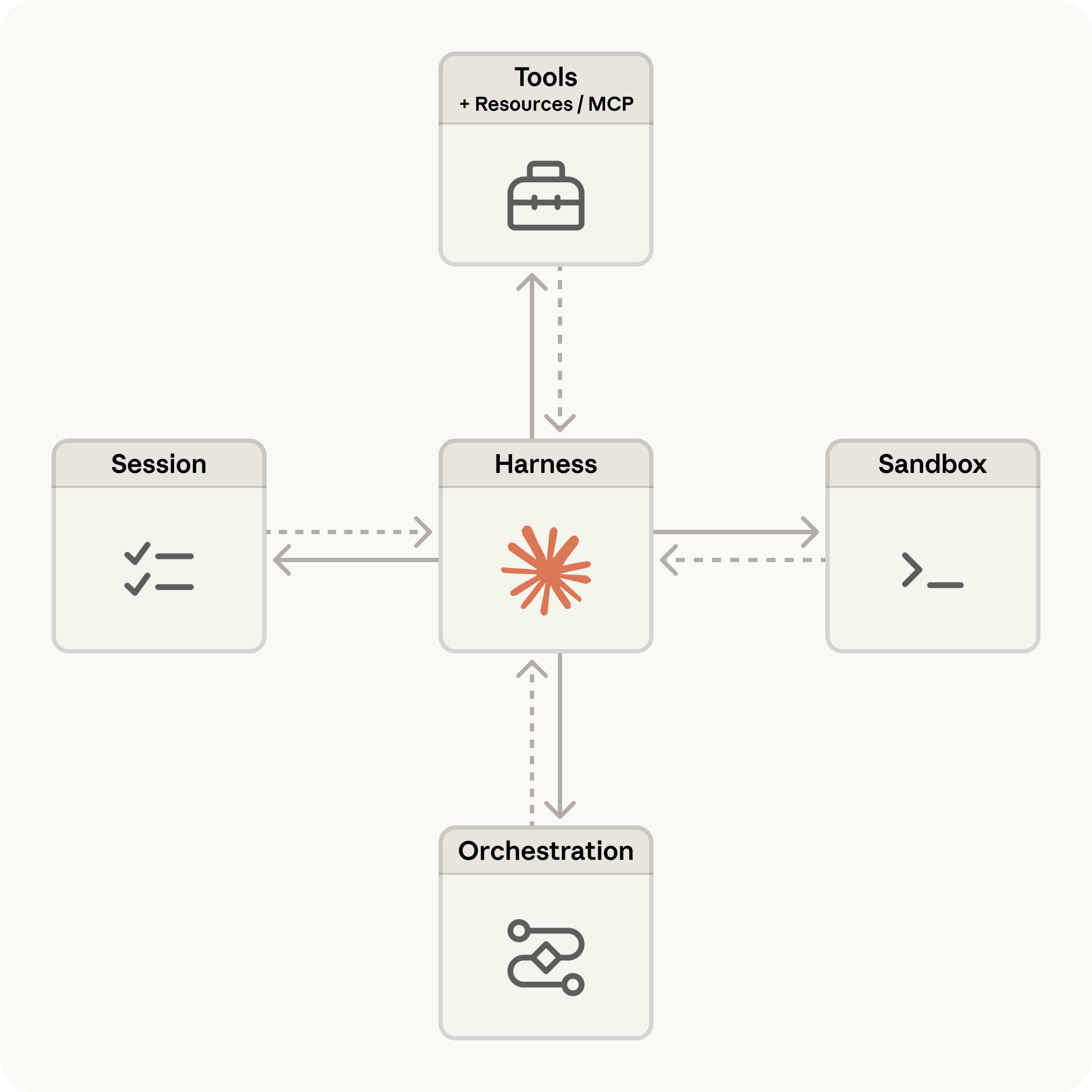
The engineering blog explained in detail why this architecture is necessary. The early versions had all components in the same container, which turned the container into a "pet." Once it crashed, the entire session was lost, and debugging could not even touch user data.
After decoupling, the container became "cattle"; when it crashes, just replace it with a new one, and the harness continues running by restoring the state from the session logs.
In terms of pricing structure, Managed Agents charge an additional $0.08 per session running hour (billed by millisecond) on top of the standard API token cost, with no charge for idle wait time. Web searches triggered by Agents are charged at $10 per 1,000 searches.
According to SiliconANGLE, companies like Notion, Rakuten, Asana, and Sentry have become early users. Asana has embedded the Agent into its project management process, building an "AI teammate" that can automatically take on tasks and draft deliverables; Sentry pairs its existing debugging Agent with a Claude-driven patch generation Agent, shortening the process from discovering bugs to submitting pull requests from the originally planned months to weeks.
Currently, there are two features in the research preview stage: first, the Agent can initiate sub-Agents when handling complex tasks; second, the Agent has self-assessment capabilities, allowing developers to define success criteria and Claude to iterate on its own until it meets the standard.
The Platform Economics Behind the Two Moves
When looking at both events side by side, the business logic is very clear.
Anthropic's ARR has just surpassed $30 billion. According to The Information, this number has more than doubled from about $9 billion at the end of 2025, with annual spending exceeding $1 million from over 1,000 enterprise clients.
Claude Code alone contributed over $2.5 billion in annualized revenue. At this scale, allowing 135,000 OpenClaw instances to consume computing power worth thousands of dollars at a $20 monthly fee is unsustainable.
However, simple cost control is not enough to explain the timing of the launch of Managed Agents.
Anthropic's platform product lead Angela Jiang stated in an interview that there is still a gap between the capabilities of the company's models and the actual usage by enterprises, and the goal of Managed Agents is to enable businesses to deploy "teamed Claude Agents" to handle real workloads.
This is a typical platform lock-in strategy. Once the enterprise's Agents run on Anthropic's hosted infrastructure, the data pipeline, monitoring configurations, and permission systems will be embedded in everyday processes, dramatically increasing migration costs.
For a company valued at $380 billion and considering an IPO, this stickiness is much more valuable than just API call fees.
Many analysts and social media influencers have previously expressed the view that "the real battlefield for AI is at the orchestration layer." Whoever controls the routing and compositional logic of the Agent makes the underlying model interchangeable.
OpenClaw has supported switching between multiple models like Claude, GPT-4o, Gemini, etc. After the 135,000 users were forced to leave fixed rates, some may turn to local models or other providers.
Google took similar actions in February of this year, prohibiting third-party tools from borrowing Gemini CLI's OAuth authentication. When looking at all these together, it can be seen that the AI industry is shifting from "model competition" to "platform competition."
The unlimited subscription model is coming to an end across the industry, while pay-per-use and infrastructure bundling will become the new norm.
免责声明:本文章仅代表作者个人观点,不代表本平台的立场和观点。本文章仅供信息分享,不构成对任何人的任何投资建议。用户与作者之间的任何争议,与本平台无关。如网页中刊载的文章或图片涉及侵权,请提供相关的权利证明和身份证明发送邮件到support@aicoin.com,本平台相关工作人员将会进行核查。


