Written by: Tanay Ved, Coin Metrics
Translated by: Luffy, Foresight News
TL;DR
- As blockchain scalability and transaction costs decline, the differentiation between public chains is shifting from cost competition to scenario-based specialization.
- Bitcoin reached the milestone of mining its 20 millionth token in March, with wrapped tokens and the ZK Rollup ecosystem continuously expanding, gradually unlocking Bitcoin's programmability and asset utility.
- Ethereum solidifies its position as the on-chain liquidity and settlement center, with L1 fees hitting historic lows, while L2 evolves from a scalability solution to a specialized execution environment.
- Solana continues to push towards its vision of an "internet capital market," with rising payment adoption and increasingly mature on-chain trading infrastructure, achieving sub-second finality with the Alpenglow upgrade goal.
As each network's block space continues to expand, on-chain transaction costs have declined significantly. After recent upgrades, Ethereum’s mainnet fees have decreased markedly, Solana’s transaction costs remain under several cents, and L2 networks also provide similarly low-cost execution environments. In the context of continuously compressed costs, the differentiation of block space increasingly relies on ecosystem liquidity, throughput, and scenario specialization, rather than merely marginal cost advantages.
This article will explore how mainstream public chains evolve around their respective positioning: Bitcoin is expanding its programmability and asset utility; Ethereum is consolidating its liquidity and settlement center status for stablecoins, real-world assets (RWA), and DeFi; Solana focuses on high-frequency payments and trading scenarios.
Bitcoin
In March 2026, the 20 millionth Bitcoin was mined, indicating that only 1 million Bitcoins remain to be issued. Over 95% of Bitcoin's total supply is already in circulation, and following the halving in April 2024, the block reward will decrease to 3.125 BTC, reducing the issuance rate according to the established schedule.
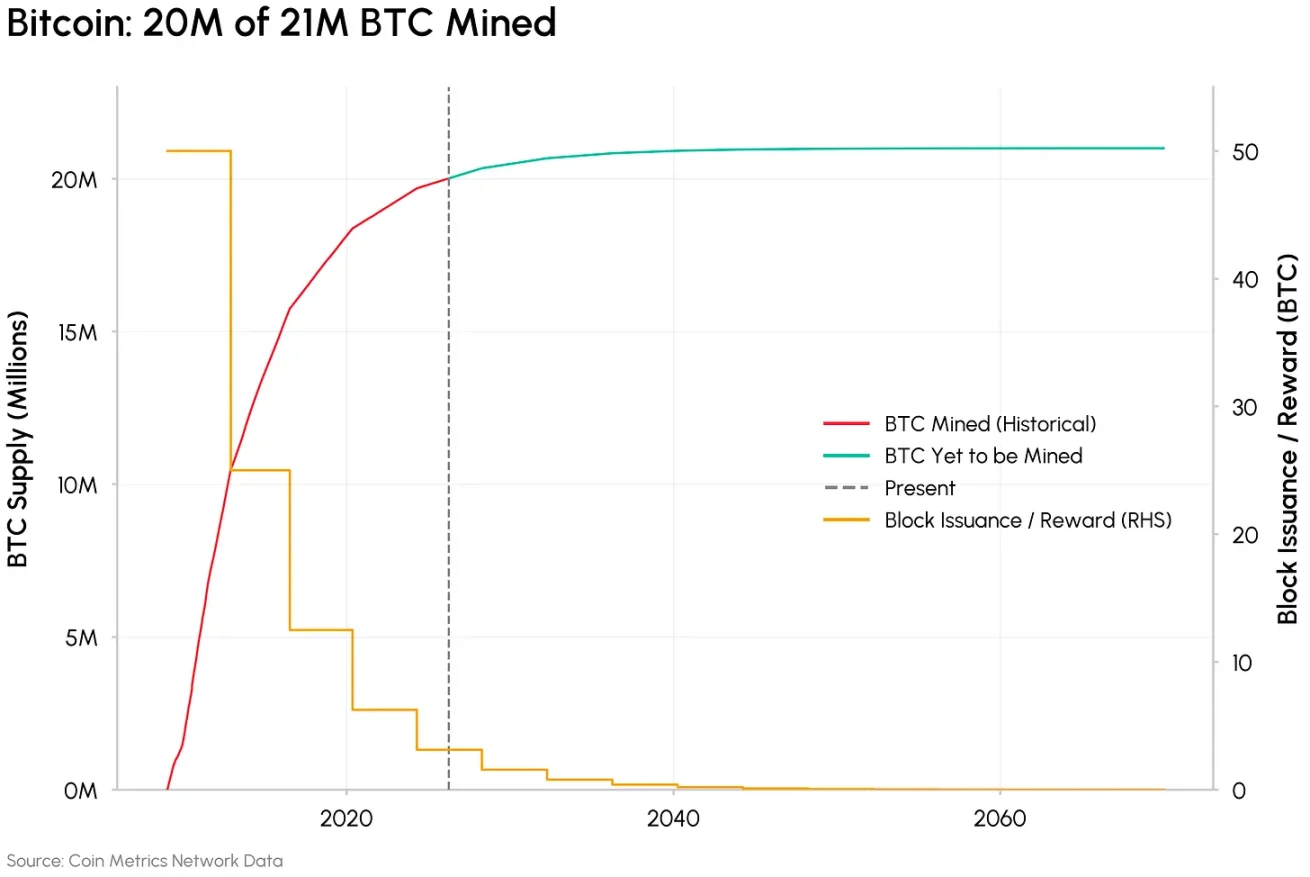
Bitcoin mining speed, data source: Coin Metrics
As the block rewards decrease, the importance of transaction fees in miner revenues is continuously increasing. Outside of periods of sporadic surges, transaction fees account for less than 1% of total miner income. Since all Bitcoin transaction fees go to miners, the long-term core issue of its security model is whether the naturally generated demand for transaction fees can continuously fill the gap created by the decline in block rewards.
Moving Bitcoin Towards Programmability and Assetization
Despite Bitcoin's market value of approximately $1.3 trillion, about 60% of BTC has not moved in a year; about 2.4 million BTC (11% of the supply) is held in centralized exchanges, with around 243,000 BTC circulating in other public chains in the form of wrapped tokens.
Most of the funds in Bitcoin remain idle, with the vast majority of related activities and transaction fee generation occurring off the main chain.
Bitcoin's functional role is evolving along two main lines: expanding its underlying programmability and enhancing BTC's asset utility. Sidechains, Lightning Network L2, wrapped Bitcoin, and liquidity staking protocols are enriching and enhancing Bitcoin's practicality, while also introducing varying degrees of trust assumptions, from full custody to smart contract interactions.
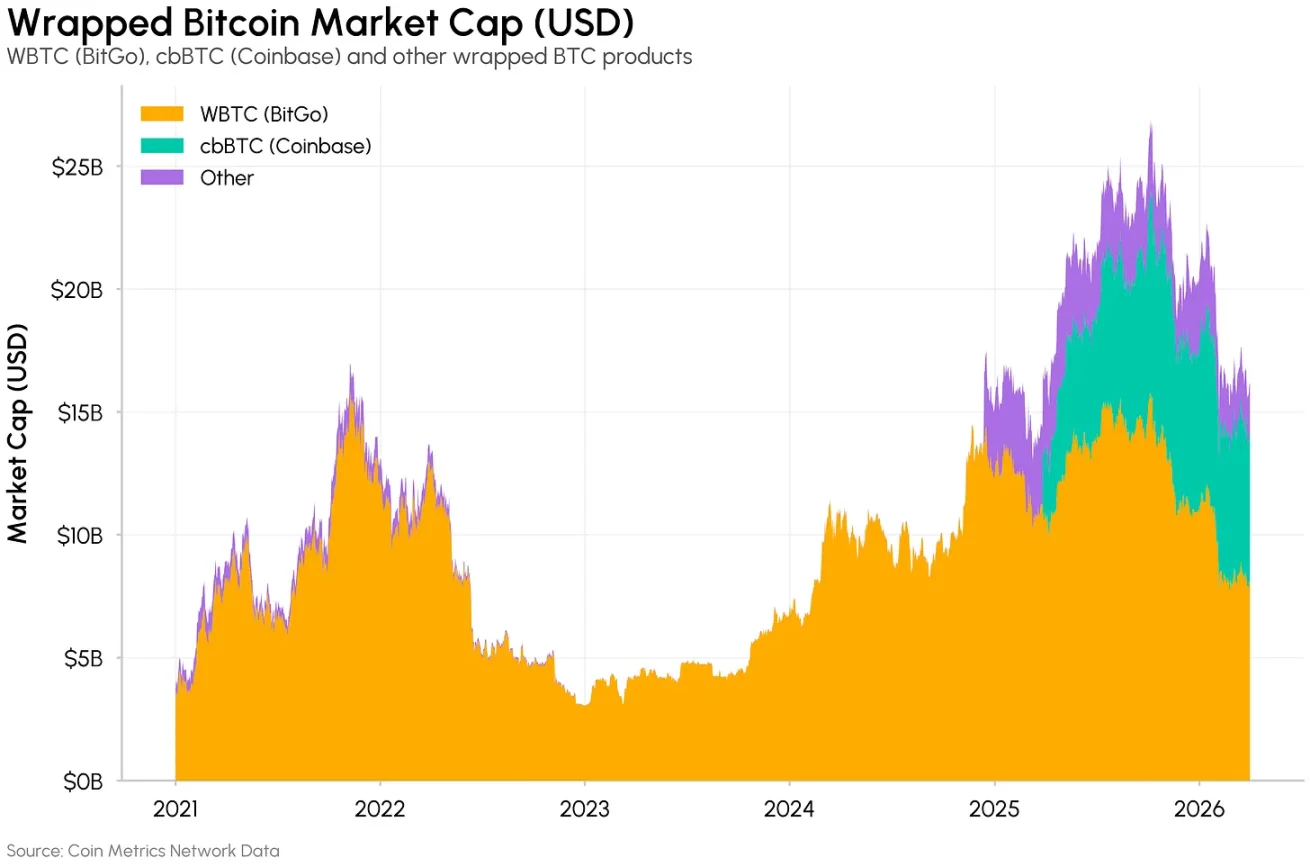
Market value of wrapped Bitcoin, source: Coin Metrics
In the direction of minimizing trust, Citrea stands out as a ZK Rollup that settles directly on Bitcoin L1. It uses the BitVM framework to validate programs within Bitcoin's existing scripting system, allowing for EVM-compatible applications, secured by Bitcoin's proof of work. Unlike sidechains, it completes settlement directly on Bitcoin through zero-knowledge proofs, with withdrawals relying on non-custodial bridges.
Meanwhile, the assetization applications of BTC as collateral continue to grow. The total value of wrapped Bitcoin across chains exceeds $15 billion, and Coinbase's cbBTC in the Morpho lending market has also surpassed $1 billion. Liquidity staking protocols like Babylon further expand this scenario, allowing BTC to provide economic security for external proof-of-stake networks. These developments are gradually unlocking the assetization potential of long-idled capital.
Ethereum
Ethereum remains the global center for on-chain liquidity and settlement. It holds about 62% of the total stablecoin market cap and has the deepest DeFi liquidity among all public chains, while also serving as an important circulation platform for tokenized real-world assets (RWA), covering money market funds, tokenized government bonds, and stocks.
Recent upgrades have further reinforced Ethereum's position as the core of economic activities. PeerDAS, increased Blob space, and upgrades from Pectra and Fusaka that raise the Gas ceiling have driven L1 fees to multi-year lows, expanding the range of activities that can settle directly on the mainnet.
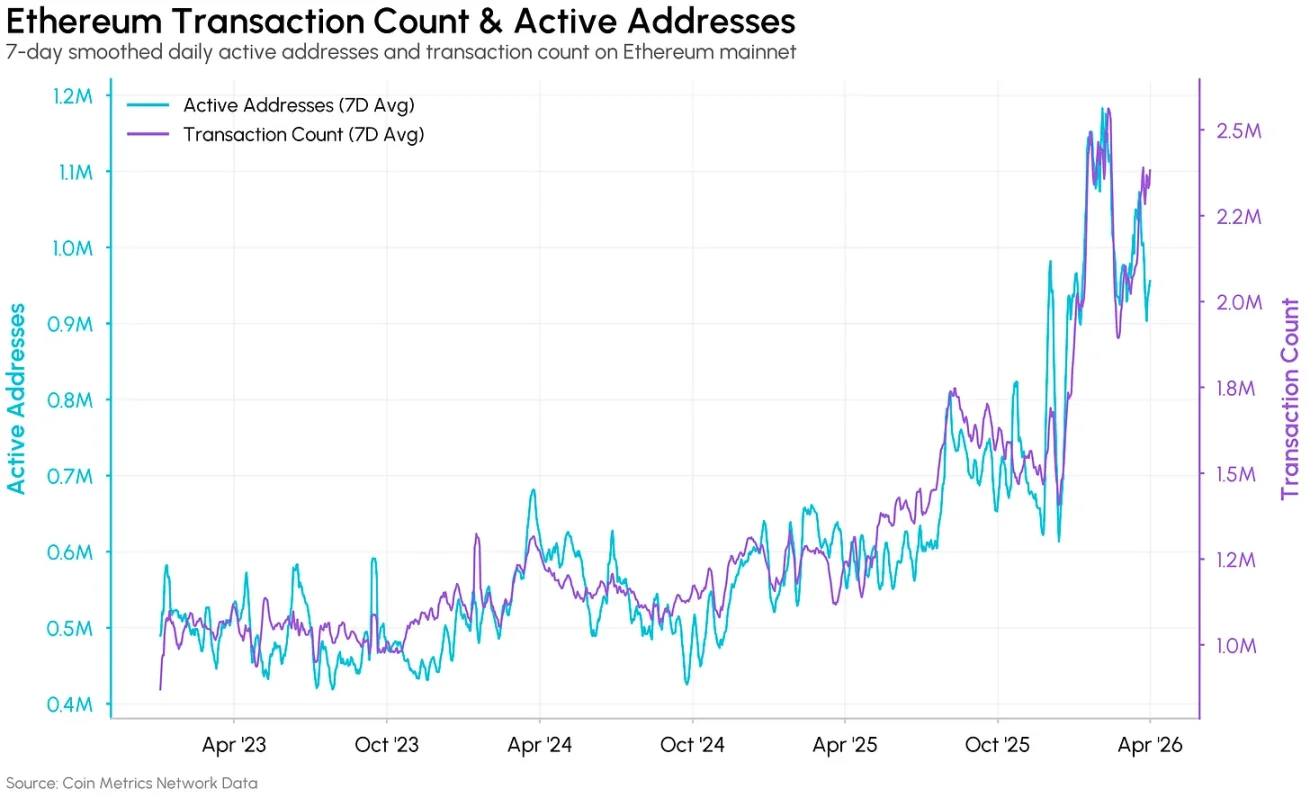
Ethereum transaction volume and active addresses, data source: Coin Metrics
The daily active addresses and transaction volume on Ethereum's mainnet almost doubled year-on-year, surpassing 1 million and 2.4 million respectively. However, as previously discovered, part of the growth comes from address poisoning attacks and low-value economic activity addresses (transactions below $1), which can sometimes constitute a very high percentage of daily active addresses.
Transformation of the L1 and L2 Relationship
As L1 transaction costs have decreased significantly, the role of Ethereum's L2 networks is being redefined. L2 was initially designed as Ethereum's core scalability solution, lowering costs by separating the execution layer. This positioning is now shifting.
According to a recent blog post by the Ethereum Foundation, the core mission of L2 has shifted to providing differentiated features, customized capabilities, and specialized execution environments, with scalability being a secondary function.
The utilization rate of Blob space for submitting transaction data to Ethereum from L2 is less than 30%, with an average of about 3 Blobs per block after expansion. Blob usage is concentrated among a few L2s, and related costs account for an insignificant portion of total transaction fees. The scaling speed of L1 has outpaced the settlement demand of L2, making Ethereum's settlement costs no longer a barrier for most L2s.
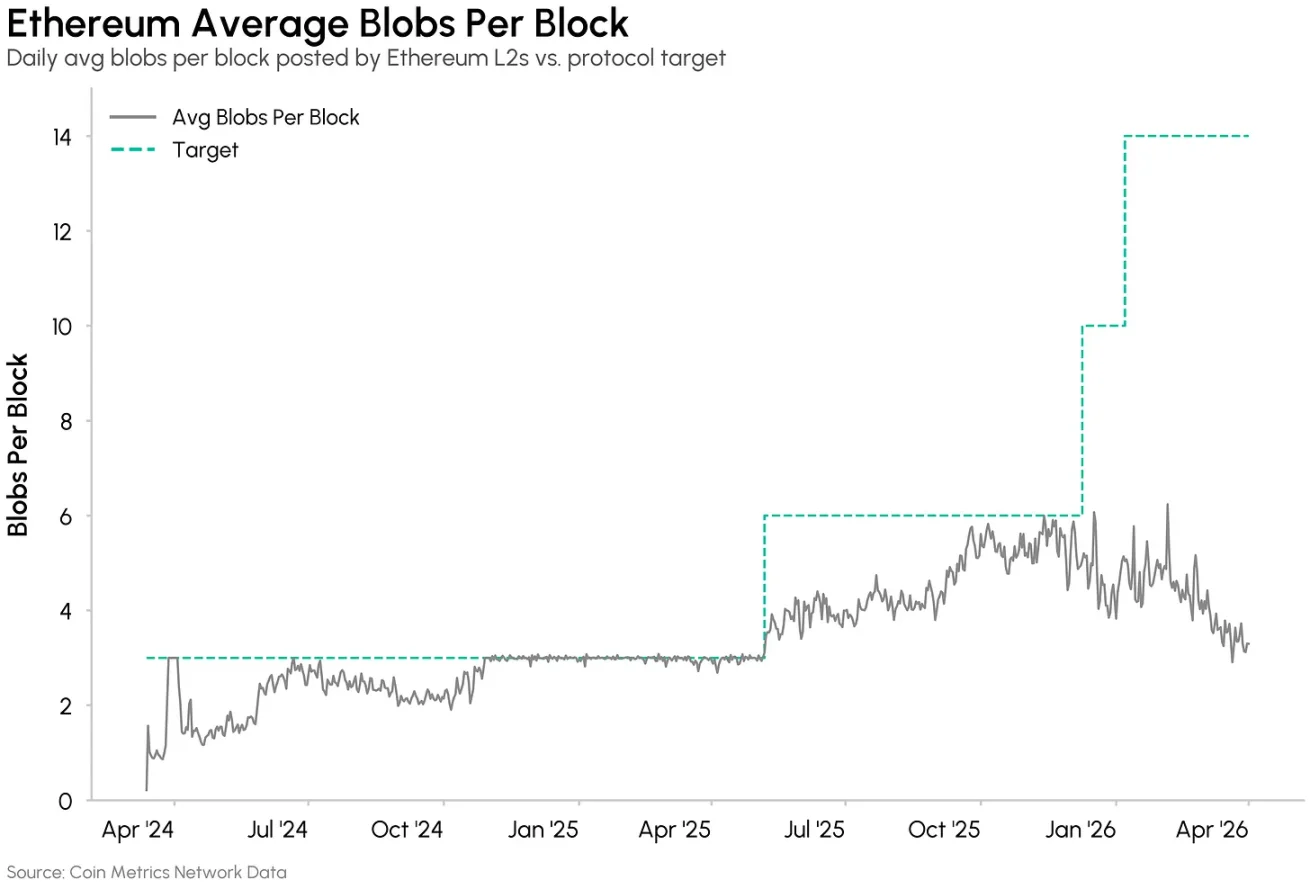
Number of Blobs contained in each block on Ethereum, data source: Coin Metrics
The L2s that have achieved sustainable growth are those with unique value propositions: Base relies on Coinbase for its distribution advantage, while Arbitrum leverages deep DeFi liquidity for its foundation. New generations of specialized public chains like MegaETH, Lighter, Robinhood Chain, and Ink target specific scenarios, providing new business models and distribution channels.
Ethereum's roadmap further promotes the deep integration of L1 and L2 through native Rollup interoperability and minimal trust architecture, consolidating its position as the core of ecosystem liquidity and settlement.
Glamsterdam and Other Upgrades
The upcoming Glamsterdam upgrade, planned for the first half of 2026, will continue this trend. By raising the Gas limit to 200 million and introducing parallel transaction execution, this upgrade aims to significantly enhance L1 throughput while reducing transaction fees for complex smart contract interactions. Additionally, the proposal-builder separation mechanism (ePBS) integrates block construction into the protocol, reducing MEV centralization and improving transaction ordering transparency. These changes aim to make Ethereum L1 a more competitive execution environment, maintaining its status as a trusted platform for high-value settlement and DeFi.
Solana
Solana is shedding its early label as "the retail and meme coin chain" and is moving towards its vision of an internet capital market. With transaction fees below one cent and block times under 400 milliseconds, it serves as a natural carrier for high-frequency applications such as payments, micropayments, and high-frequency trading. This feature has attracted a number of professional applications that require large-scale low-latency execution.
Since the end of 2024, Solana's non-voting transactions have nearly doubled, averaging over 120 million transactions per day.
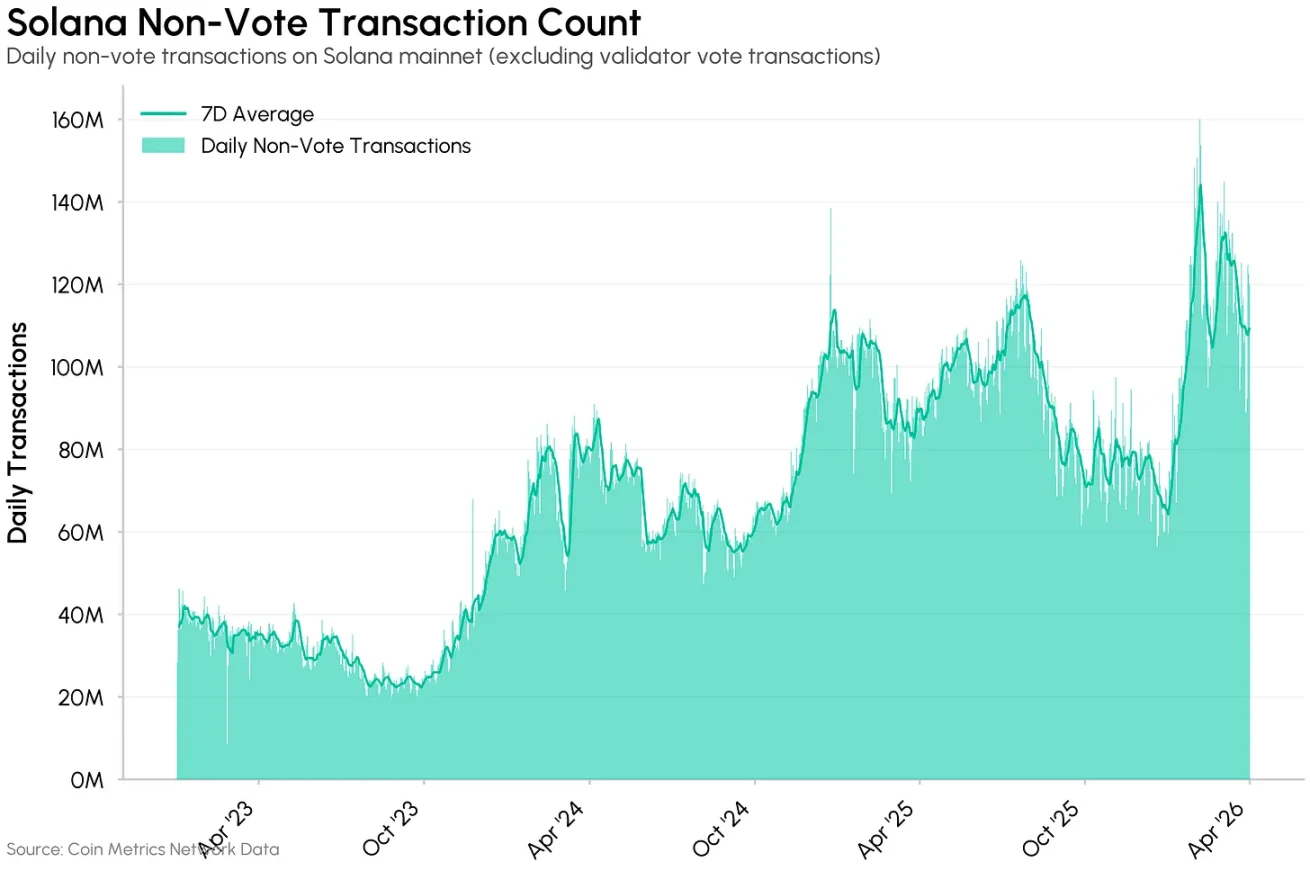
Number of non-voting transactions on the Solana network, data source: Coin Metrics
Payments and High-Frequency Micropayments
Solana's low-cost environment makes it a leading public chain for payments and personal value transfers. Daily transfers of USDC under $1,000 remain stable at around 3 million, with median transaction amounts consistently below $100.
An emerging development is the x402 protocol, an open HTTP payment protocol launched by Coinbase that allows any API or digital service to charge stablecoin fees on demand. Despite fierce competition from chains like Base and Stripe's Tempo, Solana still occupies a large share of x402 transactions, becoming an early landing layer for agent micropayments.
Trading Infrastructure
Solana's high throughput has also attracted specialized on-chain trading infrastructure. Proprietary Automated Market Makers (propAMM) developed by professional market makers use off-chain pricing models, resembling dark pools rather than public DEXs. Unlike AMMs like Uniswap, which are vulnerable to front-running and arbitrage, propAMM updates prices off-chain and settles on Solana, providing resistance to MEV.
Alpenglow and Other Upgrades
The upcoming infrastructure upgrade will further strengthen Solana's advantages. Alpenglow aims to replace the existing consensus with a lightweight voting aggregation protocol, targeting a reduction of final block confirmation time from about 12 seconds to 100–150 milliseconds. A block assembly market developed by Jito allows trading applications to independently control transaction ordering, supporting priority cancellation and other features, enhancing execution fairness.
Conclusion
As block space expands and costs compress, the core competition in the public chain industry is shifting from cost to specialization. Mainstream public chains leverage their architectural advantages to meet diverse scenario needs; specialized chains like Hyperliquid, Canton, Arc, and Tempo are optimizing extremely around application needs, making clear trade-offs in permissibility, compliance, and execution design. The key question for the future is how the industry landscape will evolve when on-chain demand truly explodes on a large scale.
The entire on-chain infrastructure still faces common risks. A paper by Google's quantum AI on March 31 pointed out that the number of physical quantum bits required to crack the elliptic curve encryption relied upon by mainstream blockchains like Bitcoin and Ethereum could be below 500,000, just 1/20 of the previously estimated 20 million. Early proposals like Bitcoin BIP-360 and Ethereum's post-quantum roadmap have begun to take shape. A deeper challenge lies in coordinating community consensus and voluntary adoption within a decentralized network, a process that may be slower and more unpredictable than with centralized institutions.
免责声明:本文章仅代表作者个人观点,不代表本平台的立场和观点。本文章仅供信息分享,不构成对任何人的任何投资建议。用户与作者之间的任何争议,与本平台无关。如网页中刊载的文章或图片涉及侵权,请提供相关的权利证明和身份证明发送邮件到support@aicoin.com,本平台相关工作人员将会进行核查。


