Since the closure of the Strait of Hormuz on March 2, approximately 17.8 million barrels per day of oil circulation globally have been disrupted. In March alone, Brent rose nearly 60%, while WTI increased by about 53%. This is the steepest single-month increase for the Brent contract since its inception in 1988, breaking the 46% record set during the Gulf War in 1990.
Normally, a surge in oil prices raises inflation expectations, leading to rising bond yields. For most of the past twenty years, oil prices and the 10-year U.S. Treasury yield have indeed been positively correlated. But this time, they moved in the opposite direction.
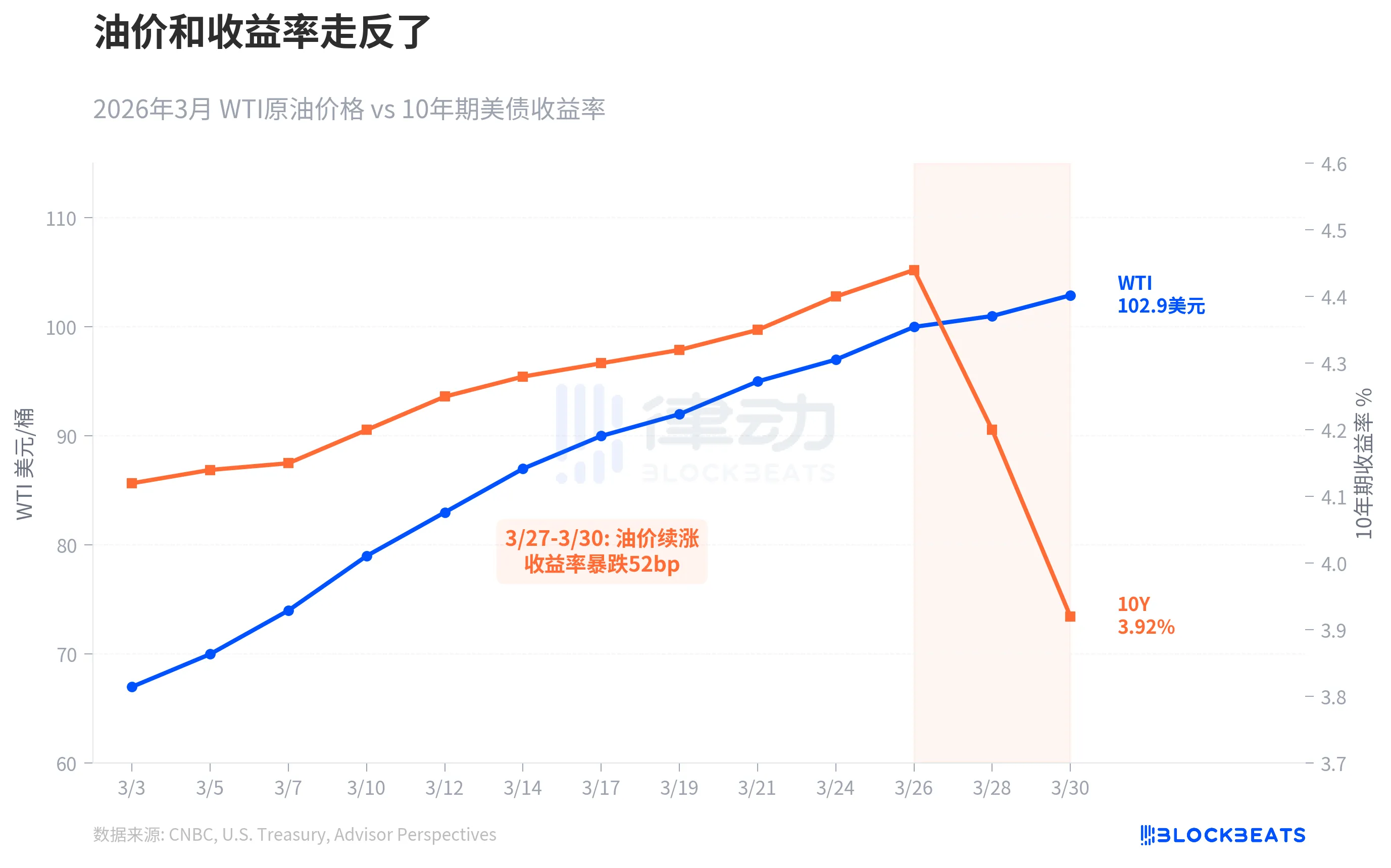
In the first three weeks of March, both were rising in sync. WTI rose from $67 to $100, and the 10-year yield increased from 4.15% to 4.44%. The turning point occurred between March 27 and March 30: while oil prices continued to soar, yields plummeted from 4.44% to 3.92%, dropping 52 basis points over three trading days and falling below the psychologically significant 4% mark.
This is a classic example of "flight to safety." The bond market is making a judgment: the risk of economic growth has surpassed the risk of inflation. The exact words of the economic research firm Oxford Economics are "the risk of economic growth is beginning to outweigh the risk of inflation." In other words, the market is not unafraid of inflation; it is more afraid of recession.
This decoupling is not common, but whenever it occurs, the subsequent story is rarely positive.
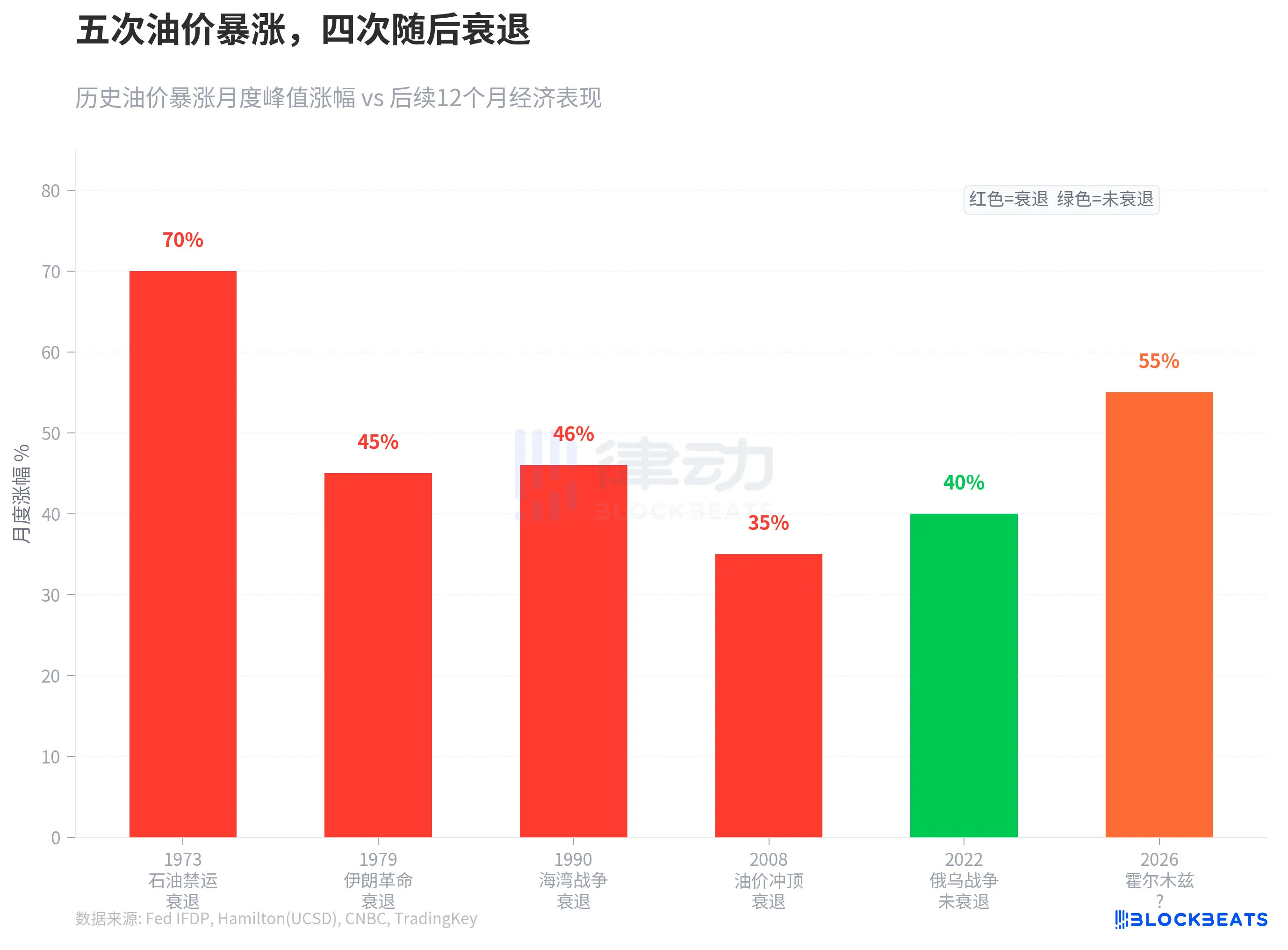
In the past half-century, there have been five instances where oil prices surged more than 35% in a short period. During the 1973 oil embargo, U.S. GDP subsequently fell by 4.7%. In 1979, during the Iranian Revolution, the global GDP deviated by 3 percentage points from its trend growth. The Gulf War in 1990 caused a brief recession in the U.S. In 2008, oil prices peaked at $147, and although the main cause of that recession was the financial crisis, the oil price shock accelerated the economic downturn. The only exception was the surge in oil prices driven by the Russia-Ukraine war in 2022, which did not trigger a recession, but came at the cost of the most severe inflation in 40 years.
The rise in March 2026 exceeded all the aforementioned cases. According to research by Federal Reserve economist James Hamilton, there is no mechanical correlation between oil price shocks and recessions, but "the greater the net increase in oil prices, the more significant the suppression of consumption and investment." Goldman Sachs has raised the probability of a U.S. recession to 30%, while consulting firm EY-Parthenon puts the figure at 40%.
The market's reaction has also been unusually swift.
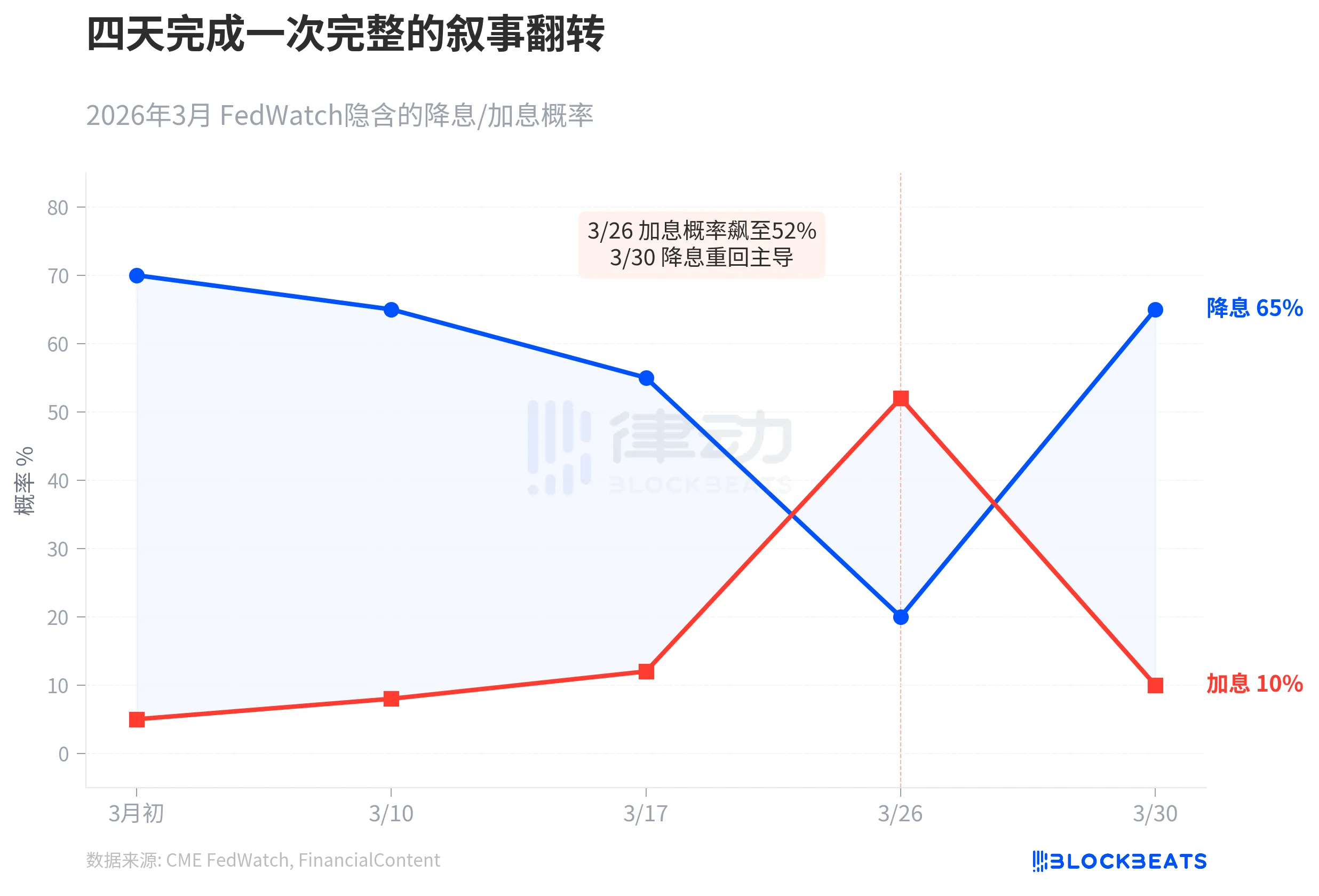
At the beginning of March, CME FedWatch indicated that the market expected three interest rate cuts throughout the year, with a 70% probability of a cut in June. Then oil prices continued to rise, and on March 26, the U.S. import price index jumped by 1.3%, while incoming Federal Reserve Chairman Kevin Warsh hinted that the neutral interest rate might be higher. On that day, the probability of a rate hike this year soared to 52%, and the 10-year yield reached 4.35%. FinancialContent defined that day as "The Great Hawkish Pivot."
Four days later, the narrative completely flipped. On March 30, consumer confidence data fell sharply, manufacturing unexpectedly contracted, and the 10-year yield plummeted to 3.92%. According to FinancialContent, the market's bets on a dovish pivot from the Federal Reserve in May rose to 65%. Goldman Sachs stated that the market had bet wrongly on the direction of rate hikes. On that day, Powell told undergraduates at Harvard University that the Federal Reserve "has not yet reached the moment when it must decide whether to look through the war's impact," but emphasized that "anchoring inflation expectations is key."
According to Axios, Powell's statement was interpreted by the market as: the Federal Reserve does not want to raise rates to combat inflation, nor is it eager to cut rates to save the economy, but is waiting to see if this supply shock is temporary or persistent. However, the bond market can no longer wait.
If history is any guide, Citigroup strategist McCormick put it plainly: the outlook is for stagflation, which is bad for bonds and bad for stocks.
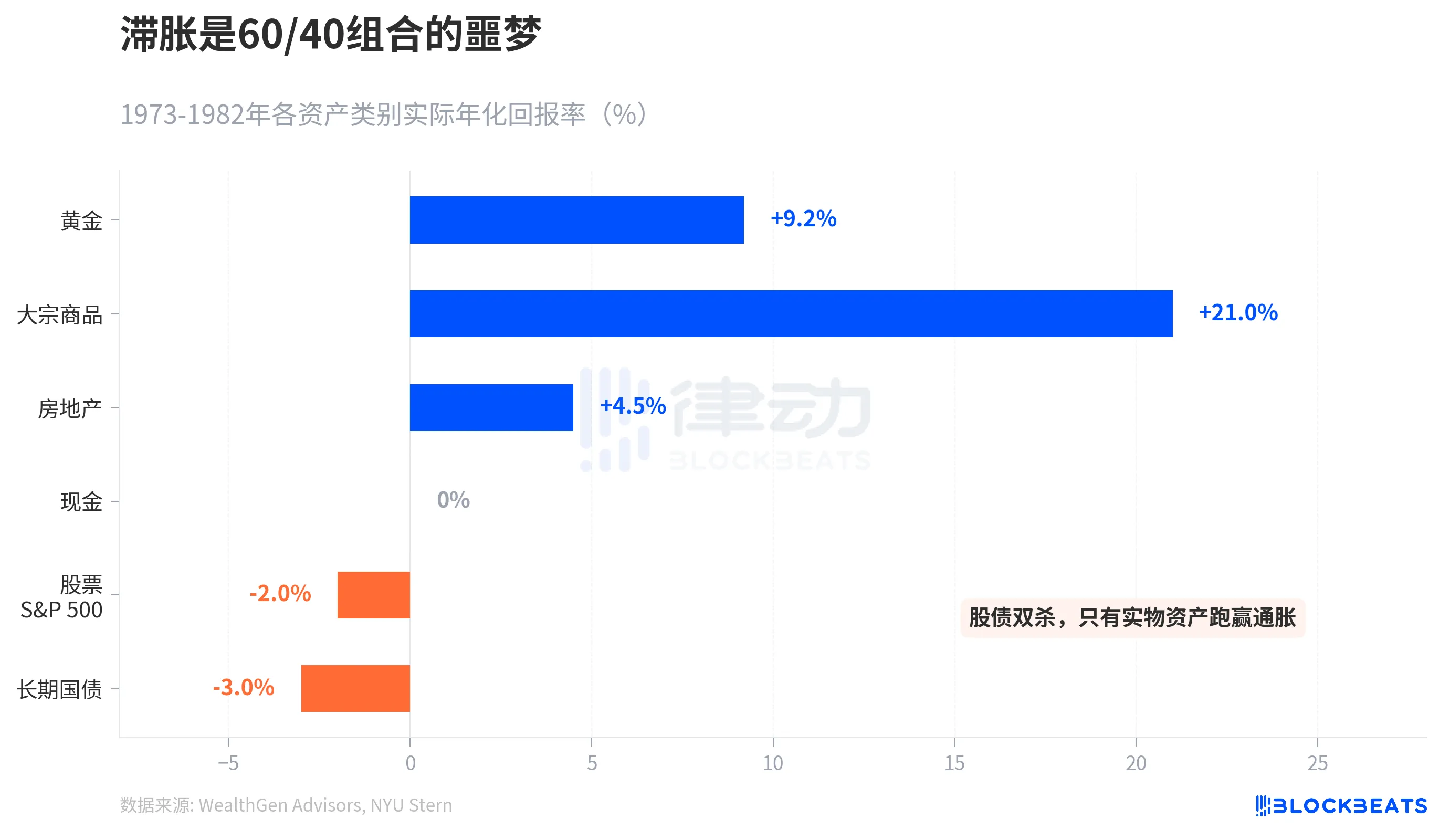
The stagflation from 1973 to 1982 provided a performance report on asset returns. Gold had an annualized real return of +9.2%, the commodity index (S&P GSCI) increased by 586% over ten years, and real estate gained +4.5%. In contrast, the S&P 500 had an annualized real return of -2%, and long-term treasuries were at -3%. According to historical data from NYU Stern, long-term treasuries in 1979 suffered a loss of -8.6% in a single year.
The traditional 60/40 investment portfolio (60% stocks + 40% bonds) was squeezed in stagflation. The only assets that could outpace inflation were tangible assets. Société Générale predicts that the average Brent price in April will be $125, with a "credible peak" of $150. Goldman Sachs is slightly more conservative, forecasting an average of $115 in April, assuming that the Strait of Hormuz will reopen within six weeks and will fall back to $80 by the end of the year.
The bond market has already made a choice for everyone, betting on recession over inflation.
免责声明:本文章仅代表作者个人观点,不代表本平台的立场和观点。本文章仅供信息分享,不构成对任何人的任何投资建议。用户与作者之间的任何争议,与本平台无关。如网页中刊载的文章或图片涉及侵权,请提供相关的权利证明和身份证明发送邮件到support@aicoin.com,本平台相关工作人员将会进行核查。


