Author: Long Yue
Recently, the memory prices that had been rising for several months suddenly turned down, sparking market concerns about reaching the peak of the memory cycle.
According to market tracking data, several U.S. retailers have significantly reduced prices of DDR5 memory, with the highest drop per set reaching $100. Taking Corsair's VENGEANCE series as an example, its 32GB capacity model with a peak frequency of 6400MHz is currently priced at about $379.99, a substantial decline from a recent peak of $490, with a drop of over $110 per set.
The domestic market has also been impacted, with wholesalers telling the "China Business Journal" that prices for mainstream 16GB memory modules have "dropped by more than a hundred yuan in a single day," and large stockpilers are selling off aggressively.
"Starting last Saturday, the prices just collapsed," said Mr. Wang, a wholesaler who has been selling storage devices for years, to the media. He showed an extreme price curve for a mainstream 16GB 3200MHz memory module: it was only over 130 yuan last May, then skyrocketed to a peak of 980 yuan in December. However, after several months of high-level fluctuations, the current spot price has fallen back to around 700 yuan.
Mr. Wang lamented that due to the price increase exceeding consumer expectations, "people won't buy unless it's a necessity, and compared to before November last year, our sales have dropped by more than 60%."
Meanwhile, Google released a paper on a new compression algorithm called "TurboQuant." The study pointed out that this technology could reduce memory usage for key-value cache (KV Cache) during large language model operations by at least 60%. Investors quickly priced this in: the AI hardware shortage issue will be fundamentally alleviated, and memory demand will be significantly reduced.
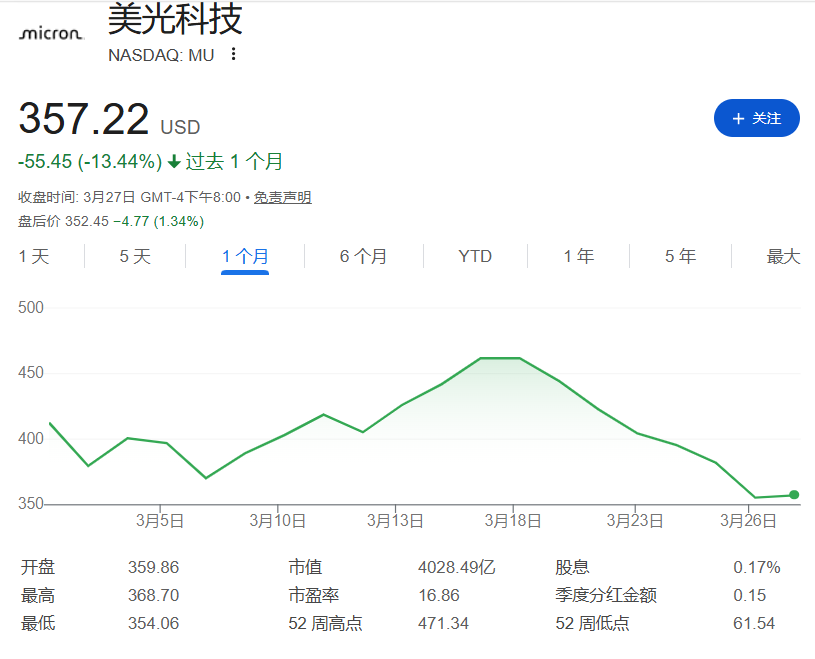
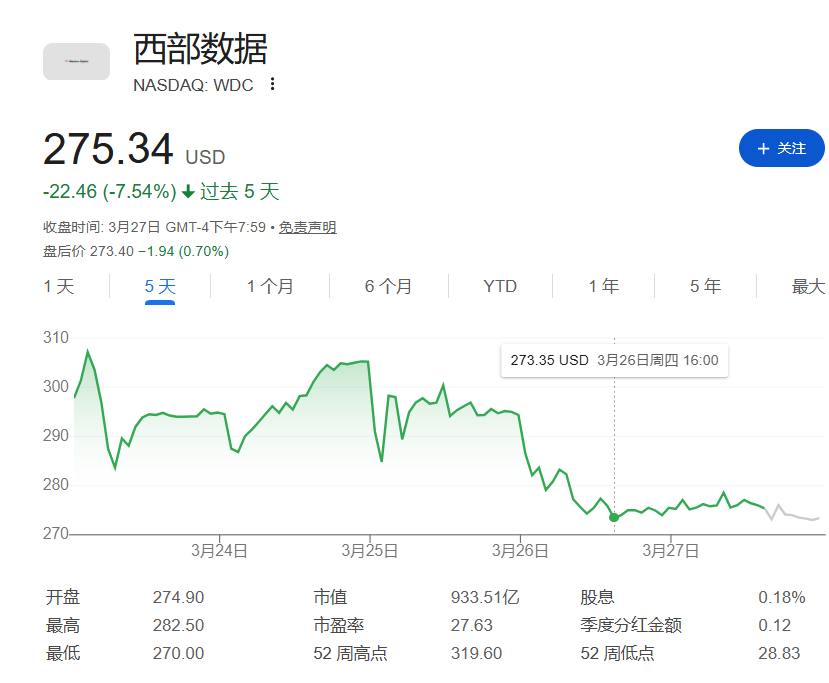
The chill of the spot market swiftly transmitted to the capital market. Micron Technology's stock price has retreated over 24% from recent highs, and Western Digital has also fallen nearly 21% from a peak of $777.60. Meanwhile, last week the U.S. memory chip sector saw nearly $100 billion wiped off its market value.
Faced with plummeting prices and stocks, market participants have developed serious divergences regarding the outlook for the memory industry. Some investors believe that the traditional memory "pig cycle" has peaked, while HSBC argues that market concerns are excessive, and we are currently in the middle of an AI-driven memory supercycle, with strong demand for high-end products like HBM, and memory shortages may persist for one to two years.
Buyers Say "No": Is the Traditional "Pig Cycle" Repeating?
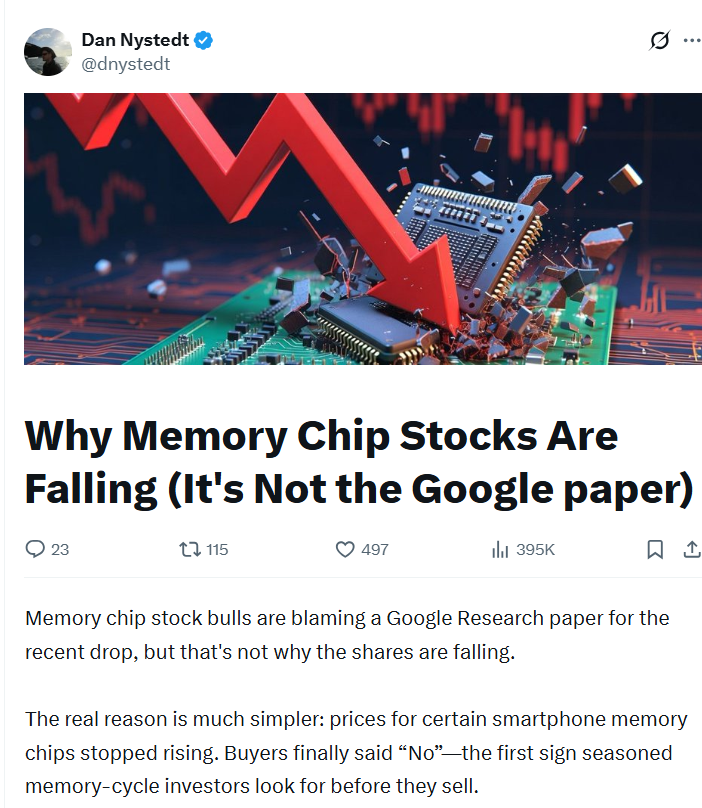
For traders following the traditional cycles, the market plunge is not that simple. Former journalist and well-known semiconductor analyst Dan Nystedt pointed out that many bulls blame the recent crash on Google's paper, but that is just a façade. Dan believes the real reason is that the prices of certain smartphone memory chips have stopped rising.
"The real reason is much simpler: the prices of certain smartphone memory chips have stopped rising. Buyers ultimately said 'no'—this is the first peak signal that seasoned memory cycle investors look for before selling."
Dan Nystedt noted that due to the high prices of DRAM and NAND, some smartphone manufacturers plan to reduce or even cancel production of mid-to-low-end phones by 2026. He revealed that two weeks ago, buyers had already rejected higher DDR4 prices.
Dan Nystedt likens the memory industry to the "pig cycle" in agriculture: high prices prompt companies to expand production, but constructing new factories takes time, leading to price crashes when new capacity is released simultaneously. He believes that investors following this script have quickly withdrawn, resulting in significant corrections in Micron and SanDisk's stock prices.
Over the past 50 years, memory chips have gone through more than a dozen major boom/bust cycles. There have been three since 2010: 3G/4G and cloud computing explosions from 2012 to 2015; the expansion of 5G and cloud service providers from 2016 to 2019; and the pandemic-driven surge in PCs/servers from 2020 to 2023. The cycle beginning in 2024 is driven by AI servers (HBM and SRAM).
"Whenever someone writes 'this time is different,' it is usually a classic sign of bullish mania," Nystedt quoted legendary trader Jesse Livermore: "The market is always right, and opinions are often wrong." He cautioned investors that when chip buyers no longer panic-buy, and when rebounds repeatedly encounter sustained sell-offs, seasoned funds will quickly retreat according to the script.
Structural Change: Are Memory Companies No Longer "Cyclical Stocks"?
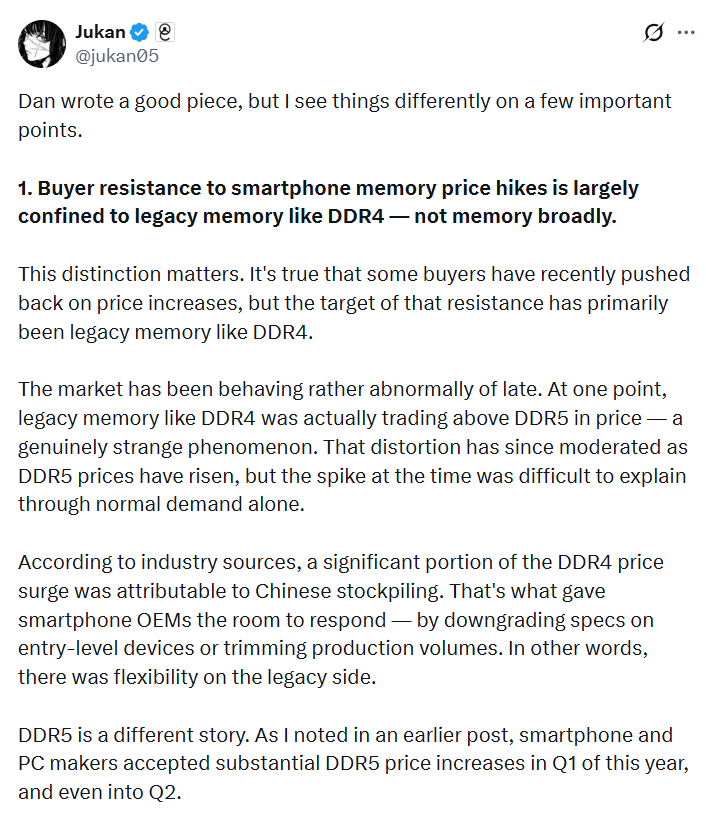
However, independent analyst Jukan has a different view on Dan Nystedt's analysis.
He pointed out that buyers' resistance to rising prices is mainly focused on traditional memory like DDR4, rather than the entire memory market. The earlier abnormal surge in DDR4 prices was partly attributed to stockpiling in the Chinese market, which gave smartphone manufacturers leeway to adjust specifications for low-end devices.
"But DDR5 is a completely different story," Jukan pointed out. Smartphone and PC manufacturers have honestly accepted significant price increases for DDR5 in the first quarter and even the second quarter of this year. In the current AI and high-end device ecosystem, DDR5 is not a negotiable target, but a core input that buyers must secure even at a premium. Flagship products built around DDR5 cannot lower their specifications at all.
Secondly, the market entirely overlooks the fundamental transformation of the business models of memory giants. Jukan scoffed at the so-called "seasoned investors" who blindly sell when spot prices drop.
"The way memory companies operate is no longer the blind expansion model of the past." Jukan keenly observed that the three giants—Samsung, SK Hynix, and Micron—are moving towards TSMC's business model—only constructing capacity after ensuring advance payments and long-term visibility of core customer demand.
Recently, South Korean media reported that Samsung is discussing cooperation agreements based on advance payments with giants like Microsoft. Memory giants understand better than anyone the pain of oversupply destroying cycles. Therefore, they are now pursuing extremely restrained capacity expansion, rather than reflexive overbuilding.
Investment Banks Support: Memory Supercycle is Just Midway, Market's Five Major Concerns are Excessive
In contrast to the panic sentiment in the spot market, investment banks remain confident about the long-term prospects for the memory industry. HSBC clarified in a research report released on March 30 that "in our view, the current concerns are exaggerated; we are at the midpoint of an AI-driven supercycle."
The current market concerns are all overreactions, and the bank listed five specific worries:
1)The negative impact of the Middle East conflict on raw material and electricity price increases;
2)Slower growth rate of memory prices in the second half of 2026;
3)Industry technologies like Google's "TurboQuant" and Nvidia's "KVTC" that reduce memory usage for AI systems;
4)Gradually increasing capital expenditure plans from major memory manufacturers;
5)Intensified competition from Chinese memory manufacturers.
The report pointed out that the Middle East conflict has no substantial impact on memory manufacturers' procurement of raw materials. And the absolute growth in profits will have a far greater impact on stock prices than the slowing slope of DRAM price increases. Meanwhile, memory manufacturers continue to exercise a high degree of awareness and restraint in executing their capital expenditures.
Regarding Google's TurboQuant technology, which triggered the market sell-off, the bank believes that concerns are premature. This technology will take about another year to commercialize, and its reference parameters are smaller than the current AI environment. More importantly, the bank noted that TurboQuant alleviates memory bandwidth bottlenecks, enhances system efficiency, and reduces Token costs, thereby accelerating the commercialization and popularization of AI. The report stated:
"The net effect is that we believe efficiency improvements will accelerate the development of AI—this is a positive event that should lead to a dramatic increase in AI adoption rates."
At the same time, the bank expects that in 2026, AI server shipments will increase by 28% year-on-year. From 2026 to 2027, the average DRAM content per server will achieve a strong increase of 17%. As demand for AI inference surges, enterprise-level solid-state drives (eSSD) are entering a golden era. The report predicts that by 2027, eSSD will account for 40% of total NAND demand, up from 18% in 2023, with AI servers consuming 62% of that.
The bank believes that the current market is at the midpoint of an AI-driven supercycle, comparable in scale to the sustained six-year DRAM shortage triggered by office automation from 1990 to 1995. Historically, from 1990 to 1995, with the popularization of Windows 3.0 and subsequent operating systems, office automation triggered a six-year structural shortage of DRAM, boosting the DRAM market size from $7 billion in 1990 to $41 billion in 1995.
The bank believes that the infrastructure development driven by large models, agentic AI, and physical AI (like autonomous driving) will lead to memory shortages that will last at least one to two years.
Based on these assessments, the report firmly supports their certainty of benefiting from the memory supercycle. Regarding the recent plunge, the report stated: "We believe any pullback provides an additional buying opportunity."
免责声明:本文章仅代表作者个人观点,不代表本平台的立场和观点。本文章仅供信息分享,不构成对任何人的任何投资建议。用户与作者之间的任何争议,与本平台无关。如网页中刊载的文章或图片涉及侵权,请提供相关的权利证明和身份证明发送邮件到support@aicoin.com,本平台相关工作人员将会进行核查。


