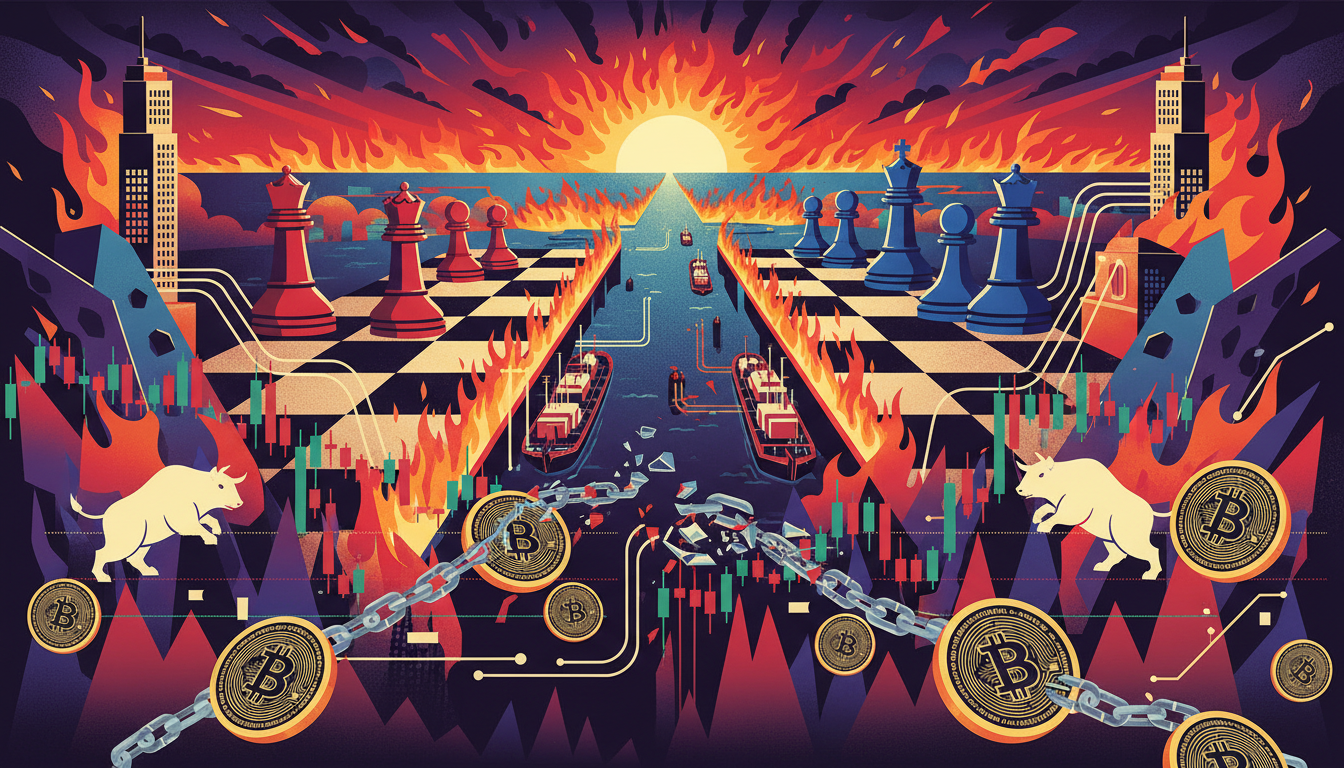
On March 26, 2026, at East 8 Time, U.S. President Trump made a tough statement on social media regarding negotiations with Iran, using direct language and setting harsh parameters for future negotiation space and concessions from the other side, though he did not mention specific military action details. This political signal, originally belonging to the realm of diplomacy and security, was quickly intercepted and pushed by information sources like Jin10 Data and soon was retweeted and amplified by several cryptocurrency and financial media outlets, including Golden Finance and Deep Tide TechFlow, rapidly entering the cryptocurrency community's vision and triggering a noticeable emotional fluctuation. The question is, why could such a statement, unrelated to on-chain technology, regulatory rules, or even exchange business, quickly mobilize discussions and trading activities in the crypto market, even being interpreted as a trigger point for "risk aversion"?
How a Tough Statement from Iran Ignited Interest
From the information link perspective, the dissemination path of this incident is relatively clear: Jin10 Data first released Trump's tough statement on Iran negotiations in the form of a news flash, followed by mainstream cryptocurrency and financial media like Golden Finance and Deep Tide TechFlow translating, recapping, and following up with news flashes, bringing originally more macro and geopolitical content into the crypto community. In social media and trading groups, headline tags like "tough" and "risk of negotiation breakdown" amplified the tension and uncertainty of this news, rapidly transforming it from "political news" to "trading material."
In the traditional asset world, similar statements are typically viewed as leading signals of escalating geopolitical tensions; the market instinctively associates them with sanctions, oil supply risks, and rising chances of regional conflict, thus making preemptive hedging and speculative layouts on oil, gold, and some defensive assets. This pricing logic of mapping political signals to risk premiums naturally spills over into all high-volatility assets. Furthermore, within the global multi-market pricing system, crypto assets have already been regarded by many institutions and traders as "high beta risk assets," often being the first to bear the brunt of emotional fluctuations.
In contrast, traditional assets typically experience a chained response to the same geopolitical signal through "macro interpretation—institutional assessment—market reaction," with a relatively layered rhythm; while in the crypto market, media news flashes and community retweets almost occur simultaneously, with emotions amplified within seconds to minutes, and price movements (even in the absence of clear data) exhibit higher frequency tentative volatility. In other words, the same geopolitical signal often reflects quicker pricing and more exaggerated emotional amplitudes in crypto assets, which is the fundamental reason why a tough statement regarding Iran can ignite discussions in the cryptocurrency circle in such a short time.
Risk Aversion Emotional Script: From Oil to Gold
In the coverage of this incident, Golden Finance directly quoted "a typical risk aversion trading environment," pointing out the classic behavioral patterns of capital driven by news: when political or geopolitical risks surge, the market's first reaction is not to accurately assess the conflict probability, but instinctively to seek hedging and speculative targets. In such an environment, the news itself resembles a "trigger switch"—what truly drives prices is investors' subjective pricing on future uncertainties and mutual imitation.
Looking back in history, there are certain commonalities in the capital migration patterns during several geopolitical conflicts and sanction escalation cycles: oil is preemptively driven up due to tightening supply expectations, gold attracts incremental funds due to its "value storage" and "risk aversion anchor" narrative, while some currencies and bonds passively benefit as hedging tools. Nowadays, as "risk aversion" becomes a mainstream keyword, capital no longer merely circulates between oil and gold, but also evaluates whether there is a need for additional layouts in high-volatility assets—this provides space for crypto assets to enter the narratives of risk aversion and speculation.
The complexity of the crypto market lies in its simultaneous carrying of nearly opposing narratives of "risk aversion" and "high-volatility speculative products." Some investors see Bitcoin as a cross-border asset allocation tool during concerns over dollar liquidity, regional currency depreciation, or expectations of capital controls; others purely regard it as a speculative target for high leverage and high elasticity. In events like Trump's statement on Iran, both narratives are often simultaneously awakened: some anticipate "risk-averse buying pressure," while others bet on "short-term opportunities" brought by volatility. If investors mistakenly take political news as a unidirectional confirmation signal and ignore the tug-of-war of such dual narratives, it can easily lead to mismatches in position selection and leverage multiples, ultimately being educated by the market in repeated oscillations.
News as Chips: How to Maneuver Political Topics
Deep Tide TechFlow explicitly warned in its commentary, "we must be cautious of market manipulation using political news,” highlighting a significant structural risk in the crypto market: news trading is more easily amplified and even abused here. In an environment lacking unified regulation, with ambiguous information disclosure standards and highly decentralized global participants, a piece of political news can often morph into different versions of a "trading story," deliberately or inadvertently crafted into an emotional lever.
If we break down the rhythm of such news trading, we can roughly see a repeating closed loop: first, there is first publishing—information platforms represented by Jin10 Data gain speed advantage, forming a "source halo"; next comes the community amplification phase, where various微博, X, Telegram, and Discord communities rapidly retweet, stacking clickbait processing, causing the event's tension level to be reinterpreted; then comes the KOL-followed interpretations, where opinion leaders often provide biased explanations, packaging the originally vague political signals into bullish or bearish "reasons"; lastly, short-term market collaboration occurs, where some funds take advantage of emotional inertia to actively push prices up or down, completing a cycle from news to price.
In such a closed loop, the importance of the event itself and the intensity of price reactions often show a clear misalignment. A statement with unclear macro-level influences can be interpreted as a trading signal that must "respond immediately," while slight fluctuations during emotional surges may be seen as "policy pricing," yet when subsequent information disclosure shows limited impact, prices may have already gone through a round of severe ups and downs. For ordinary participants, it is more crucial to learn to separate "the size of the event itself" from "the extent of price reactions", realizing that many times what they face is not "information," but rather amplified emotions and narratives.
Concurrent Positive News: XAUt and
It is noteworthy that on the same day Trump made a statement about Iran, two pieces of genuine positive news were also developing within the crypto market: first, the launch of XAUt spot trading on Binance has been confirmed; second, Alchemy Pay has completed its Hong Kong SFC license upgrade, which has also been validated by multiple sources. These two pieces of news, combined with the backdrop of geopolitical tension, made the narrative environment for that day even more complex.
Assets like XAUt, which are linked to gold prices, naturally possess appeal to capital amid heightened geopolitical tensions and risk aversion feelings. For some investors, this provides a convenient channel to "gain exposure to gold on-chain": it can connect with traditional risk aversion narratives while remaining within the crypto ecosystem for allocation and circulation. Binance's choice to launch XAUt spot trading at this juncture is inevitably interpreted by the market as a product layout "in line with risk aversion sentiments," which makes its trading volume and attention easily amplified in the short term.
On the other hand, the completion of Alchemy Pay's SFC license upgrade in Hong Kong is typically a compliance expectation positive news. Hong Kong is viewed as a key experimental field in the crypto compliance process in Asia and even globally; a firm related to payment and fiat currency gateways obtaining a higher level of regulatory approval is interpreted as a signal that "the regulatory environment is becoming clearer." This type of news does not directly point to price but rather reinforces the long-term expectations of "increased compliance and institutionalization" at the macro narrative level.
When the three types of narratives—"risk aversion sentiment," "compliance progress," and "new offerings online"—run parallel on the same trading day, market attention often shifts continuously: short-term traders may focus on Trump's statements for trades, mid-term funds will pay attention to the linkage opportunities between XAUt and gold prices, while longer-term allocation groups will direct their focus towards the regulatory direction behind the Hong Kong license upgrade. For individual investors, the challenge lies in figuring out how not to be completely led by the most dramatic one (often political news) amidst multiple overlapping narratives, while ignoring those "cold news" that may have a more structural impact on their positions.
The Lack of Data: When We
From the existing public information, this incident lacks precise and verifiable data disclosure regarding prices and trading volumes. The brief states clearly that there are currently no specific currency fluctuation points, liquidation scales, or transaction volume details that can be safely cited, thus this article can only analyze from the media dissemination path and emotional structure rather than making conclusions like "once the news is out, prices immediately surge/fall by X%." In other words, we are discussing correlations and resonance mechanisms, not the necessary causation pieced together afterward.
Also, due to the lack of complete data, we should adhere to a basic principle: we cannot simply equate Trump's statements with the price trends of Bitcoin or any specific currency. In an environment where multiple global variables are simultaneously at play, any single political event is just one part of it. It can become an emotional trigger point and can help to build narrative frameworks, but whether it truly dominated the price direction requires more systematic data support and a longer observation period, rather than relying on a few candlestick lines or social media screenshots to make judgments.
At this stage, where information has not yet been fully disclosed and data collection is still insufficient, a healthier mindset is to view the current market reaction as a "hypothesis driven by emotion"—it has some persuasive power but is far from "ironclad evidence." This is entirely different from the deterministic view of conspiracy theories: the latter tends to think "everything is a designed trap," searching for behind-the-scenes manipulators in every fluctuation; the former allows for uncertainty to exist, acknowledging that at present, one can only see part of the puzzle. In the high-noise crypto market, maintaining the former mindset is the first line of defense against incorrect attribution and overconfidence.
Establishing Oneself Amid Noise and Market Conditions
Based on Trump's statement regarding Iran and its resonance in the cryptocurrency circle, a relatively clear picture emerges: the crypto market has an extremely high sensitivity to geopolitical narratives, which is further amplified into an emotional "amplifier" under the structures of high leverage, 24-hour global trading, and social media. A political statement not yet fully verified and interpreted, which might only lead to marginal adjustments to risk premiums in traditional markets, can easily ignite community discussions, follow-ups by KOLs, and short-term speculative contests in the crypto realm.
In such an environment, the practical strategy is not to reject all messages, but to learn to break down into three dimensions: firstly, the source and credibility of the news—was it from Trump's personal social media account, or a retelling and second-hand clickbait; secondly, the timeline—do the statement occurrence time, media first release time, and large-scale dissemination time match, and is there a case of "old news being rehashed"; thirdly, the intensity of market reactions—do the changes in price and volume match the event's magnitude, or is it clearly "overreacting". Analyzing these three aspects separately can significantly reduce the probability of being exploited by a single narrative in decision-making.
Looking ahead, geopolitical events and compliance processes are likely to frequently intertwine to affect cryptocurrency prices: on one side are hardline statements and sanctions from figures like Trump, and on the other, the continuous implementation of regulatory frameworks in Hong Kong, Europe, and the United States; these two forces can either reinforce each other or hedge against one another. For investors, it is crucial not to predict the short-term direction of any single news piece, but to quickly establish a relatively stable event evaluation framework: to clarify information sources, untangle timelines, and match market reactions, leaving personal thinking space between noise and market movements, instead of passively chasing the last candlestick in every "political shock."
Join our community to discuss and become stronger together!
Official Telegram community: https://t.me/aicoincn
AiCoin Chinese Twitter: https://x.com/AiCoinzh
OKX Benefits Group: https://aicoin.com/link/chat?cid=l61eM4owQ
Binance Benefits Group: https://aicoin.com/link/chat?cid=ynr7d1P6Z
免责声明:本文章仅代表作者个人观点,不代表本平台的立场和观点。本文章仅供信息分享,不构成对任何人的任何投资建议。用户与作者之间的任何争议,与本平台无关。如网页中刊载的文章或图片涉及侵权,请提供相关的权利证明和身份证明发送邮件到support@aicoin.com,本平台相关工作人员将会进行核查。