On March 25, East Eight Zone Time, Iran formally submitted a response to the U.S. regarding their 15 proposals through intermediaries, further escalating the already tense situation in the Middle East and bringing the Strait of Hormuz back into global focus. This narrow waterway, which controls the global energy artery, is not only a shipping route for tankers but also an invisible gate for the pricing of financial assets. As news of the response unfolded, the three major U.S. stock indices all adjusted downwards, with the Dow Jones falling approximately 0.47%-0.48%, the S&P dropping 0.74%-0.80%, and the Nasdaq declining 1.09%-1.12%. Concept stocks closely related to crypto assets such as Circle, Coinbase, and Robinhood also faced pressure, reflecting that the sensitivity of traditional finance and the crypto market to geopolitical risks is being repriced.
In this confrontation surrounding the Strait of Hormuz and regional warfare, the paths for capital seeking safety have become more complex: some capital is flowing back into gold and crude oil, the two traditional safety nets, while another part is rapidly switching positions within crypto assets, tentatively searching for a new safe haven among "digital gold," energy narrative tokens, and mainstream coins. This article will explore key points such as Iran's tough response, the simultaneous adjustment of U.S. stocks and crypto concept stocks, the warming narratives of gold and crude oil, and Binance's delay in launching XAUt, examining how funds migrate between multiple assets under the shadow of war and risks in the Strait of Hormuz, seeking a new balance between panic and greed.
War Still Raging: Iran's Tough Conditions and Hormuz Chip
Iran's formal reply centers around three core demands: first, a ceasefire guarantee, requiring no further armed conflicts of similar scale in the future; second, war reparations, attempting to compensate for current and expected losses through long-term economic constraints; and third, a comprehensive ceasefire, aimed not only at halting current hostilities but also at changing the military realities of regional power plays. On the surface, this is a list concerning security and compensation, but in essence, it directly points at the United States' long-term strategic layout in the Middle East: Washington hopes to maintain dominance over regional security order and indirect control over energy routes, while Iran seeks to lock in its security boundaries and "settle" past conflicts by raising negotiation costs.
When viewed through the lens of geography and maritime power, the importance of the Strait of Hormuz is once again emphasized. This strait is a conduit for massive global oil and gas transport, and any statement by Iran regarding its control and influence over the passage will be interpreted by the market as potential "manipulation rights" over energy and financial markets. Iran's insistence on high threshold conditions in its response essentially ties the "security of the passage" to "national security," sending a signal to the outside world: as long as political demands remain unmet, Hormuz will always be an unstable factor in the pricing system. This instability does not need an actual blockade to amplify its effects; the mere expectation of "trouble may happen at any time" leads the energy market and related financial assets to continuously price in this risk ahead of time.
Under this backdrop, a more operable concept is being rapidly absorbed by the market—"Hormuz Risk Premium". It is reflected not only in Brent crude oil, shipping insurance rates, and regional bond yields but also spills over into crypto assets related to gold and crude oil. Capital begins to pay for "Hormuz uncertainty": part is locking in safety by buying gold, crude oil, and their derivatives, while another part is seeking leveraged risk exposure through tokens linked to XAU and crude oil prices on-chain. This premium mechanism sets the stage for the amplified volatility and migration of funds related to gold and crude oil in the following sections.
U.S. Stocks Adjusting and Crypto Concept Stocks Declining Together
On the same day that Iran’s response was delivered and digested by the market, March 25, the price reaction of U.S. stocks was quite direct. The Dow Jones Industrial Average fell about 0.47%-0.48%, the S&P 500 declined 0.74%-0.80%, and the tech-heavy Nasdaq index saw a larger drop of 1.09%-1.12%. The simultaneous weakness of the three major indices indicates that against the backdrop of rising geopolitical uncertainty, the market’s expectations for future profits and risk appetite are being recalibrated: even though there hasn't been a systemic sell-off, the atmosphere of "bulls are hesitant to add, and bears are starting to test" is already spreading.
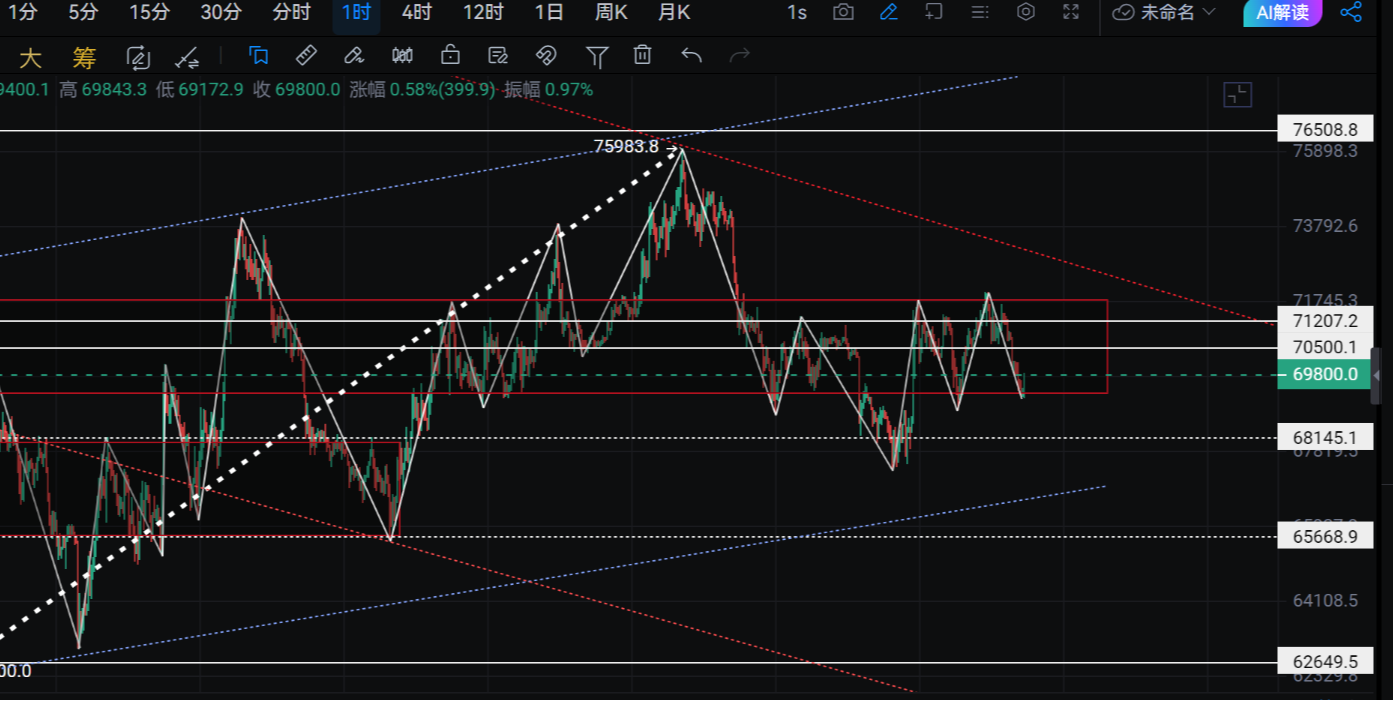
More significantly, the U.S. stocks related to crypto also experienced a widespread decline on the same trading day. Circle's stock dropped about -2.75%, Coinbase's decline fluctuated between -0.48% and -2.82%, while Robinhood fell approximately -1.16% to -1.72%. These companies stand at the intersection of "compliant finance" and "crypto-native," with their stock prices being sensitive to regulatory expectations and highly exposed to crypto asset volatility. As geopolitical risks raise overall risk premiums, Wall Street's tolerance for the combination of "crypto + geopolitical risk" has notably decreased, leading capital to discount potential liquidity withdrawals, volume declines, and rising compliance costs.
However, based on the currently available data, this round of declines appears more as a "sentiment discount", rather than a systematic deterioration of corporate fundamentals. The declines in the three major indices still remain within an acceptable range of daily fluctuation, and the adjustments in crypto concept stocks have not been accompanied by large-scale profit warnings or sudden negative regulatory news. For medium to long-term funds, this valuation compression triggered by geopolitical events actually leaves room for the subsequent narrative of "buying the dip": as war sentiment dulls and business data resumes dominance, the current discount may be partially repaired. In other words, the current price reflects the expectation of "if matters worsen," rather than the reality of "things have already worsened."
Gold and Crude Oil Narratives Heating Up: A Reflection in the Crypto Market
In every instance of escalated geopolitical conflict, gold and crude oil almost always become the first reflex of traditional markets. Gold carries the risk-hedging logic of "store of value and currency mistrust," while crude oil is closely tied to "supply security and inflation expectations." After Iran's response and the heightened tensions in Hormuz, this logic has been quickly absorbed by the crypto market, finding a speculative and hedging intersection through on-chain assets and derivatives tied to XAU and crude oil prices. For some traders, directly participating in spot gold and crude oil markets is quite challenging, while on-chain linked assets provide a more flexible and leveraged way of expression.
Interestingly, on March 26, East Eight Zone Time, media repeatedly mentioned that tankers were still passing normally through the Strait of Hormuz, indicating that from the perspective of real supply, oil and gas logistics have not seen large-scale interruptions. The "goods are moving" in the real world stands in stark contrast to the "Hormuz risk premium" already factored into the financial market: the supply side remains temporarily stable, while the price side has preemptively reacted to multiple rounds of tension. This contradiction essentially reflects the market's anticipatory trading of "tail risks"—even when there is no blockade currently, traders are still willing to pay for "potential future blockades."
In the crypto world, this expectation has been further leveraged and emotionalized. Tokens and derivatives related to gold and crude oil not only follow the fluctuations of the underlying assets but also amplify effects from on-chain capital movements, emotional FOMO, and liquidity depth. For readers, a more reasonable expectation framework is not to bet blindly on a one-sided trend but to realize: driven by geopolitical conflicts, such assets often first experience "increased volatility", then gradually reflect a directional trend over a longer cycle. In other words, what you see in the short term is more about the emotional amplification of bullish and bearish games, rather than a settled macroscopic logic.
Binance Delays XAUt Launch: The "Window" Imagination Under Risk Aversion
On the same timeline as the gold narrative is heating up, specific actions from crypto trading platforms have further stimulated market imagination. According to public information, Binance has postponed the launch time of XAUt to March 26, 22:00 (East Eight Zone Time), and this adjustment coincides with the aftermath of Iran's response, the adjustment of U.S. stocks, and rising risk aversion. In terms of substance, this is merely a timing change; the official explanation does not directly relate to the geopolitical situation. However, in an emotion-driven market, the "coincidence of timing" often has a more amplifying effect than "the explanation itself."
On one side, the risk-hedging narrative around gold is heating up in both traditional and crypto markets; on the other side, the launch of on-chain assets linked to gold is delayed, inevitably igniting richer market interpretations: some might view this as a rational adjustment for risk control and liquidity preparation, while others may perceive it as a conspiracy theory material "to leave room for large funds to layout." Regardless of the interpretation, it will further enhance the attention and trading activity received by XAUt after its official launch, as the market has already completed narrative warming in this "window period."
From the trading structure perspective, in the short term, assets linked to gold like XAUt may face a typical scene of competitive buying and profit-taking. If initial purchases are concentrated and market depth is limited when it launches, prices could be rapidly driven up under emotional influence, followed by a significant retreat due to the selling pressure from early chips and high-position short-term capital. This mode demands higher requirements for liquidity management and risk control: on one hand, insufficient depth leads to increased impact costs and price slippage; on the other hand, if ordinary participants mistakenly view "risk-hedging assets" as "unidirectionally appreciating assets," they can easily get washed out or trapped during high volatility.
From Panic to Greed: How Capital Seeks "Great Buy the Dip" Amidst War
Under the shadow of geopolitical conflict, market sentiment often first experiences amplified panic, and then transitions towards greed and reflexive buying the dip as uncertainty gradually gets digested. The judgment of Easy Li Hua, founder of Liquid Capital, is representative—he believes that "short-term wars are difficult to end, and this year will present great buying opportunities." The implication behind this statement is: the conflict will not be swiftly resolved, the risk premium will remain elevated for some time, but precisely this prolonged tug-of-war provides more ample layout windows for medium to long-term funds, rather than a sudden "panic bottoming."
Combining the volatility of crypto concept stocks and mainstream coins over the past two days, we can infer a typical path that institutions and seasoned traders might take: first, building positions in batches, slowly accumulating stocks during each sharp drop induced by geopolitical news, rather than making a single absolute bet on the "ultimate bottom"; second, using extreme emotions for price spreads, buying high liquidity assets that are undervalued during panic, and when overly optimistic, hedging or reducing positions through options, futures, or related concept stocks; third, rotating between sectors, for example, moving from more affected high-beta assets to "defensive" crypto targets related to gold and crude oil narratives, thereby lowering portfolio volatility through narrative shifts.
For ordinary investors, it is more important to learn to differentiate between "event-driven volatility" and long-term valuation logic. Iran's response, the U.S.-Iran standoff, and tensions in the Strait of Hormuz are all high-sensitivity event triggers that can significantly magnify price volatility in the short term but may not immediately change the profit and cash flow trajectory of a public chain, trading platform, or company for the next few years. If every sharp drop triggered by geopolitical conflict is regarded as a permanent reversal signal for trends, it is easy to sell at emotional lows and chase at emotional highs. A more rational approach is to view events as "amplifiers" in the cycle, used to optimize position costs and rhythm, rather than replacing long-term judgments based on fundamentals and valuations.
Standoff May Prolong: Long-Term Questions for the Crypto Market
In summary, Iran's insistence on the three major conditions of ceasefire guarantee, war reparations, and comprehensive ceasefire in its response implies that the probability of both parties reaching a "low-cost compromise" in the short term is low. As the U.S.-Iran standoff continues to pull at diplomatic, military, and public opinion levels, the critical chokepoint of the Strait of Hormuz will repeatedly emerge as a pricing factor for a longer time. In the coming months, as long as new setbacks in negotiations arise or regional conflicts see marginal escalations, the interconnected movements between gold, crude oil, and crypto assets will be reignited—sometimes manifested as stronger gold and crude oil, with risk assets pulling back, and other times as structural rotation within crypto, with capital seeking relatively safe yield zones among "U.S. tech stocks – crypto – commodities."
In the absence of detailed U.S. plans, a highly opaque negotiation process, and limited substantive progress, the geopolitical premium is unlikely to be "fully digested" by the market at once, but will instead exist in prices in the form of "repeated testing": each time news fluctuates, asset prices will repricing for the "worst-case scenarios," and then partially retract this premium when reality does not worsen to the degree imagined. This back-and-forth testing not only tests traders' risk tolerance but also their ability to manage positions and liquidity.
From a strategic perspective, a more robust response is not to attempt to predict the short-term direction of every news event but to respect volatility and prepare for position and liquidity management in advance. On one hand, view geopolitical conflict as an "accelerator" in this round of macro and crypto cycles: it can compress time and amplify the rhythm of bull-bear transitions, but should not be seen as the beginning and end of all narratives. On the other hand, maintaining a reasonable cash and high liquidity asset ratio, dynamically balancing between assets of different risk levels, is more crucial than making a high-stakes bet on a single "war inflection point." For true medium- to long-term crypto participants, the answer may not lie in "how this conflict will end," but rather in whether you have allocated enough safety margins and operational space for this potentially protracted geopolitical examination lasting several seasons or even years.
Join our community, let’s discuss and become stronger together!
Official Telegram community: https://t.me/aicoincn
AiCoin Chinese Twitter: https://x.com/AiCoinzh
OKX Benefits Group: https://aicoin.com/link/chat?cid=l61eM4owQ
Binance Benefits Group: https://aicoin.com/link/chat?cid=ynr7d1P6Z
免责声明:本文章仅代表作者个人观点,不代表本平台的立场和观点。本文章仅供信息分享,不构成对任何人的任何投资建议。用户与作者之间的任何争议,与本平台无关。如网页中刊载的文章或图片涉及侵权,请提供相关的权利证明和身份证明发送邮件到support@aicoin.com,本平台相关工作人员将会进行核查。