Recently, there are several phenomena in the cryptocurrency industry worth noting: multiple mainstream exchanges have sequentially released announcements for token delistings, including some previously popular projects; at the same time, our research indicates that nearly 90% of decision-makers at exchanges consider third-party data platforms for project evaluations.
Behind these phenomena, it reflects that project teams are facing some real challenges in terms of information disclosure. Today, we would like to sincerely discuss: what kind of solutions being included in RootData official listings can provide for these challenges.
What pain points do project teams face in information disclosure?
1. Pressure from the community and investors
When users or investors want to know about a project, they typically check: Is the team background clear? Is the financing information verifiable? Are there any updates to the product roadmap? Is the project still actively operating?
If this information is scattered across official websites, Twitter, Discord, and various media outlets and is not updated in a timely manner, it can easily be misunderstood as “the project has stagnated” or “the team is not transparent.” More troublesome is that some third-party platforms may contain incorrect information, and the project team is unsure how to correct it, leading to a distorted perception of the project.
A real situation is: The speed of information dissemination in the Web3 domain is fast, and false information can easily breed. We often encounter feedback from project teams that due to delayed information disclosure or misinformation, various unfounded speculations have emerged within the community, making them have to contact us, hoping to endorse true information through official inclusion in RootData. This not only consumes the energy of the project team but may also affect the judgment of potential investors.
2. Hidden barriers from the token listing process of exchanges
Decision-makers at exchanges need to evaluate a large number of projects every day, and information overload is the norm. According to a survey by RootData of 313 exchange practitioners:
88.9% of respondents refer to RootData's data when making token listing evaluations
91.4% believe that being included in an authoritative data platform and having detailed information can significantly improve review efficiency
50% indicate that project data opacity will prolong review time, and 16.7% may even cease review or directly reject it
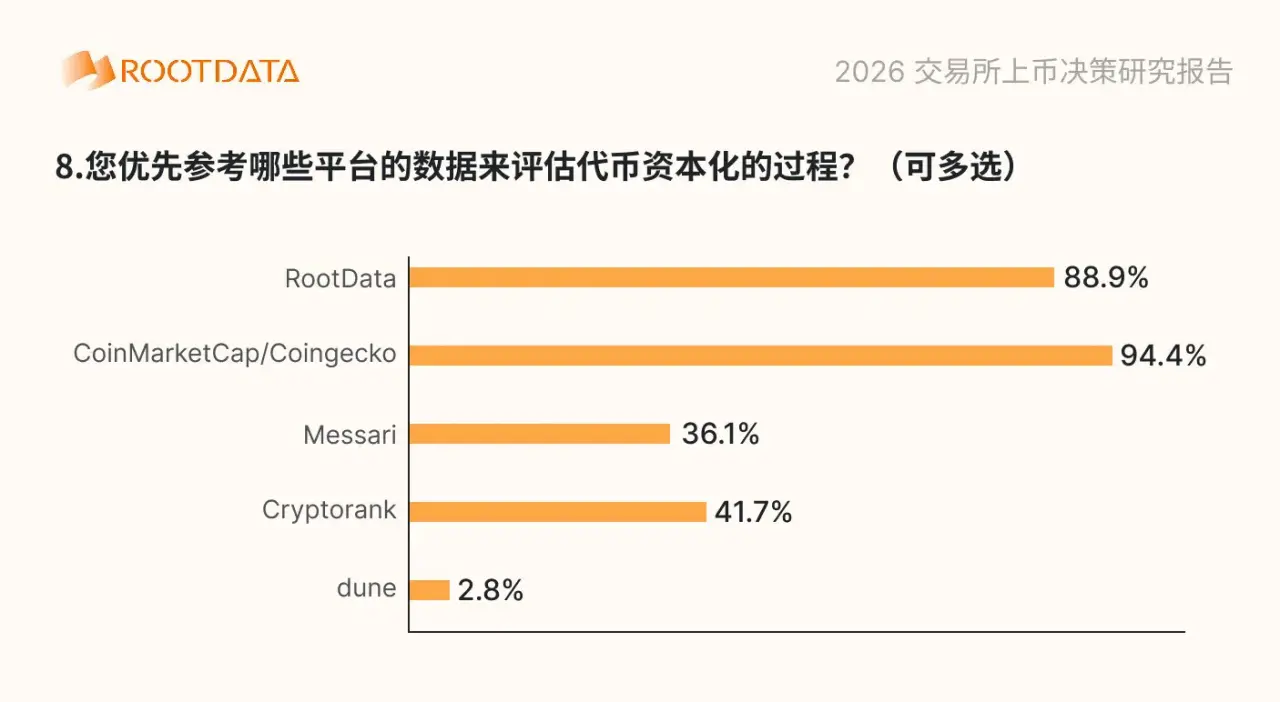
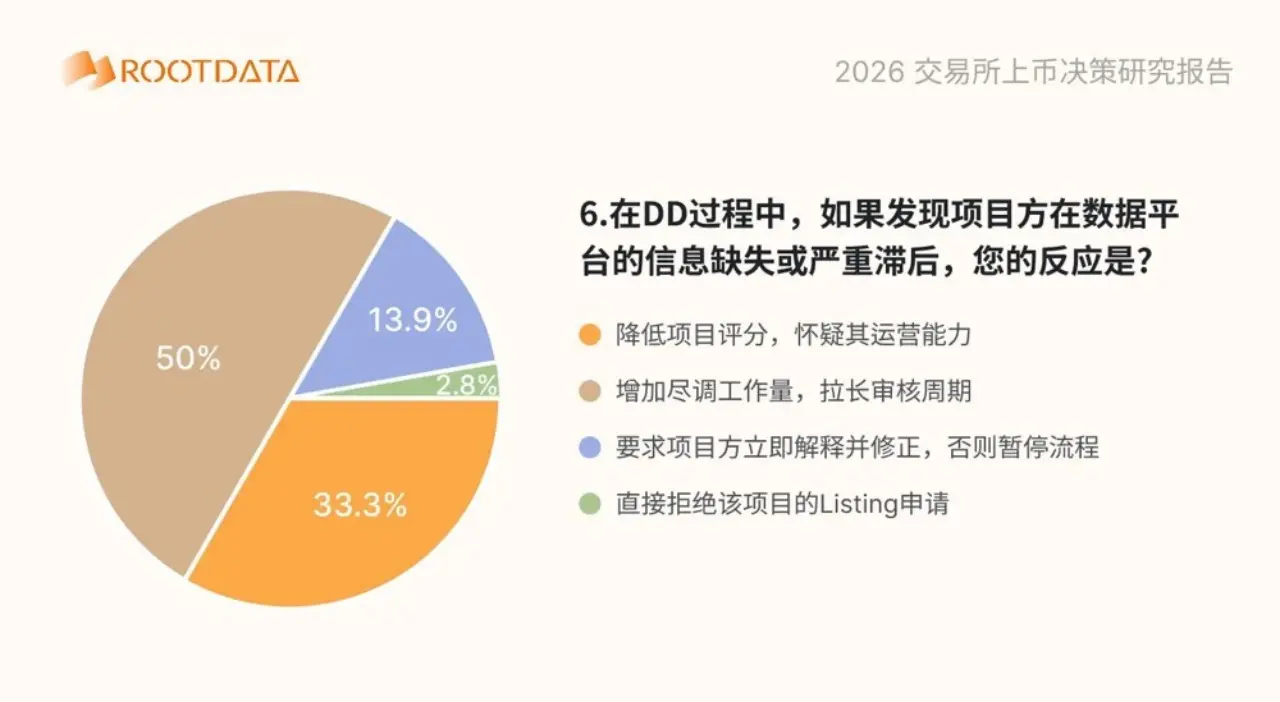
This indicates that when project information is lacking or delayed on mainstream data platforms, the token listing process may be indirectly prolonged, or even cause opportunities to be missed. It’s not that the project is poor, but that information failed to reach decision-makers efficiently.
3. Compliance pressures from the delisting process of exchanges
Since 2026, exchanges such as Binance, Coinbase, and OKX have sequentially delisted a number of tokens, including a group of once-popular tokens such as LRC, FORTH, NTRN, RDNT. (Article reference:What characteristics do projects delisted by mainstream exchanges have?)
Although the reasons for delisting each project vary, observing the projects that have been delisted reveals some commonalities: some projects lack complete information disclosure, the team communication is not active, and community dynamics are insufficient.
According to RootData’s transparency score, most of these delisted projects have transparency scores below 70%. Exchanges have explicitly included “the public communication, community participation, and transparency level of the project team” as part of the token health assessment criteria. When information remains updated for an extended period, and the team becomes invisible, the project easily gets labeled as “zombie,” becoming a target for delisting and cleanup.
This is not the standard of RootData, but an inevitable choice made by exchanges to protect users and reduce compliance risks as the industry matures.
Why is being included in RootData a solution?
1. Turning "scattered information" into "verifiable structured data"
RootData brings not just "reach," but a structured expression of trust.
In the Web3 industry, information itself is not scarce; what is rare is “information that can be quickly verified.”
Who is on the team, where the money comes from, how tokens are designed—these are questions every investor and exchange will ask, but few have time to verify each one.
What RootData does is to organize these scattered pieces of information into a standardized data slice that can be directly used. It performs basic information verification and structured organization for each included project, including: team background; financing records; basic project information; token and ecosystem data.
Being included in RootData usually means that the project has transparency of basic information, verifiable public data,and the project has research value in the industry.
2. Entry point for “investor decision-making” information
Many project teams view RootData as an “information display platform,” but it is more like a node for industry information flow.
Whether it is investment institutions screening projects, exchanges conducting token listing evaluations, or even media writing research content, they will prioritize a few structured data sources to quickly establish understanding. RootData is precisely in this position, currently having accumulated over 2 million users and is an important tool for Web3 practitioners, investors, and researchers to query project information.
The key here is not “whether there is a display page” but whether your project information has entered the default information sources in these decision-making scenarios. Once included, the project is no longer just “passively waiting to be searched,” but starts to appear in places where others look when making judgments.
Conversely, if project information is missing or incorrect on RootData, it sets a barrier right at the first hurdle for users to reach the project.
3. From “inefficient maintenance in multiple places” to “one update reaching 200+ platforms”
Furthermore, the value of RootData is not just being “seen.” Its fundamental role is as the source of a data distribution network.
Currently, RootData's API network has connected over 200 partners, including:
Wallets: Binance Wallet, OKX Wallet, Gate, Token Pocket
Exchanges and data platforms: Coinglass, Magna
Ecosystem institutions: Ethereum Foundation
Security institutions: CertiK
Financial institutions: Amber Group, CMT Digital
This means that when project teams update team, financing, or key progress information in the background, this information will not just stay on one page, but will have the opportunity to sync into the internal data systems of multiple products.
In other words, in the past, project teams needed to repeatedly maintain information on different platforms; now it has changed to: one update entering a multi-platform data flow. What fundamentally changes is not the quantity of exposure but the “path structure” of information dissemination.
What other value is there after being included in RootData?
1. Establishing a unified, authoritative information entry
Recently, RootData officially launched the “Project Information Management System,” allowing project teams to claim their project homepage through the official email and obtain official identity recognition. (Article reference:One-click residence in RootData, presenting project information accurately on over 200 platforms such as Binance Wallet, Gate, TP, etc.)
From now on, all core information (team background, financing records, token economics, roadmap, major events) can be centrally managed in one backend, ensuring that the information displayed externally is accurate and consistent.
Project teams can apply for inclusion immediately and actively manage their information pages, no longer needing to worry about inconsistent information across different platforms, nor repeatedly explaining to investors and community members “which information is correct.”
2. Enhancing transparency scores and gaining trust endorsement
RootData has launched the industry’s first “transparency score” system, which comprehensively assesses dimensions such as team, financing, token economics, key events, and completeness of basic information, divided into A–F five levels. This score is being used by investment institutions and exchanges as one of the reference indicators for quickly assessing projects.
Proactively managing information and filling in missing content can quickly enhance the transparency score. Currently, over 150 projects including Chainlink, USD.ai, and Cysic have completed claiming and updating, with scores rapidly elevated to A level. High scores not only represent recognition, but also provide a direct way to demonstrate the project's credibility to institutions.
3. Entering the industry data dissemination network, amplifying long-term influence
The data from RootData is not only used internally within the platform, but is also widely referenced in research reports by investment institutions, industry statistics by data platforms, and in-depth reports by industry media.
This means that when you update financing news, adjust token economic models, or announce mainnet launches on RootData, this information has the opportunity to appear in broader industry content, being continuously referenced and disseminated. As the transparency score system is adopted by more institutions, each change in your score may become a reference for industry research and media reporting.
In the long run, the project’s data will no longer just be an “information page,” but an asset that continuously generates influence in the industry.
How to get listed?
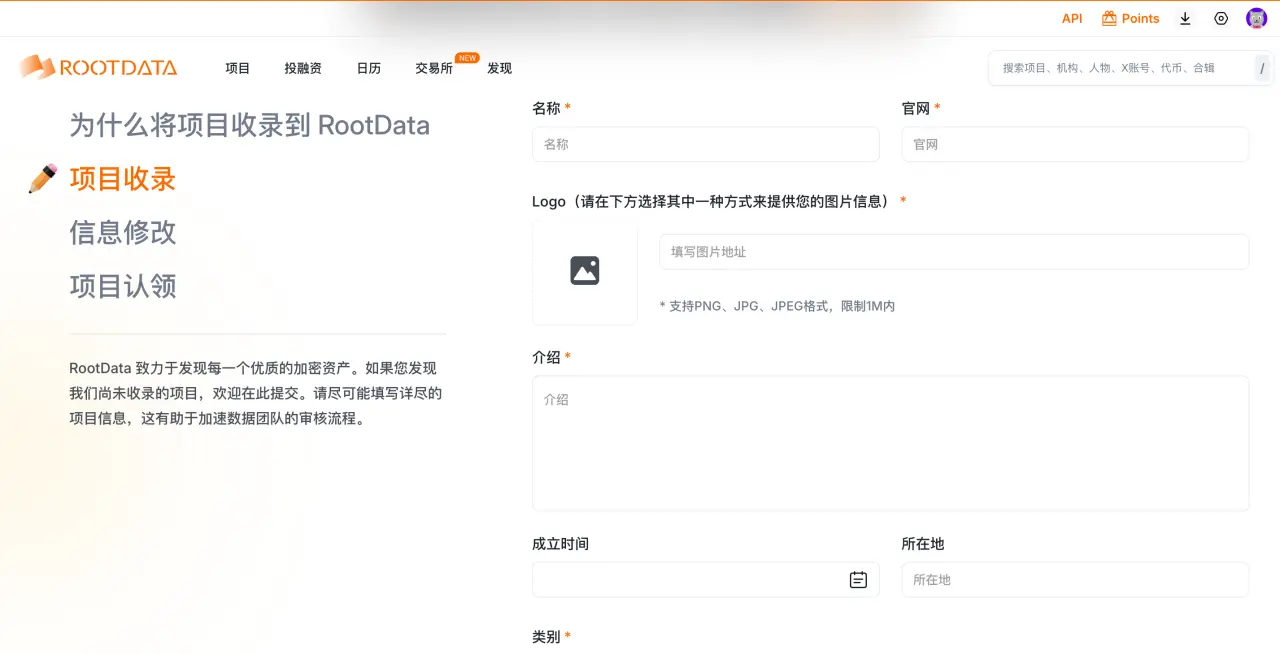
The listing process is very simple: go to RootDataProject Inclusion page, fill in the information and submit it. (Inclusion entry: https://cn.rootdata.com/Projects/submit?ft=create)
We understand that project teams already have a lot of things to handle: development, operation, financing, community maintenance… maintaining the data platform seems to be a “non-urgent” matter. But we also see that more and more project teams are proactively claiming and managing their RootData information, for a simple reason: this indeed helps them reduce communication costs and increase the opportunities to be seen and trusted.
RootData does not define “good projects,” nor do we make value judgments. We just provide a tool to make information dissemination more efficient and transparent. If you hope that your project information can be presented more accurately to the community, investors, and exchanges, welcome to join RootData.
免责声明:本文章仅代表作者个人观点,不代表本平台的立场和观点。本文章仅供信息分享,不构成对任何人的任何投资建议。用户与作者之间的任何争议,与本平台无关。如网页中刊载的文章或图片涉及侵权,请提供相关的权利证明和身份证明发送邮件到support@aicoin.com,本平台相关工作人员将会进行核查。


