Author: Jin Ten Data
On Monday morning local time, U.S. President Trump stated on "Truth Social" that the U.S. and Iran had a "very good and productive conversation" regarding resolving the Middle East war.
However, before Trump made this announcement public, several accounts on the prediction market platform Polymarket had already placed significant bets that the war would end within this week.
Ten newly opened accounts on Polymarket's "U.S.-Iran Ceasefire" market invested thousands of dollars, betting on a ceasefire to be reached by March 31 or April 15; these accounts collectively wagered about $160,000, and if a ceasefire occurs before the end of the month, they stand to profit over $1 million.
These accounts were identified by X platform user Lirrato last Sunday and were retweeted and disseminated by the PolymarketHistory account. After Trump's Monday post, the holdings of these ten accounts had already appreciated by over $300,000.
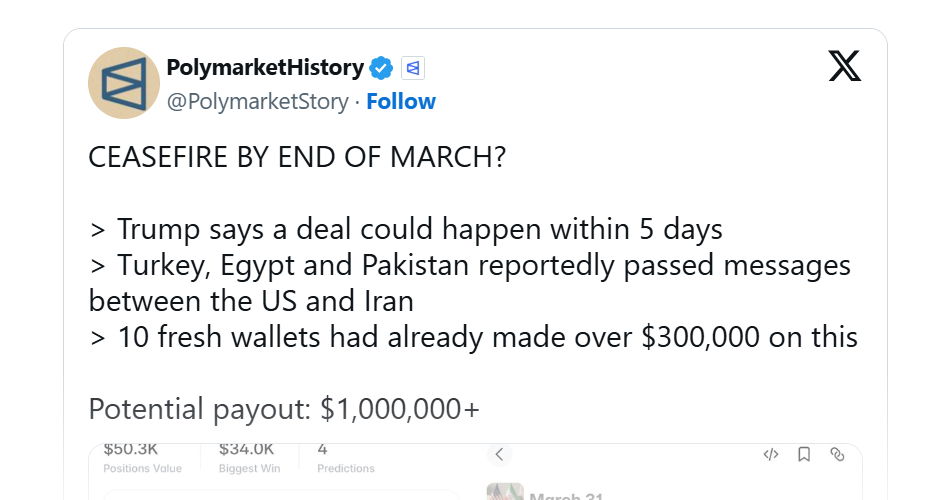
One account named "NOTHINGEVERFRICKINGHAPPENS" drew particular attention. This account was registered in late February, and its first two transactions included betting $7,600 that the U.S. would strike Iran before February 28 and betting $11,283 that it would strike before March 1, collectively profiting over $85,000. Now, the account has bet $8,005 that a U.S.-Iran ceasefire will happen before March 31, and further bet $15,614 that it will happen before April 15, with these two bets having already appreciated by over $30,000.
The scale, timing, and past performance of these bets raise suspicions about whether these Polymarket accounts belong to insiders—those connected to the U.S. and Iran political circles who possess undisclosed information regarding diplomatic developments.
The prediction market has previously been embroiled in insider trading scandals. A recent case involved a Polymarket trader betting that the U.S. would take military action against Venezuela, resulting in profits exceeding $400,000; days later, the U.S. announced the capture of Venezuelan strongman Nicolás Maduro. Its competitor Kalshi recently banned two insider trading users, marking the platform's first public investigation into insider trading.
On Monday, Polymarket announced an upgrade to its insider trading rules, explicitly prohibiting three types of behavior: trading on stolen confidential information, trading on illegal insider information, and trading when a user has the ability to influence the outcome of an event.
Neal Kumar, Polymarket's Chief Legal Officer, stated: "The prosperity of the market relies on clear rules, and the new regulations provide clarity for all participants' expectations and showcase our established compliance system."
This adjustment to the rules may indicate that Polymarket will follow Kalshi's lead and initiate an insider trading investigation. While it remains uncertain whether the accounts betting on a U.S.-Iran ceasefire belong to insiders, the platform's investigation is expected to unveil the truth.
Before Trump's Post, S&P 500 and Crude Oil Futures Also Showed Unusual Volume
Additionally, just minutes before Trump posted on the social platform about market impacts, S&P 500 futures and crude oil futures also exhibited unusual trading volume.
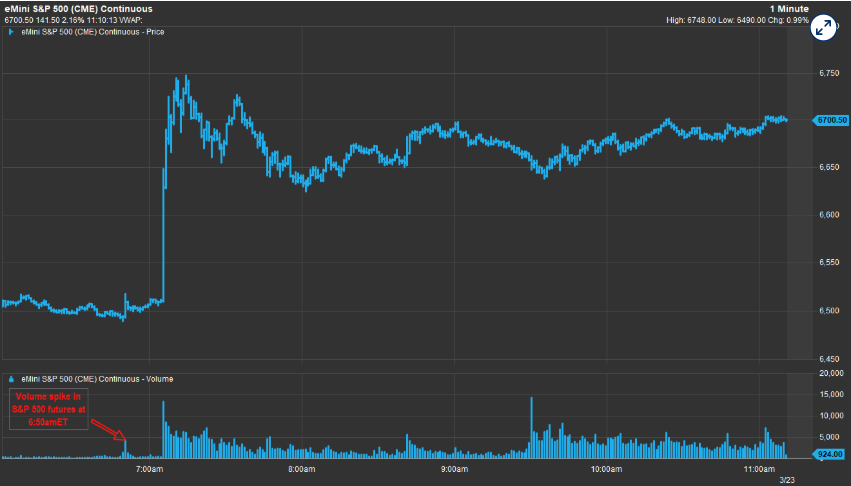
On Monday around 6:50 AM New York time, the S&P 500 e-Mini futures traded on the Chicago Mercantile Exchange (CME) experienced a sharp and isolated spike in volume, breaking the usually quiet pre-market backdrop. The morning session typically has low liquidity, making this sudden volume surge one of the largest trading moments of that period so far.
The crude oil market also displayed a similar trend. WTI crude oil May futures saw a notable uptick in trading activity around the same time, with a significant volume spike breaking the previously calm market state.
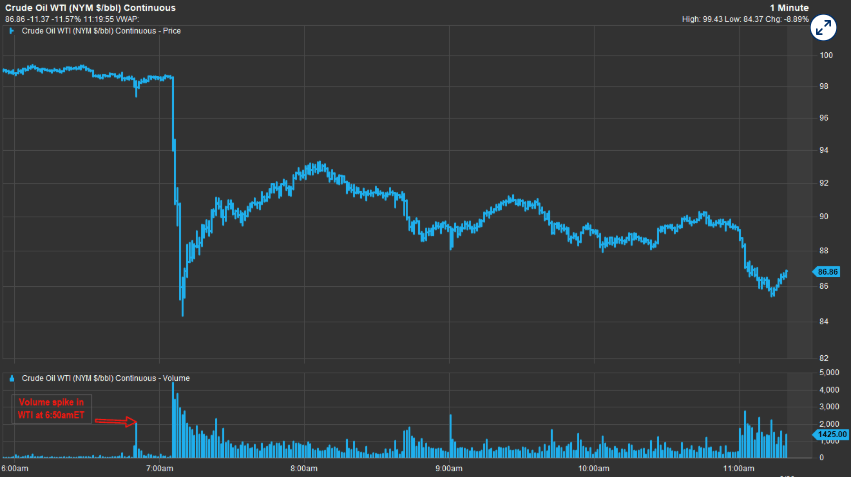
About 15 minutes later, at 7:05 AM, Trump's statement regarding a delay in strikes on Iranian power plants immediately triggered a rebound in risk assets, with S&P 500 futures surging over 2.5% before the market opened, while West Texas Intermediate crude futures fell nearly 6% following the announcement.
The simultaneous spikes in volume in the stock and crude oil markets in the morning attracted traders' attention—especially since there were no obvious catalysts pushing the volume increase at the time.
Typically, the morning futures market has lower liquidity, making temporary buying and selling explosions more pronounced than during regular trading hours. Nonetheless, these trades are still noteworthy, as anyone who bought stock futures in large amounts while simultaneously selling or shorting crude oil futures at that moment would have made substantial profits minutes later.
The U.S. Securities and Exchange Commission (SEC) and the CME Group both declined to comment.
Algorithmic trading strategies and macro-driven strategies may also have triggered rapid capital flows across asset classes during morning trading, despite the absence of a single identifiable catalyst.
免责声明:本文章仅代表作者个人观点,不代表本平台的立场和观点。本文章仅供信息分享,不构成对任何人的任何投资建议。用户与作者之间的任何争议,与本平台无关。如网页中刊载的文章或图片涉及侵权,请提供相关的权利证明和身份证明发送邮件到support@aicoin.com,本平台相关工作人员将会进行核查。


