Author: Su Yang, Tencent Technology
Editor|Xu Qingyang
AI is facing a data famine, and human life has become a business.
From Cape Town, South Africa to Chicago and Los Angeles in the United States, and to Ranchi, India, thousands of people around the world are selling snippets of their daily lives to tech companies, including videos of washing dishes, footsteps while walking, audio recordings of phone calls, and cooking actions.
These mundane daily chores are turning into industrial “raw materials” that can be priced and sold separately, becoming “textbooks” for training AI—a two-hour video of washing dishes can fetch 80 dollars, and a phone call recording is worth 0.5 dollars per minute.

Silicon Valley's thirst for real human data has spurred a booming data market industry
But the money does not come for free.
Those gig trainers who sign contracts often unwittingly give up irrevocable authorizations: their voices might be permanently used for AI customer service, their faces could appear in facial recognition databases hundreds of thousands of miles away, and the systems they train by hand might one day cost them their jobs.
This is a story about survival and calculation. On one side is the real pressure of making a living, and on the other is the invisible risk of the future. In this data “gold rush,” who are the real winners?
01, Humans Retailing Life
27-year-old South African Jacobus Loew records his footsteps and the scenery along the way each day when he goes out to feed the seagulls, and then uploads the video to Kled AI, an app that collects user data to train AI models for a fee. A short “urban navigation” video of just a few seconds can earn 14 dollars.
22-year-old Indian student Sahil Tiga has a simpler way to make money: he keeps his phone's microphone open. Through an app called Silencio, he allows others to access his phone's microphone to capture the noise in restaurants, the sounds of traffic at intersections. To earn more money, he even runs to hotel lobbies to record ambient sounds that haven't been collected yet. After a month, he can make over 100 dollars, enough to cover his monthly expenses.
18-year-old Chicago welding apprentice Ramelio Hill chooses to sell more personal things, including his call records with friends and family, selling them to a platform called Neon Mobile at a rate of 0.5 dollars per minute.
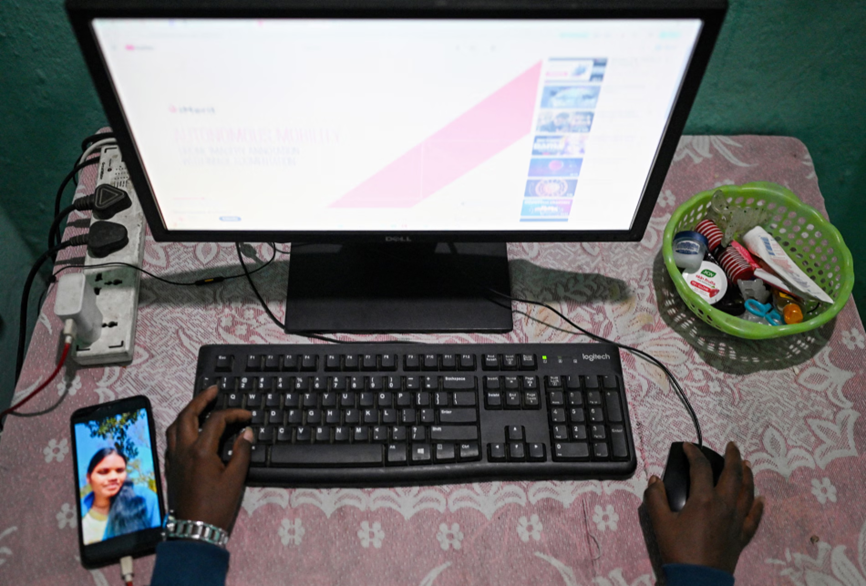
The content uploaded by gig AI trainers is diverse, and they are at the forefront of this global data gold rush
These gig workers are far more than this.
In Los Angeles, from Santa Monica to Los Feliz, hundreds of people are attaching cameras to their heads and hands while doing housework. They brew coffee, scrub toilets, water flowers, and wash dishes, and everything is being recorded.
Salvador Alciaga received a head-mounted phone holder from Instawork and recorded himself washing dishes and wiping countertops while explaining in Spanish or English what he was doing. He earned 80 dollars for two hours of recording.
“I have to do housework anyway,” he says. “Now I can earn money doing housework.”
02, Everything stems from AI's data famine
The reason these seemingly untechnical pieces of life are valuable is that AI is about to “starve”.
Large language models like ChatGPT and Gemini require massive amounts of learning material to improve continuously. However, currently, the most commonly used training data sources like C4 and RefinedWeb have begun restricting AI companies from using their data.
The non-profit research organization Epoch AI predicts that by 2026, AI companies will deplete the available fresh text resources for training. While some labs are attempting to have AI generate data to “self-learn,” this practice may lead to a decline in model quality and ultimately fall apart.
Against this backdrop, data market platforms like Kled AI and Silencio have suddenly surged in popularity.
Professor Bouke Klein Tisselingk of King’s College London points out that gig AI training is an emerging job category with significant growth potential. AI companies can effectively avoid copyright disputes by paying for user-authorized data. If they merely rely on randomly scraping content from the internet, they face lawsuits at any time.
AI researcher Benjamin Vyssilovski also stated: “Currently, human data is still the best source for AI to learn new things beyond its own routines.”
In simple terms: no matter how fast machines learn, they cannot do without real human data. This is especially true in the physical world.
Anders Beck, Vice President of AI Robotics Products at Universal Robots, pointed out that the training data collected in AI labs is mostly unsuitable for real-world deployments, and simply relying on visual feedback, robots cannot learn tasks that require “hands-on” skills. To enable robots to truly master skills like opening doors, washing dishes, and folding clothes, real humans must demonstrate these tasks repeatedly in real environments.
Jason Salzman, Insights Director at CB Insights, summarized: “Models still cannot determine what is right or wrong and cannot figure out what the real situation is; humans must teach them.”
For this reason, some countries have set up specialized "arm farms"—in fixed facilities, a large number of people record first-person videos of tasks like opening doors and folding clothes to provide real operation demonstrations for AI.
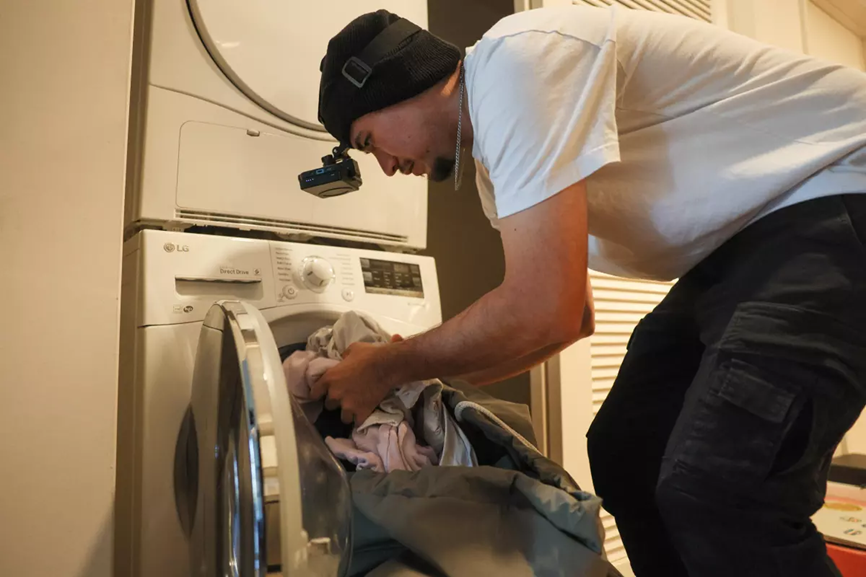
Alciaga recorded the process of putting clothes into the washing machine, which is part of his gig task
Data shows that companies like Sunain that collect human data have over 1,400 contributors in Los Angeles, extending from Culver City in the West to Pasadena in the East. Sunain co-founder Shahbaz Maghsi stated that the diversity of housing types, lifestyles, and populations in Los Angeles is “unparalleled.”
CB Insights predicts that by 2030, the global data collection and labeling market could reach 17 billion dollars. Goldman Sachs predicts that by 2035, the humanoid robot market could reach 38 billion dollars.
Seeing these prospects, capital has started to flood in.
San Francisco company Encord saw its physical AI business revenue grow tenfold last year and secured 60 million dollars in funding in February this year. Scale AI, backed by Meta, has collected 100,000 hours of robot videos. Its competitor Micro1 has hired 1,000 people in 60 countries to specifically record housework videos.
03, No Privacy, No Regrets
For those involved in feeding data to AI-backed projects, money does not come cheap.
Hill has mixed feelings about his experience. He sold 11 hours of calls on Neon Mobile for 300 dollars, but the app often disconnects, and withdrawals don’t always come through immediately. “Neon has always seemed suspicious to me,” he says, “but I have always used it to earn a little easy money.”
Soon, trouble came.
In September 2025, just weeks after the launch of Neon Mobile, TechCrunch reported a security vulnerability that allowed anyone online to directly access users’ phone numbers, call recordings, and text records. Hill said Neon never notified him. Now he worries about how his voice will be used.
This isn’t even the worst part.
New York actor Adam Koi sold his likeness to the AI video editor Captions (now called Mirage) in 2024 for 1,000 dollars. He added many protective clauses in the contract: his likeness couldn’t be used for political purposes, and couldn’t promote alcohol, tobacco, or pornography, and the authorization would expire after one year.
But soon, friends started forwarding viral videos to him. In the footage, his face and voice were promoting an unverified prenatal health product.
“Explaining this to others made me feel particularly awkward,” Koi said. “Those comments felt strange because they were commenting on my appearance, but that wasn’t really me.”
What troubled Koi even more was the thought he had when he decided to sell his likeness—after all, most models would scrape data and likeness from the internet, so why not earn some money? Now looking back, it feels like a joke. Since then, he has not touched such platforms again.
Enrico Bonadio, a law professor at St George's University of London, pointed out that the agreements of many platforms virtually allow “any use of these materials permanently without paying again.” Meanwhile, contributors “have almost no practical way to withdraw consent or renegotiate.”
Even worse, even if platforms claim to do “de-identification” processing, biological features such as voice and appearance are inherently hard to make truly anonymous.
04, The Pitfall of Full Authorization Contracts
You might think you are just “renting” out a few recordings, but the fine print in the contract may hide bigger traps.
When users share data on Neon Mobile or Kled AI, they grant a “full authorization”—globally, exclusively, irrevocably, transferrably, and royalty-free. In other words, the platform can sell, use, publicly display, store likenesses permanently, and even create “derivative works.”
Kled AI founder Avi Patel argues that their agreement is only for AI training and research. The company reviews the buyers to avoid those “with problematic intents” and institutions that might misuse the data. He said, “The whole business relies on user trust.”
But how reliable are those safeguards? Professor Bonadio pointed out that the contract allows platforms and clients to “do almost anything.”
The bigger problem is that once your data is sold, you have no idea where it went. Jennifer King, a data privacy researcher at Stanford University's Human-Centered AI Institute, says these platforms do not clearly state how data will be used or where it will be used. Consumers “face the risk of their data being reused in ways they do not like, do not understand, or never anticipated, with almost no recourse.”
Scholar Laura Kitchell's experience is more typical. She was looking for jobs at non-profits and government agencies when a friend recommended Mercor to her. When the contract came through, she looked it over carefully, and the terms required her to grant royalty-free rights, allowing the use of her existing and future academic papers, along with any intellectual property that might benefit some unspecified client.
“I thought this was a bit excessive,” she said.
She wanted to modify the contract, but an AI assistant named “Melvin” emailed her back saying: it's non-negotiable; if you don't accept it, you can leave.
Mercor later explained that the contract only applies to the contributors' own creations used during the project. Things they created on their own and haven't used are not bound. But for Kitchell, that uneasy feeling was already difficult to shake off.
05, Who are the Real Winners?
Mark Graham, a professor of Internet geography at the University of Oxford and author of "Feeding Machines," admits that for people in developing countries, this money can indeed be useful in the short term, but he warns: “Structurally, this kind of work is unstable, has no developmental prospects, and is essentially a dead-end.”
He said the AI market relies on “competition for wages to the bottom” and “temporary demand for human data.”
Once the demand changes, “workers receive no protection, learn no transferable skills, and have no safety net.” The ultimate winners will be those “Northern Hemisphere platforms that capture all the lasting value.”
In other words, every penny gig workers earn today is helping AI become stronger and smarter. And when AI is powerful enough, those who trained it might just be the first to be replaced.
As Ethan Beattie, General Manager of DoorDash Tasks, put it: “These are real-world problems we've been solving for over a decade, and we realize that the very same capabilities that helped us can help other businesses.”
What DoorDash is doing is transforming the labor experience of delivery workers into data assets to sell to any business that needs to train AI.
Uber is doing the same thing.
In October last year, Uber added a digital task category in its driver app, allowing drivers to upload restaurant menus and record multilingual audio samples. Its Uber AI Solutions division has expanded to 30 countries, providing labeling, translation, and model training services.
Both companies are following the path pioneered by Scale AI: using distributed remote workers to create new datasets and validate AI outputs. The only difference is that Uber and DoorDash have millions of people they can deploy directly to any corner of the real world.
Alciaga's friend once questioned him: “Well, you are the problem.” His friend meant that by teaching AI to do things that only humans can do, isn't he actually making things worse?
Alciaga replied: New technology always brings fear and change, but it also creates new types of work, like his latest gig. “People still need people,” he said.
The question is, when AI doesn't even need “people,” will that need still exist?
免责声明:本文章仅代表作者个人观点,不代表本平台的立场和观点。本文章仅供信息分享,不构成对任何人的任何投资建议。用户与作者之间的任何争议,与本平台无关。如网页中刊载的文章或图片涉及侵权,请提供相关的权利证明和身份证明发送邮件到support@aicoin.com,本平台相关工作人员将会进行核查。


