The Zhenguan Era Has Passed, The Kaiyuan Era Is Coming
Since then, prediction markets have completely entered the public eye from a small niche, and this sector has begun to grow at a dizzying pace.
Kalshi achieved approximately $260 million in revenue for the entire year of 2025, an increase of nearly ten times from $24 million in 2024, handling $22.88 billion in trading volume in 2025, with fees accounting for about 1.2% of the total trading volume.
Polymarket secured a$2 billion strategic investment from ICE, the parent company of the NYSE, boosting its valuation to $9 billion, and obtained CFTC regulatory approval in November 2025, returning to the U.S. market after three years.
As of March 2026, both companies have a target valuation of approximately $20 billion. Both companies reached the center of the world stage through two different paths.
If we compare 2025 to the peaceful Zhenguan era of prediction markets, then 2026 will usher in a grander Kaiyuan era. This article attempts to break down the growth history of these two prediction markets, extracting reusable growth methodologies for reference.
All data in this article are publicly available online; corrections are welcome if there are errors
The Path of Two Giants
Prediction markets are not new. From the Iowa Electronic Markets (IEM) and PredictIt to the cryptocurrency space's Augur and Gnosis, this sector has existed for decades but has always been a toy for academia and niche speculators. The real change in the landscape came from two simultaneous events: the maturation of blockchain infrastructure made on-chain settlements feasible, and the loosening of regulatory environments allowed prediction markets to enter the mainstream stage. 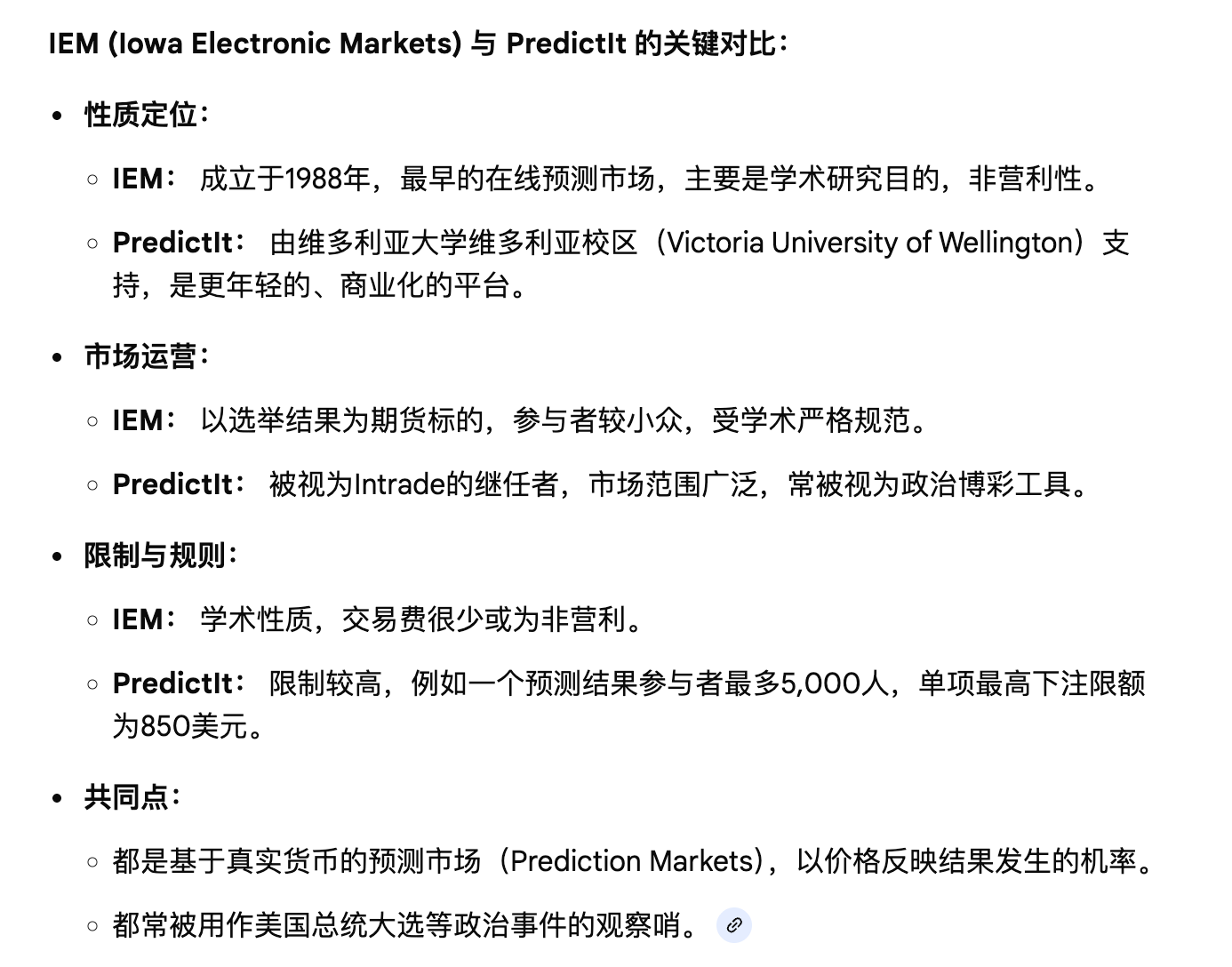
Kalshi obtainedCFTC regulatory approval in 2020, officially becoming a regulated designated contract market (DCM). What does a DCM license from the CFTC signify? Why is it a turning point?
The CFTC (Commodity Futures Trading Commission) is the highest federal agency regulating futures, options, and derivatives markets in the United States, equivalent in status to the SEC in the stock market. It is directly accountable to Congress, with authority over all futures exchanges in the United States.
DCM (Designated Contract Market) is the highest level of exchange license that the CFTC can issue. From then on, Kalshi no longer competed with Mazda but sat at the same table as CME (the world's largest derivatives exchange) and ICE (the parent company of the New York Stock Exchange).
P.S. No wonder the Robinhood market page is called select contract; fundamentally, prediction markets are futures trading, and every market is a contract event.
Polymarket was founded in the same year, but its growth path has been much bumpier than Kalshi's. First, it wasfined $1.4 million by the CFTC in 2022 and was forced to exit the U.S. market. After gaining fame during the U.S. elections, it faced aFBI raid on the founder's residence, forcing it to take a more aggressive decentralized path, choosing to surround the cities from rural areas, and only returned to the U.S. market three years later.
This created two completely different growth trajectories for the two companies.
Polymarket’s Promotion Strategy
Polymarket's growth did not rely on traditional advertising methods or a large sales team, yet it experienced significant growth after the 2024 election, with active traders increasing from tens of thousands to 450,000. The logic behind this is a meticulously designed product mechanism that encourages user-initiated dissemination.
Screenshots as Advertisements
This is Polymarket's most clever marketing design.
When a user shares a screenshot of the probability of a certain market on Twitter, Polymarket's brand logo naturally appears, and people become curious to ask or inquire. This is not a coincidence. Polymarket's UI is carefully designed to ensure brand assets are prominently displayed in any screenshot. This means that every spontaneous share is a zero marginal cost brand exposure. 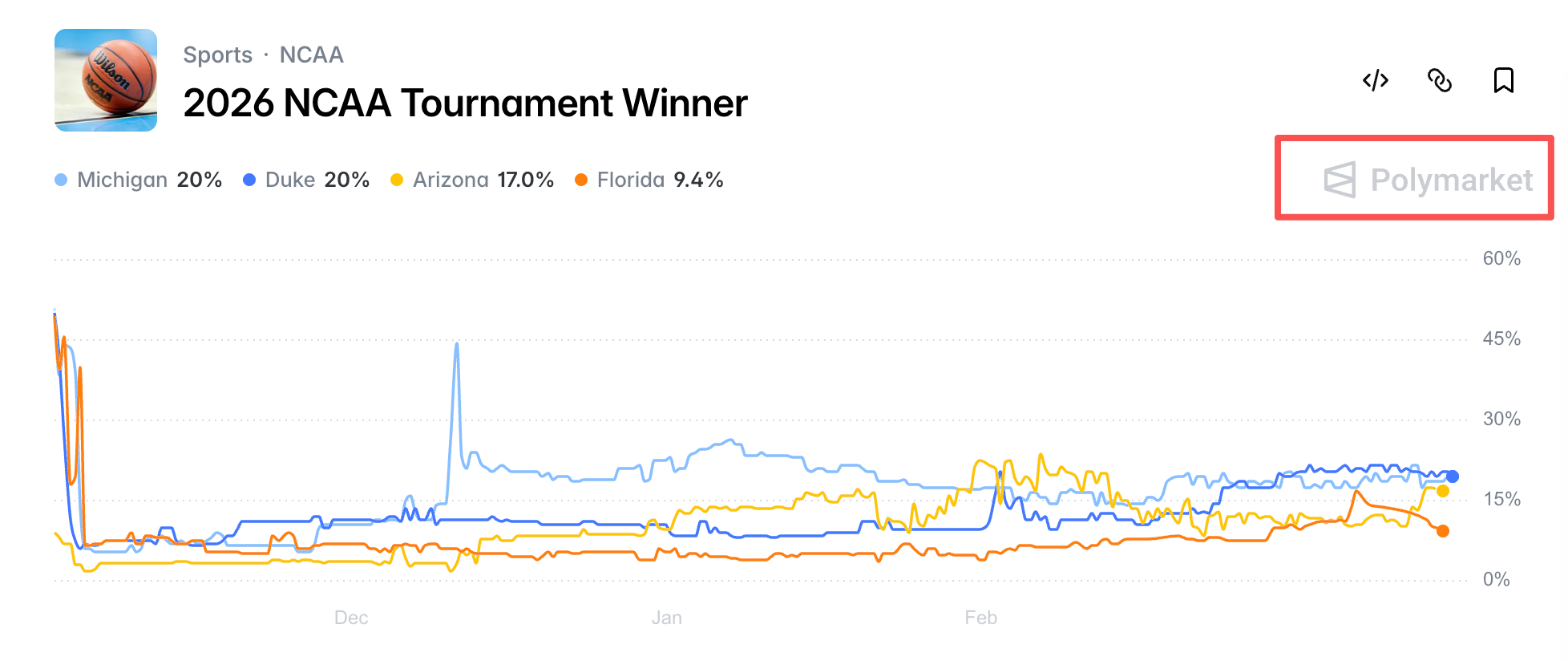
During the 2024 election, tens of thousands of users shared Polymarket screenshots on X, Instagram, Tiktok, and Reddit, and each screenshot spread the core narrative that "prediction markets are more accurate than polls." The scale of this passive dissemination is something that no paid advertisement can replicate.
In October 2024, Polymarket topped the App Store's free applications chart. This event itself triggered a new wave of viral dissemination through numerous screenshots. 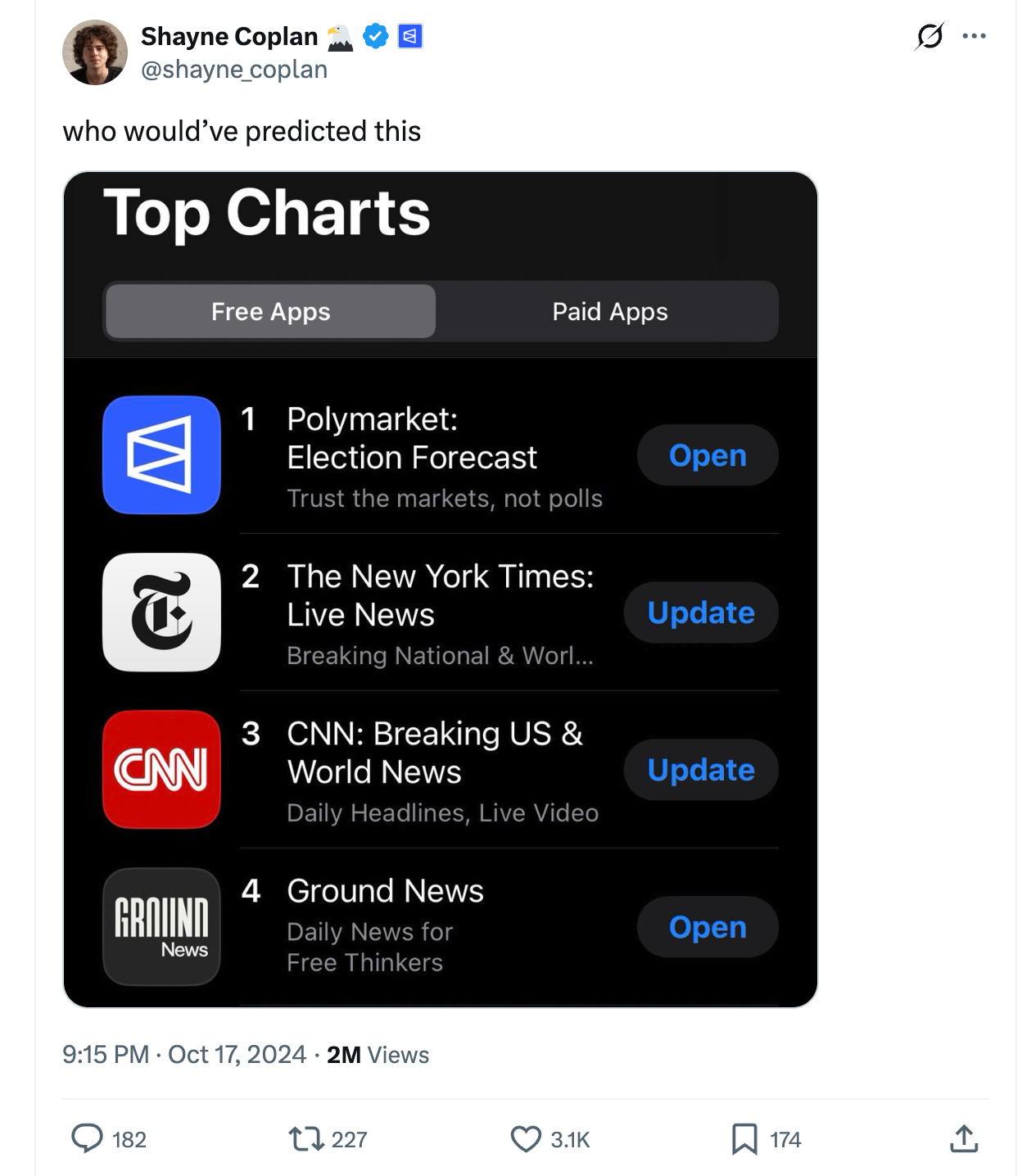
Founder IP

Founder Shayne Coplan gives me an Elon Musk vibe; he was only21 when he created Polymarket, having studied computer science at New York University but dropped out during his freshman year to pursue blockchain technology and prediction markets.
In 2020, he created Polymarket alone in a Manhattan Lower East Side apartment, as the bathroom was the only quiet place, and he often wrote code there.
In his own words on X: "In 2020, with no money and alone, my office was that makeshift bathroom. At that time, I couldn't imagine Polymarket would change the world. 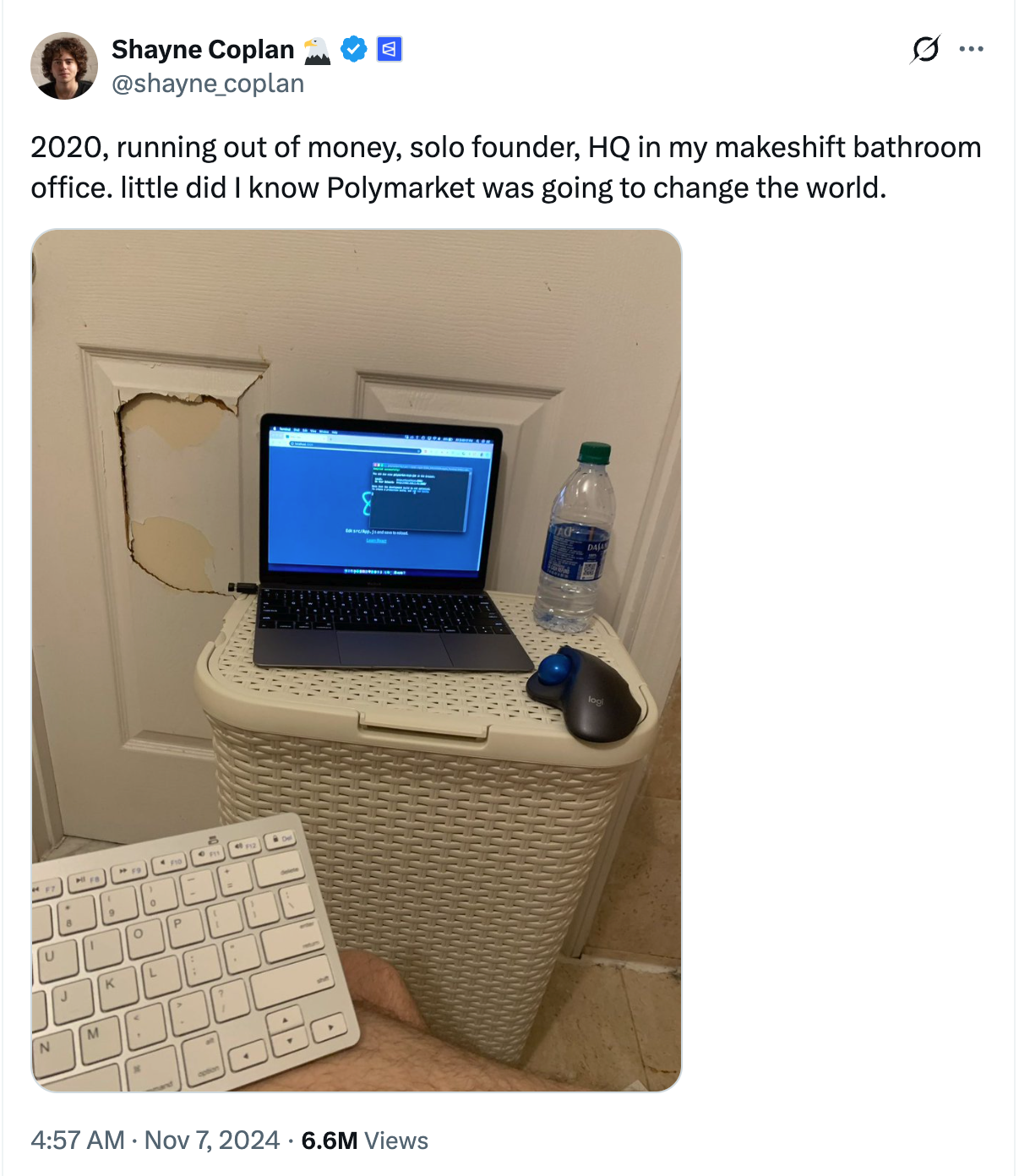
Starting from humble beginnings, his passion for entrepreneurship has never wavered; as early as 2013, when he was still a high school student, he wrote to the SEC to inquire whether creating an ECN exchange was compliant, although ultimately he received no reply. As he said: becoming famous overnight actually takes ten years. As of now, he has 160,000 followers on Twitter, but his tweets do not showcase dogs, cars, or a team; he is simply a relentless PR machine promoting Polymarket. 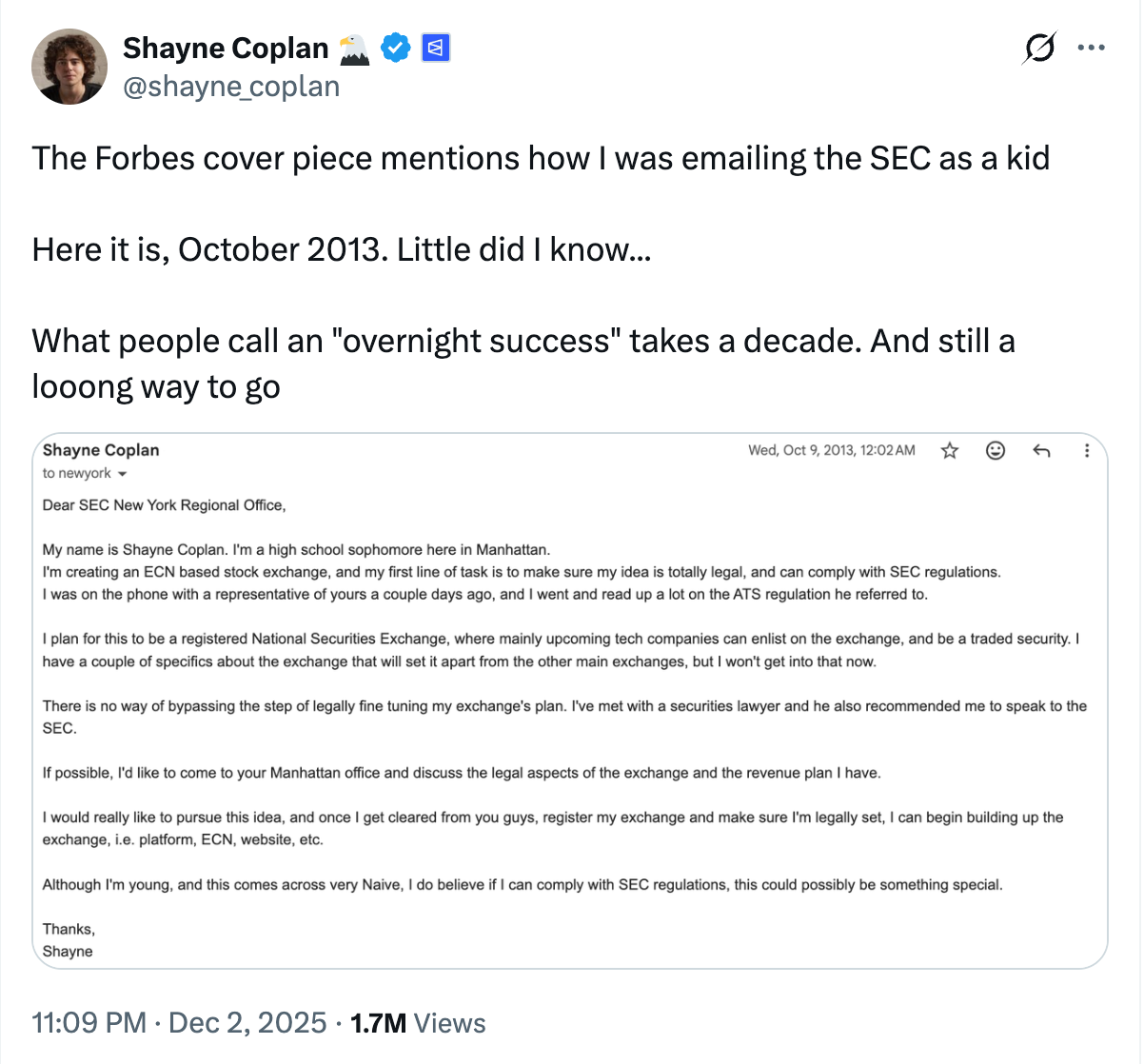
Polymarket’s Ecosystem Matrix
Polymarket has integrated its services into products with massive user bases through a series of collaborations, thus elevating its reach.
Bloomberg Terminal Integration (2024): Polymarket data is incorporated into Bloomberg terminal services, signifying that Wall Street institutional investors are beginning to view prediction market probabilities as legitimate market sentiment indicators.
MetaMask Integration (December 2025): MetaMask is the most widely used Ethereum wallet globally, with over 30 million monthly active users. After the integration, users can participate in Polymarket prediction markets without leaving the wallet, and they can earn MetaMask Rewards points. The integration adopts a one-click account opening mechanism without any additional KYC process.
Jupiter DEX Integration (February 2026): Jupiter, the largest decentralized exchange on Solana, announced the integration of Polymarket into its "Prediction" tab, making Polymarket natively available on Solana. Jupiter had previously attempted to launch a Kalshi-driven prediction market but ultimately chose Polymarket as its long-term partner. This marked Polymarket's expansion from the Polygon to the Solana ecosystem.
World App Integration: Integration through the World App from World Foundation (under Sam Altman) connects with its global verification user base.
X Official Partnership: Mid-2025, X announced Polymarket as its official prediction market partner, combining Grok's real-time analytical capabilities to provide data-driven insights for users. With over 500 million monthly active users on X, this partnership effectively provides Polymarket with a distribution channel covering hundreds of times its own user base. I suspect that Polymarket's connection with Musk may have originated during the U.S. elections, when Musk retweeted relevant tweets.
Compliance Transformation, Stepping Out of the Shadows
Polymarket's regulatory compliance journey is in itself a brand upgrade strategy.
- 2022: Fined $1.4 million by the CFTC, forced to block access for U.S. users
- End of 2024: FBI raided founder Coplan's residence, investigating whether he violated the 2022 settlement agreement
- July 2025: The CFTC and the U.S. Department of Justice officially announced the end of the investigation into Polymarket, without filing new charges. In the same month, Polymarket acquired CFTC-licensed derivatives exchange QCEX for $112 million, gaining regulatory approval
- November 25, 2025: The CFTC formally issued a revised Designated Contract Market (DCM) license, allowing Polymarket to return to the U.S. market
- December 2, 2025: The U.S. version of Polymarket was officially launched, allowing users to trade after completing KYC, currently only featuring a sports section, with its app whitelist gradually opening up
Looking back, Polymarket benefited from hardship; had it not been forced out of the U.S. market due to compliance, it might not have experienced the current trading volume in sectors other than sports, which dwarfs Kalshi, and it inadvertently turned compliance into a series of PR events, garnering extensive coverage from mainstream financial media, achieving brand exposure and positioning upgrades for free.
It is worth noting: Even after obtaining federal CFTC regulatory approval, Polymarket still faces challenges from state regulatory agencies in some states (Tennessee, Massachusetts, Nevada, etc.). Sports contract are particularly sensitive. This indicates that "compliance" in the United States is a continuous game rather than a one-time fix.
Kalshi’s Promotion Strategy
If Polymarket's growth is driven by bottom-up user dynamics, then Kalshi's growth is led by top-down institutional dynamics. Kalshi chose the regulatory compliant path from the outset and has adhered to it throughout.
Standing and Making Money
Ironically, Kalshi's most significant marketing event occurred in court.
In 2023-2024, Kalshi legally challenged the CFTC's ban on election contracts, ultimately winning a ruling from the federal appeals court in 2024, becoming the first regulated platform in the U.S. permitted to offer election prediction contracts. This victory represents not only a regulatory breakthrough but also a priceless PR opportunity: major media outlets such as The Wall Street Journal, The New York Times, and Politico extensively reported on prediction markets entering the public eye as a serious financial topic for the first time.
Kalshi firmly stated: We are not a gambling platform; we are an event derivatives market; we are not avoiding regulation; we are creating regulation. This narrative has established a foundation of trust for Kalshi with traditional financial institutions willing to collaborate.
Robinhood Comes to the Rescue
This is the most strategically valuable move in Kalshi's growth history.
Robinhood is the largest retail trading app in the U.S., with 27.4 million paying users, whose user demographics closely align with Kalshi's target audience.
Robinhood directly integrated Kalshi's sports prediction market into its app, allowing users to trade without transitioning away, providing Robinhood with revenue sharing and Kalshi with user growth.
Effectiveness Data:
- During the partnership, Robinhood’s prediction market business became one of its fastest-growing segments
- Reaching over 1 million traders cumulatively
- Generating approximately $300 million annualized revenue
Robinhood accounted for about half of Kalshi’s trading volume, yet Robinhood has announced intentions to build its own prediction market exchange, which poses a potential risk of channel dependency for Kalshi.
Jupiter Came and Went
In October 2025, Jupiter (the largest DEX on Solana, with a TVL exceeding $3.76 billion) announced the launch of a native prediction market driven by Kalshi’s data and liquidity, with the first market centered around the F1 Mexican Grand Prix.
The strategic significance of this collaboration lies in the fact that Kalshi, as a "regulated data provider," embedded its liquidity and data into the decentralized ecosystem, reaching the on-chain user base while avoiding the regulatory risks of direct on-chain operations. Jupiter provided the on-chain technology layer, while Kalshi provided the compliant data layer.
It is noteworthy that in February 2026, Jupiter subsequently integrated Polymarket, indicating that leading DeFi platforms are building prediction markets as core functionalities, with both sides vying for this channel.
Exclusive Partnerships with CNN and CNBC
You have Bloomberg, I have CNN and CNBC; media channels have become a battleground.
CNN Partnership (December 2, 2025): CNN became Kalshi's official prediction market partner, with Kalshi data integrated into CNN’s television, digital, and social channels in real-time through API. CNN's chief data analyst Harry Enten will reference Kalshi data in live reports. Notably, CNN does not pay Kalshi data licensing fees. This was a condition voluntarily offered by Kalshi, aiming to exchange free data for maximum media exposure while establishing itself as an authoritative source of news information. The agreement is exclusive, preventing CNN from using data from other prediction market platforms.
CNBC Partnership (December 4, 2025): The world’s largest financial media CNBC announced exclusive access to Kalshi data, showcasing Kalshi’s market probabilities in real-time on flagship shows like "Squawk Box" and "Fast Money" starting in 2026, and scrolling Kalshi exclusive data quotes on-screen. CNBC will also launch an exclusive page on the Kalshi platform.
The strategic value of these two collaborations: Upgrading Kalshi from "a tradeable platform" to "an information source for news reports." When reporters say, "According to Kalshi market data, the probability of the Fed cutting rates is 67%," it isn't an advertisement; it’s news. This media infrastructure positioning provides brand endorsement that no paid advertisement can achieve.
Athletes Investing to Support the Sports Ecosystem
NBA star Giannis Antetokounmpo joined Kalshi as a shareholder and participated in offline marketing activities. More importantly, Kalshi has a systematic layout in terms of sports league authorization:
- NHL: The first North American professional sports league to sign an official cooperation agreement with a prediction market platform (jointly signed with Polymarket)
- UFC: Official prediction market partner (Polymarket also collaborates)
- NFL: $300 million to $5 billion of sports betting funds traded on the Kalshi platform; CNBC’s cooperation will also extend to NFL event coverage
The logic behind this layout is that sports events are the biggest traffic-driven engine for prediction markets (over 90% of Kalshi's trading volume in 2025 came from sports contracts). Official league authorizations not only bring content legitimacy but also open avenues for distribution to league media channels (broadcast, official websites, social media).
Different Paths Leading to the Same Destination
Initially, the markedly different strategies of the two companies began to converge by the end of 2025.
After completing CFTC compliance, Polymarket began to replicate Kalshi's "media infrastructure" strategy (Yahoo Finance collaboration) and entered institutional channels via ICE's data distribution network; Kalshi, having dominated the sports market, attempted to enter the DeFi ecosystem through Jupiter DEX integration, directly competing with Polymarket’s on-chain advantages.
This strategic convergence indicates that the two paths are not mutually exclusive choices but effective tools at different stages of development. Once established, each can pursue the other's path, leaving the other with no way to go.
Insights from the Prediction Market Industry
First, a fact: Polymarket spent over $100 million just on compliance (the cost of acquiring QCEX), and the legal tug-of-war lasted three years; Kalshi's legal fees and regulatory costs are conservatively estimated at tens of millions of dollars, with CFTC approval taking over two years.
Ordinary projects simply cannot tread these paths. Thus, it’s important to distill underlying rules from their experiences and apply them to your own.
Insight 1: Ensure Users Understand the Product
If you've used Polymarket and Kalshi, you’ll find their product design is straightforward, allowing even outsiders to comprehend it somewhat; users can navigate it without needing to understand prediction markets fully.
If you’re working on a product related to prediction markets, there’s no need to overcomplicate functionality or design, as this may only slow down order placement and increase users’ hesitance to bet.
You only need to accomplish two things:
- Bring relevant events into users' view
- Facilitate smoother order placements for users
Insight 2: Encourage Users to Share
Polymarket and Kalshi both did extensive work on their product UIs to ensure users have their brand logos clearly visible in shared screenshots.
Therefore, it’s not just about making the product useful but also about striking while the iron is hot; create opportunities for users to share right when they want to, with ready-to-share buttons and attractive images for showcasing. Every share and every invitation from users are important exposures for early-stage products.
Insight 3: The Core Logic of Channels is Leveraging Opportunities
Polymarket integrated MetaMask for its over 30 million monthly active users.
Kalshi integrated Robinhood for its 27 million trading users.
Provide what the other party lacks while receiving what you lack in return as value exchange.
Where are your target users, and what products are they using? Is there a gap in that product that you can fill? Entering a channel larger than yourself in that capacity offers not just traffic, but also the endorsement from the other party.
Insight 4: Utilize Hot Events Effectively
Why have Polymarket and Kalshi invested heavily in promoting NCAAB recently? Because March Madness has a solid cultural foundation in the U.S., generating significant attention during this time. Polymarket's rise due to the U.S. elections is another example of leveraging hot events for greater outcomes.
Thus, we need to identify the key upcoming events in the next three to six months that will draw considerable attention; can the product’s cold start timeline be designed around these events? Can these events help elevate the product’s visibility? I believe prediction market-related products are gearing up for the World Cup.
The Show Has Begun
The prosperity of the Kaiyuan era is due to the convergence of systems, talent, and opportunities characteristic of that time. The rise of Polymarket and Kalshi is no different. The loosening of regulations, the improvement of infrastructure, and the market demand for tumultuous events have all matured simultaneously. Yet Polymarket and Kalshi are merely the fastest runners.
Since it's a flourishing era, diversity is essential. Beyond Polymarket and Kalshi, other products will surely emerge to share in the pie.
Polymarket and Kalshi have solved how to turn information into price, but there remains a larger unanswered question: what constitutes information worth pricing? Currently, both are overly centralized, which may lead to unmet prediction demands among people from different cultures and regions, thus prompting some prediction projects rooted in the Asian market, including @bagel.win.
Inspiring mass entrepreneurship and innovation will determine where the ceiling of this industry lies. As Shayne Coplan said: still a looong way to go.
免责声明:本文章仅代表作者个人观点,不代表本平台的立场和观点。本文章仅供信息分享,不构成对任何人的任何投资建议。用户与作者之间的任何争议,与本平台无关。如网页中刊载的文章或图片涉及侵权,请提供相关的权利证明和身份证明发送邮件到support@aicoin.com,本平台相关工作人员将会进行核查。


