Since the outbreak of the U.S.-Iran war, two commodities that are highly related to geopolitical factors, crude oil and gold, have shown completely different trends, with the former rising sharply and the latter falling slightly. Why is this the case?
As a natural currency, gold has three major hedging functions: hedging geopolitical risks, hedging inflation risks, and hedging dollar risks. Gold prices are simultaneously influenced by these three forces, hence playing varying degrees of hedging roles at different stages.
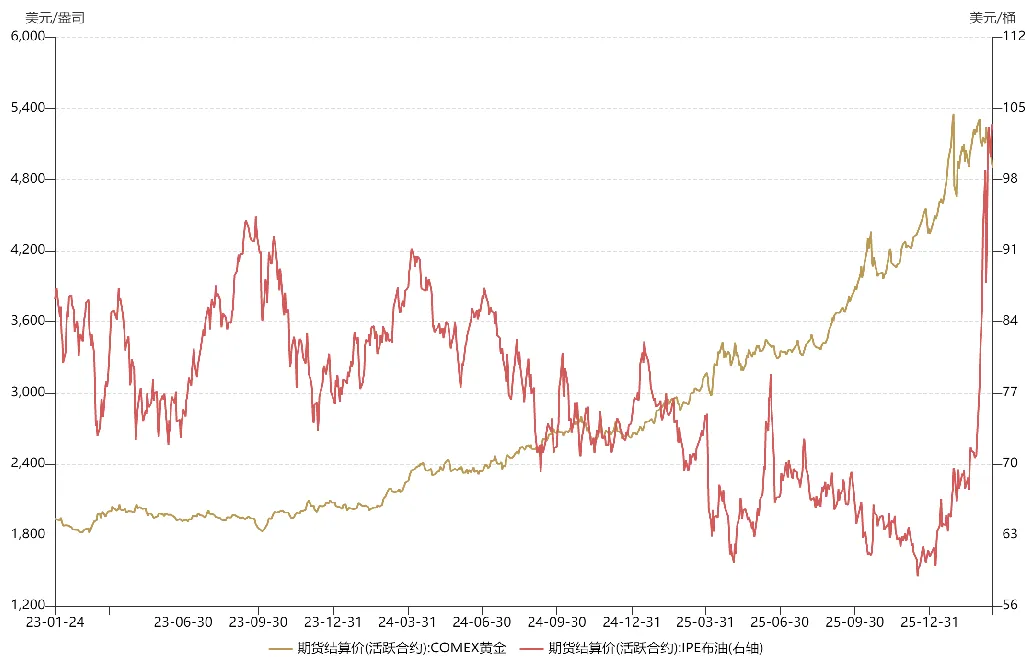
Since the end of 2023, precious metals have entered a super bull market, with gold prices soaring from 1800 US dollars to over 5000 US dollars. The strong upward momentum is due to gold simultaneously taking on the roles of hedging against geopolitical risk, inflation risk, and dollar risk.
In October 2023, amid the Russia-Ukraine war, large-scale conflicts erupted in Israel and Palestine, and the Middle East fell into turmoil. In 2024, the Red Sea crisis broke out, and the Strait of Mandeb was blocked. In 2025, Trump took office, and the international order was on shaky ground. These are all manifestations of a chaotic geopolitical situation, which strongly supports gold prices.
On the other hand, in 2023, the U.S. economy switched from overheating to stagflation. By 2024, affected by political factors, the Federal Reserve recklessly opened a rate-cutting cycle despite inflation issues remaining unresolved, causing dollars to flood back into the market. On one hand, there is a phase of loosening monetary policy, while on the other, there is a risk of secondary inflation; gold takes on both dollar hedging and inflation hedging roles, fueling gold prices for takeoff.
With all three hedging functions gathered, how can gold prices not rise? In addition, benefiting from the Federal Reserve's easing cycle, both emerging markets and developed markets, whether A-shares or U.S. stocks, are experiencing bull markets.
Now let's talk about oil prices. Last year's oil price average was significantly lower than the year before, because after Trump took office, he courted OPEC to significantly increase oil production, trying to force Russia to compromise at the negotiating table. This strategy had temporary effects, with Putin conceding several times on negotiation matters. If it weren't for the U.S.-Iran war, it was expected that the Russia-Ukraine conflict would have signed a ceasefire agreement in the first half of this year.
Since the outbreak of the Middle East war, gold and oil prices have gone through several fluctuations, showing a divergence in their trends, which has different causes.
For gold prices, in mid to late January (half a month before the outbreak of war), as the probability of conflict between the U.S. and Iran continued to rise, gold prices began to rise, reflecting gold's hedging properties against geopolitical risks. According to prevailing market expectations at the time, this conflict was likely to be similar to last year's "Midnight Hammer" operation, short-lived and more of a phase of fluctuation.
After the U.S. implemented the "decapitation" operation against Iran, gold prices rebounded in the short term, but quickly encountered a sharp decline. This was because funds shifted from gold to crude oil; due to the previous concentration of gold positions, funds aimed at going long on crude oil chose to sell gold to gain liquidity. In other words, the act of switching from gold to crude oil led to a drop in gold and a rise in oil.
On the other hand, as foreign markets began to price in the durability of the U.S.-Iran war, U.S. stocks and other risk assets came under pressure, leading to a wave of redemptions. The U.S. financial market faced a liquidity crisis, and as one of the assets with cash-like liquidity, gold was heavily sold. That is to say, the slamming of gold prices at the beginning of March was not because international investors were bearish on gold, but rather a self-protection strategy amid the liquidity crisis.
If it were merely a liquidity crisis, that would be better; in such scenarios, gold prices often form a "deep V" trend, providing a bottom-fishing opportunity. However, it has become more complicated since mid-March, as overseas expectations of the U.S.-Iran conflict have become more pessimistic, worrying not only about the possibility of prolonged blockades in the Strait but also about potential large-scale attacks on each other's energy facilities by combatants, which would maintain oil prices at elevated levels for an extended period and devastatingly impact the global economy, even leading to the collapse of the international order. In this scenario, the Federal Reserve may delay the pace of rate cuts, or possibly restart the rate hike cycle as in 2022. Based on this expectation, gold prices experienced a sharp decline, breaking the record for the highest adjustment in recent years.
In other words, while gold's hedging function against geopolitical risks is still at play, the current reason for the sharp drop in gold prices is the reversal expectation of the Federal Reserve's monetary policy; the dollar's anti-hedging properties now outweigh the geopolitical and inflation hedging properties, becoming the main driving force. Compared to previous declines, gold's fundamentals have changed; it is no longer a liquidity crisis or profit-taking but concerns about tightening monetary policy from the Federal Reserve. This concern is also reflected in risk assets like A-shares and U.S. stocks, as under a fallen nest, how can there be intact eggs?
Since the outbreak of the U.S.-Iran war, crude oil prices have also undergone twists and turns, with the reason for this fluctuation being that overseas investors had a misperception of geopolitical issues. After the "decapitation" operation, oil prices continued to surge, peaking close to 120 dollars per barrel. However, in early March, as Trump hinted that "the war will soon end," the market began executing "TACO" trades, believing that the situation in Iran might ease, leading to a temporary 30% plunge in oil prices. However, unlike tariff issues, the dominance of geopolitical crises does not lie in Trump's hands; he cannot escape unscathed under the scenario of a blockade in the Strait. Ultimately, the market corrected its expectations for crude oil, and prices returned to an upward channel.
In geopolitical matters, markets sometimes exhibit deviations; however, such pricing distortions may not necessarily be a bad thing. A decline in oil prices can actually create an opportunity for accumulation, making it easier for latecomers to enter the market.
Looking to the future, the trends of gold and oil prices depend on the rhythm of the U.S.-Iran conflict. If it unfolds into a prolonged war like the Russia-Ukraine conflict, then gold may lack allocation value in the first half of the year, and it may be better to focus on the energy chain in the short term. However, there is still a possibility of reversal; the U.S.-Iran war could reach a critical juncture, depending on whether the Strait of Hormuz can be reopened in the short term and how Trump chooses to act.
免责声明:本文章仅代表作者个人观点,不代表本平台的立场和观点。本文章仅供信息分享,不构成对任何人的任何投资建议。用户与作者之间的任何争议,与本平台无关。如网页中刊载的文章或图片涉及侵权,请提供相关的权利证明和身份证明发送邮件到support@aicoin.com,本平台相关工作人员将会进行核查。


