Author: Kaff
Translation: Yuliya, PANews
TL;DR
Bittensor consists of 128 independent subnetworks, each operating like a startup with its own token (Alpha), revenue model, and team.
There are two ways to make money: TAO emissions (protocol subsidies based on staked inflow) and capital gains on Alpha tokens (from subnet performance).
Since Taoflow in November 2025, subnetworks with negative net staked inflow will receive zero emissions, either going live or being eliminated.
Approximately 3,600 TAO (around $960,000) are allocated daily across all subnetworks, with the top ten controlling about 56% of the share.
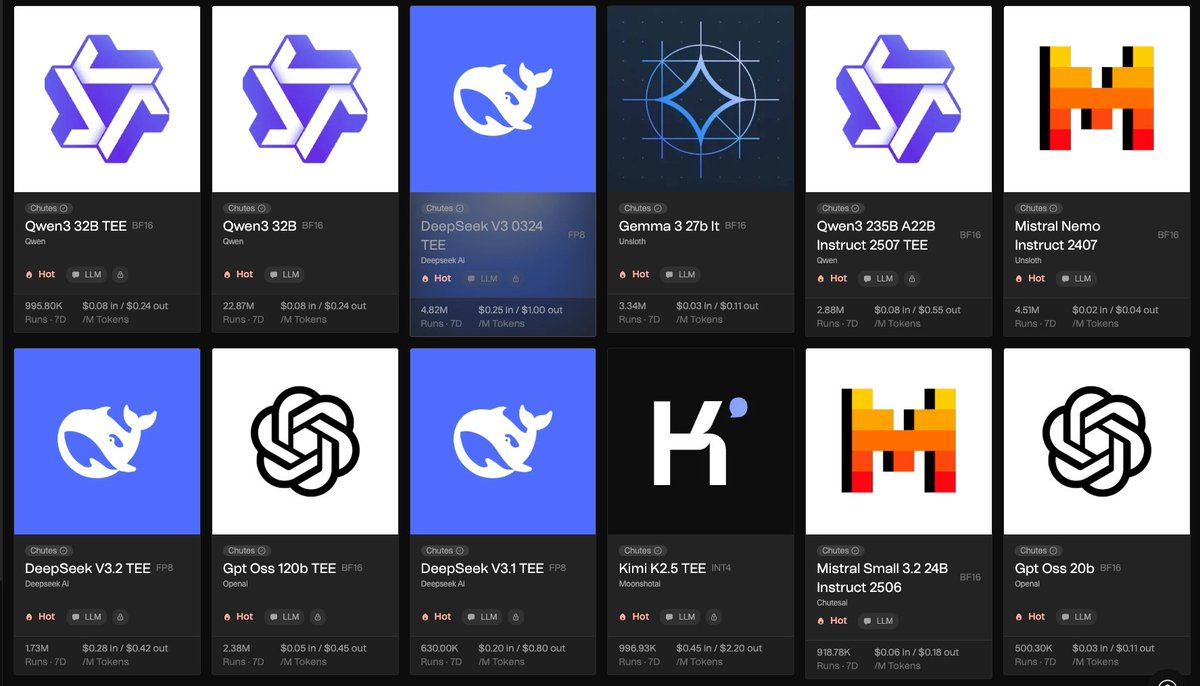
Chutes (SN64) is the most obvious example of market fit: with 400,000 users, it has processed 9.1 trillion tokens at a cost 85% cheaper than AWS.
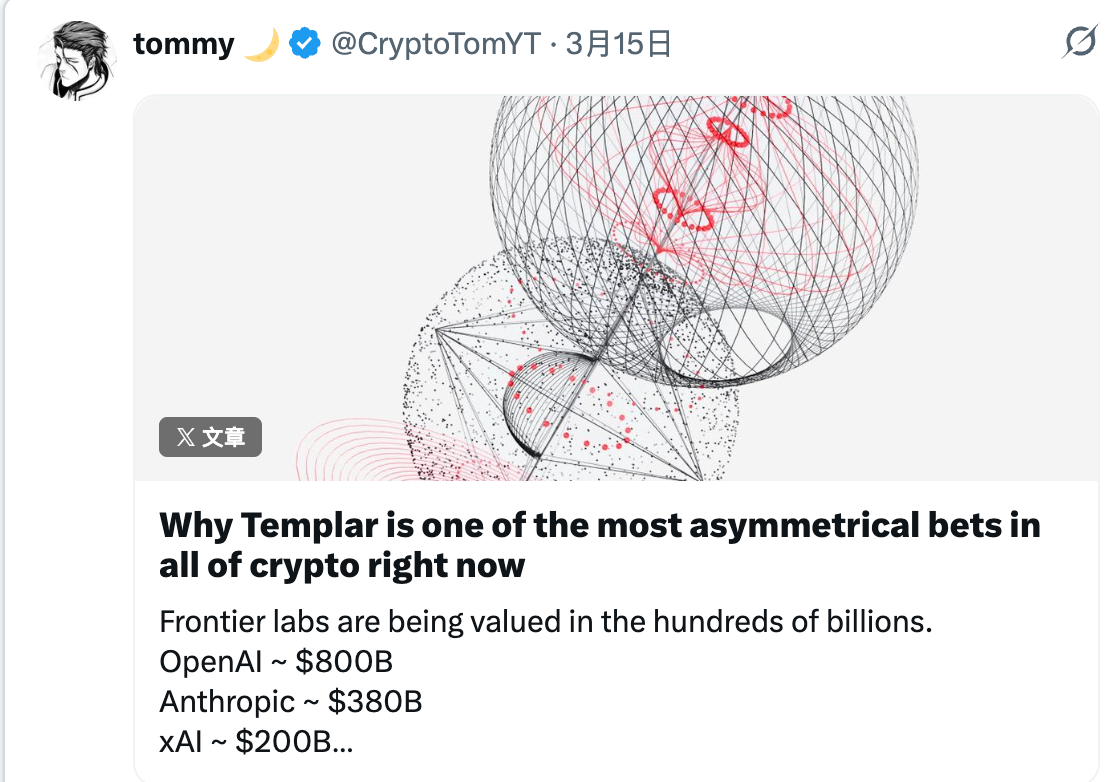
Templar (SN3) represents the most asymmetric investment: it trains cutting-edge LLMs fully decentralized, with a market cap of about $60 million, while OpenAI is valued at $800 billion.
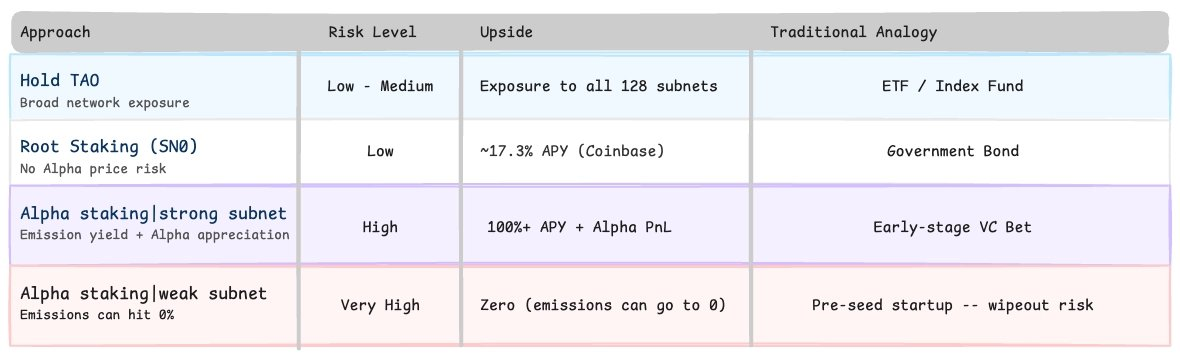
TAO = index fund exposure for the entire network, while Alpha staking = investment concentrated in specific startups—offering over 100% annual return potential, but also real risks.
Alpha tokens do not come with any formal revenue promises, and their value depends entirely on market dynamics and team execution.
1. Subnetwork Structure: Who Does What?
When people think of Bittensor, the most common mental model is: this is a decentralized AI project. While this is true, it is not comprehensive.
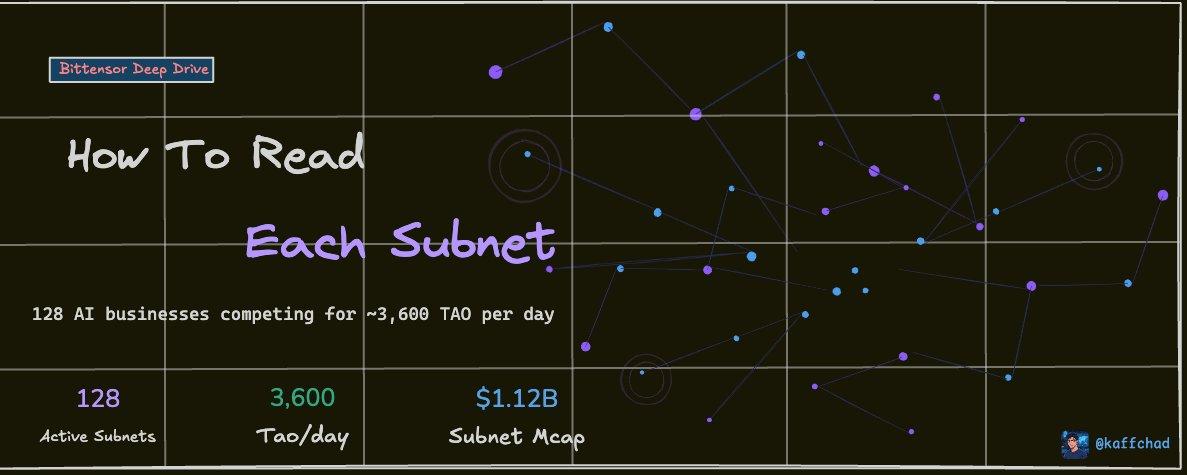
In fact, Bittensor is a network of 128 independent AI startups, competing with each other in a brutal economic system, each with its own token and revenue model, striving to survive. By March 2026, the total market capitalization of all subnetwork tokens is estimated to be around $1.12 billion, representing 27% of TAO's own market capitalization. Grayscale refers to it as “the Y Combinator of decentralized AI.” However, unlike those funded by committee decisions, the market decides for itself.
Understanding this mechanism allows for the assessment of which subnetworks are creating real value and which are declining.
Each subnetwork functions as an incentivized competitive market, producing specific digital goods—AI inference, GPU computation, model training, financial data analysis, and various services.
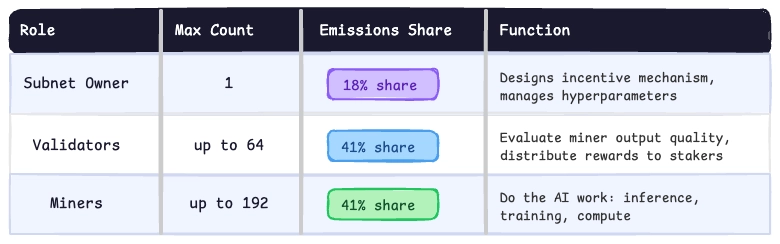
Each subnetwork is powered by three roles: subnetwork owners, validators, miners:
Alpha Tokens: Equity in the Subnetwork
When you stake TAO to a subnetwork, your TAO enters an on-chain AMM pool (similar to Uniswap V2's mechanism). In return, you receive Alpha tokens. The price formula is:
Alpha price = TAO in the pool ÷ Alpha in the pool
The hard cap for Alpha tokens is 21 million (in line with the supply of TAO), and they are automatically compounded released approximately every 72 minutes (one “tempo” = 360 blocks).
2. Two Sources of Income and Why They Are Often Overlooked
In Bittensor, there are two completely independent ways to make money:
Income Source 1: Getting TAO Emissions via Taoflow
Since November 2025, Bittensor has adopted the Taoflow model, which represents a fundamental change in the way token releases are allocated.
Previously, releases were calculated based on the token price. This created a loophole: project teams could artificially inflate the token price to achieve releases, establish a “TAO treasury,” and then slowly sell while still collecting rewards.
Taoflow addresses this issue by tracking net staked flow of TAO: that is, TAO staked inflow minus TAO unstaked outflow. This mechanism operates in four steps:
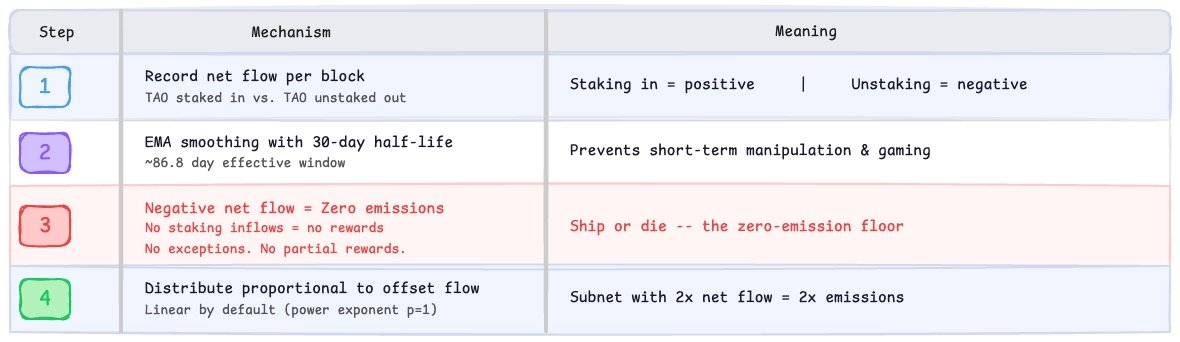
After the first halving on December 14, 2025, the block reward dropped from 1 TAO to 0.5 TAO/block. Currently, approximately 3,600 TAO (around $960,000 at current prices) are distributed daily to 128 subnetworks. DCG estimates over $100 million flows into the ecosystem annually.
Income Source 2: Alpha Token Profits and Losses (PnL)
This is a part that most TAO holders do not track.
If a subnetwork performs well, the price of Alpha (in TAO terms) will rise. When you unstake, you receive more TAO than what you initially invested. This is essentially Alpha profits and losses = capital gains from holding tokens of that specific subnetwork.
Taoflow has created a powerful flywheel effect:
Excellent products → more people stake TAO → positive net flow
Positive flow → more token releases → deeper liquidity pool
Deeper liquidity → lower slippage → attract more capital
More capital → Alpha price increases → existing holders' Alpha profits and losses increase
Conversely, the same harshness applies. Prolonged negative flow in a subnetwork → zero releases → stakers continually withdraw → death spiral.
3. Which Subnetworks Are Winning and Why?
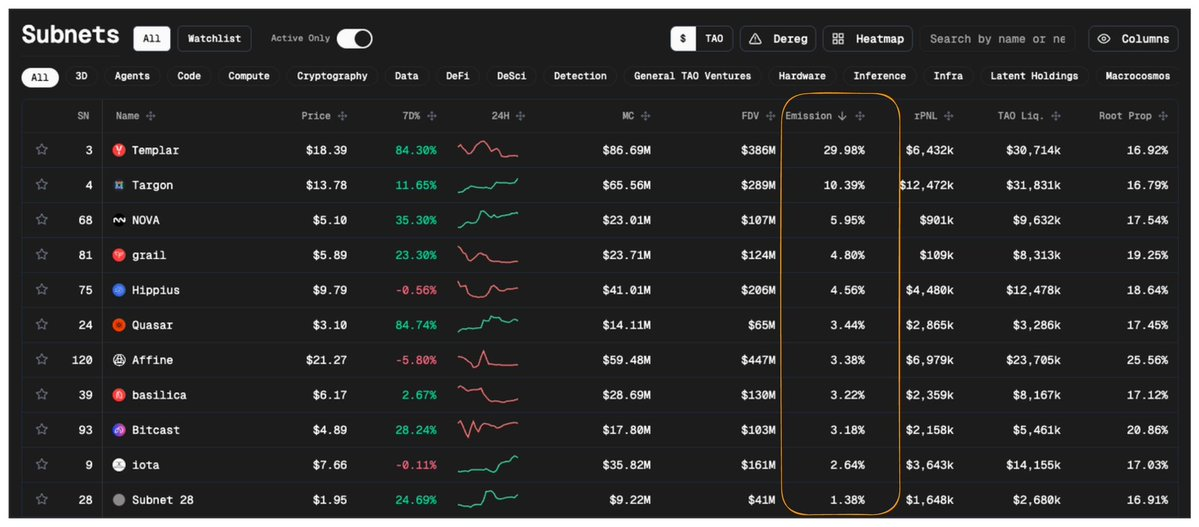
Here’s a snapshot of the leading subnetworks ranked by dominance in releases and realized profits and losses (rPnL):
SN3 | templar: large-scale LLM pre-training | Release Share: 30.39% | rPnL: $6.43 million
SN4 | Targon: AI inference market—hosting and providing AI models for real-time predictions | Release Share: 10.39% | rPnL: $12.47 million
SN68 | METANOVA: AI drug discovery company, developing therapies to reprogram mind and body | Release Share: 5.95% | rPnL: $900,000
SN81 | grail: verifiable LLM training post-processing | Release Share: 4.8% | rPnL: $109,000
SN75 | Hippius: decentralized storage and network infrastructure with IP management | Release Share: 4.56% | rPnL: $4.48 million
The top 10 subnetworks control about 56% of the total daily release volume.
Case Study: Chutes, a Model of Product-Market Fit (PMF)
Built by Rayon Labs, Chutes is a decentralized serverless AI inference market, a Web3 alternative for model deployment to the OpenAI API and AWS.
Chutes stands out by:
Processing 9.1 trillion Tokens since the end of 2024
Having over 400,000 users (over 100,000 accessing via API)
AI model deployment costs are 85% cheaper than AWS
Supported models: dozens including DeepSeek, Mistral, LLaMA, etc.
Platform revenue auto-stakes → repurchase Alpha tokens → organic demand flywheel
In a surge in February 2026, Chutes attracted over 2,740 TAO in just 9 hours. Alpha tokens peaked at $99.94 (0.225 TAO), with an FDV of 2.05 million TAO (around $518 million at the peak price of TAO).
Rayon Labs also operates SN56 (Gradients—model training) and SN19 (Nineteen—high-frequency inference), which combined at peak account for over 23% of total release volume.
Case Study: Templar (SN3), the Stake with the Most Asymmetric Return Potential in the Subnetwork Ecosystem
On March 10, 2026, Templar (SN3) completed Covenant-72B, a model with 72 billion parameters, known as the largest decentralized pre-training run in history.
4. The Mechanism Behind: Registration, Yuma Consensus, and Competitive Pressure
Registration, a Competitive Arena
Not everyone can establish a subnetwork. Registration employs a dynamic destructive pricing mechanism: the cost doubles each time a new subnetwork registers; when no new subnetworks are registered, the cost linearly halves over 28,800 blocks (about 4 days).
When all 128 slots are filled, new subnetworks must replace the worst-performing existing ones (measured by lowest EMA price). Newly registered subnetworks receive a four-month grace period before being eligible for deregistration. The network is expected to expand to 256 subnetworks by 2026.
Yuma Consensus, Automated Independent Auditing
Within each subnetwork, Yuma Consensus converts validators' subjective assessments into objective reward distributions:
Validators submit weight vectors and score each miner they have assessed
The blockchain calculates a median based on staked weight for each miner (kappa=0.5)
Weights above the median are clipped—to prevent collusion and overvaluation
Validators use the commit-reveal mechanism—submitting sealed weights that are revealed only after a set number of blocks—to prevent the replication of weights
Validators who can early recognize quality miners and maintain consistent assessments will establish stronger binding positions and earn larger reward shares
The result is: no subnetwork owner can unilaterally change who can receive rewards. This is a fundamental distinction that sets Bittensor apart from typical "AI projects" in the crypto space.
5. Investment Framework: TAO = Index Fund, Alpha Staking = Startup Bets
Auditless Research has accurately summarized this: "TAO is in fact more like an option token—a call option that points to any seemingly undervalued Alpha token releases."
How to Interpret Subnetworks Like an Asset Balance Sheet
Release Volume = Protocol Subsidy - Network Revenue, similar to government grants or accelerator funding
Alpha Profits and Losses = Market Cap Signal - The market is pricing the true value of this subnetwork
Net Staked Flow = Revenue Growth Indicator - Positive Flow = "Product is selling well," Negative Flow = customer churn
Subnetwork Owners = Founder Quality - Communication frequency, delivery speed, and product roadmap are critical to track
Number of Validators = Board Quality - More independent validators = lower chance of score manipulation
Institutional Signals Are Strengthening
This is no longer just a retail story:
DCG holds over 500,000 TAO (about 2.4% of total supply)
Polychain Capital holds approximately $200 million in TAO
Grayscale GTAO Trust listed on the New York Stock Exchange (NYSE) on January 6, 2026
Stillcore Capital (co-founded by Jason Calacanis) launched a fund specifically targeting subnetwork tokens
6. Conclusion: Entry Framework
Bittensor has created a structure that is unique in the crypto space: 128 AI companies compete with each other, sharing approximately 3,600 TAO (around $960,000) daily, with capital allocation entirely determined by the actions of stakers.
When evaluating a subnetwork, consider these five questions:
Product: What does this subnetwork offer? Is there a real demand for it?
Flow: Is the net staked flow positive or negative? What is the trend over the last 30 days?
Team: Is the subnetwork owner continuously communicating and delivering?
Flywheel: Is revenue creating organic demand for Alpha or purely speculative?
Exit: Is the liquidity pool large enough to exit without significant slippage?
TAO provides you with broad exposure to the entire ecosystem. Meanwhile, Alpha staking offers concentrated bets on specific “startups”—accompanied by all the upside potential and downside risks that come with it.
免责声明:本文章仅代表作者个人观点,不代表本平台的立场和观点。本文章仅供信息分享,不构成对任何人的任何投资建议。用户与作者之间的任何争议,与本平台无关。如网页中刊载的文章或图片涉及侵权,请提供相关的权利证明和身份证明发送邮件到support@aicoin.com,本平台相关工作人员将会进行核查。


