Written by: Andjela Radmilac
Translated by: Saoirse, Foresight News
Polymarket and Kalshi are seeking funding as they aim for valuations that place them among the top consumer fintech companies, while at the same time, U.S. regulators are tightening regulations for such products. Reports indicate that both companies are in early-stage funding negotiations, with valuations expected to reach around $20 billion.
This fundraising frenzy coincides with a political storm.
Contracts related to Iran have transformed the prediction market from a niche forecasting tool into a controversial focal point involving insider information and war speculation. A Reuters investigation into trading markets on Polymarket related to the timing of an attack and the ousting of Khamenei found that around $529 million was invested in contracts related to the timing of the attack, with about $150 million directed towards contracts related to Khamenei; meanwhile, it has been reported that six accounts profited about $1.2 million through precisely timed trades.
Now, U.S. lawmakers are drafting relevant bills, and the Commodity Futures Trading Commission (CFTC) has also stated that it will advance new regulatory rules.
Wall Street believes that event probability forecasts will become part of the information system; however, Washington is trying to block it because it fears that this system could allow undeserving individuals to profit at the worst possible moment.
Why Wall Street is Optimistic About Prediction Markets
Prediction markets can turn attention into trading, earn transaction fees from trading, and generate real-time probability data, packaged into informational products.
It is this data product that has allowed prediction markets to escape the realm of "gambling" and be categorized alongside market data, polling, and financial terminals as a similar information tool—because its output form is highly similar to market quotes.
Mainstream media has begun to collaborate with these platforms:
- CNBC has signed a multi-year agreement with Kalshi to integrate its probability data into television and digital programs starting in 2026.
- Dow Jones has reached an exclusive partnership with Polymarket to bring predictive data into platforms such as The Wall Street Journal and Barron's, treating contract prices as part of the news infrastructure alongside earnings reports, interest rates, and election coverage.
These collaborations have also amplified the impact of scandals: once probability data is embedded in mainstream media, it influences the public's judgments about the likelihood and urgency of events. This is also why regulators believe that platforms must adhere to higher standards of fairness, oversight, and settlement.
This explains why, even as Iran-related trades spark political controversy, the valuations of both companies continue to rise.
Iranian Events Turn Prediction Markets into a Washington Dilemma
The greatest advantage of prediction markets is the ability to gain information ahead of time. The contracts related to Iran clearly indicate that these platforms are touching on sensitive information that the government seeks to control.
On March 2, bets on the timing of the attack reached $529 million, and contracts related to Khamenei's death and ousting garnered about $150 million. Just hours before the attack on Iranian leaders, six accounts suddenly injected funds and profited $1.2 million through these contracts.
As tensions escalated, multiple reports indicated a surge of new registered accounts making precise bets on events related to Iran. Such reports have drawn Polymarket, from a niche crypto platform, directly into the focus of government regulation and enforcement.
The core issue these platforms currently face is: trust and fairness.
For prediction markets to operate, users must trust that the rules are stable, that result determinations are consistent, and that there is no insider bias. Once the traded subject is a military action, trust issues elevate to political issues—because the motive for early trading could turn into a motive for leaking sensitive or even classified information.
This is also why policy responses have rapidly escalated.
Representative Mike Levin and Senator Chris Murphy are already drafting bills aimed at constraining prediction markets. Congress will directly define which event contracts can be legally traded.
Additionally, CFTC Chairman Michael Selig has stated that the agency has submitted a rule-making pre-notice to the White House Office of Management and Budget, ready to launch a regulatory framework for prediction markets that may affect contract design, oversight, enforcement, and other aspects.
The choices facing Washington are clear:
- Recognize prediction markets as legitimate event contracts, strengthen regulation, clarify limitations, and allow the industry to expand orderly under rules;
- Directly prohibit categories of contracts related to war, assassinations, and the ousting of leaders, as these types of trades are highly prone to insider trading and could foster malicious motives.
The following data reveals why this conflict is difficult to quell:
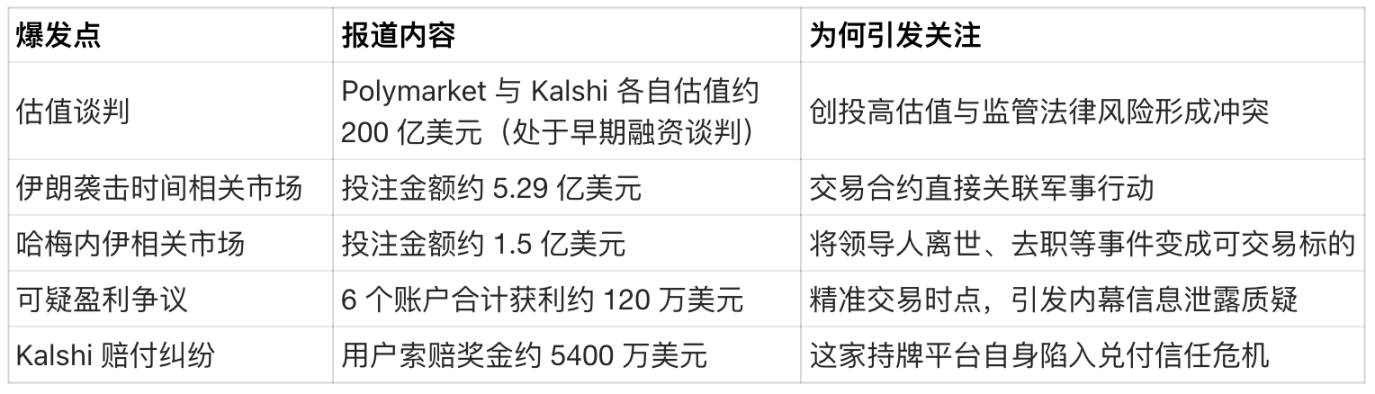
Kalshi's own disputes also indicate that relying solely on regulation cannot fully resolve trust issues.
On March 5, Kalshi faced a class-action lawsuit, with users accusing the platform of refusing to pay about $54 million in payouts—users had bet that Iran's supreme leader would step down before March 1. Plaintiffs claimed that the platform invoked the "death-related exception clause" only after the Iranian leader was attacked to deny the payout.
However, Kalshi stated that its rules regarding leader death-related trades had been clear all along, and that it had refunded transaction fees and compensated user losses, asserting that users did not incur losses.
This is precisely the contradictory dilemma faced by current investors and policymakers.
Investors hope the industry will grow, become more widespread, and that probability prediction data can be reasonably integrated into the mainstream information system.
Users, on the other hand, hope that when the outcomes of events are contentious and emotionally charged, the platform's rules can be stable and credible.
Regulators, meanwhile, seek to prevent such markets from turning sensitive national actions into tradable products, avoiding a situation where "having access to confidential information yields optimal trading returns." Because once these trade prices begin to affect the public opinion information environment, the associated risks will morph into governance challenges.
免责声明:本文章仅代表作者个人观点,不代表本平台的立场和观点。本文章仅供信息分享,不构成对任何人的任何投资建议。用户与作者之间的任何争议,与本平台无关。如网页中刊载的文章或图片涉及侵权,请提供相关的权利证明和身份证明发送邮件到support@aicoin.com,本平台相关工作人员将会进行核查。


