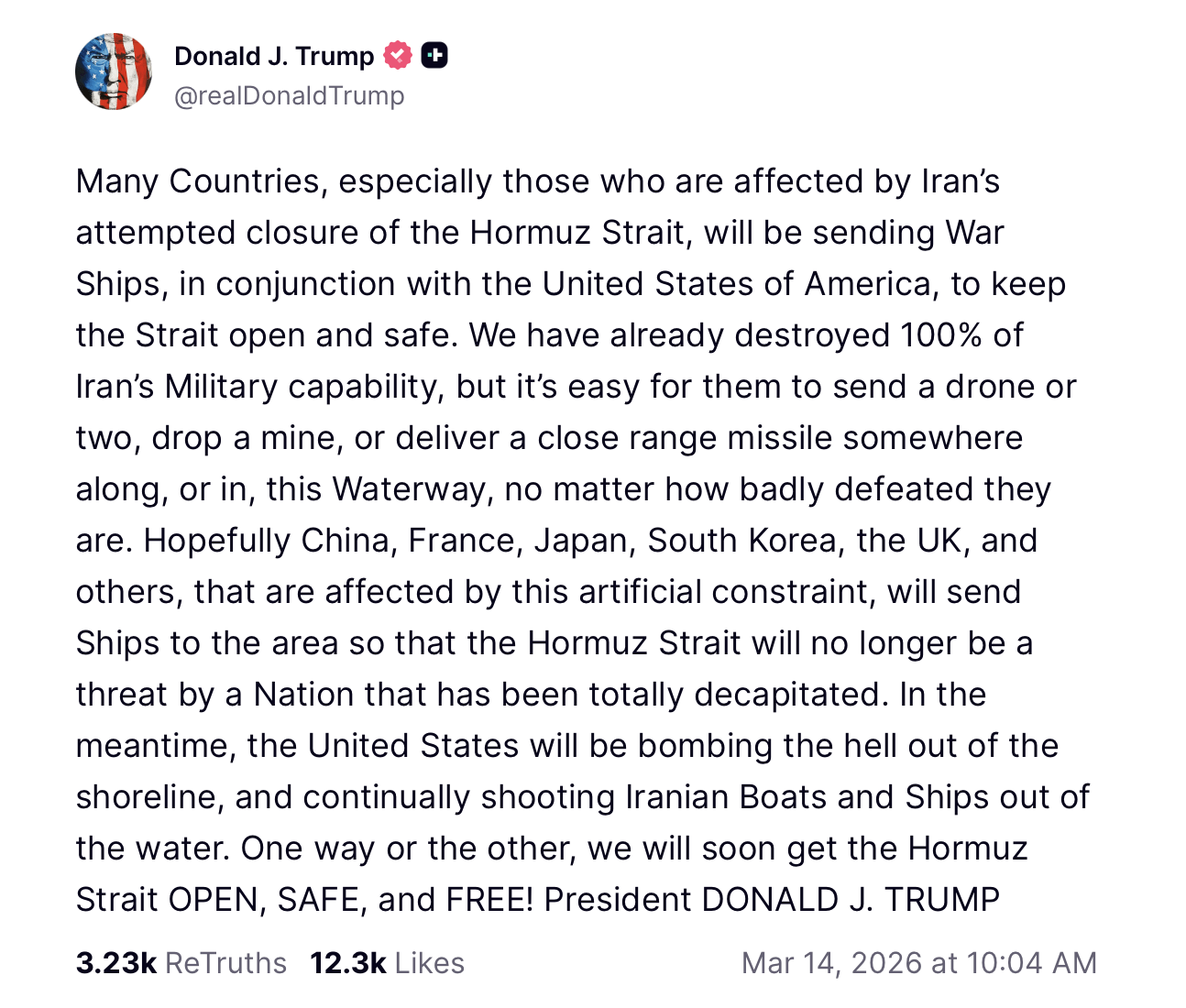
Trump’s March 14 announcement landed like a flare over already-tense waters. In a Truth Social post, the president said the U.S. and “many countries” would deploy naval forces to ensure ships can pass through the Strait of Hormuz without Iranian missiles, drones, or floating surprises turning tankers into maritime bonfires.
The move comes just two weeks after the United States and Israel launched strikes against Iran under Operation Epic Fury on Feb. 28, setting off a chain reaction that has now dragged one of the world’s most critical shipping lanes into the crossfire.
For those keeping score at home, the Strait of Hormuz is not just another blue squiggle on a map. The narrow passage—about 21 miles wide at its tightest—connects the Persian Gulf to the Gulf of Oman and funnels oil and liquefied natural gas exports from Saudi Arabia, the United Arab Emirates, Iraq, Qatar, and Kuwait into global markets.
Before this latest geopolitical drama, roughly 20 million barrels of crude and condensate per day passed through that corridor—about one-fifth of the planet’s petroleum liquids consumption. When that artery clogs, the global economy notices. Quickly.
Since early March, Iranian forces linked to the Islamic Revolutionary Guard Corps (IRGC) have reportedly targeted commercial shipping in the strait, damaging or forcing the abandonment of at least 11 merchant vessels. More than 10 seafarers have been killed or remain missing, and insurers—never fond of missiles—have jacked premiums skyward.
Shipping companies, understandably uninterested in starring in the next viral maritime disaster video, have pulled back. The result: tanker traffic that once hummed through the corridor has dropped dramatically, with some estimates showing declines approaching 70% before activity nearly froze altogether.
Energy markets responded with the enthusiasm of a cat meeting a cucumber. West Texas Intermediate crude (WTI), which hovered near $67 per barrel before the conflict erupted, has climbed toward the mid-$90 range as traders scramble to price in the possibility that the world’s busiest oil gateway could remain contested. Brent crude is now above $100 per barrel.
Defense Secretary Pete Hegseth attempted to strike a steadier tone during a Pentagon briefing on March 13, telling reporters that the situation—while serious—was being handled. “We have been dealing with it,” Hegseth said. “The only thing prohibiting transit in the strait right now is Iran shooting at shipping.”
Translation: the waterway is technically open, provided nobody fires anything explosive at the vessels using it. Hegseth also confirmed U.S. forces have already targeted Iranian naval assets believed to be laying mines or preparing attacks, including multiple minelayers and coastal launch positions.
The Pentagon has reportedly struck thousands of Iranian military targets since the conflict escalated, with operations focused heavily on degrading Iran’s naval capabilities. In other words, if you’re wondering why Tehran suddenly seems fond of drones and asymmetric tactics, that’s because its conventional naval muscle has been taking hits.
Trump, meanwhile, is pushing for a broader coalition—naming countries such as China, France, Japan, South Korea, and the United Kingdom as potential contributors to a multinational naval presence. Historically, there is precedent. During the Iran-Iraq Tanker War of the 1980s, the U.S. Navy escorted commercial vessels through the Gulf under Operation Earnest Will, effectively running maritime bodyguard duty for oil shipments.
But the 2026 version of that challenge comes with updated complications: swarming drones, anti-ship missiles, floating mines, and the occasional speedboat packed with unpleasant intentions. Escorting tankers in such an environment is less like directing traffic and more like threading a convoy through a fireworks factory.
Meanwhile, Gulf producers are already feeling the ripple effects. Some have scaled back exports or declared force majeure on contracts as the security environment deteriorates. And while Asia remains the biggest customer for Hormuz oil—roughly 84% of shipments head east—Europe and global supply chains are hardly immune.
When the energy system hiccups, the economic consequences rarely stay local. Trump’s blunt message Saturday was that the United States intends to restore freedom of navigation—preferably with help.
“We will soon get the Hormuz Strait OPEN, SAFE, and FREE!” he wrote.
The timeline for that promise remains unclear. But until tanker traffic resumes at anything close to normal levels, the global economy—and energy traders everywhere—will keep one nervous eye on a narrow strip of water that suddenly feels much smaller than 21 miles.
FAQ 🔎
- Why is the Strait of Hormuz important to global energy markets?
About 20% of the world’s petroleum liquids pass through the strait each day, making it the most critical oil shipping chokepoint on Earth. - Why did President Trump call for warships in the Strait of Hormuz?
The deployment aims to protect tanker traffic after Iranian attacks severely disrupted commercial shipping through the corridor. - How has the Iran conflict affected global oil prices?
Crude prices jumped sharply after tanker traffic collapsed and markets began pricing in supply disruptions from the Gulf. - Could international naval escorts reopen the Strait of Hormuz?
A multinational naval presence could deter attacks and stabilize shipping routes, though modern drone and missile threats complicate escort operations.
免责声明:本文章仅代表作者个人观点,不代表本平台的立场和观点。本文章仅供信息分享,不构成对任何人的任何投资建议。用户与作者之间的任何争议,与本平台无关。如网页中刊载的文章或图片涉及侵权,请提供相关的权利证明和身份证明发送邮件到support@aicoin.com,本平台相关工作人员将会进行核查。


