Author: BiyaNews
Recently, a piece of news from the cryptocurrency industry has caused many investors to furrow their brows. Blockchain payment giant Ripple announced a stock buyback plan of up to $750 million, a move that is expected to boost its company valuation to about $50 billion. This should have been a shot in the arm, but the market reaction has been rather "divided": on one side is a "show of confidence" from the company level, while on the other side, its native token XRP continues to struggle at low levels, even falling below key psychological and technical support levels.
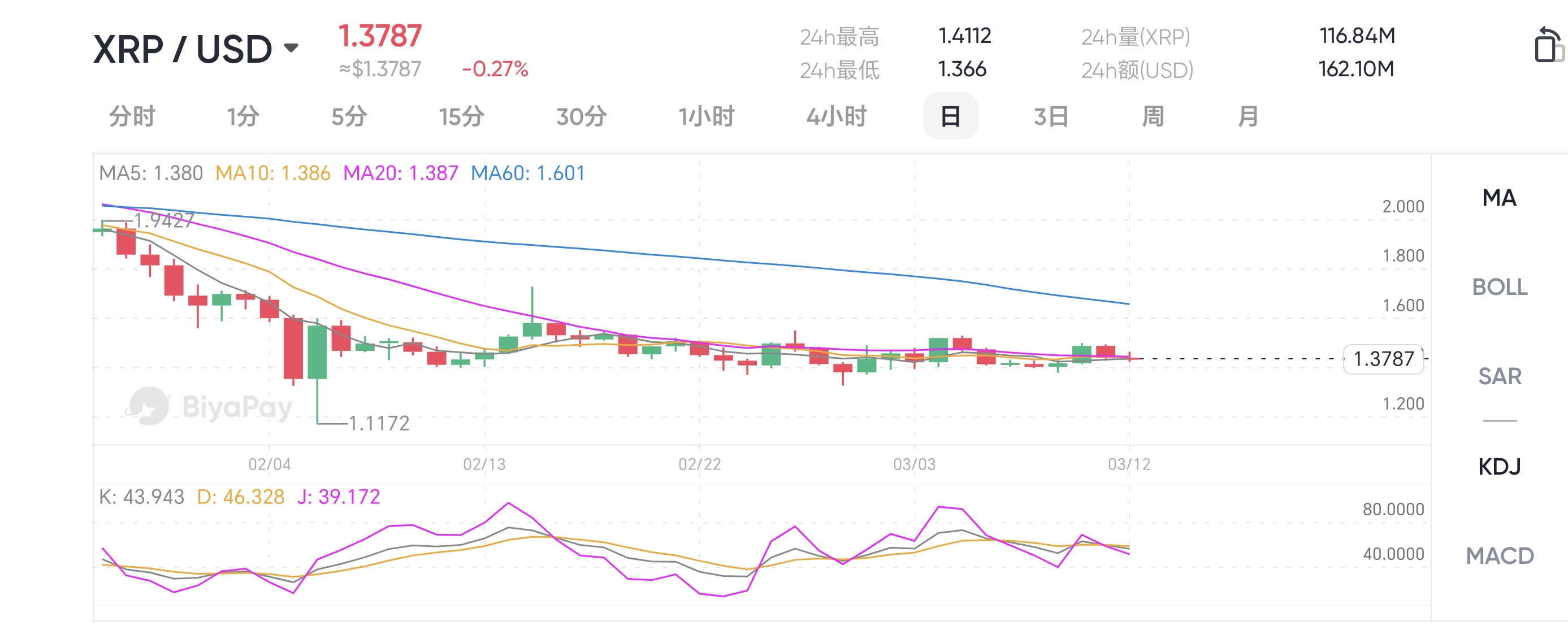
This strange phenomenon of "the company going left, the token going right" inevitably raises the question: Is Ripple's "cash ability" buyback just a "pie in the sky" for shareholders, or a "poison" for XRP holders? What underlying deep logic is hidden behind this in the crypto market?
The "Sunshine Plot" Behind the Buyback: Confidence, Control, and Market Signals
When a company chooses to pull out real money to buy back its stock in an environment of macro uncertainty and low market sentiment, this is certainly not just a simple financial operation. It is first and foremost a "statement of confidence" addressed to shareholders and the market.
From a psychological perspective, buybacks directly reduce the number of circulating shares, and with profits unchanged, earnings per share (EPS) will correspondingly increase, which directly enhances the "value" of the existing shareholders' holdings. Especially against the backdrop of pressure tests on global tech stocks and the crypto market, this proactive "supporting the market" posture can effectively stabilize the emotions of core investors and prevent panic-driven sell-offs. I remember during the tech stock bear market in 2022, many cash-rich giants like Apple and Google conveyed long-term confidence through large-scale buybacks, with immediate effects.
Furthermore, from a deeper perspective, buybacks are also a strategic move to strengthen control. By purchasing shares from the open market or early investors, Ripple’s management and founding team can further consolidate their control over the company, reducing interference from external shareholders and paving the way for executing its long-term, sometimes quite controversial, blockchain strategy. One analyst pointed out that this clearly demonstrates the company's strong confidence in its own growth, particularly in expanding the capacity for blockchain application scenarios.
However, there is always another side to the coin. Where does the massive buyback funding come from? Although Ripple's financial situation as a private company is opaque, a troubling speculation has begun to circulate in the market: Is the company continuously selling its substantial XRP reserves to "blood transfuse" the buyback? This speculation is not unfounded; it directly touches the most sensitive nerve in the Ripple ecosystem.
XRP's "Darkest Hour": Technical Collapse and Erosion of Confidence
While Ripple's board outlines a blueprint for a $50 billion valuation, XRP traders are staring at dismal candlestick charts. The token's price is not only far below the highs of the previous bull market but has recently broken through the critical support level of $1.80, dipping below $1.50, forming a textbook-level bearish structure.
This weakness has spread from the charts to on-chain data. Observing on-chain activity, signals of retail investors' "surrender" are accumulating. Many addresses are in an "unrealized loss" state, especially after XRP underwent over a 16% drawdown in February. This continuous decline depletes morale, turning holders from "faithful holding" to "questioning life," with every rebound becoming an opportunity to reduce positions and escape.
Thus, the sharp question becomes unavoidable: If Ripple is indeed raising buyback funds through selling XRP, it is equivalent to continuously creating selling pressure in the open market. This forms a bizarre cycle: the company uses money obtained from selling tokens to boost the value of its equity, while token holders bear the cost of the price decline. The "seesaw effect" between the company's strategy and token value has never been clearer.
This divergence did not happen overnight. Looking back over the past few years, Ripple has made frequent moves in global business expansion, from collaborating with central banks to explore central bank digital currencies (CBDC) to expanding payment corridors in regions like Asia-Pacific and Europe. There haven’t been few positive news at the company level. However, the positive "fundamentals" seem to create ripples in the price of XRP that quickly dissipate. The market seems to be learning to price "Ripple the company" and "XRP the token" as two independent assets.
The "Company-Token" Paradox in the Crypto Market: What Are We Really Investing In?
The divergence between Ripple and XRP actually exposes a long-standing fundamental confusion in the crypto world: When investing in a blockchain company with a native token, what are we actually investing in? Is it the company's technology, team, and business contracts, or the token that operates on a decentralized network with its price determined by the entire network's traders?
In traditional stock markets, company value is closely tied to stock price through the equity link. Company profit growth, stock buybacks, stock price rises, and shareholders directly benefit. However, in Ripple's case, this logic chain has experienced a "decoupling." XRP is legally defined as a non-security (at least in the current case in the U.S.), and it does not represent ownership or dividend rights in Ripple. Its value depends more on its utility in the RippleNet payment network, market liquidity, and pure speculative demand.
This creates an awkward situation: no matter how well Ripple company develops, if market demand for XRP as a cross-border settlement medium does not meet expectations, or if more efficient competitors emerge, XRP's price can still weaken independently. Conversely, even if XRP surges due to market speculation, if Ripple cannot translate that into stable revenue and profit, its equity value may remain stagnant.
I remember during DeFi Summer, many protocol tokens also went through a similar phase. The usage of the protocol itself exploded, but the token price lagged or even moved in the opposite direction until more sophisticated token economic models (such as tying protocol revenue with token buybacks and burns) emerged, which partly resolved this divergence. For Ripple and XRP, establishing a more direct and transparent value transmission mechanism may be key to restoring market confidence.
The Path Ahead: A Triple Test of Regulation, Utility, and Market Patience
Looking ahead, Ripple and XRP face multidimensional challenges.
First, the Damocles sword of regulation has not completely lifted. Although Ripple has achieved some key victories in its legal battle with the U.S. SEC, the regulatory environment remains complex and variable globally. Any new adverse rulings or tightening of policies could simultaneously impact both the company's business and the confidence in its token.
Second, proving real-world utility is urgent. XRP needs to demonstrate that it is not just an "experimental product" of Ripple, but an indispensable, high-efficiency, low-cost component of the global payment system. This requires greater adoption by mainstream financial institutions and significant, sustainable growth in cross-border payment volumes. Recently, some regional banks have begun to experiment with using Ripple's technology for cross-border settlement, which is a positive signal, but the scale still needs to be observed.
Lastly, the market's patience is being tested. The cycles in the crypto market are becoming shorter, and investors' attention can easily shift. If XRP cannot demonstrate vitality in price that matches Ripple's development in the long term, funds and attention may flow to other public chains or payment tokens with stronger narratives and faster growth.
For investors, the current situation calls for a clearer understanding. You must think carefully: Are you investing in Ripple, a tech company that may go public in the future with strong business capabilities, or in XRP, a crypto asset with specific uses? These are two distinctly different investment logics and risk-return characteristics.
Perhaps Ripple's buyback plan will ultimately succeed in enhancing its valuation and pave the way for future listings. And XRP may, at some point, find an explosive point in a huge market due to its unique settlement efficiency, breaking out into an independent trend. But before that, this "decoupling drama" between the "company" and the "token" will continue to test the wisdom and resolve of every market participant. The market is always changing; the only constant is that we need to keep asking: Where exactly is the source of value?
免责声明:本文章仅代表作者个人观点,不代表本平台的立场和观点。本文章仅供信息分享,不构成对任何人的任何投资建议。用户与作者之间的任何争议,与本平台无关。如网页中刊载的文章或图片涉及侵权,请提供相关的权利证明和身份证明发送邮件到support@aicoin.com,本平台相关工作人员将会进行核查。


