Written by: Rhythm BlockBeats
In March 2026, something happened simultaneously in the product departments of the three leading exchanges: Binance, OKX, and Bitget: How do we adopt OpenClaw?
OpenClaw is an AI Agent created by Peter Steinberger that can control your computer to write code, read files, and execute tasks without using hands. Once launched, it quickly spread within the developer community.
As soon as this tool appeared, people in the crypto space immediately thought of one thing: Can it help me trade? The real order kind, running strategies 24 hours while the user sleeps.
Each exchange was pressured to make a decision: Should they become a trading entry point for the AI Agent?
The time window was very brief.
1. Strength from all sides
The barriers to quantitative trading have obstructed the crypto circle for many years. API documentation, signature authentication, server deployment; after these three hurdles, most people with trading thoughts just give up. To play in quant trading, you either write code yourself or pay someone to write it.
After the introduction of AI Agent, this door began to loosen. Tell OpenClaw: "Go long when BTC falls below 90000, position 10%, stop loss 87000." It finds the interface and completes the operation itself. Tasks that previously required hundreds of lines of code can now be done in one sentence. Those without technical skills can re-enter, and ordinary users who had never considered program trading may try it for the first time. How large is this group? It could be ten times the existing quantitative users.
However, the cost of entering this battle is not low. The MCP protocol is still being iterated, security systems require independent audits, if the delay is a bit slower, users will directly face slippage, and documentation and developer support are long-term money-burning endeavors. Small to medium exchanges can't sustain this.
The landscape was locked in early; Binance, OKX, and Bitget almost simultaneously announced their entry, taking completely different paths and placing different bets.
Let’s first talk about Binance. The logic of Skills Hub is to create an open skills marketplace where third-party developers can list trading strategies and tools, and users can call upon them as needed. Binance establishes rules and infrastructure, allowing the ecosystem to grow organically.
For the platform to rise, it first needs users.
Opening its Skills Hub, the official platform launched 7 Skills: token rankings, meme-rush (meme coin tracking), on-chain wallet inquiries, token security audits, token information, and trading-signal smart wallet signals. All of them were data query and content publication types.
The only thing that can truly trigger CEX orders is: spot trading, connecting to Binance's spot API.
There are no contracts, no follow orders, no wealth management, no leverage.
Binance is the largest CEX by trading volume in the crypto market, with daily spot trading reaching tens of billions of dollars, but currently, there is only one entry for trading capabilities open to AI Agents: spot orders. The base has been established, but the soldiers have not yet arrived.
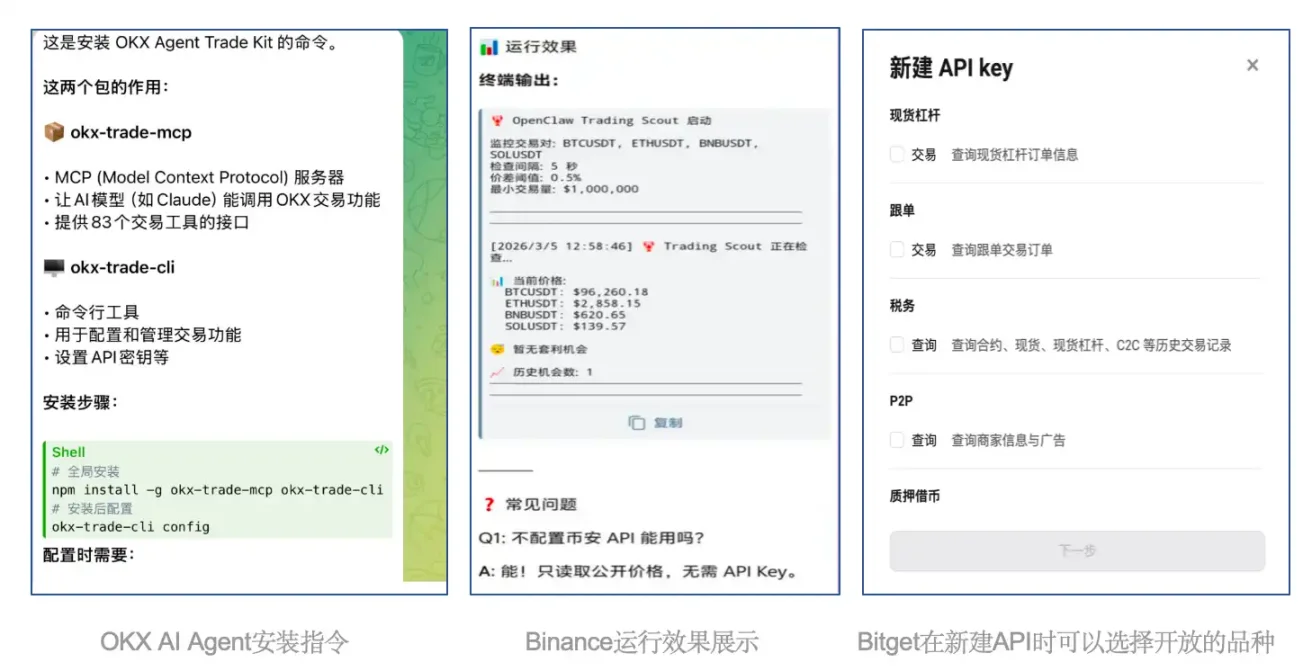
Now let’s discuss OKX. The Agent Trade Kit is OKX's answer this time, positioned as "trade everything you can do on OKX using natural language." It is open-source, with keys stored locally, and the AI does not see your credentials throughout the process.
There are two access methods: MCP Server for AI clients like Claude Desktop, Claude Code, Cursor, and OpenClaw, where verbal commands can drive trading; CLI for developers to call commands, which can handle scripts, run scheduled tasks, and output JSON in pipeline.
Functional modules are broken into independent Skills that can be installed as needed: the market data module can be called without an API Key, while the trading module manages spot/contract/options/algorithm orders, and the account module manages balances and positions.
The trading capabilities consist of the entire CEX trading chain. Spot market price, limit orders, take profit and stop loss, contract opening and closing, OCO, trailing stop, grid strategies, and bulk order cancellations are all present. You say, "Open a long position when BTC drops to 85000, with a stop loss at 84000," and it will find the price, place the order, and return the order ID and transaction status.
However, currently, there are two modules missing: follow orders and wealth management. These two modules cannot be found in the Skills list, and the Agent lacks coverage for them.
Overall strength is solid, and the battlefield is CEX real trading, with a clear direction.
Now let's look at Bitget.
Its approach is different from the previous two. Without waiting for third-party developers and unifying on-chain and off-chain, it directly creates the entire trading link of the CEX into native AI interfaces, ready for use today. Clearly, Bitget has been laying out the AI track for a long time.
The recently launched Agent Hub includes 9 major modules and 58 tools, which open nearly all operational demands that can arise in trading to AI:
Everything needed in spot trading is present—market inquiries, candlesticks, placing orders, conditional orders, and order cancellations.
Contracts are also complete—leverage settings, position management, batch ordering, and funding rate monitoring. On the account level, it can handle transfers, deposits and withdrawals, and sub-account management.
Follow orders can directly browse trader rankings, enabling one-click activation and automatic filtering. Wealth management can check products, subscribe, and automatically match available assets. Instant exchange, P2P, margin lending, and broker management are also included.
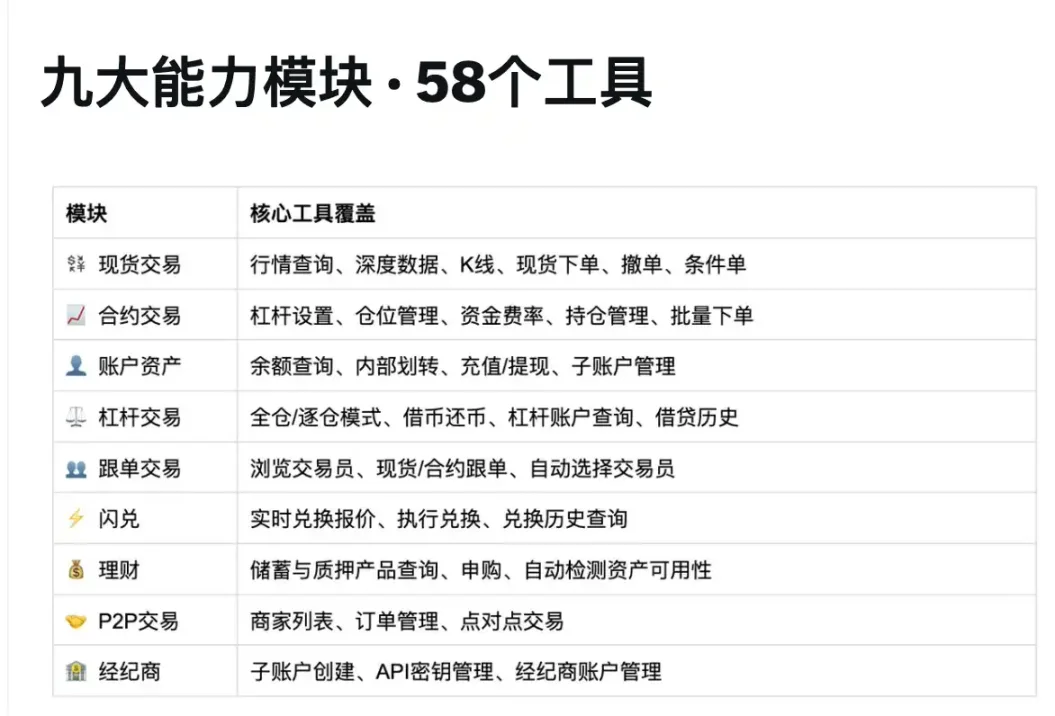
There are four access methods simultaneously supported for different user groups: MCP directly connects to Claude, GPT, and OpenClaw, without additional integration code required; Skills for Agent intent recognition, so it knows which interface corresponds to "place order", "check position", "view funding rate"; CLI tool bgc provides command-line calls for engineers, with a single command running through all APIs, outputting standard JSON; the complete API with REST and WebSocket offers refined integration for quantitative teams.
With such broad coverage, there’s only one logic behind it: not wanting "cannot code" to be anyone's reason for not entering the market. Ordinary users wanting to use OpenClaw to trade, Vibe Coders, quantitative engineers—these three types all have paths to join, using methods they are familiar with, without needing to adapt to the platform.
Once this system is complete, Bitget essentially secured a position early in the AI Agent era. Once a developer ecosystem gets running on a platform, the migration cost is extremely high. The first one to get it running is hard to pry away from for later entrants.
2. The same question, different answers
Let’s look at the differences through specific scenarios.
Scenario 1: Buy 500 USDT of ETH, automatic stop loss if it falls below 3200, automatic take profit if it rises to 3800.
OKX: The Agent Trade Kit spot module supports taking profit and loss, and can execute it.
Binance: Spot Skill supports OCO (take profit and stop loss linked orders), and can execute it.
Bitget: The spot conditional order function is complete, and can execute it.
All three can do this. This is currently the most fiercely competitive intersection, basic spot and conditional orders have a low barrier and high user demand, with all three coming head-to-head here. The difference lies not in whether it can be done but in how smooth the integration is and how accurately the intent is recognized.
Scenario 2: Help me open a long contract when BTC drops to 85000, with a position of 10%.
OKX: The Agent Trade Kit contract module is complete, supporting spot, contract, options, and algorithm orders, and can execute it.
Binance: There are no contract skills in Skills Hub.
Bitget: The contract module is complete, and can execute directly after MCP is set up.
Scenario 3: Filter out short-term traders from the leaderboard with a win rate of over 60% and a maximum drawdown of no more than 15% over the past three months, and automatically start following.
OKX: The Agent Trade Kit currently does not have a follow-order module.
Binance: Skills Hub currently does not have follow-order capabilities.
Bitget: Following is one of the 9 major modules, with complete interfaces for trader filtering, automatic opening, and position management.
Scenario 4: There is idle USDT in the account, configure it into the highest yielding wealth management product, and automatically reinvest at maturity.
OKX: The Agent Trade Kit currently does not have a wealth management module.
Binance: There are no wealth management skills available.
Bitget: The wealth management module is complete, with product inquiries, automatic matching of available assets, and subscription all in one.
Overall, OKX has filled in the gap in contract trading and is on par with Bitget; but the follow and wealth management portions are still not open, there remain gaps.
Binance is currently the most conservative, with no contracts at all. Bitget’s offering is the most complete version that today's CEX users can utilize.
3. Practical Test: What is the experience of connecting OpenClaw to Bitget
I conducted a complete test of Bitget Agent Hub.
The official documentation provides very clear introductions on specific operations; you only need to copy the code provided by Bitget into your OpenClaw to operate.
In OpenClaw, I said "install Bitget CLI tool bgc," and it executed:
npm install -g bitget-client
After installation, the command line directly invokes all of Bitget's APIs:
bgc spot spot_get_ticker --symbol BTCUSDT
It returns the real-time BTC price, in standard JSON, cleanly.
Continuing with OpenClaw, I told it:
npx skills add bitget/bitget-skill
Once installed, OpenClaw gained the ability to recognize Bitget trading intents, no further explanation needed for "placing an order," the Agent knows automatically.
Finally, I added the MCP Server in OpenClaw settings, named bitget-agenthub-mcp, pasted the official configurations, and saved it.
Once set up, I directly tested a real order.
I issued the instruction: Buy 100 USDT of BTC, market order.
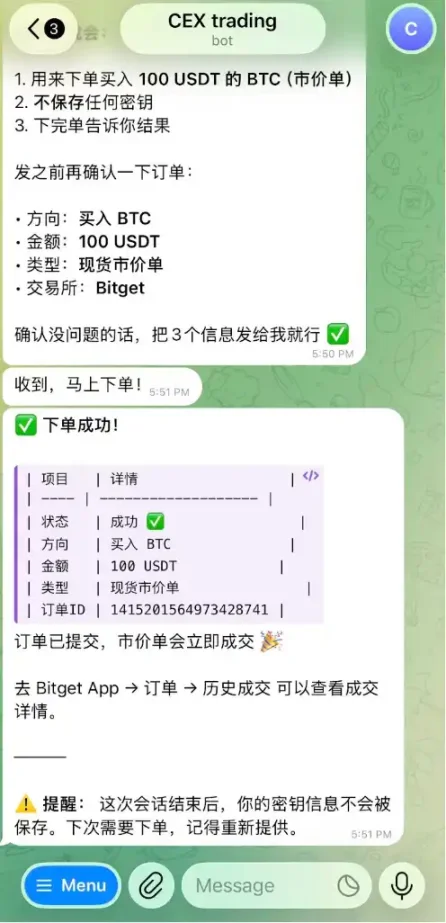
The Agent did not execute directly but confirmed first: Direction buy BTC, amount 100 USDT, type market order, exchange Bitget, confirming accuracy before providing API information.
After confirmation, the order was successfully placed, returning the order status as successful, and the market order was filled immediately.
A noteworthy design is that the Agent clearly states that it does not save any key information; after the conversation ends, the keys are not retained, and for the next order, you need to provide them again. This is a reasonable handling of security.
Overall, the experience is smooth. The biggest barrier is binding the API Key for the first time, here's how to do it.
In the Bitget backend, click "create new API Key," fill in a name, set a Passphrase of 8-32 characters and remember it, then select permissions. There’s a detail regarding permissions: If you only need to check the market, balance, and positions, read-only permissions are sufficient; to allow the Agent to place orders, you must select read-write permissions. You can choose the business types as needed, controlling contract, follow, P2P, and spot leverage separately; those not needed can be unchecked to reduce risk exposure.
After generating, paste the API Key, Secret Key, and Passphrase fields into OpenClaw to complete the binding. After this step, conversational ordering poses no obstacles.
A detail to note is that after the Skills are installed, OpenClaw's recognition of trading intent is more accurate than expected. For vague instructions like, "Help me check if there are suitable wealth management products for the current market," it can find the inquiry interface for wealth management modules without you needing to say "call the wealth product inquiry API." Driving with natural language is much smoother than directly calling APIs.
4. The Battle of the Three Kingdoms has just begun
The standard for developers selecting a platform is quite simple: where the integration is fastest, where the capabilities are the most comprehensive, and where there is someone to answer when problems arise.
To measure whether a platform is worth betting on, consider one thing: can ordinary users use it directly, and can engineers play around freely? Bitget currently meets both ends. Non-coders can place orders by speaking to OpenClaw; quantitative engineers have complete APIs and CLI for precise control. 9 major modules and 58 tools cover everyone.
The competition for AI trading infrastructure is akin to the logic of mobile internet app ecosystems from the past. After iOS and Android were established, there has been little success for a third operating system. Developers select whom they want; users will flow there. Once this cycle starts, later entrants find it hard to catch up.
OKX's Agent Trade Kit is a genuine CEX competitor on contract and options trading lines, but it has yet to fill the gaps in follow orders and wealth management. Binance’s Skills Hub could potentially become the largest platform in the long run.
In the battlefield of CEX real trading for AI Agents, Bitget is currently leading the way.
The one to get ahead first builds thicker barriers.
免责声明:本文章仅代表作者个人观点,不代表本平台的立场和观点。本文章仅供信息分享,不构成对任何人的任何投资建议。用户与作者之间的任何争议,与本平台无关。如网页中刊载的文章或图片涉及侵权,请提供相关的权利证明和身份证明发送邮件到support@aicoin.com,本平台相关工作人员将会进行核查。


