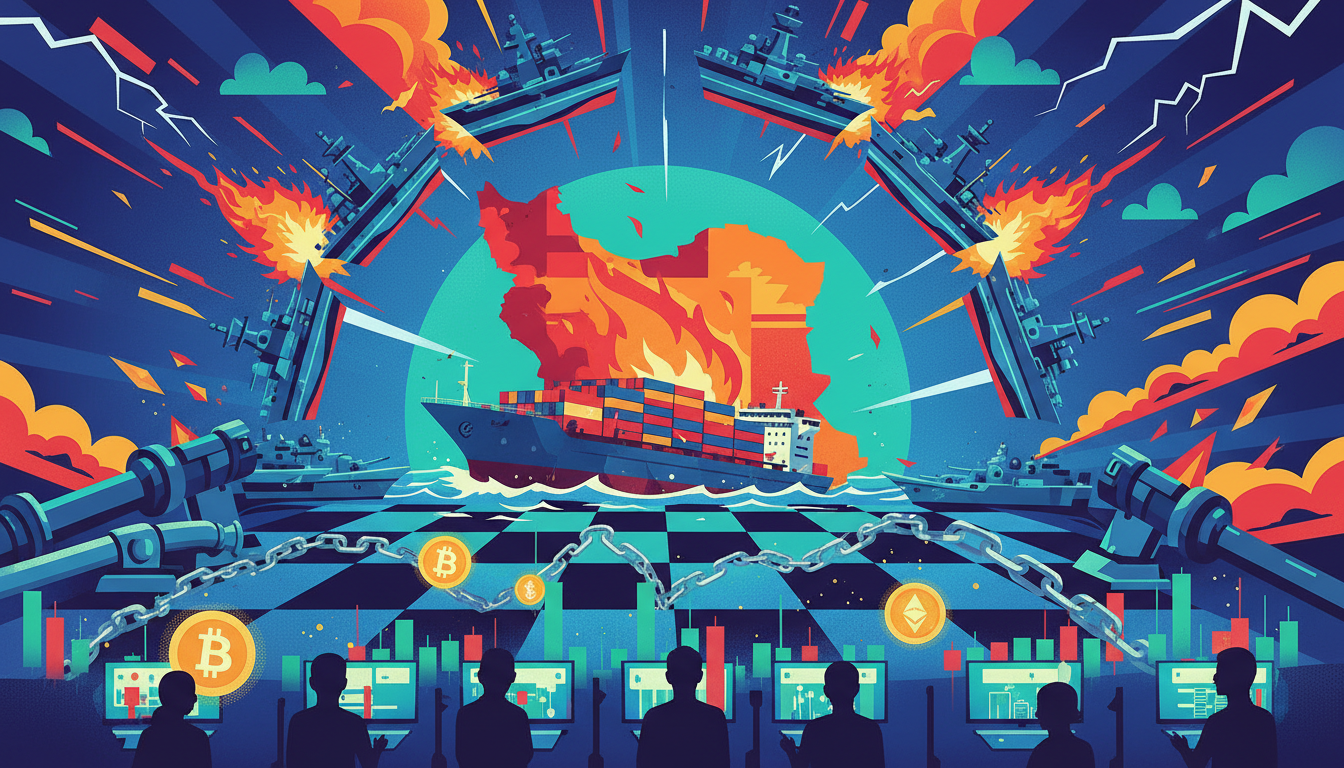
Recently, against the backdrop of a continually tense geopolitical situation and high macroeconomic uncertainty, crude oil futures prices have seen a retreat. Meanwhile, the Meme coins on the Base ecosystem and the compliance technology landscape of on-chain prediction markets are heating up simultaneously. Traditional commodities and crypto assets present a complex picture of both interconnection and misalignment within the same time window: on one side, the clouds over the Strait of Hormuz have yet to dissipate, with ongoing games of capacity and passage; on the other side, the high Beta Meme coins are experiencing wild fluctuations, and the prediction markets are actively embracing AI monitoring to be “seen.” These clues ultimately converge on the same core contradiction—high volatility and high regulatory pressure are both squeezing a group of market participants chasing returns while having to face risk control and compliance constraints.
Oil Price Retreat: A Temporary Easing Under the Clouds of Hormuz
● Surface Retreat: According to a single source, crude oil futures prices have recently dropped, triggering rapid market judgments on whether “the risks have been fully cleared.” However, in the absence of multi-source data and specific support points, this price adjustment resembles a phase of emotional release rather than a confirmation of dissipating geopolitical risks. The contrast formed between the price curve and news headlines lays the groundwork for subsequent discussions on whether risks are being undervalued.
● The True Test is Yet to Come: BOK Financial analyst Dennis Kissler emphasized, “The true test of oil prices depends on whether tankers can safely pass through the Strait of Hormuz.” This statement highlights the key of the current market trend—short-term price retreat is used to rehearse a geopolitical node that has not yet genuinely undergone a “traffic disruption” stress test. Real systemic shocks depend on whether the strait remains smooth, rather than fluctuations in the market over a few days.
● Capacity Hedging Actions: In this unstable expectation, it is reported that Saudi Arabia is increasing the utilization of its oil pipelines to hedge against transport risks potentially brought about by the Strait of Hormuz. Such capacity and route adjustments are typical measures in the traditional energy market's response to geopolitical uncertainty; they act both as preemptive defense against potential blockade scenarios and as a soothing tool for downstream consumer countries regarding “supply sustainability” expectations.
● Surface Easing and Deep Tension: On one hand, futures prices have retreated, while on the other, supply routes and capacity utilization rates are undergoing tense adjustments, creating clear tension between the two. Prices appear to be cooling, but the geopolitical layout is heating up; this divergence suggests that risks have not truly been eliminated, only repriced and misaligned in time, providing important contextual coordinates for the discussion on how funds understand and transfer risks.
Displacement of Hedging and Speculation: Funds Searching for Exit Between Oil and Chains
● Reallocation Choices: When prices of bulk commodities like crude oil retreat from highs, some previously invested funds face the choice between “continuing to bet on geopolitical premiums or pulling out to seek new targets.” In the short term, a cooling of traditional commodity positions naturally leads to reallocation questions: under the same macroeconomic uncertainty, do these funds flow back to cash, shift toward traditional safe-haven assets, or dare to extend into higher volatility but potentially faster-returning sectors?
● Risk-Return Misalignment: In an environment where inflation expectations and geopolitical tensions coexist, traditional safe-haven assets like gold and treasury bonds provide relatively predictable but limited elastic return curves, while high-volatility crypto assets offer enormous withdrawal risks in exchange for the potential to amplify returns in a short time. For some participants with higher risk tolerance, this logic of “exchanging higher volatility for faster compensation” aligns well with the psychological demand when traditional commodities are retreating.
● High Beta Assumption: In such an emotional and macro context, it can be reasonably assumed that some funds affected by geopolitical tensions and inflation expectations will attempt to shift toward high Beta assets on-chain, especially those with narrative heat and liquidity, in pursuit of short-term returns. This is not a simple linear migration of “oil out, coin in,” but rather a search for assets with stronger price elasticity on the same risk spectrum to hedge against uncertainty.
● Paving the Way for Meme Frenzy: The explosive trading of Meme coins in emerging ecosystems like Base provides an emotional and liquidity convergence exit for these funds. It is essential to emphasize that this correlation remains at the level of macro emotions and funding environments, rather than a one-to-one causal chain—the retreat of the oil market and the frenzy on-chain are more of two different reactions under the same era pressures rather than directly driving each other.
MOLT on the Base Chain: Volatility Driven by Emotional Engines
● Market Cap Peak Data: In the Meme segment of the Base ecosystem, MOLT once became the center of discussion, with data from a single source showing its market cap peaked at nearly $9.9 million. During a phase of continuous inflow into new public chains and triggering of market emotions by narratives, such a volume is not unfathomable, but it serves as a significant footnote for the amplified speculative preferences on-chain.
● Extreme Market Path: The trajectory of MOLT almost mirrors the textbook path of speculative assets on-chain—transitioning from relatively dull early trading to a rapid fermentation phase of social topics, with prices pushed to highs in a short time by emotions, followed by sharp adjustments and consecutive crashes as profit-taking occurs and new buying hesitates. The entire process showcases massive price fluctuations and compressed cycles, reflecting an extreme emotional-driven structure rather than a stable growth asset pricing logic.
● Narrative and FOMO Driven: As a typical Meme coin, MOLT lacks quantifiable fundamental support; its perceived value largely comes from community culture, joke cores, social media topics, and the FOMO emotion of “don’t miss the next chance to get rich.” Retweets, memes, and candlestick screenshots fuel price movements, with the intensity of narratives directly reflecting the strength of buying impulses. Once the focus of public opinion shifts or internal funds spiral, prices will similarly reset downwards in extreme ways.
● A Reflection of New Public Chains Competing for Traffic: Placing MOLT back within the broader trend, it serves as both a “traffic signboard” for the Base ecosystem to capture user mindset and transaction duration, and a phase phenomenon of new public chains contesting for funding attention amid rising risk preferences. During this flourishing period of Layer 2 and new public chains, whoever creates more intense Meme market topics has a better chance to gather developers and retail investors quickly, but this also means risks are highly concentrated in a purely emotional realm lacking underlying cash flow support.
Polymarket Bets on AI: Reshaping Prediction Markets Under the Compliance Spotlight
● Collaboration and Positioning: On another front, the on-chain prediction market Polymarket announced a partnership with traditional data giant Palantir to develop a monitoring system called the “Vergence AI Engine”, focusing on the recognition and analysis of behaviors related to sports prediction markets. This collaboration aims to provide technical support for the platform in dealing with external audits and internal risk management through stronger data processing and monitoring capabilities.
● Background of Compliance Pressure: The sports prediction market itself is under regulatory scrutiny, with many jurisdictions imposing increasingly stringent requirements on its betting attributes, information disclosure, and user protection. Against the backdrop of ongoing tightening audits, simple on-chain transparency is no longer sufficient to eliminate regulatory doubts; the platform is compelled to seek new technical balances between user experience and regulatory compliance.
● The Symbolic Meaning of Being Proactively “Seen”: Introducing a traditional giant like Palantir, which has long operated in the field of government and institutional data analysis, is a declaration of intent: the prediction market is no longer deliberately staying in a “grey area,” but is willing to actively expose trading behaviors, betting distributions, and anomalous patterns, allowing itself to operate under a stronger spotlight. This choice of “self-monitoring” symbolizes the industry's transition from resisting regulation to exchanging transparency and traceability for survival space.
● AI Monitoring and Product Attraction: From a product design perspective, monitoring tools like Vergence AI can identify suspicious behaviors along dimensions such as betting patterns, frequency anomalies, and account associations, addressing regulatory concerns about manipulation, money laundering, or structured betting; on the other hand, it must avoid suppressing normal speculative behavior in an overly restrictive manner, or it will harm the core appeal of the prediction market as “information aggregation + price discovery.” How to ensure users feel secure rather than fully tamed is the key challenge of this technological path.
The Same Stormy Sea: The Resonance of Volatility Dilemma and Compliance Pressure
● The Consensus Among Three Clues: By aligning the retreat of the oil market, the on-chain frenzy of MOLT, and the introduction of AI regulation into prediction markets, a single picture reveals that they all point to a theme of risk repricing. Oil prices test the boundaries of geopolitical premiums with a temporary retreat, Meme coins test funds' resilience to volatility with dramatic surges and crashes, while prediction markets redefine which risk behaviors are acceptable and which must be excluded from the system through technology and data.
● Risk Management in Different Worlds: The traditional commodity market manages risks primarily through physical world means such as capacity adjustments, transport path restructuring, and inventory management, like Saudi Arabia increasing pipeline utilization to hedge against the uncertainties of Hormuz. In contrast, the on-chain world tends to reconstruct participation boundaries and risk-bearing mechanisms using smart contract rules, risk control algorithms, incentive designs, and permission layers, forming entirely different risk governance toolboxes.
● Compliance Pressure and Migration of Grey Play: As regulatory focus increases in areas like sports prediction markets, platforms like Polymarket that proactively enhance visibility will inevitably push some high-risk or grey plays out of mainstream scenarios. These funds and participants will either be forced to accept more transparent and constrained rules or turn to marginal assets and long-tail agreements that are harder to regulate and lack protective mechanisms, shifting systemic risks to more obscure corners.
● The Survival Interval Between Regulation and Volatility: In the coming years, the factors determining the winners and losers among different markets and platforms may not only be nominal yields but who can find a sustainable survival interval between regulatory constraints and price volatility. It is not feasible to rely solely on “frenzy + no regulation” for short-lived growth, nor can one over-tighten at the expense of risk compensation and innovation space. This ability to balance will ultimately distinguish which assets and platforms can participate long-term and which are merely cyclical noise.
From Hormuz to On-chain Betting: Who Will Hold the Next Round of Pricing Power
The shadows of geopolitics, the peaks of on-chain speculation, and the evolution of technical compliance are overlaying and shaping market sentiment during the same period—from the shipping risks in the Strait of Hormuz to the explosive trading of Meme coins like MOLT on Base, to Polymarket pushing forward AI monitoring with Palantir. These seemingly disparate events are essentially different market participants seeking their positions on the same global risk map. A short-term drop in oil prices does not signify the end of geopolitical premiums, and Meme frenzies are unlikely to become synonymous with long-term value; what truly determines the endpoint is how institutional frameworks evolve and how technology is used to reconstruct rules and trust boundaries.
Looking ahead, the crude oil market is likely to experience repeated tug-of-war between geopolitical tensions and capacity adjustments, with prices rebalancing around channel safety and demand expectations. Meme coins will continue to showcase periodic frenzies and liquidations in the competition between new public chains and Layer 2, serving as a sensitive thermometer for risk preference swings. Prediction markets must prove their social value through AI and data infrastructure in an increasingly tightening compliance environment to secure their legitimate survival space. For investors, what is genuinely worth paying attention to in the next phase is not just where one can “make quick money,” but who can construct a more stable and sustainable participation framework amidst high volatility and high regulatory scrutiny.
Join our community to discuss and become stronger together!
Official Telegram community: https://t.me/aicoincn
AiCoin Chinese Twitter: https://x.com/AiCoinzh
OKX welfare group: https://aicoin.com/link/chat?cid=l61eM4owQ
Binance welfare group: https://aicoin.com/link/chat?cid=ynr7d1P6Z
免责声明:本文章仅代表作者个人观点,不代表本平台的立场和观点。本文章仅供信息分享,不构成对任何人的任何投资建议。用户与作者之间的任何争议,与本平台无关。如网页中刊载的文章或图片涉及侵权,请提供相关的权利证明和身份证明发送邮件到support@aicoin.com,本平台相关工作人员将会进行核查。