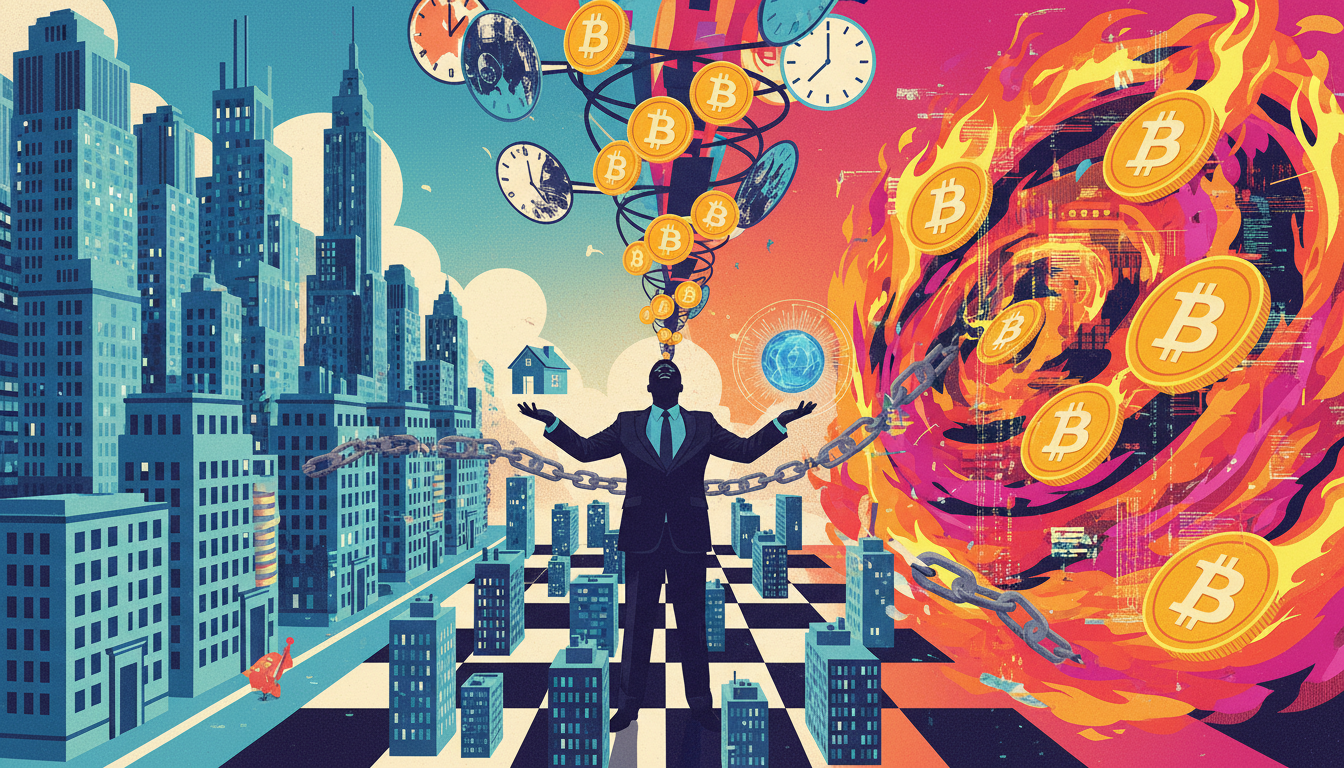
On April 16, 2026, BitMEX Research publicly proposed an alternative to the Bitcoin Improvement Proposal BIP-361 called the "canary fund," transforming the originally technical discussion into a debate about sovereignty and security. One side advocates a protocol-level, rigid timeline for mandatory freezing mechanisms, while the other proposes a dynamic protection path that only triggers when there are genuine signs of quantum attacks. What is at stake behind these two ideas is the Bitcoin cultural bottom line of "your keys, your coins": does the system have the right to act on behalf of users before they have consented and before the threat is verified, just to guard against future quantum threats whose timing is uncertain? The market clearly cares not only about technical details but also about the deep-seated concern that this self-protection could evolve into "self-defeating."
How the one-size-fits-all freezing proposal ignited community anger
BIP-361 stands for "Post Quantum Migration and Legacy Signature Sunset", and as the name suggests, it attempts to establish a "legacy signature sunset mechanism" for Bitcoin's migration in the post-quantum era. Following this line of thought, old addresses and scripts that rely on existing quantum-vulnerable signature forms will gradually lose their usability on a preset timeline, making migration to new quantum-resistant solutions no longer a voluntary choice but instead written into the "countdown" at the protocol level.
This rigid arrangement written into the consensus layer has been criticized as a "one-size-fits-all" enforcement measure. The core criticism from opponents is: imposing a treatment similar to "technical requisition" on the existing Bitcoin before any clear, real quantum attack capability has emerged effectively undermines today's holders' expectations of asset durability under the pretense of an uncertain future threat. This does not merely remind of risks but directly alters the rules of the game itself.
BitMEX Research clearly stated in their assessment that the rigidity of BIP-361’s freezing could disrupt the market unnecessarily. If quantum threats do not materialize for many years, triggering a "sunset" too early could merely create panic fluctuations and migration costs out of thin air. The research brief also noted that there exists a "strong divergence" within the community regarding mandatory freezing measures: proponents emphasize systemic security as a priority, while opponents see it as excessive intervention into the sovereignty of coin holders, arguing that no matter how grand the technical vision, it is insufficient to justify such actions.
The canary fund comes into play: let’s drop one first...
Compared to directly pulling the emergency brake at the consensus layer, the "canary fund" proposed by BitMEX Research resembles a "let's first drop a canary into the mine" plan. The key design is to generate a set of P2PK addresses using the NUMS (nothing up my sleeve) method, ensuring that the generation process of these addresses is open and transparent, without any suspicion of backdoor tampering, and then lock an appealing bounty on these addresses to serve as an early detector of quantum capabilities.
According to the research brief, the observation period for this canary mechanism is set at 5 years, with the goal of constructing a bounty pool larger than 1000 BTC. The logic is straightforward: if, during this period, an attacker with practical quantum computing power can successfully steal funds from these addresses under public supervision, it would send a strong signal to the entire network that "the quantum threat has moved from theory to reality." The bounty is designed to be large enough fundamentally to incentivize attackers to reveal themselves early—the risk is concentrated on the canary address rather than being spread across all old addresses.
In contrast, the path of BIP-361 is a rigid route written into the timeline: regardless of when real quantum capabilities materialize, it will progress according to a predetermined sunset rhythm. The canary fund, on the other hand, attempts to take a condition-triggered dynamic path—only after the bounty is compromised and quantum attacks are proven feasible does the community enter the next stage of large-scale migration and protocol upgrade decision-making. The difference between the two lies not just in the technical implementation but in the value choices between "assuming the threat is already present" and "verifying how far the threat can actually go."
From your keys, your coins to quantum time...
The phrase "your keys, your coins" is repeatedly quoted in Bitcoin culture because it essentially serves as a guarantor of the entire system's legitimacy: as long as the private key remains in the user's hands, no one—including developers, miners, or foundation-like organizations—can forcibly move your assets at the consensus layer. This principle is not just a slogan but has delineated the boundary that distinguishes Bitcoin from traditional finance, the "custodial black box," and regulatory arbitrariness over the past few years.
Therefore, when proposals like BIP-361, which have compulsory migration undertones, emerge, the community's sensitivity lies not only in "whether it will be safer," but in the fact that it challenges this cultural bottom line: if the consensus layer can impose a mandatory timeline on assets with specific signature forms because of an unfulfilled technical threat, then "whether your coins are still entirely governed by your private key" is no longer a question that can be unconditionally answered with "yes."
The canary fund attempts to find a compromise in this tension. It opts not to freeze anyone's assets ahead of time but delegates the task of "testing quantum attackers" to a specifically designed set of bounty addresses. Users' existing holdings do not need to be immediately migrated and will not be written into a mandatory sunset table, but instead wait for a signal based on real attacking behaviors: only when the canary falls does the system further discuss the necessity of a large-scale migration across the entire network. This design fundamentally carves out a buffer zone that respects user sovereignty while maintaining collective security, replacing "prematurely avoiding every possibility" with "first observing actual attacking power."
If the quantum threat does not materialize for a long time, the differences between the two paths in terms of trust costs and governance legitimacy will be further amplified. Mandatory freezing will continually deplete holders’ trust in developers and consensus decision-makers—since they are asked to bear the genuine migration costs and psychological costs for a crisis that has never truly arrived; whereas the canary mechanism is viewed more as an "insurance vault": as long as the bounty remains intact, the mainnet rules do not need to enter a high-pressure mode. For participants accustomed to long-term holding, the former can easily be interpreted as institutional uncertainty, while the latter resembles compressing uncertainty into a manageable set of monitored experimental addresses.
The market seeks security but fears being prematurely frightened
The narrative around quantum threats has repeatedly been amplified in the crypto world over the past few years, yet it still lacks a widely recognized timeline. This situation creates a subtle emotional structure: on one hand, there always buzzes a security anxiety background about "the quantum may strike at any time"; on the other hand, when repeated prophecies remain confined to papers and popular science videos, many people develop a kind of fatigue or even numbness towards the "quantum crisis." This coexistence of anxiety and fatigue makes any protocol-level change touching on quantum topics easily amplified into a psychological warfare.
In this context, the market chain reaction of forced freezing proposals is difficult to categorize simply as "security favorable." Once a definitive sunset time is written into consensus, some holders might choose to sell off or restructure on-chain assets before the deadline to avoid various technical and operational risks during the migration process; the expectations of long-term holders will also be reshaped—from "as long as I don’t touch the coins, they will always be there," to "even if I don’t act, the system may act on me first due to external threats." These invisible psychological shifts can easily be released in concentrated form during a specific time window, creating unpredictable selling pressure and liquidity shocks.
The design of the canary fund attempts to keep this panic contained within a manageable range. Risk is front-loaded onto a few highly public bounty addresses rather than simultaneously pressuring millions of coin holder addresses across the network. For the market, it provides a "visible experimental field": as long as the canary remains intact, the mainnet lacks immediate justification for initiating forced migration; if the canary is compromised, panic initially "explodes" on this bounty, leaving a signaling window for subsequent larger-scale responses, rather than pulling all assets into the same escape route without actual evidence.
Quantum clock has not rung: how should Bitcoin...
Returning to the essence of this debate, the question is not whether the Bitcoin community should face quantum threats, but rather under the condition of having no clear idea of when the "quantum clock" will start ticking, which part should be sacrificed first: should a portion of the "your keys, your coins" sovereignty certainty be sacrificed for a peace of mind regarding systemic security through compulsory freezing; or should the promise of being infallibly protected against future threats be sacrificed first, only to use the heaviest defensive tools after real-world attack behaviors occur?
It is foreseeable that the negotiations surrounding compromise solutions like the canary fund will not be resolved overnight. In the coming years, the community is more likely to iterate on similar proposals, fine-tuning the bounty size, observation period length, and triggering conditions, while also forming a race with more mature quantum-resistant signature technologies: on one hand, engineers are pushing the usability of new signature schemes in the lab, while on the other, protocol designers are figuring out how to create smooth migration paths for these technologies.
The truly unresolved question remains the key point that most discussions deliberately avoid: when one day, the quantum clock is recognized to have begun its countdown—whether through the canary being compromised or through some external event—who exactly has the authority to press the button for the "Bitcoin migration"? Is it the developers, miners, multi-signature committees, or a more decentralized on-chain governance mechanism? Before the shadow of quantum has fallen, Bitcoin may still have time to continue debating, but there is no standard answer to which side time ultimately favors.
Join our community to discuss and grow stronger together!
Official Telegram community: https://t.me/aicoincn
AiCoin Chinese Twitter: https://x.com/AiCoinzh
OKX benefits group: https://aicoin.com/link/chat?cid=l61eM4owQ
Binance benefits group: https://aicoin.com/link/chat?cid=ynr7d1P6Z
免责声明:本文章仅代表作者个人观点,不代表本平台的立场和观点。本文章仅供信息分享,不构成对任何人的任何投资建议。用户与作者之间的任何争议,与本平台无关。如网页中刊载的文章或图片涉及侵权,请提供相关的权利证明和身份证明发送邮件到support@aicoin.com,本平台相关工作人员将会进行核查。