Written by: Kyle Soska
Translated by: Block unicorn
The crypto market has been in a risk-off state for several months, and I have been carefully studying various market data to look for signs of a potential turnaround. In this article, I will delve into the market structure of perpetual futures and analyze market risk appetite using data provided by Ethena's transparency dashboard.
In short: Ethena's deployed capital is at its lowest point in years, just 71% of the low in 2025. This is not a criticism of Ethena, but rather a reflection of the current market conditions. Directional short positions are almost on par with directional long positions, which is an extremely rare and historically difficult balance to sustain in the cryptocurrency field.
The cryptocurrency market has long been characterized by the extreme volatility of its assets and the extensive use of leverage by traders. My previous research, "Understanding Cryptocurrency Derivatives: The BitMEX Case Study," explored the introduction of new 100x perpetual contracts on BitMEX.
Since the BitMEX era, cryptocurrency futures have become the largest product by trading volume in the cryptocurrency market, with volumes 5 to 20 times that of the spot market. As a leveraged trading hub for retail investors, perpetual contracts can reflect the risk appetite of the cryptocurrency market, making them worthy of our attention.
Ethena provides us with an extremely unique perspective that allows us to gain insights into the cryptocurrency derivatives market. As shown in the figure below, Ethena facilitates cryptocurrency arbitrage trading. The strategy is simple: when cryptocurrency traders go long, Ethena acts as their counterparty going short. Ethena ensures that it buys exactly the same amount of assets that the trader is shorting. In a sense, what Ethena offers is a leveraged service. Traders want to profit from a rise in cryptocurrency but lack funds; Ethena has the funds but limited risk tolerance. Thus, traders leverage perpetual contracts to borrow funds from Ethena at the basis plus the financing cost of the perpetual contract.
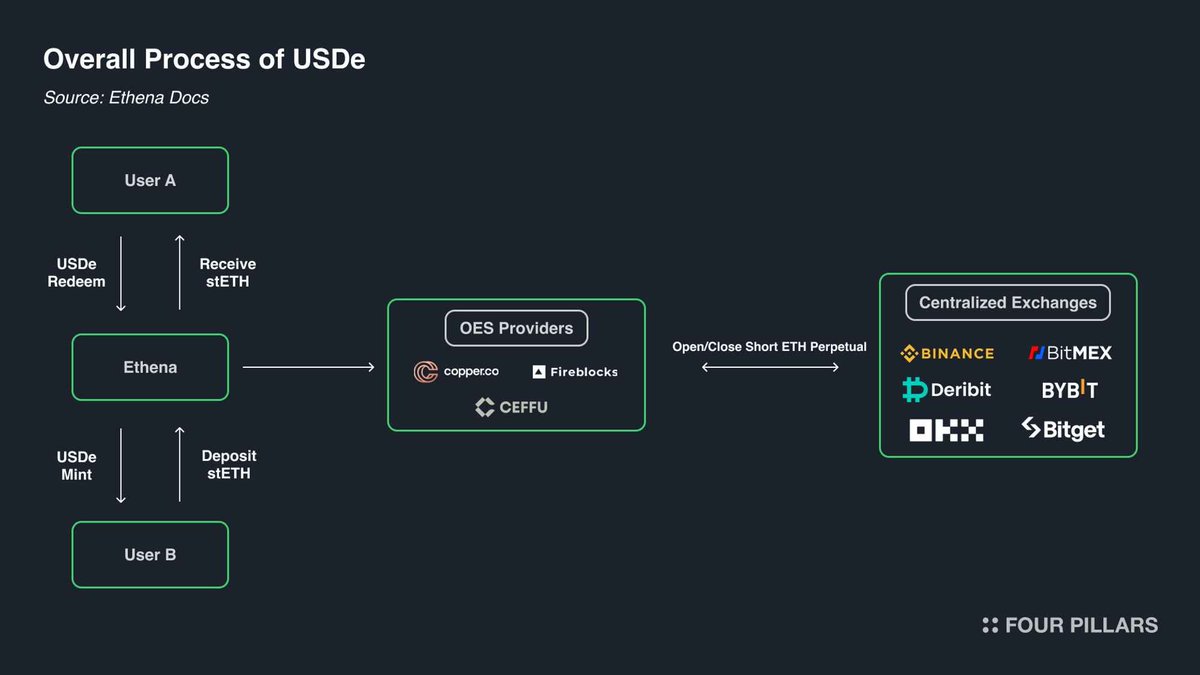
According to the structure of perpetual contracts, each long contract corresponds to a short contract, and they have a 1:1 relationship. Each open contract of a perpetual contract represents a cash flow agreement between the two parties. The role of the exchange is to facilitate the matching of these contracts, ensuring that each contract always has sufficiently funded long and short holders. The table below shows four possible outcomes facilitated by the exchange.
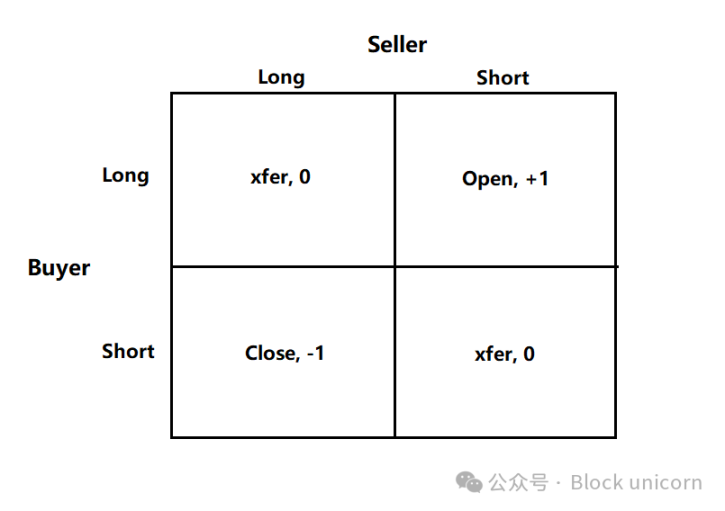
Perpetual Contract Matching Matrix
Every trade has a buyer and a seller. When both the buyer and seller of a contract are long or both are short, the exchange merely transfers the ownership of the contract from one party to the other. This transfer does not create or destroy any contracts. When the buyer goes long and the seller goes short, a new contract must be created; the buyer assumes the long position and the seller assumes the short position, increasing the open contract volume by 1. On the other hand, if the seller goes long and the buyer goes short, the exchange can directly unwind the contracts of the buyer and seller, and cancel the newly released contract, decreasing the open contract volume by 1.
So, who are the actual holders of these contracts in a typical market? I believe contract holders can be primarily divided into four categories:
- [Long] Directional Longs
- [Short] Directional Shorts / Hedgers
a. Direct asset shorts / hedges
b. Structured product hedges
- [Short] Basis Traders (such as Ethena, etc.)
- [Mixed] Perpetual Contract Arbitrageurs
Directional longs seek exposure. They are risk-seeking and their demand for risk depends on their own risk preference level.
Directional short traders include both investors who wish to assume the downside risk of assets and those who want to hedge their own assets in a tax-efficient manner. Venture capital firms and employees of companies who are compensated in tokens typically wish to hedge the tokens that will unlock at current prices. For altcoins, many markets have such low trading volumes that effective direct hedging is difficult or even impossible. In such cases, companies like Cumberland, Wintermute, FalconX, Flowdesk, and Amber can construct dynamically managed synthetic positions to hedge exposure in illiquid markets (like Monad) by shorting highly correlated liquid assets like Bitcoin and Ethereum. Projects like Neutrl also adopt this strategy, using such hedging as a yield strategy.
Basis traders are opportunistic shorts. They are not interested in directional risk exposure, but rather actively fill the excess demand of directional longs when market supply and demand are imbalanced. Under most market mechanisms, demand from longs exceeds demand from shorts, with longs serving to bridge the price gap. Their position sizes are typically highly elastic.
Perpetual contract arbitrageurs hold both long and short positions in perpetual contracts. Their role is to connect different perpetual contracts and correct any minor price discrepancies, with costs not exceeding trading fees. Their long positions can perfectly match their short positions at any given moment.
By construction, all perpetual contracts are in a 1:1 ratio, fully matching long positions and short positions, so we know:
Directional Longs + Arbitrage Longs = Directional Shorts + Basis Shorts + Arbitrage Shorts
Furthermore, the structure of perpetual contract arbitrage tells us:
Arbitrage Longs = Arbitrage Shorts
Canceling this from the first equation gives us:
Directional Longs = Directional Shorts + Basis Shorts
Ethena provides us with an indicator of all basis shorts, which helps us gain insights into the differences between directional longs and shorts.
The figure below is Ethena's self-reported balance sheet, divided by cash and deployed capital, covering the period from December 27, 2024, to March 7, 2026:
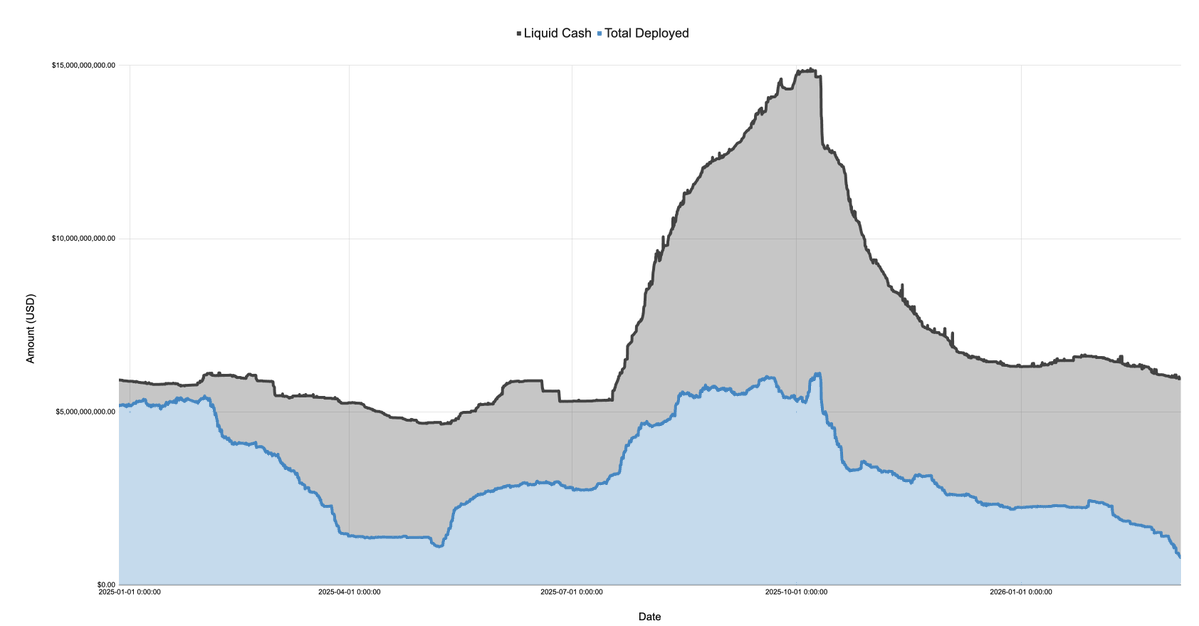
In January 2025, the market drastically shifted to a risk-off sentiment following the launch of the $TRUMP token, and subsequently continued to decline during initial tariff discussions and the "Liberation Day" in April. During this period, Ethena's deployed capital plummeted from over $5 billion to only $1.108078914 billion, a drop of over 75%.
It is important to note that Ethena's deployed capital can serve as a reference indicator for the degree of excess demand for longs in the market. While Ethena is not the only institution engaging in such trades, its scale is large (at times around 25% of Binance and Bybit), and as long as it has ample cash, it will expand its positions to meet any unmet long demand. This indicates that while total long demand may not have decreased by 75% by April 2025, the excess demand not matched by directional shorts indeed fell by 75%.
The figure below illustrates the deployment of Ethena's balance sheet relative to its total scale, the lowest point in 2025, and the highest point.
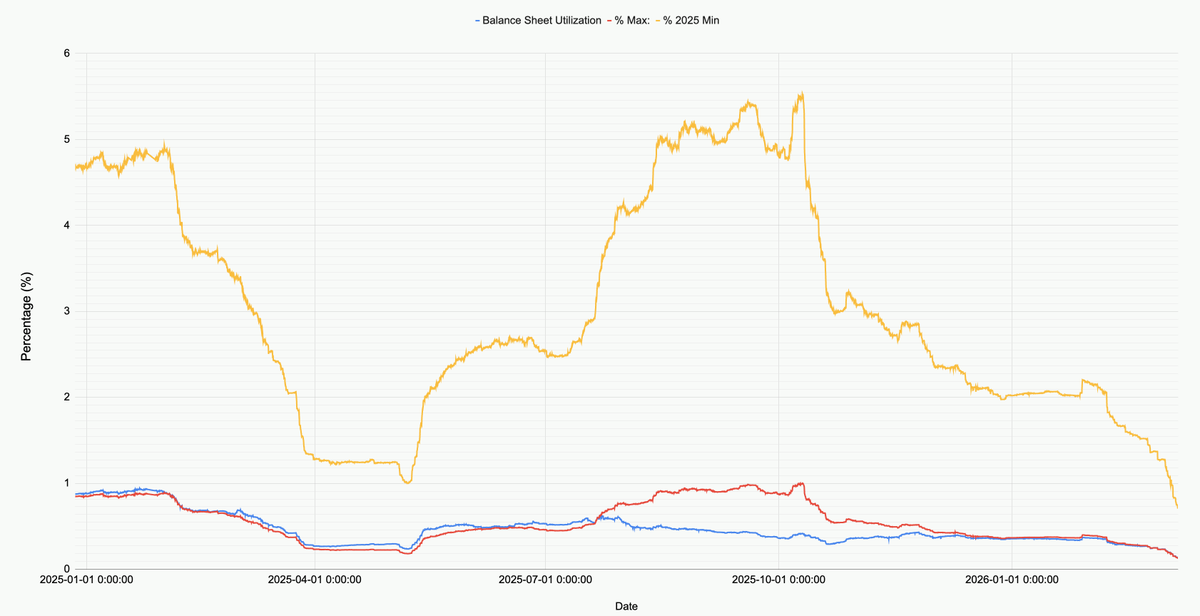
Observing the current market, the total amount of funds deployed by Ethena across all markets (BTC, ETH, SOL, BNB, XRP, HYPE) is only $791.2415456 million. This is equivalent to 71% of the lowest point in 2025 and only 12.9% of the highest point before October 10. This figure is not a denial of Ethena but reflects the current market conditions: net long demand is at a historical low.
It is particularly noteworthy that during the market crash when Bitcoin prices fell to $60,000, Ethena deployed over $2 billion. Since just a month ago, on February 8, 2026, Ethena's deployed capital has astonishingly dropped by 60%!
The figure below highlights Ethena's deployed capital alongside Bitcoin's price trends since January of this year.
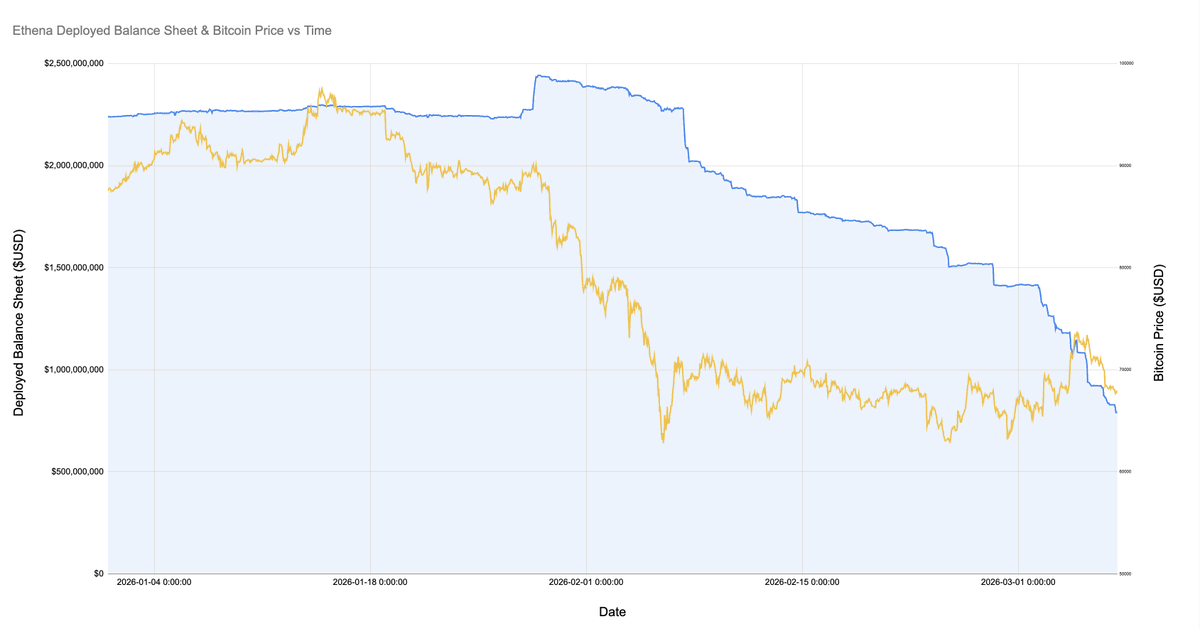
Since Bitcoin prices dropped to $60,000, Ethena's basis positions have shrunk by over 60%, from more than $2 billion to less than $800 million. This change is puzzling because the market during this period has been relatively stable. The reasons for this include:
1. Profitable but unsustainable basis trades established after the plunge in February (the basis has turned negative, but the funding rates are also negative) are gradually being closed out.
2. Increased hedging activities from directional shorts and participants insensitive to price are squeezing the market space for opportunistic basis traders.
3. Insufficient demand for long exposure from traders seeking leverage.
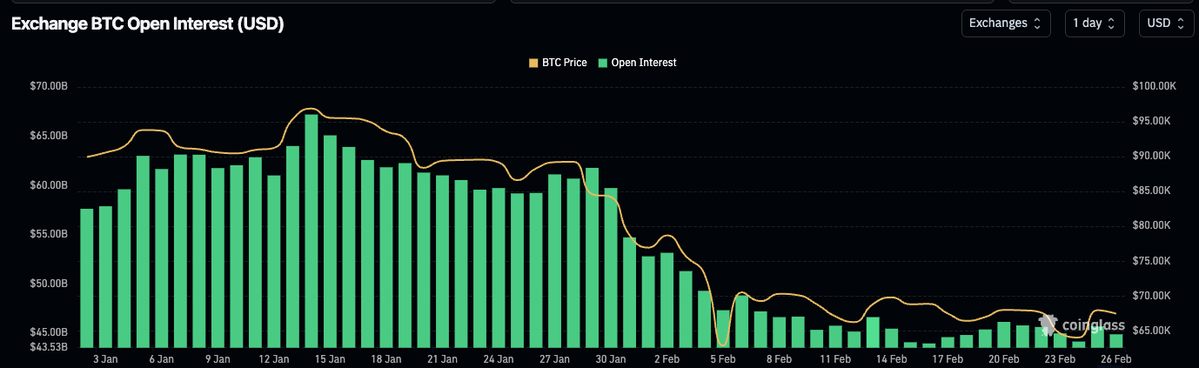
In my view, the truth is primarily determined by factors 1 and 2, while the impact of factor 3 is minimal. As illustrated in the above figure, during the gradual exit of Ethereum projects, the overall volume of open contracts for Bitcoin (and other major cryptocurrencies) has remained relatively stable. Meanwhile, funding rates have long been in negative territory, with many cryptocurrencies (such as SOL) having cumulative funding rates that are negative across multiple exchanges. This indicates an increasing demand in the market for shorting or hedging a certain risk exposure.
If I were to guess, I believe that small and medium-sized cryptocurrency companies and venture capital firms are all facing a crisis. Think about small-cap projects like Eigen, Grass, Monad, etc. These cryptocurrencies number in the hundreds, each representing dozens of venture capital firms and a company with funds and employees. Venture capital firms need to control losses and lock in profits to meet their fund investment goals, while these companies need to ensure cash flow and employee retention. This situation creates a scenario where all participants want to extract maximum profit from the "stone," with the answer being through actively managed structured products that short a basket of related assets.
We saw the presence of these structured products during Ethereum's explosive growth, which also triggered short covering among many small and medium-sized cryptocurrencies. Another piece of evidence is that opportunistic basis trading like that of Ethena has been significantly squeezed out.
Regardless of the specific reasons, one thing we can be sure of is that this is the first time in the history of the cryptocurrency market that directional longs and directional shorts have nearly reached a state of equilibrium. There are no compelling reasons to suggest this state cannot become the new normal, nor can it be proven that this market structure must change, but when viewed across other asset classes and markets, it is quite unusual for this trend to be sustainable.
免责声明:本文章仅代表作者个人观点,不代表本平台的立场和观点。本文章仅供信息分享,不构成对任何人的任何投资建议。用户与作者之间的任何争议,与本平台无关。如网页中刊载的文章或图片涉及侵权,请提供相关的权利证明和身份证明发送邮件到support@aicoin.com,本平台相关工作人员将会进行核查。


