Author: Nancy, PANews
The next battleground for AI computing power is extending into space, gradually becoming a new direction for commercial narratives.
Following the successful launch of the first space AI server, a space computing startup has recently planned to send Bitcoin mining into outer space.
Plans to mine Bitcoin in space this year, symbolic significance may outweigh actual value
After going through the first half of the competition focused on chips and models, the competition for AI computing power has quietly shifted to a battle over energy. Electricity, as the core resource in this competition, is rapidly becoming a scarce resource in the global computing power struggle. This shift is not only changing the industry landscape but also directly restructuring the cost structure of the Bitcoin mining industry.
In particular, the once steady Bitcoin miners are now turning to the AI computing power track. Behind this transformation are the survival pressures brought about by Bitcoin halving, the profit compression from intensified competition and rising energy costs, and the huge opportunities presented by the AI narrative.
As the profitability of Bitcoin mining is squeezed by global energy competition, Starcloud has proposed a bold plan to move Bitcoin mining into space.
In a recent interview with HyperChange, Starcloud CEO Philip Johnston revealed that the company is currently focusing on its existing space computing power business, and it also has plans for Bitcoin mining. Starcloud will carry some ASIC hardware specifically designed for Bitcoin mining on the Starcloud-2 satellite to be launched later in 2026. If successful, Starcloud will become the world's first spacecraft to mine Bitcoin in space.
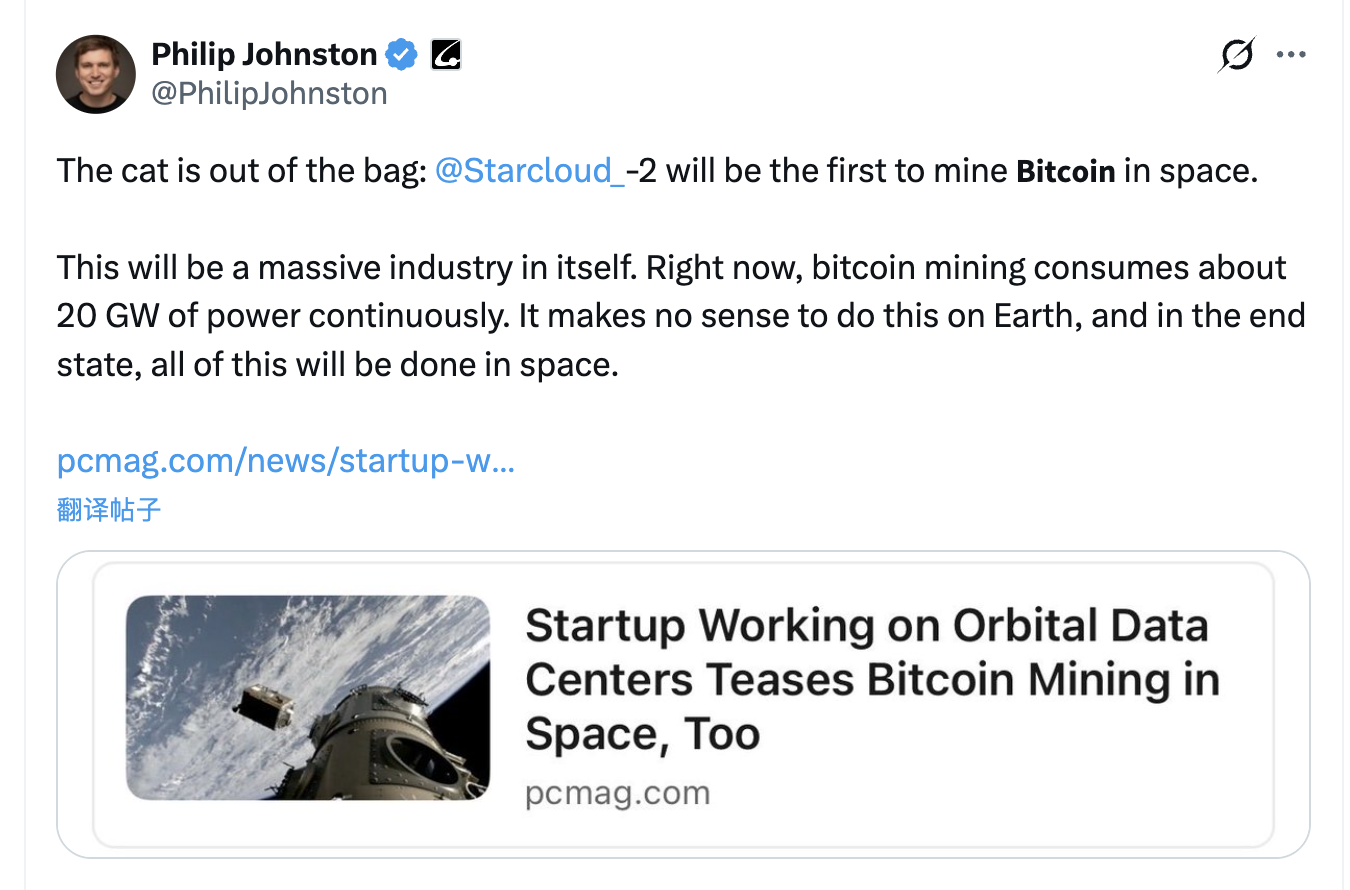
Johnston believes that space has multiple inherent advantages compared to Earth. Firstly, space has an infinite supply of continuous solar energy, which is more stable and cost-effective than renewable energy on Earth; at the same time, the environment in space is superior, with extreme temperature differences and radiation that can significantly reduce the hardware's heat dissipation energy consumption, decreasing cooling costs and maintenance burdens. Most importantly, Bitcoin mining in space can avoid the increasingly tight energy bottlenecks, grid limitations, and regulatory pressures on Earth. Currently, about 20GW of electricity on Earth is used for Bitcoin mining, and this large-scale power consumption is no longer feasible on the ground. In space, utilizing solar energy to obtain cheap power will provide a new solution for Bitcoin mining.
Johnston also added that the cost of Bitcoin mining equipment typically ranges from $600 to several thousand dollars, far lower than Nvidia's enterprise-level GPUs (which usually exceed $30,000). This makes the economics of Bitcoin mining in space extremely attractive.
Starcloud views Bitcoin mining in space as a "future business," leveraging solar energy in space to obtain cheap energy, and stated that this is also one of the reasons it and other companies (including SpaceX) are building data centers in space. Space mining not only significantly reduces costs but also provides a new resource acquisition model for the global computing power market.
The concept of space mining is not new. Last year, Intercosmic Energy also stated that it was researching Bitcoin mining in space.
However, mining Bitcoin in space still faces many challenges. Johnston admitted that the economics of Bitcoin mining in space is still unstable. Currently, Bitcoin ASIC devices can operate on any cheap energy source, and as new types of devices continue to be released, the profitability of mining equipment may decline rapidly.
Moreover, although launch costs decrease year by year, sending hardware into space remains an expensive task. Compared to terrestrial mining sites, the initial and maintenance costs of space mining are still high, including expenses for launching, spacecraft integration, satellite communication, and equipment upgrades.
More troublesome is the harsh requirements of the space environment on hardware. Bitcoin mining ASIC devices need to operate stably under extreme conditions such as high radiation and extreme temperature changes, which poses a severe test to the performance and lifespan of the equipment. Maintenance and upgrades of the equipment will also become a significant issue, as once a failure occurs, the costs and difficulties of repairing and replacing hardware will increase significantly.
Previously, many organizations in the crypto space have been exploring bringing blockchain businesses into space. For example, the veteran company Blockstream in the Bitcoin community has been leasing multiple geostationary satellites since 2017 to broadcast Bitcoin blockchain data globally for free; even in the event of widespread internet outages on Earth (such as due to natural disasters or human blockades), as long as you have a small satellite dish (receiver), you can sync the Bitcoin ledger and complete transactions. SpaceChain installed the first commercial Ethereum node on the International Space Station (ISS) as early as 2019. Earlier this year, a new project focusing on space commerce called Spacecoin also attracted market attention, aiming to realize cryptocurrency payment settlements through a satellite network.
Therefore, in space mining, short-term investments may far exceed returns; currently, it serves more as a symbolic meaning or a narrative technique for this startup to attract market attention.
For the first time in human history, sending Nvidia AI servers into space
Founded in 2024, Starcloud, formerly Lumen Orbit, has begun to stand out in the global tech circle as one of the first companies to propose building data centers in space.
As a member of Nvidia's acceleration program and part of Y Combinator and Google Cloud incubator projects, Starcloud is not simply relocating data centers to space; its goal is to utilize the unique resources in the space environment to build infrastructure that can support AI computing and large-scale computations.
Currently, Starcloud has completed at least $21 million in funding, supported by well-known investment institutions such as NFX, Y Combinator, FUSE, Soma Capital, a16z, and Sequoia Capital.
Starcloud has secured a position in the competition for space AI computing power. Last November, Starcloud completed the first-ever large model training in space orbit, launching its Starcloud-1 satellite aboard a SpaceX Falcon 9 rocket, sending the NVIDIA H100 GPU into Earth orbit, and successfully running Google's open-source AI large model Gemma, sending the first message from space to Earth: "Hello Earthlings!"
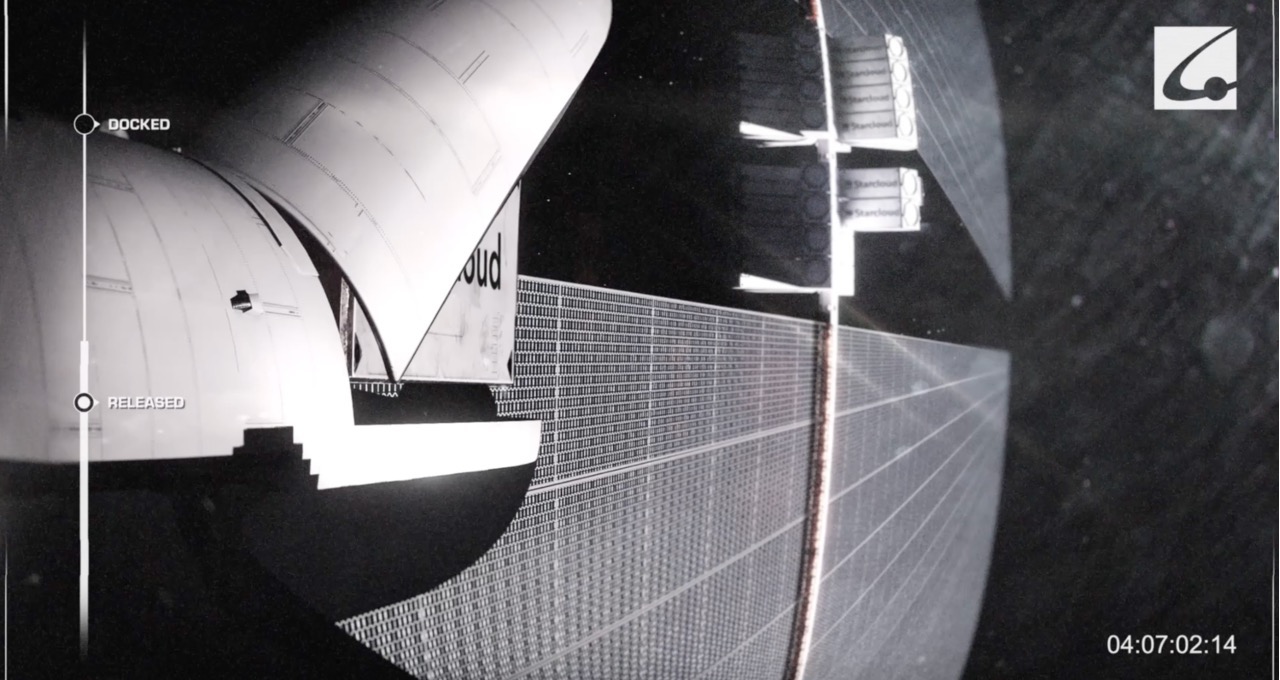
At that time, Philip Johnston stated that space AI is not a gimmick; the company's goal is to achieve energy costs in orbital data centers that are ten times lower than those of ground data centers.
After achieving preliminary success, Starcloud's ambitions have not stopped. Recently, the company submitted an application to the FCC to deploy a massive constellation of 88,000 satellites to build a distributed, space-based AI training and cloud computing platform. However, turning this vision into reality is fraught with enormous challenges. From funding scale, regulatory approval, launch capacity, orbital resource allocation to operational sustainability, this is not just a commercial race, but a systemic engineering challenge, with each step filled with uncertainty and complexity.
Not only Starcloud, but as the AI industry increasingly demands computing resources, more and more tech companies are seeking new sources of computing power, and space is gradually becoming the focus of this competition. For instance, Google officially launched its solar catcher project at the end of last year, announcing plans to send its self-developed TPU AI chips into space, aiming to build a prototype of a solar-powered space data center; not long ago, SpaceX, under Elon Musk, submitted an application to deploy one million satellites in Earth orbit to create an orbital data center; recently, data storage and disaster recovery company Lonestar, along with semiconductor and storage company Phiso, launched a data center infrastructure set aimed at the moon via SpaceX rockets.
As the concept of space data centers moves from science fiction to reality, a new arms race in infrastructure is unfolding. According to Musk's predictions, in five years, the annual new computing power for space AI will reach hundreds of gigawatts; the AI computing power sent into space each year will exceed the historical cumulative total of all AI on Earth.
By that time, the main battlefield of AI computing power competition will truly shift to space. In the coming years, we will see more commercial explorations and technological innovations, and space mining may just be one of the stepping stones in this wave.
免责声明:本文章仅代表作者个人观点,不代表本平台的立场和观点。本文章仅供信息分享,不构成对任何人的任何投资建议。用户与作者之间的任何争议,与本平台无关。如网页中刊载的文章或图片涉及侵权,请提供相关的权利证明和身份证明发送邮件到support@aicoin.com,本平台相关工作人员将会进行核查。


