More than half of Americans said they had used an artificial-intelligence platform in the past two to three months, according to a new poll.
Yet when respondents were asked to rate their feelings toward the technology, AI ranked near the bottom of the list.
The survey of 1,000 registered voters was conducted by NBC News in partnership with Hart Research Associates and Public Opinion Strategies, from February 27 through March 3.
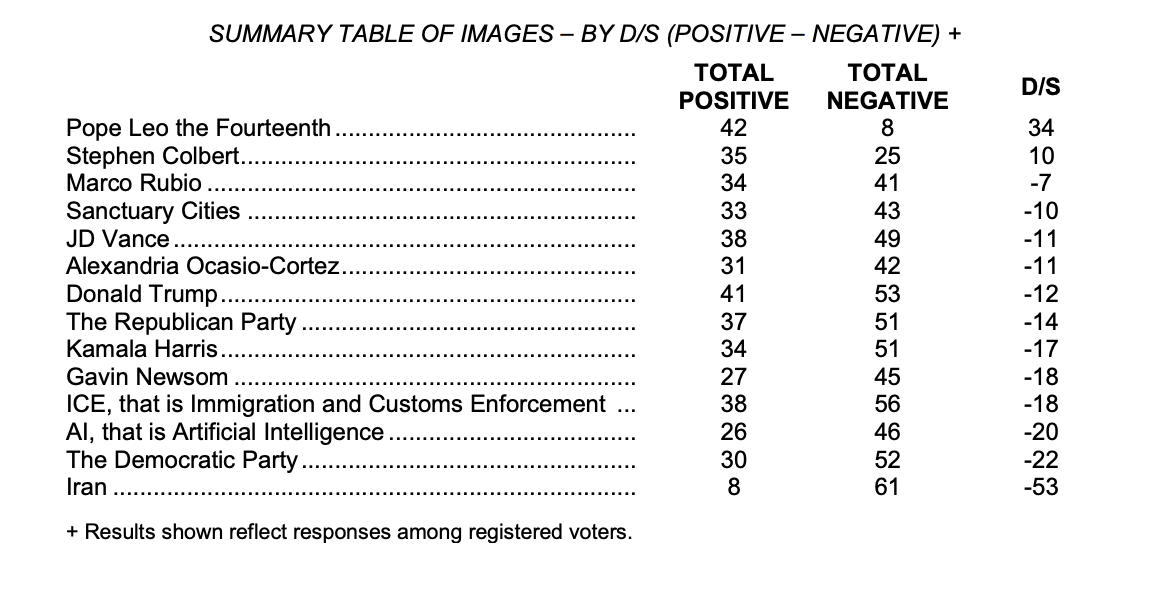
Just 26% of registered voters view AI positively, while 46% say they view it negatively, yielding a net favorability score of minus 20 points.
AI’s net favorability trailed Immigration and Customs Enforcement at -18, the Republican Party at -14, President Trump at -12, Kamala Harris at -17, and California Gov. Gavin Newsom at -18.
Only the Democratic Party, at -22, and Iran, at -53, ranked lower.
Usage figures, however, point to a different trend. Some 56% of respondents said they had used an AI platform such as ChatGPT, Microsoft Copilot, or Google Gemini in the past few months, up from 53% in August 2025 and 48% in December 2024.
The data indicate Americans are adopting the tools even as their views of the technology remain lukewarm.
The poll also asked whether the benefits of artificial intelligence outweigh the risks. A majority of respondents, 57%, said the risks outweigh the benefits, while 34% said the opposite.
The results align with a Pew Research Center survey from last September, which found that 50% of U.S. adults were more concerned than excited about AI, up from 37% four years earlier.
Other surveys paint a similar picture. A December 2025 YouGov poll found that 35% of Americans use AI at least once a week, yet only 5% say they deeply trust it.
Trust is lowest in healthcare and finance, sectors where AI is also expanding fastest. A Quinnipiac University survey from April 2025 found that just 4% of Americans think they can trust AI-generated information almost all the time, and nearly three-quarters said the government should intervene to prevent AI-caused job losses.
The NBC data also show a sharp partisan gap in how the question about AI governance is framed: Democrats trust the U.S. to regulate AI at lower rates than Republicans, while Democrats are more likely to trust the EU with the task—a reversal of the usual pattern on foreign institutions.
Overall, most Americans think neither party is good at handling AI policies, with 33% saying both are bad, 4% unsure, and 24% saying they do a similar job.

But despite that perception, politicians have not slowed down their interest in AI.
President Trump is pushing for tighter controls on AI hardware, while lawmakers are exploring ways to expand domestic AI industries without alienating voters.
The debate is unfolding amid persistent concerns about privacy and the technology’s economic impact.
At the same time, the White House is advancing AI infrastructure projects, including the controversial Stargate Project, even as the technology holds a net favorability rating worse than most politicians.
免责声明:本文章仅代表作者个人观点,不代表本平台的立场和观点。本文章仅供信息分享,不构成对任何人的任何投资建议。用户与作者之间的任何争议,与本平台无关。如网页中刊载的文章或图片涉及侵权,请提供相关的权利证明和身份证明发送邮件到support@aicoin.com,本平台相关工作人员将会进行核查。


