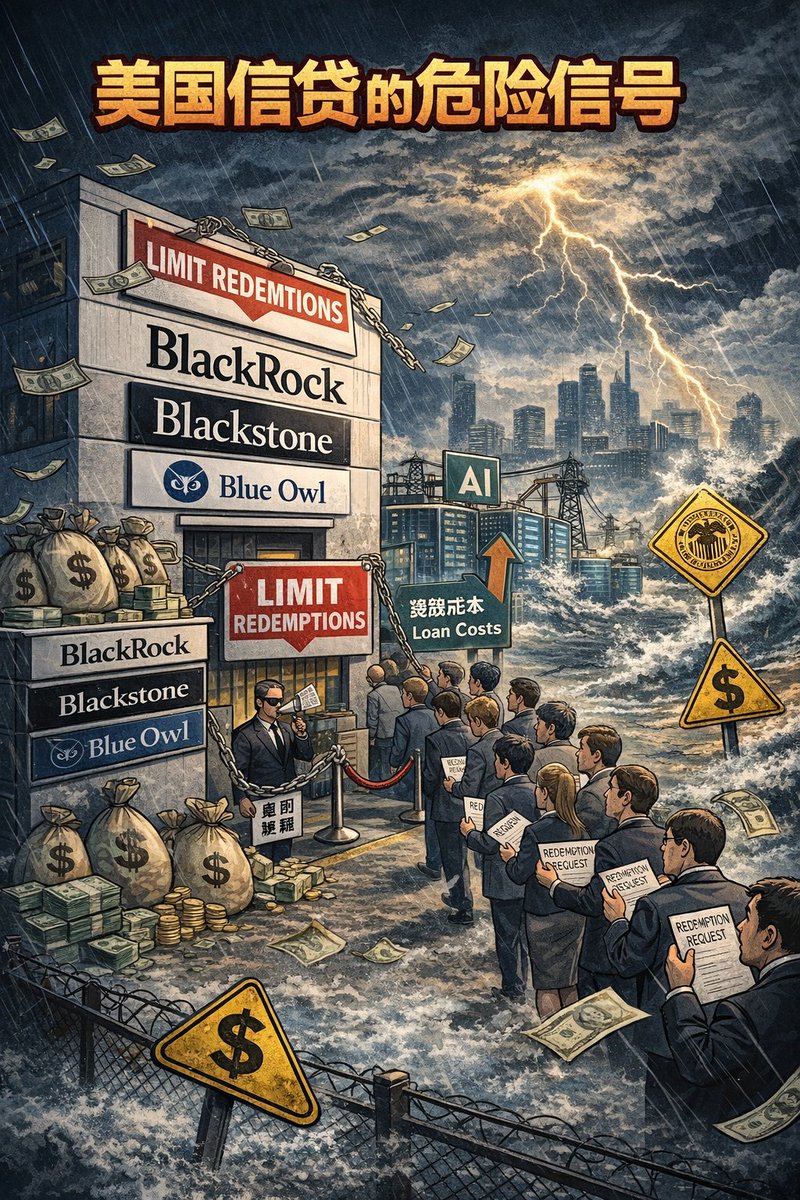
Danger Signals in U.S. Credit!! BlackRock is starting to encounter troubles.
Recently, I feel that there is a signal that is increasingly worth paying attention to, which is that the risks of private credit in the United States are gradually being exposed.
Previously, I posted about global fund managers' expectations regarding a U.S. recession. The market feels that the U.S. is not yet at a stage of recession; although U.S. stocks have fluctuated, the overall narrative remains, and confidence in the economy not landing is even quite high. Concerns about recession have reached a historical low point.
However, recent disclosed data shows that private credit has increasingly been listed by many as one of the important tail risks, followed by a spike in open interest for hedged put options on credit ETFs hitting a historical high, along with top institutions experiencing a series of redemptions or liquidity pressures. This matter is no longer just talk.
(1) BlackRock's Users Request Increased Redemptions
Recently, the most sensitive issue for the market has been that BlackRock's HPS Corporate Lending Fund (HLEND) has begun to limit redemptions. The fund size is approximately $26 billion, and in the first quarter of 2026, redemption requests from investors amounted to about 9.3% of the total fund shares, but the fund's quarterly buyback limit was only 5%. In other words, BlackRock has triggered the liquidity cap in the terms for the first time.
According to media estimates, investors originally wanted to take back approximately $1.2 billion, but in the end, they could only take out about $620 million. In layman's terms, this type of product isn't designed for full withdrawal at will, and what has really made the market tense is that even products of BlackRock's caliber are starting to touch redemption limits for the first time.
(2) Blackstone Uses Its Own Funds to Complete Redemption
It's not just BlackRock; although Blackstone's BCRED didn’t directly hit the 5% limit like BlackRock, the pressure is still significant. BCRED received about $3.7 billion in redemption requests in the first quarter of 2026, equivalent to 7.9% of the fund shares. Blackstone raised the usual 5% buyback limit to 7% and also injected an additional $400 million of internal funds.
Over $150 million of this came from executives and senior employees. This indicates that although Blackstone also faces pressure, it still chooses to stabilize investors by raising the buyback limit and injecting internal funds. This is no longer just the sentiment of individual clients; the entire industry is beginning to face the reality of investors wanting to exit and funds needing to find ways to repay.
(3) Blue Owl's Liquidation Refund
This isn’t over yet; Blue Owl's OBDC II, with a size of approximately $1.6 billion, encountered the same situation. Blue Owl's approach is more aggressive than that of BlackRock and Blackstone; it canceled the original quarterly redemption arrangement and instead provided liquidity to investors through asset sales and capital refunds.
Blue Owl sold around $1.4 billion in assets from its three funds to North American pension and insurance institutions and returned this money to shareholders as capital, changing the original quarterly 5% redemption framework to a return arrangement of up to about 30%. The sold loans correspond to 128 companies across 27 industries, of which about 13% are in the software industry.
PS: I will write about the software industry when I have some time.
If we look at these three cases together, it becomes clear that whether it is BlackRock's limiting redemptions as per the terms, Blackstone increasing the limits and injecting its own funds, or Blue Owl canceling the original quarterly redemption arrangement in favor of liquidity provision through asset sales and capital refunds, all three companies, although using different methods, indicate that credit liquidity is starting to tighten. The tightening liquidity likely stems from redemption risks, which, the more it persists, the easier it becomes to reinforce investors' willingness to redeem.
Data from Fitch in February shows that the average redemption rate for permanent non-public BDCs it tracks rose to 4.5% NAV in the fourth quarter of 2025, up from 1.6% in the previous quarter. This indicates that the pressure of capital withdrawals is not just an issue with individual products but is emerging across the entire retail private credit channel.
(4) Why is this outbreak happening now?
Because high interest rates have lasted too long, and the Federal Reserve's rate cuts have been too slow. Private credit has been lent to many borrowers, including mid-sized companies, private equity-backed companies, highly leveraged borrowers, and those companies that traditional banks are unwilling to lend to or do not lend enough.
In times of low interest rates, easy financing, and high asset prices, these issues can be masked. However, once high interest rates persist, refinancing becomes more difficult, and expectations of economic slowdown arise, investors will begin to reassess three key questions:
First, can the underlying borrowers hold on?
Second, are the book valuations sufficiently accurate?
Third, when it comes time to need money, can redemptions take place?
Currently, the protective put positions on credit ETFs have surged to historical highs, which is essentially investors hedging against these three concerns.
Thus, the most dangerous place right now is that institutions have started to gradually reduce their risk assets, increase cash, go long on gold, and short or hedge credit. Once private credit encounters issues, more funds will begin to limit redemptions, more borrowers will default, credit spreads will widen rapidly, and the first response from institutions may be to sell the most liquid assets first, such as tech stocks.
(5) Conclusion, risks are gradually increasing
U.S. credit has not yet experienced a widespread collapse, but it has reached a very dangerous edge. BlackRock encountering redemption issues may just be the beginning. If high interest rates continue, market differentiation expands, private credit may face higher redemption pressures and stricter valuation scrutiny. If redemptions increase, defaults rise, and credit spreads widen, liquidity pressure may further evolve into a real credit event.
(6) The Impact on AI Cannot Be Underestimated
If private credit continues to tighten, the most easily affected are not just ordinary corporate financings; AI itself will also feel the pressure. Currently, the most capital-intensive aspects of AI are data centers, electricity, servers, and supporting networks, all of which heavily rely on continuous financing.
The Chicago Federal Reserve's 2026 research explicitly mentions that the financing chains of banks and non-bank institutions have increasingly flowed, either directly or indirectly, to data centers and AI-related investments, indicating that AI infrastructure is tightly linked with credit.
S&P Global Ratings included "AI-driven tech bond issuance, AI valuation risks, and rising leverage of non-bank institutions" as key variables for credit market liquidity in 2026, and the market has begun to worry about whether the financing of AI and infrastructure will be affected if the credit environment deteriorates. A typical case is Oracle!
This is because the core issue of AI infrastructure has always been the need for continuous and low-cost investment. If the credit environment deteriorates, AI infrastructure may not immediately stop, but the cost of financing will rise, and the pace of expansion will slow down. The market will also demand higher returns.
In summary, once credit tightens, AI infrastructure is likely to become more expensive, slower, and harder to finance first, thus slowing down the pace of AI development.
End
PS: I know this article is long, and there are hardly any buddies patient enough to read it all, but these are the risks that are most likely to happen recently.
免责声明:本文章仅代表作者个人观点,不代表本平台的立场和观点。本文章仅供信息分享,不构成对任何人的任何投资建议。用户与作者之间的任何争议,与本平台无关。如网页中刊载的文章或图片涉及侵权,请提供相关的权利证明和身份证明发送邮件到support@aicoin.com,本平台相关工作人员将会进行核查。


