Author: Blockchain in Plain Language
At the beginning of March 2026, American actor William Shatner—also known as Captain Kirk from "Star Trek"—posted a screenshot on X.
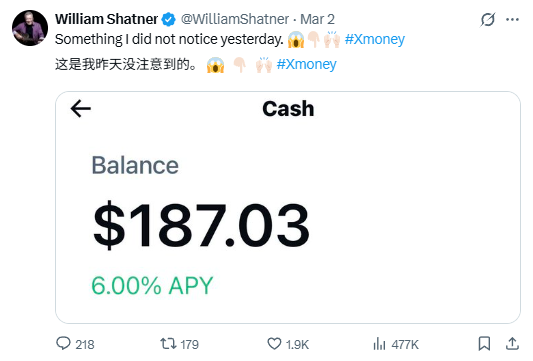
Nothing much, he was just testing a new product called X Money.
In the screenshot, there was a line of numbers, annualized yield: 6%.
This post didn’t incite much sharing, but it quietly stirred a commotion in the financial circle.
Not because of William Shatner, but because of that 6%.
If you open a regular savings account at JPMorgan Chase, the deposit rate is 0.01%. At Wells Fargo, the answer is similar. Deposit $100, and after a year, the big bank gives you one cent. But X Money gives you $6.
The difference is 600 times.
This is Musk's way of declaring war on traditional finance—not through technical white papers, nor regulatory PR, but through a screenshot.
01 A Black Metal Card
The appearance of X Money is easy to understand: a digital wallet that can send money, receive money, and store money, also comes with a physical debit card.
But every detail reveals ambition.
That debit card is made of black metal, laser-engraved with your X username (Handle). It’s not your name, it’s not your account number, but your social identity on the X platform.
This design is not accidental. It ties social accounts to spending power. Every time you pull out the card to check out, you show not just a payment tool but also your digital identity. The stickiness of the X ecosystem builds layer by layer in this way.
On the settlement side, X Money connects with Visa Direct. Traditional banks’ ACH transfers take 1 to 3 business days to complete, while Visa Direct can be instant. For the gig economy and content creators, this speed difference is a tangible experience enhancement.
Deposit is held by Cross River Bank (a member bank of the Federal Deposit Insurance Corporation), with each user enjoying up to $250,000 in federal deposit insurance protection.
In one sentence, this product can be summarized as: 6% APY, laser-engraved name black metal card, instant settlement, zero overseas transaction fees, $250,000 insurance limit.
Looking solely at the specifications, it’s hard to nitpick.
02 Why Provide 6%
This is the most critical question.
6% APY, where does the money come from? X Money is not burning cash to subsidize users—at least the current business logic is not. The answer lies in an unassuming difference in cost structure.
Traditional large banks maintain a complete physical network: branches, tellers, ATM clusters, decades-old IT systems. These are huge fixed costs; no matter how the deposit scale changes, this expense remains.
And X Money is a cloud-native, API-first platform with no physical locations and no historical baggage. The front-end user experience is managed by X, while bank compliance and fund custody are handled by Cross River Bank. This embedded finance model of "tech company for the front end, licensed bank for the back end" significantly reduces operational costs, and the savings can be shared with users.
This logic itself is not new. Companies like Robinhood, Ally Bank, and SoFi are taking the same route.
But X Money has something that traditional fintech companies generally lack: over 500 million monthly active users, with a nearly zero customer acquisition cost (CAC).
No money needs to be spent on acquiring new customers; it only needs to keep the existing users on X and keep their money there.
03 Who is Being Threatened
The competitors X Money aims to squeeze are far more than they appear.
First is the traditional deposit market.
The business model of large banks relies on a premise: depositors have no better choice, or are too lazy to switch.
The 6% APY breaks this premise. Once over 500 million X users have access to this interest rate, the pressure for fund migration will turn into real pressure. Banks will have to raise their deposit rates to retain deposit customers, thereby compressing interest margins. About 60% of U.S. banking revenue comes from net interest margins; this is no trivial matter, it is a systemic upheaval of profit structure.
Second is the payment intermediary layer.
Players like Venmo, PayPal, and Cash App have grown accustomed to their positions in this field. But they do not have a social platform with over 500 million users as a traffic entry.
The core logic of X Money is to build a "closed loop of funds": money comes in, circulates within the X ecosystem for content tipping, subscriptions, and product purchases, without needing to flow out. Once the closed loop is formed, the intermediary roles of PayPal will be marginalized.
Lastly, there’s cross-border remittances.
According to World Bank data from the first quarter of 2025, the average cost of global cross-border remittance is about 6.49%, and often takes days to arrive. X Money aims to significantly lower this cost with Visa Direct's global network and achieve almost real-time arrivals. Businesses like Western Union and MoneyGram in markets dense with X users such as India, Indonesia, and Brazil are the most direct targets for X Money.
04 The Regulatory Battlefield
However, whether the threat can materialize, the biggest variable is regulation.
X Payments LLC currently has obtained money transfer licenses (MTL) in over 40 states and Washington D.C. But there is one state that has always withheld approval: New York.
New York legislators have publicly written to the state's Department of Financial Services (DFS), demanding that a license not be issued to X. The reasons cover: Musk's historically hostile attitude towards regulators, vulnerabilities in the identity verification mechanism of the X platform, and a more sensitive accusation—that during Musk's leadership of the Department of Government Efficiency (DOGE), staff reportedly accessed consumer payment data from the Consumer Financial Protection Bureau (CFPB), which theoretically contains trade secrets of competitors.
If regulators participate in competition, this accusation, if substantiated, could trigger a series of antitrust lawsuits.
Another variable is the GENIUS Act. This stablecoin legislation that officially came into effect in July 2025 explicitly prohibits payment-type stablecoin issuers from paying any form of yield or interest to holders.
Currently, X Money’s 6% APY on fiat deposits operates under traditional bank deposit agreements, so within the current framework, there are no direct issues. However, if X wants to convert account balances into stablecoin form in the future, or deeply integrate assets like Dogecoin or XRP, the yield ban in the GENIUS Act will directly block that pathway.
Musk needs to demonstrate to regulators: that 6% is compliant bank deposit interest, not a disguised yield of unregistered security, nor a prohibited stablecoin dividend.
05 Grok Enters the Scene
If 6% APY is the entrance ticket for X Money, Grok is the moat it wants to build.
X's AI Grok is deeply integrating with financial functions. Musk’s vision is that Grok is not just a chatbot, but a "smart agent" that can fulfill financial responsibilities—suggesting trades based on real-time sentiment on the platform, automatically reallocating funds among products of different risk levels, and even directly jumping to the trading interface through the "Smart Cashtags" function while users scroll through posts.
This is a new product form: seeing content and managing assets happen in the same interface.
Traditional wealth management companies charge fees based on information asymmetry and manual services. When AI can process massive social data and market signals at millisecond speed, that informational advantage will diminish.
For creators, the change is more direct: tips, subscription shares, and ad revenue directly enter the X wallet with 6% APY, without going through intermediary bank accounts. X is turning itself into the settlement center for creators—essentially their de facto "bank."
06 Conclusion
The success of WeChat Pay and Alipay in China has made countless American tech companies envious, yet they have never been able to replicate it. The reasons are multifaceted: more decentralized financial regulation in the U.S., consumer habits favoring credit card cashback culture, and barriers between different platforms.
X Money is the closest attempt to this goal so far.
It has a user base, AI capability, Visa's global network, a founder who does not care about existing rules—and also a bunch of regulators and politicians waiting to create trouble.
The outcome of this power struggle will gradually become clear in the next 18 months. If X Money can secure the New York license, maintain compliance with the GENIUS Act, while successfully deploying Grok's AI wealth management functions—it may indeed complete the experiment of a super app in the U.S.
If it cannot, what it leaves behind is just a pretty black metal card, and a 6% good interest rate.
For traditional banks and payment giants, the difference between these two outcomes is a matter of the company's fate.
免责声明:本文章仅代表作者个人观点,不代表本平台的立场和观点。本文章仅供信息分享,不构成对任何人的任何投资建议。用户与作者之间的任何争议,与本平台无关。如网页中刊载的文章或图片涉及侵权,请提供相关的权利证明和身份证明发送邮件到support@aicoin.com,本平台相关工作人员将会进行核查。


