Written by: Cointelegraph
Translated by: AididiaoJP, Foresight News
The "CLARITY Act" proposes a clear division of functions between the U.S. Securities and Exchange Commission (SEC) and the Commodity Futures Trading Commission (CFTC) with the aim of clarifying how digital assets, exchanges, information disclosure, and regulation should operate in the U.S. cryptocurrency market.
Key Points
- Clarifying definitions and responsibilities: The act aims to address years of regulatory ambiguity with a clearly structured framework, specifying what constitutes digital assets, the roles of intermediaries, and what information needs to be disclosed.
- CFTC and SEC each perform their duties: Most qualified token spot trading will be under the supervision of the CFTC, while the SEC will continue to oversee primary market issuances, information disclosure, and investor protection.
- Regulating both assets and behaviors: The act focuses not only on the assets themselves but also on standardizing market behavior by establishing registration and behavioral standards for exchanges, brokers, and dealers to enhance market integrity and transparency.
- Complementing the stablecoin act: Stablecoins are primarily governed by the "GENIUS Act," while the "CLARITY Act" only plays a supplementary role in related fields, such as information disclosure and reward functions regarding the use of stablecoins.
The "CLARITY Act" (2025 Digital Asset Market Clarity Act) aims to break the industry's legislative deadlock through a dual approach: defining digital assets clearly on one hand while allocating regulatory authority based on their actual function in the market. This legislation seeks to change the previous model that relied on case-by-case enforcement to address issues, instead providing a comprehensive framework for asset classification, intermediary roles, and mandatory information disclosure.
This article will explain what the "CLARITY Act" is and why it is important, outline its objectives, and explore how it intends to regulate stablecoins. The article will also touch on the concept of mature blockchains, major arguments against the act, and its legislative progress.
Why the "CLARITY Act" is Important
The "CLARITY Act" addresses a long-standing issue in the cryptocurrency field: regulatory uncertainty.
For years, digital asset companies have faced the dilemma of unclear authority between the SEC and CFTC. The SEC often views many tokens as securities, while the CFTC classifies them as commodities. This grey area has slowed the pace of innovation, complicated compliance efforts, and confused investors, causing significant trouble for crypto businesses.
The goal of the "CLARITY Act" is to break this deadlock by clearly defining digital assets and assigning regulatory responsibilities based on asset types and related activities. With a predetermined clear framework, market participants can know from the outset what rules they must follow instead of passively facing uncertainty from enforcement actions.
Main Objectives of the "CLARITY Act"
The act aims to establish a relevant regulatory system in the following three ways:
More Precise Asset Category Definition
The "CLARITY Act" introduces the concept of "digital commodities," referring to digital assets whose value primarily derives from the use of their underlying blockchain systems. This definition excludes traditional securities and stablecoins. Consequently, the spot trading of many qualified tokens will fall under CFTC regulation. This definition particularly emphasizes the functionality of blockchain and the degree of decentralization of the network, considering the actual operational conditions of crypto networks.
Clarifying Regulatory Boundaries
The act delineates regulatory authority by function:
- The CFTC gains primary authority over digital commodity trading, especially in secondary markets, spot markets, and trading platforms.
- The SEC retains power over primary market issuances, investor protection, necessary information disclosures, and initial sales.
- The act also encourages the two agencies to collaboratively develop rules in overlapping areas such as information disclosure.
Establishing Unified Information Disclosure and Behavioral Standards
To protect investors and maintain fairness in the market, the act requires developers and issuers to engage in standardized information disclosure. This information needs to cover technical details of the blockchain, token economic models, and major risks, allowing market participants to have comparable information to assess different projects. Intermediaries such as digital commodity exchanges, brokers, and dealers must also meet registration, reporting, and regulatory requirements, with trading-related activities mainly overseen by the CFTC.
Overall, the "CLARITY Act" seeks to replace ambiguity with clear rules while protecting investors and maintaining market integrity, as well as supporting industry innovation.
The debate over the structure of the cryptocurrency market is influencing policymakers' thoughts on how to regulate artificial intelligence models, as both involve issues related to defining responsibility and fast innovation iterations.
How the "CLARITY Act" Regulates Stablecoins
The "GENIUS Act," passed in 2025, has established a federal regulatory framework for payment stablecoins. It stipulates that qualified stablecoins that meet strict reserve, redemption, and regulatory requirements are not classified as securities or commodities.
The "CLARITY Act" will not cover or duplicate this stablecoin regulatory framework. Instead, its provisions only play a supplementary role, particularly in areas related to incentives, information disclosure, and how stablecoins interact with the broader digital asset market.
About "Mature" Blockchains
Recognizing that assets can evolve, the "CLARITY Act" establishes a path for blockchains to attain a "mature" designation once they meet certain decentralized and functional standards.
Once the "mature" standards are reached, the related tokens will be considered "digital commodities" and regulated by the CFTC. As long as the project meets other conditions, this can significantly alleviate its regulatory burden, such as potentially eliminating the need for registration.
The concept of "mature blockchains" reflects the idea that as networks become increasingly decentralized and broadly distributed, the way they are regulated should also adjust accordingly. It provides projects with a clearer path to potentially apply more lenient compliance requirements in the future.
In past regulatory disputes, courts have sometimes referenced decades-old securities law precedents to determine the nature of crypto tokens, highlighting how the existing legal framework has been awkwardly applied to an entirely new digital market.
Ongoing Criticism of the "CLARITY Act"
While the act aims to bring clarity, doubts remain. Critics argue that its definitions may still have loopholes, especially in decentralized finance (DeFi) areas, as these projects often do not neatly fit into traditional regulatory models.
Some believe that the investor protection offered by the act is not as robust as existing securities law standards. Other concerns focus on potential jurisdictional overlaps, such as how the SEC's anti-fraud authority would apply in areas primarily under CFTC's responsibility, especially for tokens that possess multiple characteristics.
Legislative Progress of the "CLARITY Act"
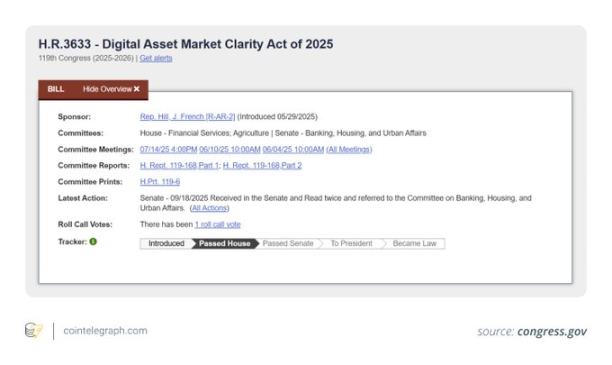
The U.S. House of Representatives passed the "CLARITY Act" (H.R. 3633) in July 2025 with bipartisan support. As of January 2026, the act is awaiting action from the Senate and has currently been submitted to the Senate Committee on Banking, Housing, and Urban Affairs for consideration. The legislative process also involves the Senate Committee on Agriculture, Nutrition, and Forestry providing input on matters related to CFTC regulation.
As of January 2026, relevant Senate committees have held hearings, released discussion drafts, proposed amendments, and advanced several versions of broader market structure legislation. However, due to disputes over issues such as stablecoin yields and investor protection, the process of amending and refining the act faces delays and adjustments. Coordination between the Senate bill and the House-passed bill is ongoing, and the Senate has yet to conduct a final vote.
If ultimately passed in a coordinated form, the "CLARITY Act" will become the first comprehensive federal legal framework targeting the digital asset market structure in the United States.
Some blockchain networks now publish real-time transparency dashboards showcasing validator concentration, token circulation velocity, and governance participation. Regulators sometimes reference this data when discussing whether a network is "sufficiently decentralized."
How to View the Blueprint of the "CLARITY Act"
At its core, the "CLARITY Act" aims to solve a longstanding issue in the cryptocurrency field: unclear regulatory boundaries, which hinder innovation and lead to reactive enforcement rather than proactive compliance.
The act intends to create a more predictable regulatory environment by clearly defining asset categories, mandating uniform information disclosure, and clarifying the roles of the SEC and CFTC, allowing market participants to clearly understand what rules they must follow from the outset.
Of course, legislation is just the first step. The key to determining the actual impact of the "CLARITY Act" lies in how it is implemented, how specific rules are formulated, and potential adjustments in the future. Whether it can truly deliver the promised clarity will profoundly impact the direction of U.S. crypto policy and industry competitiveness in the coming years.
免责声明:本文章仅代表作者个人观点,不代表本平台的立场和观点。本文章仅供信息分享,不构成对任何人的任何投资建议。用户与作者之间的任何争议,与本平台无关。如网页中刊载的文章或图片涉及侵权,请提供相关的权利证明和身份证明发送邮件到support@aicoin.com,本平台相关工作人员将会进行核查。


