Author: Hu Shixin, Deep Web · Tencent News Xiaoman Studio
Editor: Ye Jinyan
On March 3, Jack Ma, accompanied by Cai Chongxin, Wu Yongming, Shao Xiaofeng, Jiang Fan, as well as key executives from Alibaba and Ant Group including Jing Xiandong and Han Xinyi, rarely gathered at Hangzhou Yun Gu School. This roundtable discussion, marking the first stop of the New Year’s work, focused on the opportunities and challenges brought by AI, sending a strong strategic signal of “All in AI” from the two major groups.
Dramatically, in the early hours of the day after this high-level discussion, Lin Junyang, the youngest P10 of the group and the technical leader who propelled Alibaba Qwen to the pinnacle of global open source, suddenly posted on social platform X, “me stepping down. bye my beloved qwen.” This update ignited the global AI community.
Overnight, Alibaba Qwen lost its “helmsman”.
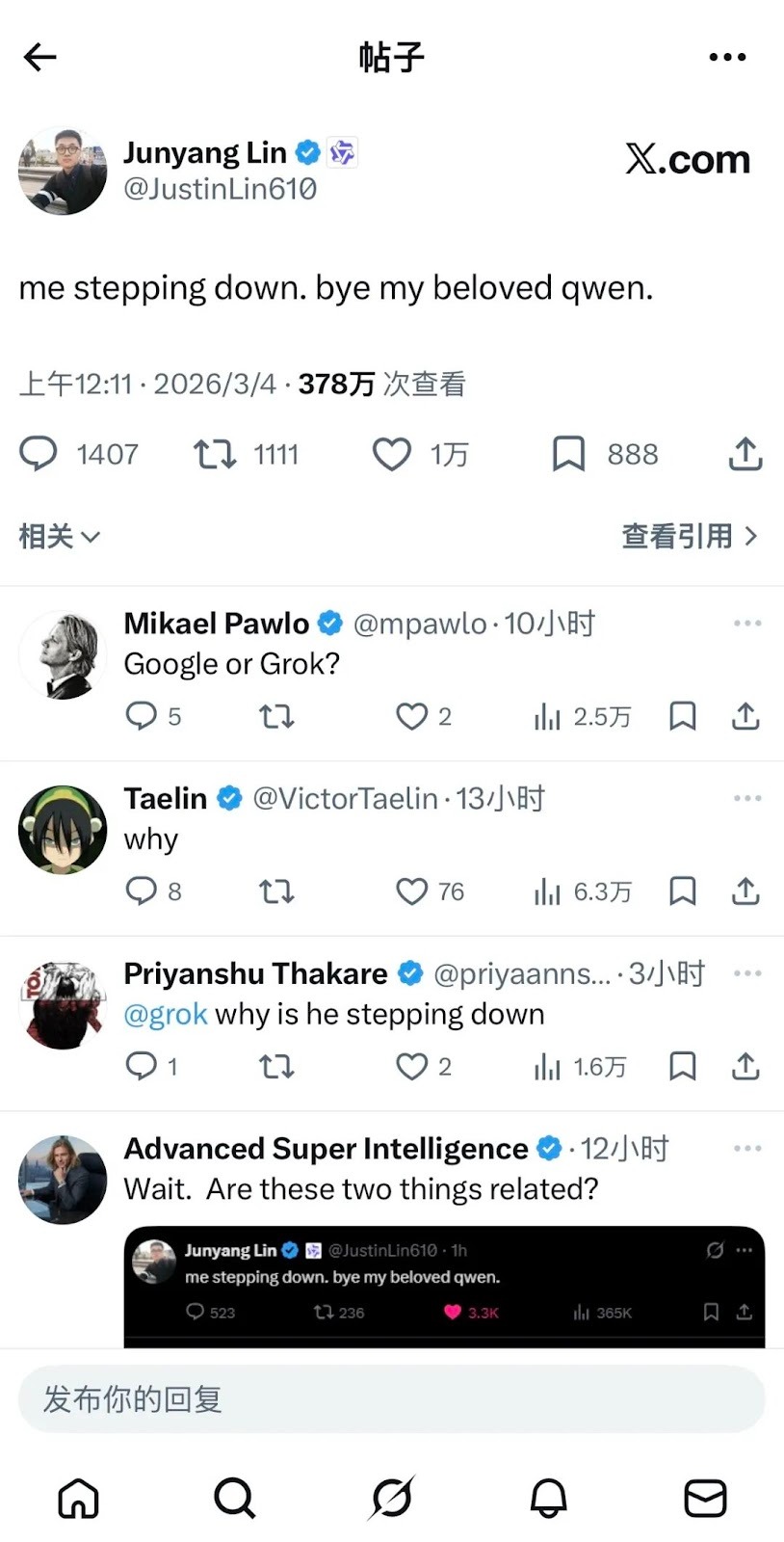
(Lin Junyang's latest update on X)
Was Lin Junyang's resignation involuntary?
Based on various sources, we have reconstructed the key points of this resignation incident.
On the evening of March 2, Lin Junyang led the team to release four Qwen 3.5 small-sized open-source models, which immediately attracted attention in the global tech scene, with Musk commenting on its “impressive intelligence density”, and Lin himself retweeting the comment to express gratitude. On the same day, Alibaba officially announced the unification of the B-end and C-end branding of its large models as “Qwen”, establishing it as the core AI brand of the group.
According to reports from LatePost and Phoenix Technology, on the afternoon of March 3, Lin Junyang left on the spot during an internal meeting disagreement and submitted his resignation, bringing some team members to tears upon hearing the news.
On the evening of March 3, Lin Junyang reposted the song "Cheers to Myself" on his WeChat Moments.
In the early morning of March 4, Lin Junyang publicly released a resignation update on platform X, which received over 10,000 likes and more than 1,400 comments by 4 PM today. Many industry developers expressed their gratitude to him and the Qwen team for their contributions to the open source field, with official accounts of AI companies like MiniMax also appearing in the comment section to express their recognition.
On the morning of March 4, Qwen post-training leader Yu Bowen and core contributor Li Kaixin of Qwen 3.5/VL/Coder announced their resignations.
On the afternoon of March 4, Lin Junyang posted on Moments saying: “Sorry my friends, I won’t be replying to messages and calls today, I really need to rest. Brothers of Qwen, continue working as previously scheduled, no problem.”
Notably, core contributor Chen Cheng of the Qwen team candidly stated when reposting Lin Junyang's update: “I am really heartbroken, I know leaving was not your choice. Just last night, we launched the Qwen 3.5 small model together, I cannot imagine what Qwen would be like without you.”
This comment fueled the narrative of involuntary resignation within the industry, and so far, Alibaba has not publicly responded to this personnel change. A source close to Alibaba believes that Lin Junyang's resignation was not voluntary, and that his prompt post on platform X may have resulted from not being able to control his emotions at that moment.
Why did he resign?
Lin Junyang’s sudden resignation has stirred up a storm in the industry, with endless speculation from the outside. At its core, it stems from the long-standing accumulation of multiple contradictions in Alibaba’s internal organizational structure, technology roadmap, business objectives, and talent dynamics.
The immediate trigger may have come from the team structure restructuring. According to LatePost, Tongyi Lab plans to break the Qwen team’s vertically integrated R&D model, splitting the originally closed-loop team covering pre-training, post-training, multimodal research and infrastructure building into several independent horizontal divisions, each directly under the overall coordination of Tongyi Lab, thus narrowing Lin Junyang's management authority and business boundaries.
Behind this structural adjustment is a fundamental conflict between Lin Junyang and Alibaba’s top management over the philosophy of large model development. Lin Junyang believes that the core competitive advantage of large model development comes from the deep collaboration of a complete team, while fragmented pipeline work will severely deplete R&D efficiency and innovation space; his team has long established a self-built infrastructure framework. However, the direction of the lab's fragmented adjustment is completely contrary to his judgment on the development trend of large model technology.
Even more difficult to reconcile than the technical route divergence are the deeper contradictions between the open-source route and the group’s commercialization goals. Under Lin Junyang's leadership, Qwen topped the global open-source large model rankings with a fully open-source strategy, becoming a benchmark for the overseas expansion of China’s large models. However, Alibaba's core assessment of Qwen has shifted from creating technological influence to commercial implementation.
Moreover, there has always been skepticism about the revenue efficiency of the open-source model within the company. It is reported that some executives commented on Qwen-3.5, which debuted on New Year's Eve, as an unfinished "semi-finished product." Coupled with market pressures from C-end Qwen App’s 3 billion subsidy not meeting expectations and B-end AI cloud business facing aggressive competition from rivals, the misalignment between technical ideals and commercial objectives has become increasingly difficult to balance.
Behind this change, the reconfiguration of talent dynamics at Tongyi Lab also dilutes core discourse power. Since 2025, Alibaba has continued to attract top AI talents globally. IEEE Fellow Xu Zhuhong, after transferring to Tongyi Lab, has responsibilities overlapping with Qwen's layout; in early 2026, former Senior Researcher at DeepMind Zhou Hao joined, reporting directly to the lab leader and taking over related responsibilities from the departing Yu Bowen.
The lab has transitioned from a single-core model led by Lin Junyang to a “multiple strong parallel” structure, coupled with the continuous loss of Qwen’s core founding base, prompting this highly impactful resignation event within the industry.
Who can replace Lin Junyang?
The reason this resignation has triggered a chain reaction within Alibaba and the global open-source community is Lin Junyang's key industry position within the Qwen team, Alibaba’s AI system, and the global open-source large model sector.
As a rare technical leader in China's AI industry who has grown entirely locally, Lin Junyang, born in 1993, has an interdisciplinary background with a Bachelor's degree in Computer Science from Peking University and a Master's degree in Linguistics and Applied Linguistics, giving him a unique advantage in large language model development.
After graduating with a Master’s degree in 2019, he chose not to go abroad for further education but directly joined Alibaba’s Damo Academy, starting as a senior algorithm engineer, rising four levels in six years, becoming Alibaba's youngest P10 level technical expert at 32, standing alongside other leaders from returnee PhD backgrounds like Tang Jie of Zhizhu AI, Yang Zhilin of Moon's Shadow, and Yao Shunyu from Tencent, establishing himself among the recognized “Four Great Model Founders” in the domestic large model field.
At the end of 2022, when Lin Junyang took over as the technical head of Tongyi Qwen, the domestic large model track had just emerged, and Alibaba's large model layout had yet to form a clear differentiated advantage. Under his leadership, Qwen launched a comprehensive open-source strategy, creating a family of models covering sizes from 0.8B to 72B parameters, with the trillion-parameter flagship model Qwen3-Max launched in 2025 surpassing contemporaneous international mainstream models in several authoritative assessments.
As of January 2026, the number of derivative models of the Qwen series in the largest global AI open-source community, Hugging Face, exceeded 200,000, with downloads surpassing 1 billion, maintaining the first place in global open-source large models. Stanford University's “2025 AI Index Report” shows that the performance gap between top AI large models in China and the U.S. shrank to 0.3%, with Qwen's core model ranking third globally in contribution.
After Lin Junyang's departure, two main questions arose.
- Who will take over Lin Junyang’s position? According to insiders, due to the sudden nature of the incident, there is currently no one who can fully replace Lin Junyang. His originally comprehensive management duties will be dismantled into multiple parallel teams with the restructuring.
- Where will Lin Junyang go? An industry observer who has long followed Alibaba said it is highly likely he will start his own business, though he may also join a prominent team in embodied or world models, with a low chance of being retained.
For Alibaba AI, the most significant immediate impact of this personnel change is the chain risk of core team loss and team morale decline. According to Phoenix Technology, Alibaba's top management is still in discussions to persuade Lin Junyang to stay.
Within a short span of 3 months, core founding members such as Qwen’s technical lead, post-training lead, and code lead have consecutively resigned, which will not only directly affect the subsequent iteration pace of Qwen models but may also trigger further talent exodus.
Lin Junyang’s exit marks a pivotal point in Alibaba's AI strategy shift. This means that Alibaba's large model will say goodbye to the phase focused on creating technological benchmarks and building a global open-source ecosystem, fully transitioning to a new cycle centered on commercialization.
However, Alibaba now faces disturbances in R&D pace due to core team loss, fluctuations in the trust of the global open-source ecosystem, and the pressing competition from adversaries like ByteDance and Tencent; the chain effects triggered by this personnel upheaval will directly test the resilience of Alibaba's All in AI strategy.
免责声明:本文章仅代表作者个人观点,不代表本平台的立场和观点。本文章仅供信息分享,不构成对任何人的任何投资建议。用户与作者之间的任何争议,与本平台无关。如网页中刊载的文章或图片涉及侵权,请提供相关的权利证明和身份证明发送邮件到support@aicoin.com,本平台相关工作人员将会进行核查。


