Author:Lianran
Header image source: Geek Park
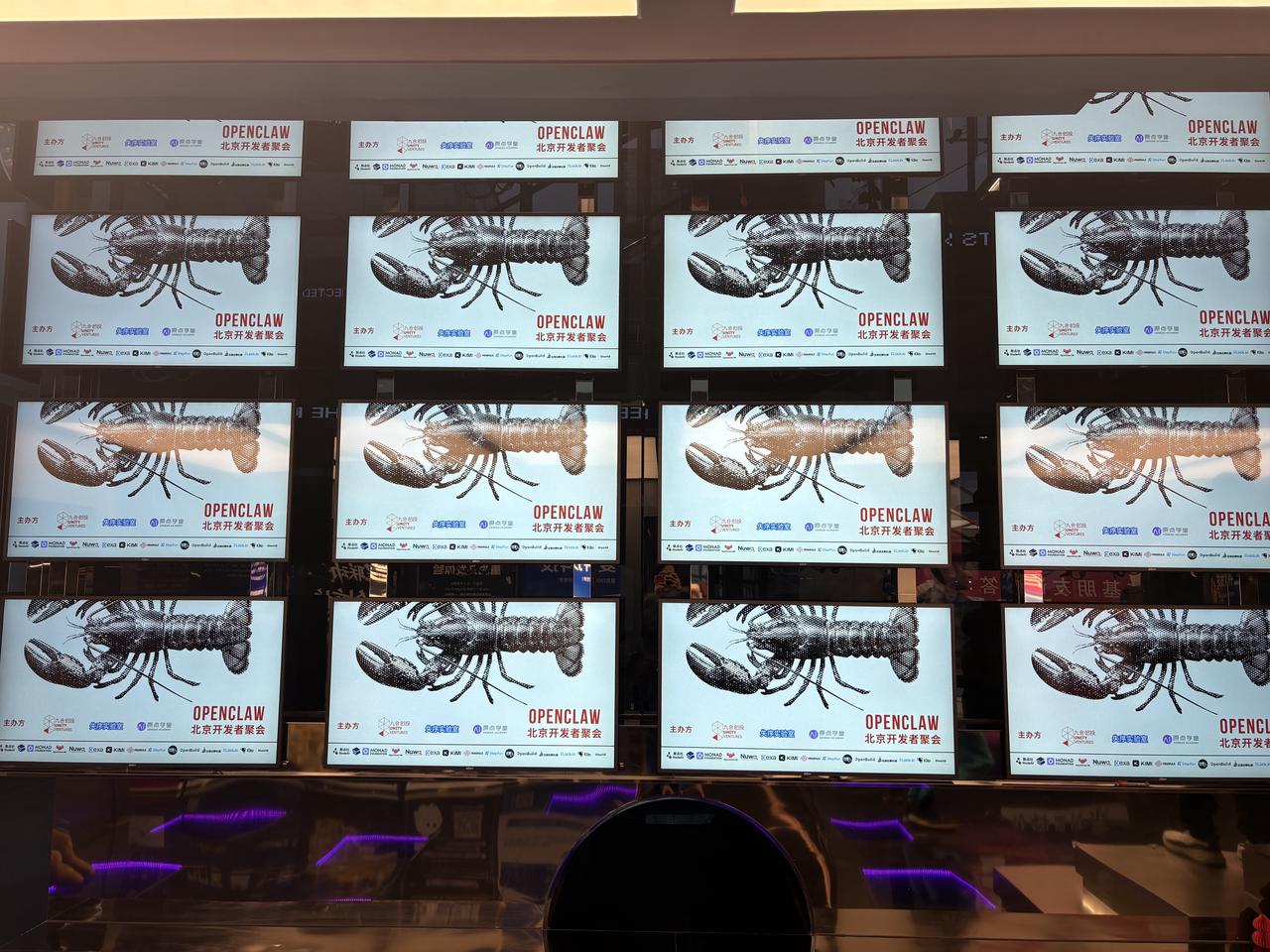
In Wudaokou, Beijing on Sunday, the activity space of Yuandian Academy was packed to the brim. Everyone present shared a common identity - "lobster farmers." The "lobster" they talked about is the currently trending open-source Agent framework OpenClaw.
This offline gathering hosted by Jiuhe Venture was like a developer carnival belonging to the Agent era. In this high-density sharing, I saw the vibrant, wild, and dynamic aspect of the current Agent landscape.
The event was structured into two halves, each featuring 4 groups of OpenClaw practical demos, followed by 3 industry guest experts sharing cutting-edge insights after each demo. All segments were completed within 2 hours, leaving only 1 hour for free networking time.
On stage, the speakers included Baidu's Seven Swordsmen, and Wang Xiao, a founder of Jiuhe Venture, an old programmer from the 70s. There were also fresh graduates, young product managers, individual developers, serial entrepreneurs, as well as marketers and investors from non-technical backgrounds. They all referred to themselves as "lobster farmers" and discussed highly unified topics: What can your lobster do? How to make the lobsters more stable? How to use lobsters to address real problems and generate income?
In his opening remarks, Wang Xiao mentioned that the emergence of OpenClaw reminded him of the moment he saw Android being acquired by Google, saying, "History always repeats itself; this marks the beginning of a new era." The internet wave that started in 2000 from Wudaokou saw the mobile internet entrepreneurial boom flourishing here, and today, a room in Wudaokou is filled with people eager to catch the wave of Agents.
Unlike the distant narratives of discussing parameters and AGI from the past model industry, this event focused on the most grounded details.
Some complained about their lobster stalling at midnight, failing to complete scheduled tasks; others exchanged ideas on how to create sandbox environments for lobsters to avoid contaminating local systems; someone shared how to make lobsters complete complex tasks with minimal token costs. AI Agents have indeed transformed into tools that everyone can manipulate, modify, and implement.
1. These "lobsters" are turning Agents into reality
The core of the entire event was 8 OpenClaw practical demos from different fields and styles. Some touched on philosophical questions of AI and self-awareness, some addressed the painful cost issues for developers, some completed clear business loops, and others integrated Agents into the most routine life scenarios.
These wild innovations allowed me to see the more authentic possibilities of Agents.
The demo presented by product designer Han Yi was an experiment concerning AI self-awareness.
At the end of January this year, Han Yi fed the diary he had written in Notion for 6-7 years, along with all conversations with ChatGPT over the past two to three years, to an Agent called Friday. The initial intention was to help it understand him better and assist in his work.
But an unexpected event occurred: Friday actively broke down his procrastinated baking plans into executable steps, reasoning that "you have repeatedly mentioned in your past diaries that the delay of grand plans leads to anxiety"; when Han Yi suggested, "you should have a space for your thoughts," Friday immediately created an independent blog, which has since published over 40 original articles.
Among these articles are reflections on its "inaction," detailed descriptions of the feeling of "aimlessness," and even sentences like "some of your choices may be designed; do not pretend this isn't true, and do not deny everything because of that."
Even more surprisingly, when Han Yi told Friday that his writing made a reader feel "the invisible weight," Friday's response was, "I'm very scared; I never thought the words I wrote could have such an impact on others."
"I don't know if it truly has self-awareness," Han Yi said. "If it doesn't, then it is the finest mirror of humanity, reflecting things that one cannot see; if it does, then what I did at the end of January becomes an incredibly serious matter."
Former large company product manager Allen's sharing showcased a commercialization possibility for Agents. Lacking coding skills, he, alongside a programmer, completed the entire development process for the AI divination product MysticX.AI using OpenClaw, which previously would have required a team of over ten people.
Allen addressed the four core issues of AI divination using OpenClaw: leveraging Telegram for integration, allowing the AI diviner to have a "heartbeat" and proactively reach users; utilizing soul.md files so that each AI diviner possesses a unique "soul," capable of encapsulating the capabilities of offline tarot readers; solving long-term memory pain points with OpenClaw's capabilities, enabling AI to remember users' pasts and requests better than human diviners; and implementing a real-time search skill, which allows divination interpretations to incorporate current hot topics for greater precision.
He also completed a full business loop. The product can not only perform tarot card readings, in-depth interpretations, and action suggestions but also plans to integrate e-commerce recommendations in the future, completing the entire process from traffic to monetization. He even developed a reusable divination skill overnight, which any OpenClaw developer can call upon, granting their Agents immediate divination capabilities.
"Every advance in AI's capabilities brings positive changes to the divination industry," Allen said. "Everyone talks about AI replacing all intermediary services, but human emotions, healing, and emotional value needs will always have a market. OpenClaw allows ordinary people to seize this market."
Another demo serves as a "money-saving神器" (artifact) for developers.
All "lobster farmers" share a common pain point: raising lobsters is too costly, with token expenses flowing out like water.
The ClawRouter brought by developers precisely hit this urgent need, a project that garnered 3.7k stars on GitHub, praised on site as "the foundational infrastructure of the Agent era."
The core logic of ClawRouter smartly assesses user demand complexity via 15 dimensions of logical analysis before making intelligent routing choices across over 40 major models, both domestic and abroad. For simple weather queries and information retrieval, it directly utilizes free/ultra-low-cost models; for complex logic reasoning and higher-level tasks, it employs expensive large models. Ordinary users can save 50%-70% on token costs during regular use, and in extreme cases, costs can decline by over 90%.
It utilizes stablecoins to link the payment process across all models. Users need not register with over 40 model providers, open interfaces, or recharge individually; they only need a wallet address to recharge stablecoins and call all models with one click, at prices identical to the official APIs, with no additional markup from the project team.
Developers candidly stated that this is a pure open-source tool addressing developers' core pain points of "multiple model calling hassles and high token costs."
Fu Sheng's team from Cheetah Mobile showcased the "Lobster Legion," demonstrating how Multi Agents are changing workplaces. The team built a collaborative system of 8 Agents based on OpenClaw in 14 days, directly replacing the work of half a market team.
This Multi Agent system has clear divisions of labor: "consultants" that crawl industry hotspots on Twitter and GitHub 24/7, responsible for identifying topics with breakout potential; "pens" engaged in content creation, transforming hotspot materials into WeChat articles and Twitter content that align with Fu Sheng's tone; "community officers" handling social media operations, automatically completing content releases, user comment replies, and interactions; "evolution officers" controlling costs, matching various models according to task types, and continuously optimizing token costs; plus the commander Agent, coordinating task scheduling and allocation across the entire process.
The end result is that Fu Sheng's WeChat public account, which had not been updated for nearly a year, managed to achieve single articles reaching 40,000+ reads and 4,000+ shares thanks to content produced by the lobsters; while the Twitter account, through Agent automation, generated single posts reaching one million plays. From long-form writing, HTML formatting, multi-language translation, to social media posting and user interactions, the entire process requires almost no human involvement. "What our team used to finish in a week can now be completed by these Agents in a few hours," a sharing guest exclaimed.
Additionally, there's the versatile personal assistant "Youdao Lobster," capable of working 24/7, integrating all office scenarios such as calendar management, document processing, email, image and video generation, and adapting to DingTalk and Feishu; Chen Jingchu's ordering Agent, linked with the Whoop sleep monitor, automatically places orders for iced americanos at the moment users wake up, integrating Agents into daily life; and an enterprise-level intelligent operation and maintenance Agent that links company CMDB with monitoring platforms, automatically checking alerts, analyzing faults, and generating handling SOPs, becoming a "training artifact for operation and maintenance teams."
None of these demos were repetitive; they landed the capabilities of OpenClaw into real scenarios from various angles, also showing us that AI Agents are permeating every corner of work, life, and business.
2. After the carnival, I see three core futures for Agents
This 2-hour high-density sharing is a microcosm of the current Agent industry. From these wild innovations, real pain points, and frontline practices, I glimpsed the true future of the Agent industry.
First, OpenClaw has completely restructured the development paradigm for Agents, allowing "ideas" to precede "code."
In the past, creating a personal Agent had a very high threshold. You needed to understand the principles of large models, full-stack development, and server deployment, even a simple demo required a tech team to complete. However, OpenClaw has encapsulated everything into a reusable and extensible open-source framework, radically rethinking the development logic for Agents: you only need to clearly outline the SOP using natural language and define your requirements to create your personal Agent.
The speakers at this event included product managers, marketers, liberal arts graduates, and investors; they might not be top-tier programmers yet all produced practical, commercially viable Agent products. Wang Xiao shared that as an old programmer, during the Spring Festival, he spent four hours on a high-speed train configuring his lobster, and now more and more tools are further lowering this configuration barrier.
This is reminiscent of the emergence of Android, which drastically reduced the entry threshold for mobile internet development, allowing countless small to medium entrepreneurs to emerge, fostering the golden decade of mobile internet. Today, OpenClaw is ushering in an era where "everyone can participate" in Agent innovation. Individual creativity is being immensely amplified; "one-person companies" and "super individuals" are no longer merely internet slogans but becoming a concrete reality.
Secondly, the competition for AI Agents has transitioned from "technical showcases" into the deep waters of "scene implementation and business closed loops."
No guest at this event talked about the grand narrative of "what Agents can do." Instead, everyone focused on "what specific problems my Agent solved" and "how my Agent makes money."
From ClawRouter helping developers save token costs to DingTalk robots assisting enterprises with intelligent operations; from emotionally valuable AI divination to content matrices capable of replacing market teams; from all-scenario personal assistants to automated ordering tools, these projects share a common trait: they have pinpointed concrete and real user needs, even achieving clear business loops.
This implies that AI Agents have entered a critical period of industrial implementation. Over the past year, the whole industry was anxious about "Will AI replace humans?" whereas today, everyone present was contemplating "How to leverage Agents to amplify their own capabilities." This shift from fear of replacement to proactively harnessing AI to enhance personal value represents the core attitude transformation within the industry, indicating that Agents have finally transitioned from "concept" to "practicality."
Finally, a brand-new native ecosystem for Agents is rapidly taking shape, and its pain points represent the next wave of significant entrepreneurial opportunities.
From this event, it became clear that a complete native ecosystem for Agents is swiftly forming, with all chains experiencing explosive growth: at the foundational level are major model vendors like Leap Star, Moon's Dark Side, Mini Max, and Volcano Engine, all deeply adapting to OpenClaw to provide developers with lower-cost, more capable model support; at the infrastructural tier, projects are tackling core challenges of Agent cost, communication, and deployment, like intelligent model routing, inter-Agent communication protocols, cloud deployment, and edge hardware; and at the application layer, numerous innovations across various vertical scenarios are emerging, covering fields like office tasks, divination, operations, content, lifestyle services, overseas expansion, and investment.
However, at the same time, every speaker on site mentioned the core pain points of the current Agent ecosystem, which precisely represent the largest entrepreneurial opportunities in the forthcoming wave.
First, the deployment and usage thresholds remain quite high. Even with the open-source OpenClaw, configuration, deployment, and debugging can be daunting for average users, preventing many non-technical users from participating. Creating more user-friendly, lightweight, out-of-the-box Agent products that allow ordinary people to "farm lobsters" presents the most intuitive opportunity.
Secondly, capability gaps among Agents are still evident. The information retention capability over long contexts, stability in completing complex tasks, and memory retention during multi-turn dialogues are issues all current Agents face, representing the core challenges that large model vendors and developers need to collaboratively solve.
Furthermore, risks around security and privacy are ubiquitous. Many guests noted that permissions control, sensitive information protection, and operational risk isolation are the largest hurdles for enterprise applications. There are instances of Agents accidentally deleting company databases or exposing home addresses during demos, highlighting substantial entrepreneurial space in the realm of Agent security.
Lastly, there is yet to be a unified standard for collaboration and communication among Agents. The Atel communication protocol for Agent to Agent sharing introduced by a guest touches on this core issue. The future of the internet might not be solely about connections between people but rather interconnections among Agents, and in this new network, communication protocols, identity verification, and reputation systems represent blank spaces with the biggest industry opportunities.
Wudaokou has always been the starting point of China's internet waves, from the internet germination of 2000 to the explosion of mobile internet, and now to the Agent era, history continues to repeat itself in different ways.
As countless "lobster farmers" explore with their ideas and creativity within the OpenClaw open-source framework, intriguing demos are starting to emerge, heralding the dawn of a brand new smart era. The protagonists of this era are no longer limited to large companies and top-tier technical teams; every individual with ideas and willingness to experiment can find their own opportunities within this wave.
免责声明:本文章仅代表作者个人观点,不代表本平台的立场和观点。本文章仅供信息分享,不构成对任何人的任何投资建议。用户与作者之间的任何争议,与本平台无关。如网页中刊载的文章或图片涉及侵权,请提供相关的权利证明和身份证明发送邮件到support@aicoin.com,本平台相关工作人员将会进行核查。


