On February 26, 2026, Derlin Holdings disclosed that the Hong Kong Securities and Futures Commission had "no further comments" on its RWA tokenization business plan. This is not an ordinary compliance progress, but rather a milestone event marking the first replicable RWA business structure paradigm in Hong Kong.
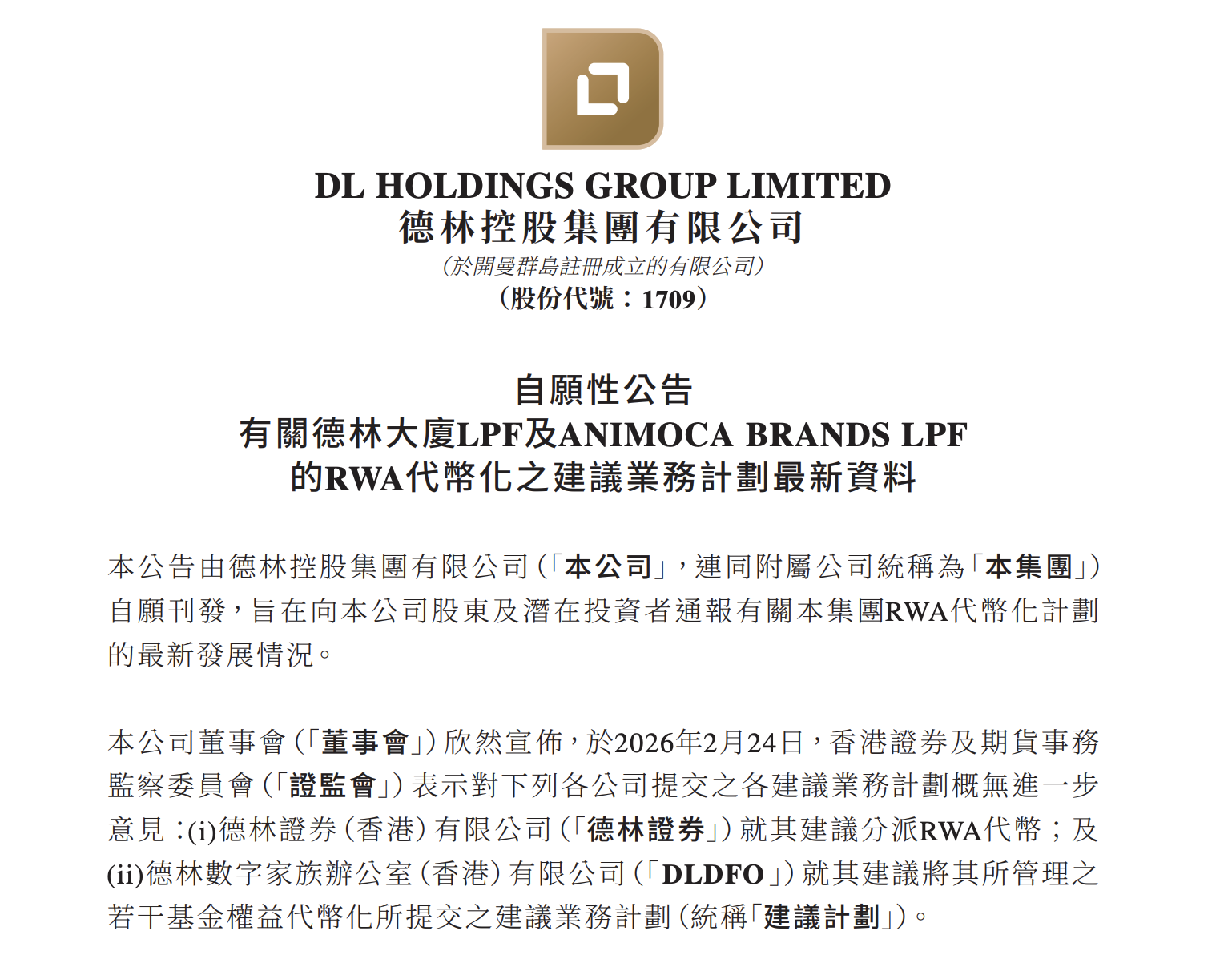
In the past two years, the RWA industry had remained at the proof of concept and technology trial level, but this time, a complete licensed business chain was truly run through: assets were put into a local fund structure, managed by a licensed institution, distributed by licensed intermediaries, and registered on-chain shares were completed within the existing regulatory framework.
This is not the advancement of a particular project, but a financial infrastructure path that has been successfully established.
01 A complete business chain has been closed-looped
The structure of this business is extremely traditional, with almost no "crypto-native" components.
Assets are placed into a Limited Partnership Fund (LPF), managed by an asset management institution holding a Type 9 license, and distributed by a brokerage holding a Type 1 license, targeting professional investors (PIs). The role of blockchain is not as a trading venue, but merely as a share registration system.
In other words, what has been put on-chain this time is not property nor equity, but fund shares.
The first form of RWA landing in Hong Kong is clearly outlined: it is not "assets directly on-chain," but "fund shares on-chain."
02 New asset narrative integrated into old regulatory system
Assets have not left the traditional financial system, legal relationships have not changed, and investor rights have not been newly defined due to tokenization. All core links still operate within the existing regulatory framework, and the chain merely completes digital expression at the ledger level.
The underlying regulatory logic is very clear: the same type of financial activity, whether using paper ledgers, electronic systems, or distributed ledgers, must comply with the same set of regulatory requirements.
The license system has not changed, but the business boundaries have been pushed outward by technology.
03 Only targeting professional investors
Tokenized fund shares essentially still belong to non-publicly issued securities, characterized by complex product structures, limited liquidity, and valuation dependent on the asset manager.
In the absence of a market-making mechanism, real-time net value system, and complete custody structure, if directly targeted at retail investors, any inability to exit at any time or significant fluctuations in net value would mean that the existing investor protection mechanisms are insufficient to handle these situations.
The day when it truly targets the retail market must meet three conditions: standardized product formats, compliant secondary markets, and penetrable custody and clearing systems. Until these infrastructures are completed, RWA can only exist in the professional investor market.
04 LPF becomes the legal interface for real assets to enter the chain
The key role in this round of Hong Kong RWA is not blockchain, but the LPF.
LPF addresses not a technical issue, but a legal issue. Real assets cannot directly complete ownership transfer through blockchain; properties still need registration at the land registry, equity still requires confirmation from the company registry, and debts still depend on contracts and the court system for execution.
The fund structure provides a securitized container that is separable, distributable, and transferable. Investors hold fund shares, the fund holds underlying assets, and tokenization merely migrates share registration from the traditional system to the chain.
Real assets now have a standard legal interface that can be digitally expressed.
05 Exchanges have not entered this path
This structure does not include any VATP or any secondary market trading arrangements. This is a stage-specific inevitability.
Currently, RWA is still a primary market product, with its issuance, subscription, holding, and redemption all completed within the licensed financial institution system. Without standardized product formats, market-making mechanisms, and continuous pricing capabilities, exchanges cannot assume liquidity functions.
The sequence of RWA entering exchanges is not "first list the tokens and then find the assets," but "first complete primary market digitization, then form tradable products."
06 The essence of asset on-chain is ledger rewriting
In the past, the industry repeatedly discussed which public chain is more suitable for carrying RWA; the answer in Hong Kong has become clear: it is not the chain that determines whether RWA can be established, but the legal structure.
Real assets must first enter a licensed financial system and transition into a regulated security form before blockchain can serve as its ledger.
RWA has never been about "moving assets onto the chain," but rather "making the chain part of the financial system."
Once the ledger is rewritten, liquidity, exchanges, and retail markets will subsequently emerge.
That will be the story of the next stage.
免责声明:本文章仅代表作者个人观点,不代表本平台的立场和观点。本文章仅供信息分享,不构成对任何人的任何投资建议。用户与作者之间的任何争议,与本平台无关。如网页中刊载的文章或图片涉及侵权,请提供相关的权利证明和身份证明发送邮件到support@aicoin.com,本平台相关工作人员将会进行核查。


