In the financial market, capital is always the most honest voter's tool. When funds have continuously withdrawn from the US spot Bitcoin ETF for five weeks, the market has to face a reality: the institutions that once fervently pursued crypto assets are collectively pressing the "pause button".
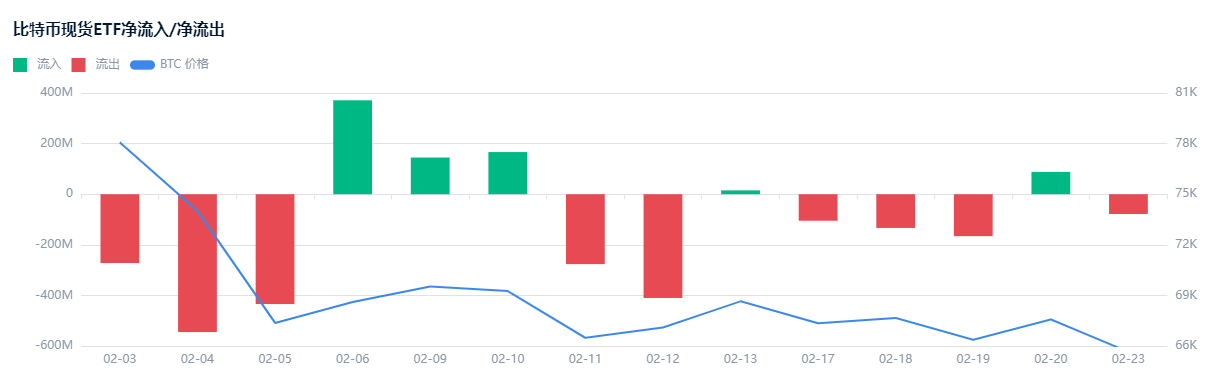
According to the latest data from SoSoValue, as of the week of February 20, the US spot Bitcoin ETF saw a net outflow of $316 million, marking the fifth consecutive week of capital outflow, totaling $3.8 billion. This prolonged "capital withdrawal" has not only set a record for the longest outflow since the product's launch but has also triggered a reassessment of the short-term outlook for crypto assets.

1. Record “Five Consecutive Week of Outflow”: Withdrawal Path Behind the Data
When extending the timeline, the severity of this wave of capital outflow is crystal clear.
1. Accelerating Rate of Loss, Record Outflow in a Single Week
● In the last five weeks, the capital outflow has shown a "stepped" amplification pattern. Particularly in the week of January 30, the net outflow reached as high as $1.49 billion, setting the largest single-week capital outflow record since the launch of the spot Bitcoin ETF.
● Although there were occasional rebounds on certain trading days during this period—such as a net inflow of about $88 million recorded last Friday, in the face of the overwhelming redemption wave, these sporadic returns were like a drop in the bucket, unable to reverse the overall downturn.
2. Leading Players “Top the Outflow List”
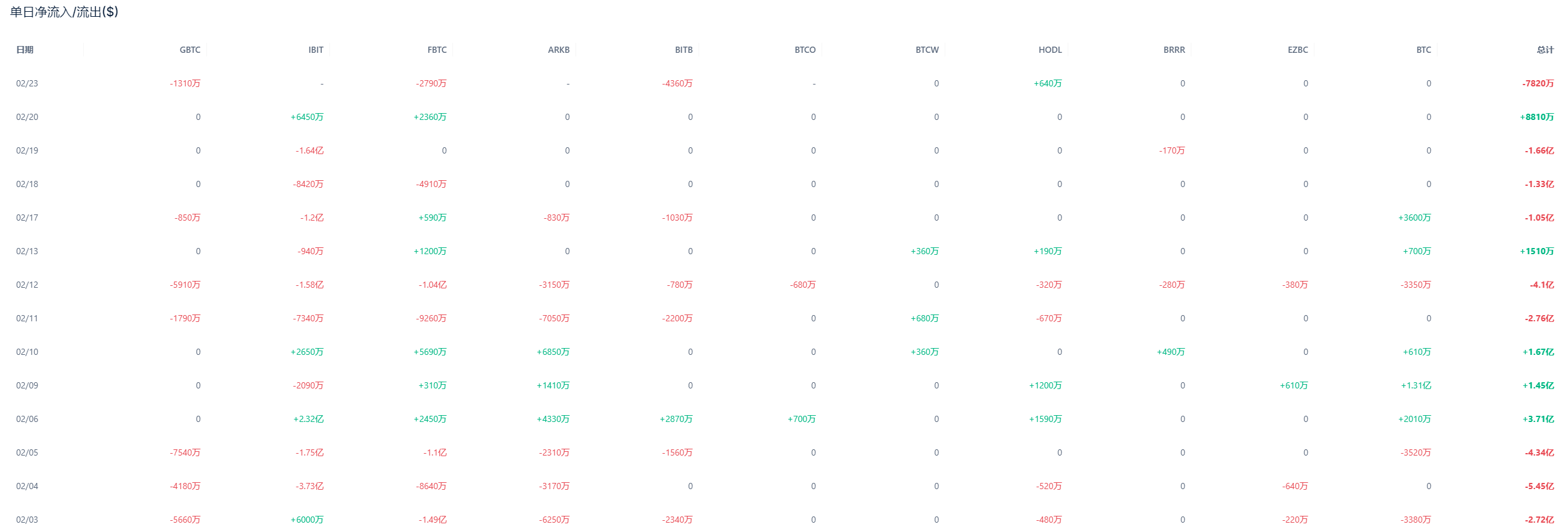
● From the product structure perspective, the current capital exit is not a sporadic sell-off by retail investors, but a systematic reallocation of institutional funds. Data shows that industry leader BlackRock’s IBIT has become a “disaster area” for outflows, with a single-week net outflow of $303 million, nearly accounting for the entire outflow for that week.
● Following closely is Fidelity’s FBTC, with a single-week outflow of $19.59 million. This sends a clear signal: even the leading players are currently shrinking their risk exposure.
3. Grayscale Mini ETF Becomes the Only Bright Spot
● In an atmosphere of harshness, Grayscale’s Bitcoin Mini Trust BTC recorded a net inflow of $35.97 million against the trend, becoming the only highlight of last week. This may reflect some investors seeking safer assets with lower fees, but the lone bravery of a single product is insufficient to counter the overall chill.
2. Under Pressure Together: Ethereum ETF Also Struggles
The chill in the Bitcoin ETF is not an isolated event; the entire digital asset ETF family is experiencing a winter.
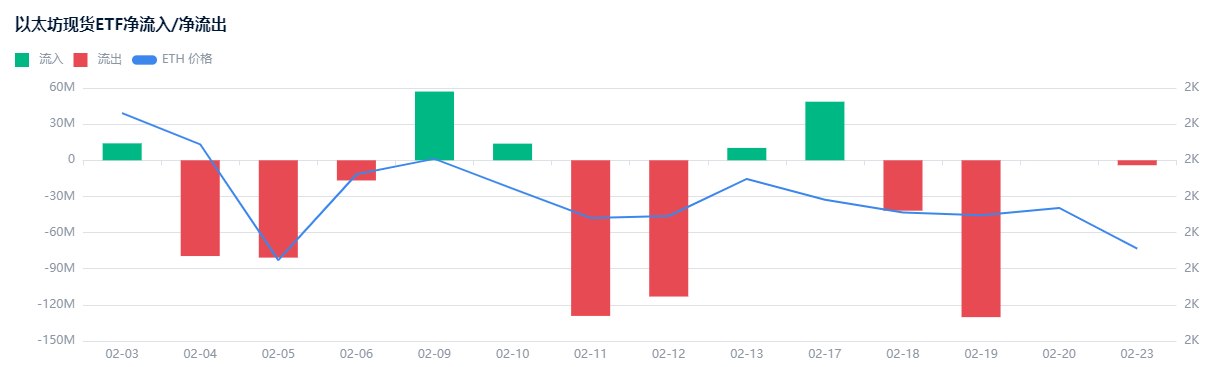
● In line with the Bitcoin ETF, the US spot Ethereum ETF also delivered a "five consecutive weeks" report. In the most recent week, the Ethereum ETF experienced a net outflow of approximately $123 million. Among them, BlackRock's ETHA product had a single-week net outflow of $102 million, also a major contributor to the outflow.
● The synchronous pressure phenomenon faced by both Bitcoin and Ethereum products has been interpreted by market analysts as a overall contraction in digital asset allocation. BlockBeats analysis indicates that the capital outflow is not targeting a specific asset's fundamentals, but rather a strategic reduction in overall digital asset exposure by investors in the context of global macro changes. When the tide recedes, neither the leader nor the second can remain unaffected.
3. In-depth Analysis: Who is Retreating?
To understand this wave of withdrawal, one must not only look at the crypto sector itself but must also look up at the sky—the “sky” of the macro economy has changed.
1. Macro “Tightening Spell”: From Rate Cut Expectations to Hawkish Shadows
● The core driving force behind this wave of capital outflow is the market's dramatic fluctuation in expectations surrounding the Federal Reserve's monetary policy. Entering 2026, although the market previously had high hopes for rate cuts, with the recurrence of US inflation data and the potential hawkish stance that the newly appointed Federal Reserve Chair (like Kevin Walsh) might bring, the market began to reprice liquidity expectations.
● An analysis by Nasdaq noted that Walsh historically leans hawkish, and he may tighten financial conditions by shrinking the balance sheet, which directly impacts the liquidity-dependent crypto market. When “cheap money” is no longer available, high-risk assets are naturally the first to be affected.
2. Trade War 2.0: Tariff Uncertainty Resurfaces Risk Aversion
● In addition to monetary policy, the resurgence of trade friction has intensified market panic. Analyst Linh Tran pointed out that after the court vetoed President Trump's tariff measures, the government immediately announced a new global taxation scheme, whichsignificantly exacerbated global trade uncertainty. In this context, investors are more inclined to hold cash and bonds, rather than the highly volatile Bitcoin.
3. Institutional “Smart Money”: Risk Reduction Rather than Structural Abandonment
● A noteworthy detail is that despite the continuous outflow of funds, the cumulative net inflow of the spot Bitcoin ETF since its launch is still as high as $54.01 billion, with total net assets around $85.31 billion, accounting for 6.3% of Bitcoin's total market value. This data indicates that long-term “foundation” funds are still present in the market.
● Market participants generally believe that this wave of outflow reflectsthe stage-wise risk reduction and position rebalancing by institutions. Under the triple pressure of geopolitical risks, trade frictions, and macro uncertainties, risk control departments first sounded the alarm, urging trading desks to reduce risk exposure; this is a routine operation in the asset management industry rather than a structural “death sentence” for crypto assets.
4. Future Outlook: Where is the Dawn of Reversal?
From the current standpoint, the most concerning question for investors is: How long will this wave of loss continue?
● In the short term, pressure remains. Market sentiment is highly linked to macro data; until the Federal Reserve's policy path becomes clearer, institutional funds are highly likely to maintain a “defensive posture”, leaning towards controlling risk exposure.
● However, turning points often emerge from pessimism. Industry perspectives believe that if subsequent US macro data weakens, it could actually become a positive signal—weak data will reinforce market expectations for rate cuts. Once “rate cut trades” become the market's main storyline again, digital asset ETFs are likely to see a strong influx of capital.
● Additionally, the ongoing heat in the AI field may serve as a “revival agent” for risk appetite. Some analyses suggest that if AI giants led by Palantir can consistently deliver better-than-expected results, driving an overall recovery in tech stocks, the improvement in risk appetite may spill over into the crypto market.
● Ultimately, this $3.8 billion outflow is a macro stress test and a test of the quality of crypto assets. For long-term believers, the current withdrawal is merely a rest stop on a long journey; for short-term traders, it is undoubtedly the time of greatest turmoil.
● The storm has not yet calmed, and funds are still on the sidelines. The next turning point for the Bitcoin ETF may be hidden in the upcoming non-farm payroll data or in the next speech by the Federal Reserve Chair.
免责声明:本文章仅代表作者个人观点,不代表本平台的立场和观点。本文章仅供信息分享,不构成对任何人的任何投资建议。用户与作者之间的任何争议,与本平台无关。如网页中刊载的文章或图片涉及侵权,请提供相关的权利证明和身份证明发送邮件到support@aicoin.com,本平台相关工作人员将会进行核查。


