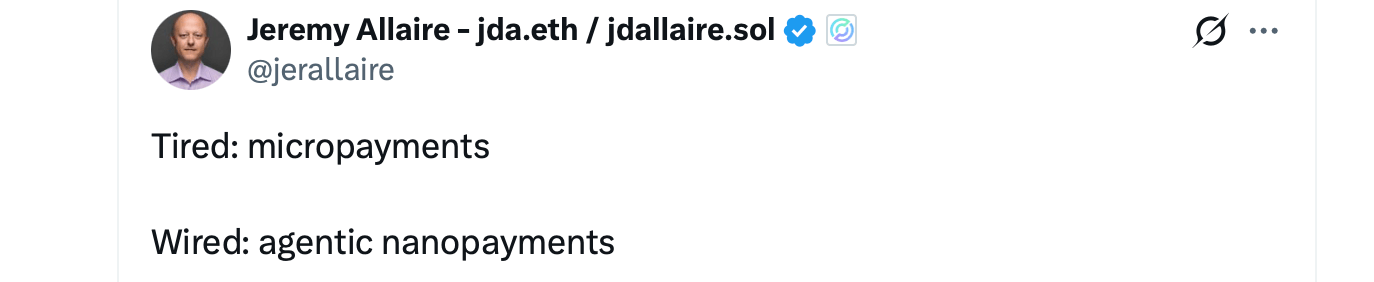
Circle Developer — the builder-focused division of Circle — announced this week that its new Nanopayments feature is now in private beta on testnet. The system leverages Circle Gateway to enable gas-free transfers of USDC down to one-millionth of a dollar.
Yes, that is $0.000001.
The timing is hard to ignore. AI agents — particularly autonomous tools such as Openclaw — have exploded in popularity in recent months. These agents browse, transact, and execute tasks independently, and they increasingly require programmable, machine-native payments. Paying a fraction of a cent per API call or task execution is not a novelty; it is becoming a functional requirement.
Circle’s pitch is straightforward: remove gas friction and let software pay software.
The “gas-free” mechanism is powered by Circle Paymaster, which allows transaction fees to be paid in USDC rather than native blockchain tokens like ETH. Users authorize a small USDC permit, and the system handles settlement behind the scenes. Combined with Gateway’s unified balance architecture — spanning more than a dozen supported blockchains — developers can move value across chains without juggling fragmented liquidity.
At the infrastructure layer, Gateway consolidates USDC balances into a non-custodial smart contract system, allowing near-instant cross-chain liquidity once funds are deposited. Transfers are executed through a signed burn-and-mint process, designed to reduce latency and eliminate the need for traditional bridging workflows.
The use cases are unapologetically machine-centric. Circle says the system is built for AI agents, high-frequency settlements, streaming payments, usage-based billing and programmable commerce. Imagine IoT devices compensating one another in real time or AI agents paying per query without human approval loops.
Still, the beta label matters.
Nanopayments remains in private testnet rollout, and open questions linger around throughput limits, transaction abuse, and compliance guardrails. Automated micropayment systems could invite spam or regulatory scrutiny if not carefully monitored. Circle says the system incorporates monitoring tools and compliance checks, but real-world stress testing will ultimately decide its durability.
The broader context is clear: as autonomous AI tools scale, the financial rails beneath them must evolve. Whether Nanopayments becomes foundational infrastructure or simply another developer experiment will depend on adoption — not marketing copy.
For now, the AI economy has a new financial sandbox.
- What is Circle Nanopayments?
A permissionless beta system that enables gas-free USDC transfers as small as $0.000001 using Circle Gateway. - How does the gas-free feature work?
Circle Paymaster allows transaction fees to be paid in USDC instead of native blockchain tokens. - Who is this designed for?
Primarily AI agents, machine-to-machine payments and high-frequency programmable commerce. - Is it live on mainnet?
No, it is currently in private beta on testnet with early developer access.
免责声明:本文章仅代表作者个人观点,不代表本平台的立场和观点。本文章仅供信息分享,不构成对任何人的任何投资建议。用户与作者之间的任何争议,与本平台无关。如网页中刊载的文章或图片涉及侵权,请提供相关的权利证明和身份证明发送邮件到support@aicoin.com,本平台相关工作人员将会进行核查。


