Market Cold Thoughts: The Market Is Down, Who Is "Going Up in the Opposite Direction"?
Recently, everyone has witnessed the market—Bitcoin has been jumping around the 70,000 USD mark, causing panic among investors, even leading to fears of hitting 60,000 USD. However, during this "bull head retreat," a project called Stable quietly reached a new high, increasing by more than 40% this week.
Why? Because everyone finally realized: speculation may stop, but as long as people are alive, they must use stablecoins to pay.
The current market is actually "de-leveraging and squeezing out the excess," with funds flowing from those ethereal "air coins" to the track of real demand, which is the stablecoin exclusive public chain—Stablechain.
The Track Everyone Is Currently Focusing On: Stablecoin Infrastructure
In the past few years, stablecoins have been more of a "liquidity tool" rather than a "native application layer." The volume of USDT and USDC has approached or even surpassed the circulation scale of many national currencies (the circulation of USDT has exceeded 190 billion USD, covering over 350 million users), yet the underlying settlement still highly relies on general public chains like Ethereum.
The problem lies in:
- Gas fees are priced in ETH, creating a natural mismatch with stablecoin payment logic;
- Transaction fees fluctuate drastically during peak times, making them unsuitable for high-frequency, small-value settlements;
- High cross-chain friction adds operational costs for businesses;
- Financial institutions find it difficult to balance the needs for privacy, compliance, and auditability.
Therefore, a new sub-track has recently emerged—“Stablechain / Stablecoin Dedicated Public Chain”, aiming to upgrade stablecoins from "assets" to "native payment track."
Representative players include:
- Stable (focusing on USDT native settlement and payment infrastructure)
- Plasma (more focused on stablecoin clearing networks)
- as well as several customized chains/Layer-2 solutions around USDC, PYUSD
Overall, the key variables for this track are not "whose TPS is higher," but rather:
1) Is there a real payment demand?
2) Is there institutional-level cooperation?
3) Does the network economy align with stablecoins themselves?
Why is Stable Worth Noting?
Among various stablecoin infrastructures, Stable's recent market performance is quite remarkable. On the eve of the mainnet v1.2.0 upgrade on February 4, its native token briefly reached an all-time high, increasing by about 43% this week and peaking at 0.03 USD, with a current market value of approximately 420 million USD and an FDV exceeding 2.4 billion USD, clearly outpacing most competitors in the same track.
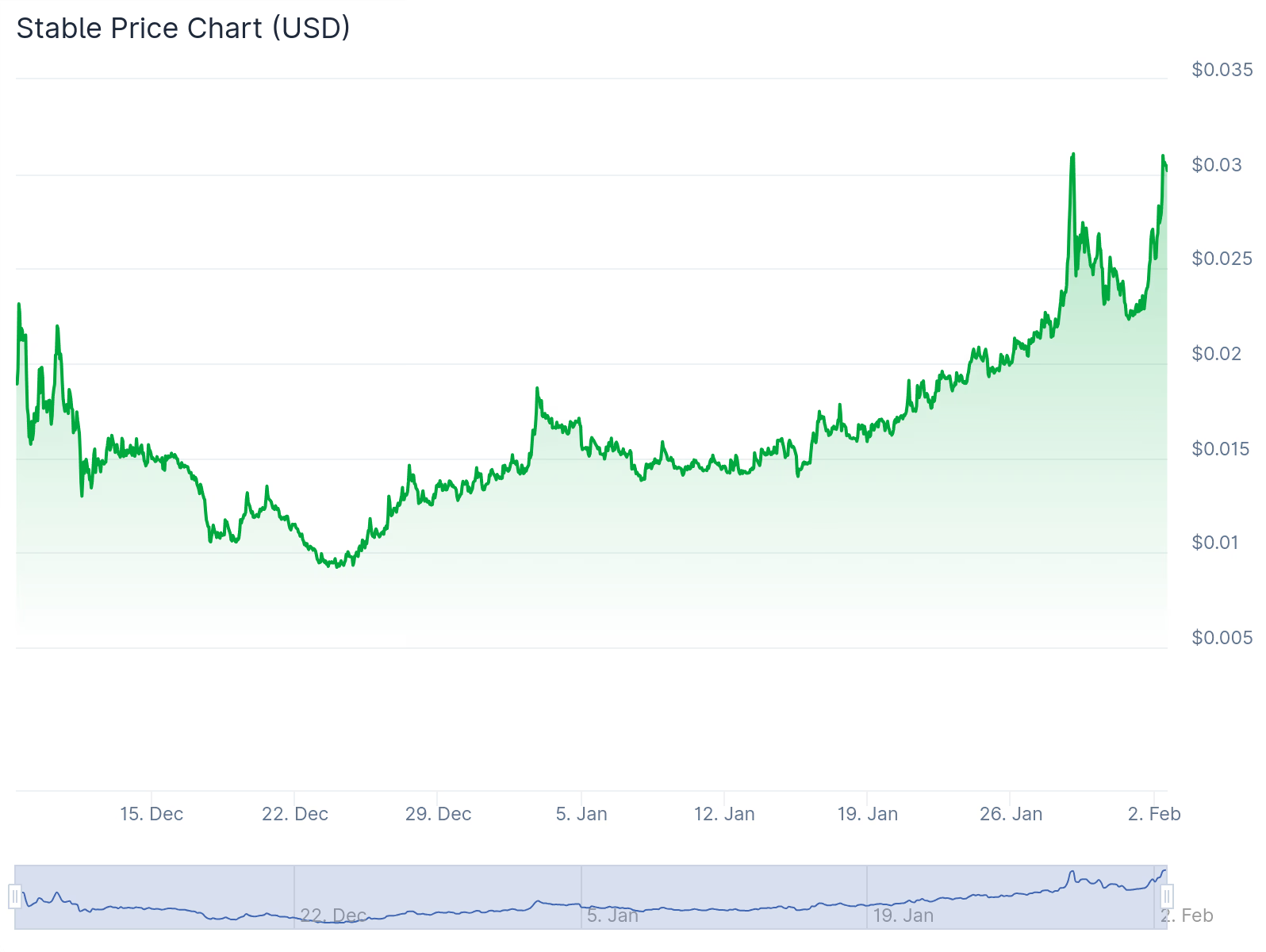
What’s even more interesting is that this price movement is not a typical "event-driven speculation," but rather a reflection of fundamentals gradually materializing.
(1) Product Positioning: From "Transaction Chain" to "Settlement Chain"
The core positioning of Stable is not to attract DeFi speculative traffic, but to focus on real payments, forex settlement, salary disbursement, and corporate fund management. This stands in stark contrast to general smart contract platforms like Ethereum and Solana.
The key differences are:
- Stable natively uses USDT as the Gas asset (v1.2.0 completely eliminates gUSDT and fully switches to USDT0)
- This means: user payments, corporate settlements, and the network economic model are all centered around stablecoins
- This fundamentally reduces the structural friction of "paying transaction fees with volatile assets"
From a payment perspective, this is a more meaningful design choice than simply improving TPS.
(2) v1.2.0 Upgrade: A Key Step Towards a "Production-Level Network"
The focus of this upgrade is not on showcasing skills but on making the network more usable, more reliable, and easier to integrate:
- Consensus and Execution:
- Financial Institution Friendly Design:
- Five Key Technical Improvements (more focused on engineering implementation):
1) Native Stablecoin Gas: USDT0 becomes the only Gas asset, reducing wallet and corporate integration costs.
2) Visibility of Staking/Unstaking Enhanced: New on-chain signals avoid "guessing the state" at the application layer.
3) STABLE Token Compatibility Fix: Enhancing the reliability of migrating old Solidity contracts.
4) Gas Exemption Mechanism: Supporting controllable zero Gas transactions, beneficial for payment scenarios while setting limits and rate protection.
5) Infrastructure Stability Upgrade: Enhancing production environment resilience.
Overall, this upgrade is essentially a transition from "usable testnet" to "scalable commercial network."
(3) Capital and Ecosystem: This is Stable's Real Advantage
Many public chains rely on incentive subsidies to attract traffic, but Stable takes a different path: first, there are payment scenarios, then on-chain activities.
(1) Crypto Native Capital Support
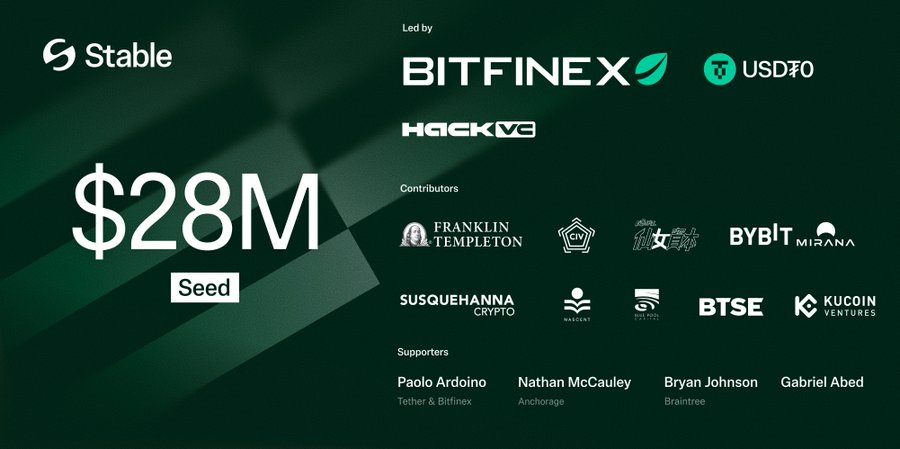
Stable is deeply bound to Bitfinex, which provides liquidity, market resources, and ecosystem synergies; it also receives support from institutions like Morpho, Paxos, Anchorage, covering DeFi, compliant stablecoin issuance, and custody.
(2) Traditional Financial Access
Currently, Stable has successfully connected with several well-known traditional financial institutions, including the global top asset management firm Franklin Templeton, payment giant PayPal and its venture capital arm PayPal Ventures, as well as quant trading giant Susquehanna International Group. The backing of these heavyweight partners brings funding and resources to Stable and validates its reliability and long-term potential as a stablecoin payment infrastructure.
On this basis, the most significant signal is that PayPal USD (PYUSD) has officially gone live on StableChain. This integration allows PYUSD to be used permissionlessly, further expanding its distribution channels, practicality, and liquidity, bridging blockchain with traditional payment giants.
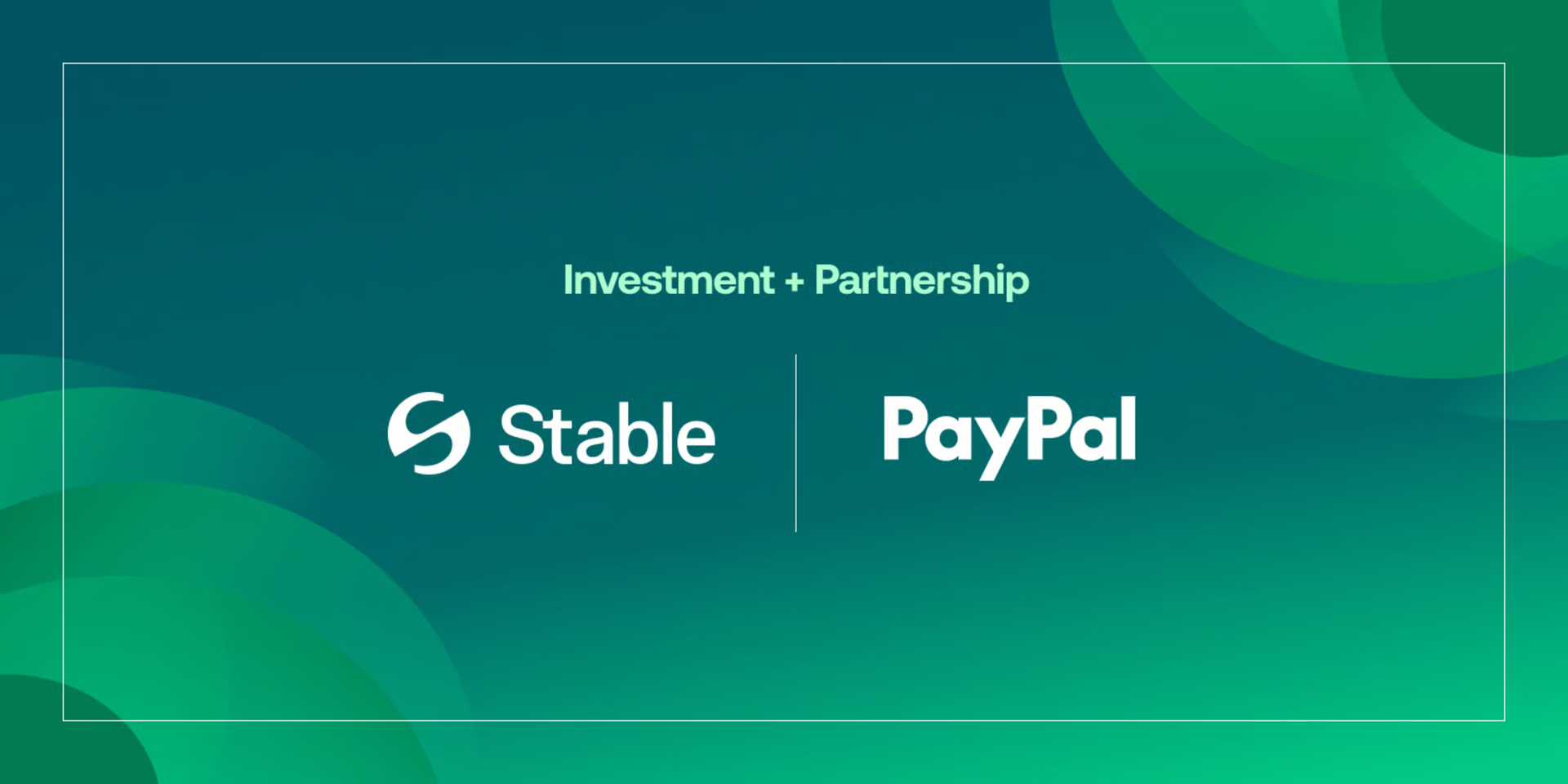
This is not just a technical integration, but also a "validation." If PayPal is willing to run PYUSD on Stable, it indicates that its infrastructure has reached standards acceptable to institutions.
Additionally:
- PXP Financial (processing 30 billion euros in payments annually)
- Chipper Cash (leading in cross-border payments in Africa)
have also joined the ecosystem, meaning Stable is not only serving Web3 but is attempting to build cross-border payment tracks.
(3) Driven by Real Demand, Not by Token Incentives
Some more key data points:
- 50+ PSPs are in the integration pipeline, with launches coming one after another;
- Covers scenarios like corporate fund distribution, salary, merchant payments;
- Partner network reach:
- Prior to its public release, it had completed $2B+ in pre-deposits, indicating genuine interest from businesses.
Furthermore, Stable is also advancing regulatory communication, collaborating with teams participating in regulated pilot projects like Basal Pay and Holdstation to mitigate policy risks.
Stable Project Research Summary
In simple terms, projects like Stable earn "toll fees." Regardless of how bearish the market is, these essentials like cross-border trade, salary payments, and merchant collections cannot stop. As long as there are transactions, its network value will increase.
Short-term outlook: The landing of v1.2.0 and new cooperation announcements are tangible catalysts.
Long-term outlook: If it can truly tackle the payroll business for that one million companies, its current market value is definitely just a starting point.
Operational advice: Stable is not the type of "dark horse for sudden wealth" based on probabilities, but a stable infrastructure contender with long-term certainty. In a market that now emphasizes fundamentals and verifiable data, rather than betting on meme speculation with no cash flow support, it's better to focus more on leading tracks like Stable that have real settlement flows and institutional recognition. From a risk-reward perspective, projects with stable long-term development are actually more cost-effective and have investment value.
免责声明:本文章仅代表作者个人观点,不代表本平台的立场和观点。本文章仅供信息分享,不构成对任何人的任何投资建议。用户与作者之间的任何争议,与本平台无关。如网页中刊载的文章或图片涉及侵权,请提供相关的权利证明和身份证明发送邮件到support@aicoin.com,本平台相关工作人员将会进行核查。


