Organized & Compiled by: A Fish CoolFish
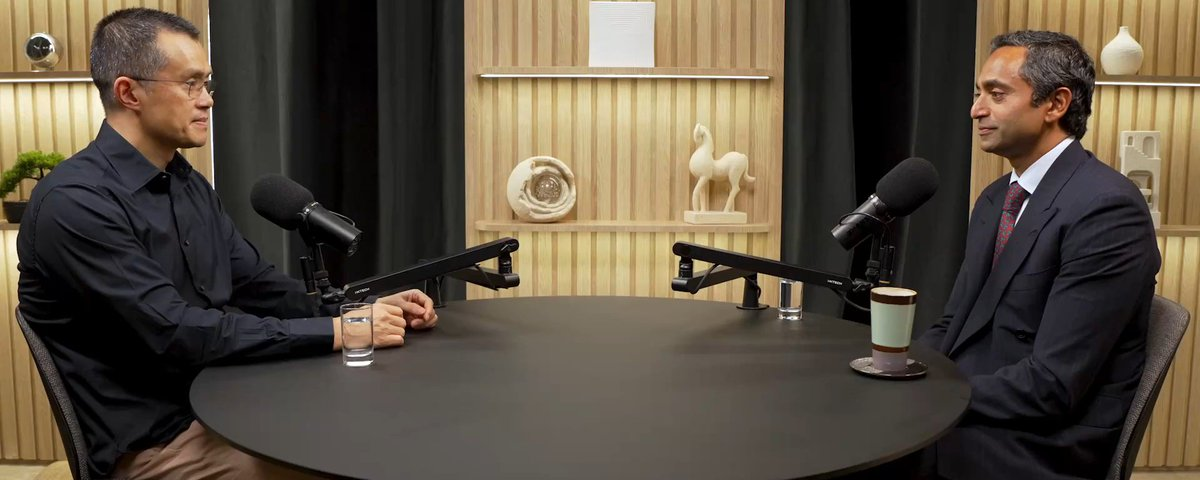
Guest: CZ (Zhao Changpeng @cz_binance)
Host: Chamath Palihapitiya (@chamath)
Podcast: All In Podcast (@theallinpod)
Original Title: CZ's Untold Story: The Rise, Fall, and Redemption of Binance's Founder
Broadcast Date: February 10, 2026
Key Points Summary
In this episode of the All In Podcast, Binance founder CZ delves into his personal growth journey, from part-time work at McDonald's to founding the world's largest cryptocurrency exchange, as well as the valuable lessons he learned while facing challenges. He also shares his outlook on the future of cryptocurrency and profound insights on success, wealth, and the meaning of life.
Highlights of Opinions
- Early Experiences and Education: CZ spent his teenage years in Canada, worked part-time at McDonald's, later studied computer science at McGill University, and developed financial trading systems in Tokyo and New York.
- All-in on Cryptocurrency: After getting involved with Bitcoin in 2013, CZ believed in its potential, sold his apartment in Shanghai, and fully immersed himself in the crypto industry, even holding firm during bear markets.
- Entrepreneurship and Challenges: Founding Binance was full of challenges, emphasizing the importance of resilience, adaptability, the ability to cope with uncertainty, and sticking to one's principles.
- Definition of Success: Success is not just about money; it also includes health, family, time freedom, values, contributions, and a positive impact on the world. Money is just one dimension of happiness, and beyond a certain point, more money does not lead to more happiness.
- Life Advice: You can't be too stupid, but you don't need to be exceptionally smart either. Many other factors like principles, values, and emotional intelligence are equally important. You can only change yourself. Just make slight daily breakthroughs, keeping yourself in the 120%, 110%, 130% range. If you can persist for thirty years with some luck, you are likely to achieve considerable success.
......
1. From China to Canada
Chamath: CZ, welcome to the All In podcast. I want to turn the clock back to the beginning because I feel many people don't know your background as well as they should. One thing I’m particularly interested in is that your early experiences growing up in Canada are very similar to mine. You worked at McDonald's, and I worked at Burger King. But before that, your parents immigrated from China around 1989. How did that happen?
CZ: My father actually went to Canada to study as early as 1984. He could come back to see us about twice a year, but most of the time he was in Canada.
He was a professor at that time, first went to the University of Toronto as an exchange student, and a few years later moved to the University of British Columbia (UBC) in Vancouver. We were applying for immigration at that time. In those years, getting a passport was quite difficult and usually took three to four years. We started applying around 1985, and it took about two to three years to get the passport.
Chamath: You mean the Chinese passport?
CZ: Yes, the Chinese passport. After getting the passport, it took a few more years to get the visa. The process was just that long back then. After 1989, getting a visa became easier. But the hardest part was always the passport; after that, the government found it hard to issue new passports. But we were very fortunate because we had already gotten our passport. So thereafter, with the relaxation of visa policies, we ended up getting the visa smoothly. I remember very clearly that my mother took me to queue at the American consulate—at that time the American consulate was handling Canadian affairs or they were sharing an office.
That was August 6, 1989, and we queued outside the American consulate for three full days. To queue, we even camped there, rotating every three hours. My mother, my sister, and I took turns queuing. It was one of those queues that stretched out of sight.
Chamath: You were only 12 at the time. Did those events, those discussions, shape your worldview in some way?
CZ: To be honest, at the conscious level, maybe not at that moment. But I was living in a university campus (University of Science and Technology of China), one of the top four universities in China. I was surrounded by college students who were seven, eight, or nine years older than me, and I often heard them discuss various topics. Although I was only 12 and didn’t participate deeply, those voices must have left some impressions in my subconscious.
Chamath: How did it feel moving to Vancouver? Could you speak English at that time?
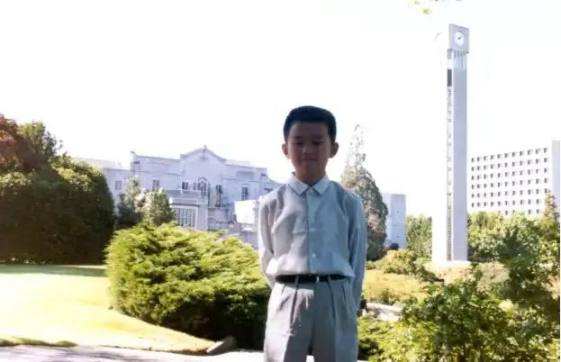
CZ: Vancouver was great; it was a completely different world for me. A brand-new country, green grass everywhere, very open spaces, a high standard of living, even the fruits looked fuller. I had studied English for two years in high school, but at that time I was not fluent at all; I basically couldn't speak.
Chamath: What was your parents’ work situation like at that time? Did they struggle?
CZ: My father was in his PhD program, and he had about 1,000 CAD in stipends each month. We lived in a subsidized housing for student families provided by UBC. It was a very small apartment with only two bedrooms. My mother was originally a mathematics and history teacher in China, but due to the language barrier, on the third day after arriving in Canada, she went to work in a garment factory as a seamstress. She worked there for a long time, about seven to ten years, and always earned minimum wage.
Chamath: This sounds exactly like my family situation back then. Did you also get your first job when you were 14?
CZ: Yes, I started working at McDonald's when I was 14 or 15 years old. I remember very clearly that the minimum wage in Vancouver at that time was 6 dollars, but McDonald's had a special exemption for hiring teenagers, so they only paid 4.5 dollars. I applied for the job on my 14th birthday, and a week later I was flipping burgers in the back kitchen. That was the first time I made money in my life.
2. CZ's Early Career: Surprisingly Ordinary
Chamath: You weren't the kind of overly mature tech genius who spent all day coding and delving into computer science, were you? Or were you?
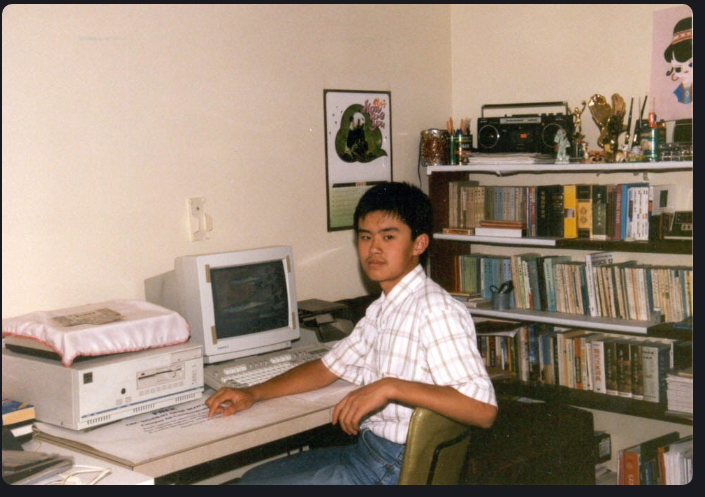
CZ: No, I wouldn't describe myself that way. I consider myself a tech guy, I studied computer science. I was interested in programming in high school, but I wasn’t a programming prodigy or a true genius programmer. I think I was a decent programmer; I wrote some good code in my career. Around the age of 28 to 30, I moved away from pure coding and started doing more business development, sales, and so on. That accounted for about eight years of my career.
Chamath: So you were just an ordinary immigrant kid trying to adapt to Canada. Did you have many friends?
CZ: Yes, I had many friends.
Chamath: Were they mostly Asian friends?
CZ: All kinds, both Asian and non-Asian friends. Actually, at our school, most Asians only hung out with other Asians, but I was a bit of an exception, I had white friends, and a variety of friends. My teenage years in Canada were great; they were the best years of my life, and I feel those years truly shaped me and made me a happy person. I am generally a very happy person.
Chamath: How did you feel when you didn't get into the University of Waterloo and had to "settle" for McGill? Did it make you feel dumb?
CZ: In fact, my sister went to Waterloo. I was torn between Waterloo, McGill, and U of T, but I knew I didn't want to stay in Vancouver at UBC; I wanted to go to a different city. Actually, UBC offered me admission, but I just knew I didn't want to go there. A mother of a friend I respected at that time suggested I might want to become a doctor because doctors have a good life and high social status. I listened to her advice and studied biology, but Waterloo wasn’t exactly known for biology.
So I went to McGill. However, after one semester, I decided, no, biology wasn't for me. I wanted to switch to computer science.
Chamath: Was your college life typical? Did you look for great summer jobs, or were you just an ordinary college student? By the way, how did you finance your tuition?
CZ: I worked every summer. I worked in the summer and also had part-time jobs during the semester. I had no debts; I was adamant about not graduating with debt. The first year I borrowed about 6,000 CAD from my dad, and the second year I borrowed a bit from my sister, about 3,000. After that, I never took any more money from my family and became completely self-sufficient, without student loans by the time I graduated. I was very fortunate, but I did work every summer.
Chamath: You graduated from McGill's computer science program?
CZ: Actually, I didn't graduate from McGill. I studied there for four years. In my third year, I got an internship, and in my fourth year, another one, and the internships kept getting extended. I didn't return to McGill. Later I found out that applying for a work visa for Japan required a bachelor's degree; it was 2000, the peak of the Internet bubble. So I participated in an online education program called “American Computer Science Academy” and got my degree there. So technically, I’m a graduate of that school.
Chamath: Which internship led you to work there long-term?
CZ: My internship was in Tokyo. I had been doing programming work since my freshman year; I wrote simulation software at a company called OriginalSim. In my junior year, I joined a company called Fusion Systems Japan in Tokyo. They were developing order execution systems for brokers on the Tokyo Stock Exchange.
Chamath: Was that a Japanese company with offices in Canada?
CZ: No, I went to Tokyo. It was actually a bunch of Americans who opened the company in Tokyo.
Chamath: Were you thinking, this is an adventure, I'm going to live in Tokyo for a summer?
CZ: Yes, I was still a college student, living in Tokyo felt like a dream, it was super fun, and Tokyo felt like it was from the future.
Chamath: What kind of software were you writing?
CZ: Mainly order execution software. That is software that processes orders and drives trades. Basically, it's similar to the software that drives Binance today. In fact, all the software development I participated in did not involve decision-making.
Chamath: So when you first encountered it, was it that "wow, this is so cool, this is so interesting"? Or was it more like "okay, the company asked me to write this code, I understand the principles, so let’s do it"? Were you attracted to the field, or was it purely out of work necessity?
CZ: Initially, it was purely out of work necessity. I was too young back then, I didn't understand the nuances across different industries. When I joined, the project assigned to me was to develop a digital imaging storage system—not like the iPhone photo library, but a Nikon medical imaging system. But soon I found out that the core product of the company was actually the order execution system.
I participated in that project, and it later became a mainstay of my career. I enjoyed the field because it required a deep technical background. Everything revolved around efficiency—pursuing extreme speed and achieving minimal latency. This drive for efficiency became deeply embedded in my subconscious.
Chamath: In high-frequency trading, how is this pursuit of low latency reflected in the code?
CZ: There are several layers. The first layer is to make the software itself efficient and fast, removing all database queries and finishing everything in memory. You also want to reduce any form of extra computation and simplify risk checks. More advanced implementations would use network chip cards like FPGAs so that you don't have to go through the processors, which can reduce round-trip latency from 100 microseconds to 20 microseconds.
Chamath: Did the company where you worked in Japan succeed?
CZ: Yes, it was successful. The company was acquired by a Nasdaq-listed company just before 2000. The amount was around 52 million dollars, which was quite significant.
Chamath: So at that time, did you realize—wait a minute, there's an opportunity here? Or was something else happening?
CZ: No, at that time I was still too young, just in my early twenties, what you would call a "salaryman" in Japan. After that company was acquired, there was a significant cultural clash between the parent company and the original company. That was my first experience understanding that acquisitions do not always guarantee success. There was constant conflict between the two managements. Later, those partners started their own company called Building 2. However, I didn't receive any payout, but the other partners made a lot of money. They rented a fancy office, and the company lasted just one year before collapsing. This showed that past success does not guarantee future success. In fact, they spent a lot of money on a luxury office but had no revenue source. The company ultimately went bankrupt in 2001.
3. The First Company in Shanghai
CZ: In early 2001, I was looking for a new job. Bloomberg was hiring at that time, even before the 9/11 events. I actually received a job offer before 9/11 while I was still in Tokyo, and Bloomberg was in New York. After 9/11, I called to ask: is the position still available? Do you still want me to come? They said: do you want to come? I said: yes. So in November 2001, I went to New York. I worked there for four years, doing the same thing.
I joined as a senior developer and was assigned to a team called Tradebook Futures. This team had just been formed; they had developed a system that allowed users to trade futures on the Bloomberg terminal. But before, these functions were scattered across different systems and were later consolidated under this team's responsibility.
Chamath: What were you pursuing at that time? Stability? Why choose Bloomberg? Is it because of New York or something?
CZ: I was just a young man, probably around 24 or 25 years old. I wanted to experience different fields and explore the direction of my life. I knew I lacked experience and couldn't start my own business. At that time, I was working at a small company in Tokyo, which had about 200 people. Bloomberg had around 3,000 employees at that time. To me, that was a big company. The company had fancy offices, fish tanks, complimentary meals, and various benefits. I joined as a senior developer and met some great bosses, getting promoted three times in two years. Initially leading a team of 60, later the team grew to about 80, and I started to take on a management role. I stopped coding and began to focus on management.
Chamath: And then you quit and went to China? How did that happen?
CZ: In early 2005, a friend I met in Japan wanted to start a new fintech company; they were then in Asia, discussing whether to go to Tokyo, Shanghai, or Hong Kong. They said Shanghai was likely to be the most active place for fintech in the future. We were supposed to choose Hong Kong, and indeed it turned out to be busier. We were a total of six people going to Shanghai: four white guys, one Japanese, and me. I was the only one who could speak Chinese.
Chamath: What was your idea?
CZ: Our idea was to bring Wall Street trading technology to China, serving Chinese brokers and exchanges.
Chamath: So when you founded the company—this counts as your first entrepreneurship. Did you have an attitude of "great, let's just do it"?
CZ: Basically, yes.
Chamath: Did you consider equity distribution at that time? Like a cap table or something? Or was it purely "awesome, let’s take action"? What was the reality?
CZ: Actually not one-sixth. At that time, the core members held about 39% or 40% of the shares, and the remaining five split it evenly. So at that time, I only had an 11% stake, and I didn't really understand the difference between common shares and preferred shares. But I just went along with it; I was the junior partner of the team. After arriving in China, I began to engage potential clients—since I could speak Chinese, I started talking to brokers. Later I found out we registered as a Wholly Foreign-Owned Enterprise (WFOE), but at that time, Chinese financial institutions were not allowed to work with WFOEs.
We only realized this after starting the company in Shanghai, so we transformed into a company providing any IT systems to any company, doing everything. We initially had quite a few clients in the automotive industry: Shanghai General Motors, SAIC Volkswagen, and SAIC Group were all our clients. About three to four years later, we set up an office in Hong Kong and began serving Morgan Stanley, Deutsche Bank, Credit Suisse, and other financial institutions. The company scaled up like that, reaching 200 people when I left, and it was still quite robust. I worked there for eight years until I left in 2013.
Chamath: As a junior partner, did you directly receive profits?
CZ: Yes. However, the actual payout wasn't much; I reinvested most of my savings back into the company and didn’t cash out a single penny. But a few years later, when the company stabilized, the partners’ salaries were enough to send kids to international schools, and we all received six-figure annual salaries.
4. Discovering Bitcoin
Chamath: So far, these experiences don’t show that you would go on to create Binance.
CZ: Not at all; I wasn’t even aware of it myself at the time.
Chamath: So in 2013 or 2014, how old were you?
CZ: I was 36 in 2013.
Chamath: So you were still a salaried worker, a junior partner in that project, everything was going smoothly, and the kids were in private school. What happened next?
CZ: Later, I got into Bitcoin. A friend of mine told me, "CZ, you need to check out this thing called Bitcoin." I started researching it, and it took me about six months to fully understand it. That was around July 2013.
Chamath: Was it because you read the white paper and thought, "I need to read it again," or was it something else?
CZ: Something like that. And there was also the Bitcoin forum (Bitcoin Talk). Basically through those.
Chamath: The friend who introduced you to Bitcoin, was he a colleague or a friend you met randomly in Shanghai?
CZ: He was a friend. We had no business dealings. His name is Ron Cao. I guess he is now running Sky9 Capital; at that time, he was the managing director for China at Lightspeed Ventures.

Ron Cao
We had a private poker game; it wasn't a large one, just a group of struggling entrepreneurs against venture capitalists. The VCs had money and time. It was a fun game. At one of the games, Ron Cao said, "CZ, you should check out this thing called Bitcoin." I said, "Okay, Bitcoin," and we chatted a bit.
At that time, Bobby Lee was also present; he was working at Walmart and was just about to resign to join BTC China as CEO. As part of that deal, Bobby invited Ron Cao as a representative of Lightspeed Ventures for investment. That was in July 2013. I thought, these two people seemed very serious about Bitcoin.
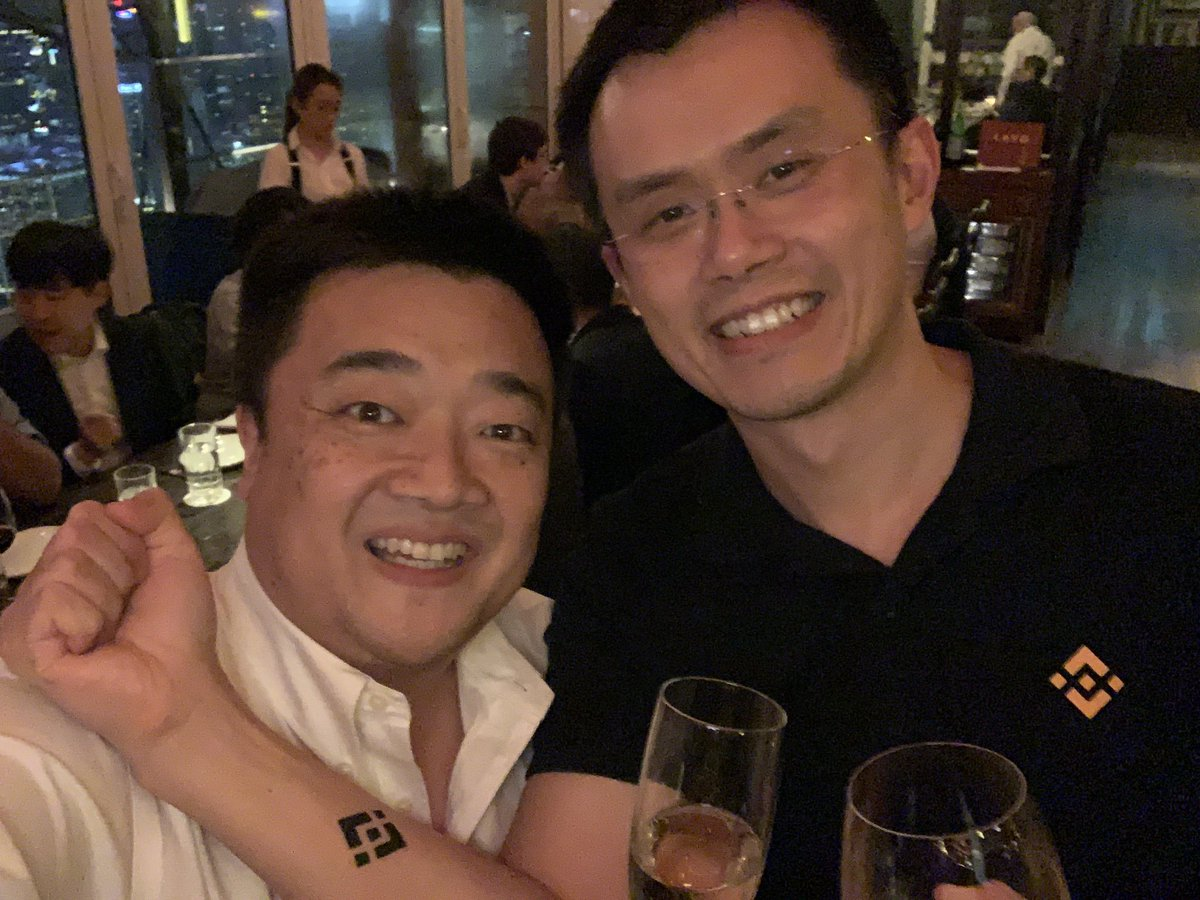
Bobby Lee on the left
CZ: The next day I had lunch with Bobby Lee, and he said, "Put 10% of your net worth into Bitcoin. Although there’s a small chance it could go to zero, you’re only losing 10%; but the greater likely outcome is that it will go up 10 times, doubling your net worth." I thought to myself, "That sounds pretty reasonable." So I started studying the white paper seriously, taking a whole six months to do it. By the end of 2013, I was finally determined to enter the market. But at that time, Bitcoin's price had skyrocketed from 70 dollars in mid-2013 to 1,000 dollars by the end of 2013. It had risen over 15 times.
Chamath: How did you feel at that time?
CZ: I felt like I was too late. I thought, "I wish I had got in earlier." But the reality is, no matter when you get into Bitcoin, you always feel like you're late. Because every industry insider you talk to bought in earlier than you.
Chamath: During your study of it, did you communicate with communities in Shanghai?
CZ: At that time, there was a very small circle in Shanghai. Basically, I was willing to talk to anyone interested in Bitcoin worldwide. I had a few friends in Taiwan working at TSMC who later resigned to try mining Bitcoin chips. Although that startup didn’t succeed, they were one of the groups I interacted with.
There was another group that was mostly miners. There was someone called “Shen Yu” (神鱼), who is famous in China for being a big miner. He is still operating F2Pool (鱼池) today. They were in Hangzhou but often came to Shanghai to talk with me.
Shen Yu
CZ: The most important thing was the Bitcoin conference held around December 2013 in Las Vegas. I flew there and met everyone. All the industry elites were present, about 200 people. Vitalik (co-founder of Ethereum) was there, along with Matt Roszak, Charlie Lee (founder of Litecoin) and others. It’s the same group of people even today.
It was during the time when "Silk Road" founder Ross Ulbricht was arrested. The media was heavily reporting that Bitcoin was merely a tool used by drug traffickers. But when you went to that conference, you saw a bunch of young people, geeks. They were all very nice people; for example, you could chat with Vitalik; he was very approachable.
Chamath: Were you still partially working at your original company while doing all this?
CZ: Yes, that was toward the end.
Chamath: You could tell your partners: "Hey guys, I'm going to Vegas for a few days, I’ll be back soon."
CZ: Basically. When I returned, I told my partners, "We should create a Bitcoin payment system." Because at that time, BitPay was the big player in the industry and had just raised 4 million dollars in 2013.
Chamath: So you were thinking of creating a Chinese version of BitPay. Your partners must have been thinking, "What are you talking about?" By that time, you still hadn’t bought any Bitcoin, right?
CZ: No, at that time I had about 1 Bitcoin. It was only worth about a thousand dollars.
免责声明:本文章仅代表作者个人观点,不代表本平台的立场和观点。本文章仅供信息分享,不构成对任何人的任何投资建议。用户与作者之间的任何争议,与本平台无关。如网页中刊载的文章或图片涉及侵权,请提供相关的权利证明和身份证明发送邮件到support@aicoin.com,本平台相关工作人员将会进行核查。


