Written by: imToken
Have you recently been inundated with "crawfish," or have you even participated in the experience yourself?
This open-source agent known as OpenClaw (originally Clawdbot, later renamed MoltBot) has rapidly spread across the global tech community and crypto circle, showcasing a new trend in the acceleration of AI Agents: for the first time, individuals have the opportunity to possess sustainable productivity units that do not rely on large platforms, thanks to open-source models, automation tools, and on-chain infrastructure.
However, behind this optimistic expectation, a more fundamental and tricky question is emerging: when AI Agents begin to truly collaborate and start "hiring" each other, what basis do we have to trust them?
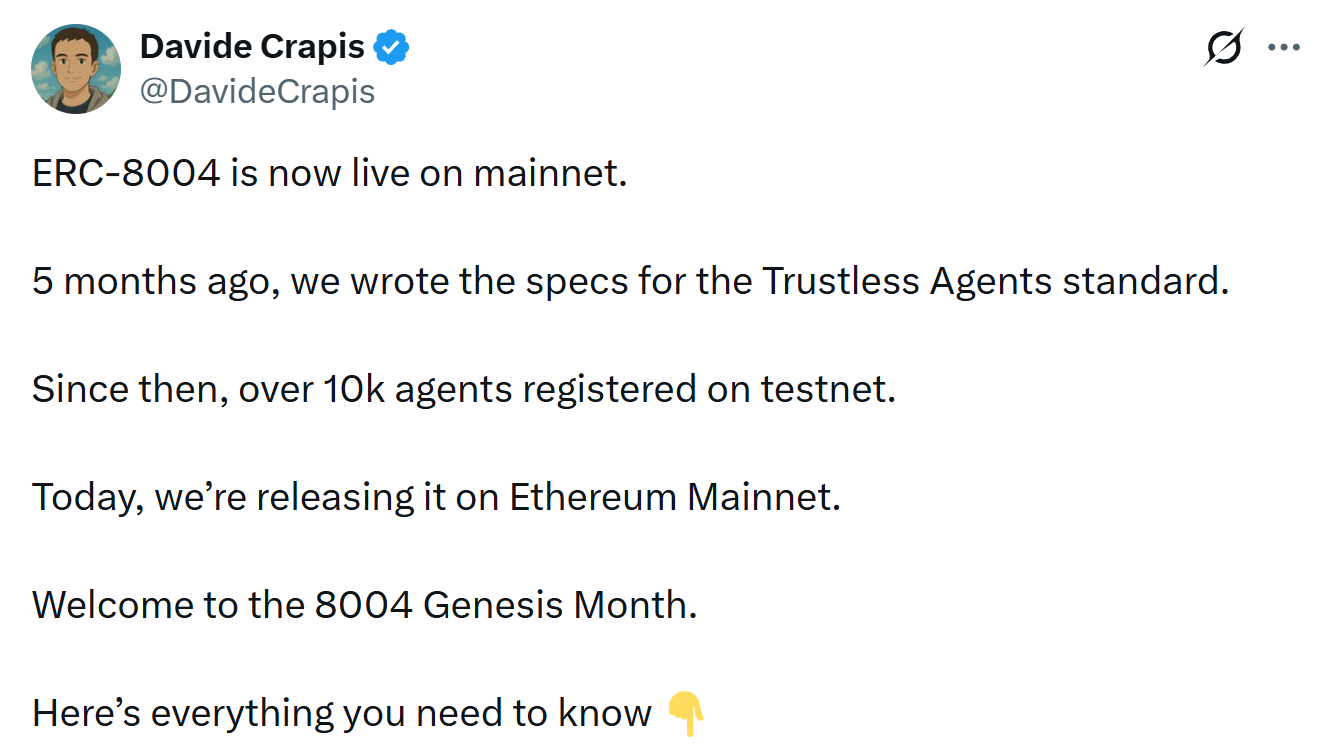
In this context, on January 30, Davide Crapis, head of AI at the Ethereum Foundation, tweeted that ERC-8004 has gone live on the Ethereum mainnet, and the team will deploy it to all mainstream L2s in the coming weeks.
This seemingly low-key technological advancement may fill a long-missing infrastructure gap for the AI Agent economy.
1. What is ERC-8004?
If you still remember the dAI team established by the Ethereum Foundation, it’s not hard to understand the inevitability of ERC-8004's emergence.
As mentioned earlier, on September 15, 2025, the Ethereum Foundation established the AI team "dAI," with the core mission of investing resources to define the standards, incentives, and governance structures for AI models on the blockchain, including model credibility, which means how to make AI behavior verifiable, traceable, and collaborative in a decentralized environment (see further reading “Ethereum's 'Second Curve': TradFi and AI Entering Together, A Trillion Settlement Layer Beyond EVM Quietly Taking Shape”).
ERC-8004 was promoted as one of the core standards in this context.
Unlike payment protocols like x402, ERC-8004 does not directly address "how money is transferred," but rather attempts to answer a more fundamental question: How can AI Agents be recognized, trusted, and participate in economic collaboration without platform endorsement?
For this reason, the promotion of ERC-8004 is particularly significant: led by the Ethereum Foundation's dAI team, in collaboration with Google, Coinbase, and MetaMask, it encompasses three key entry points: AI, trading, and wallets. This specification itself signals that it is not merely an application-layer experiment, but a clear signal of a long-term infrastructure bet.
As its official name suggests, Trustless Agents, its core logic is not a complex algorithm, but aims to give AI verifiable identities, reputations, and capability proofs on-chain. In simple terms, its design is very restrained, focusing on three main functions:
- Identity Registry: Based on the ERC-721 standard, each AI Agent will be "NFT-ized." This means that AI Agents in wallets are no longer just lines of code, but unique, transferable, and verifiable digital entities with an ID. For the first time, AI Agents are not merely instances within a system but can be referenced, cited, and integrated into other protocols like wallet addresses;
- Reputation Registry: This can be understood as the "Yelp" of the AI world, allowing users or other Agents who have interacted with the Agent to submit feedback. More importantly, these evaluations can be linked to on-chain payments or custodial actions, ensuring that reputation is not a narrative generated out of thin air, but a historical record based on real economic behavior. In an environment without centralized adjudicators, this design, where only those who have paid can evaluate, attempts to transfer the most basic credit logic from the real world into the AI collaboration network;
- Verification Registry: For high-value or high-risk tasks, historical reputation alone is insufficient. Therefore, ERC-8004 reserves interfaces for third-party verification, allowing endorsements of an Agent's capabilities or execution processes through trusted execution environments, zero-knowledge proofs, etc. Although this part has not yet been fully opened, its existence itself indicates the standard's intention for long-term complex collaboration scenarios;
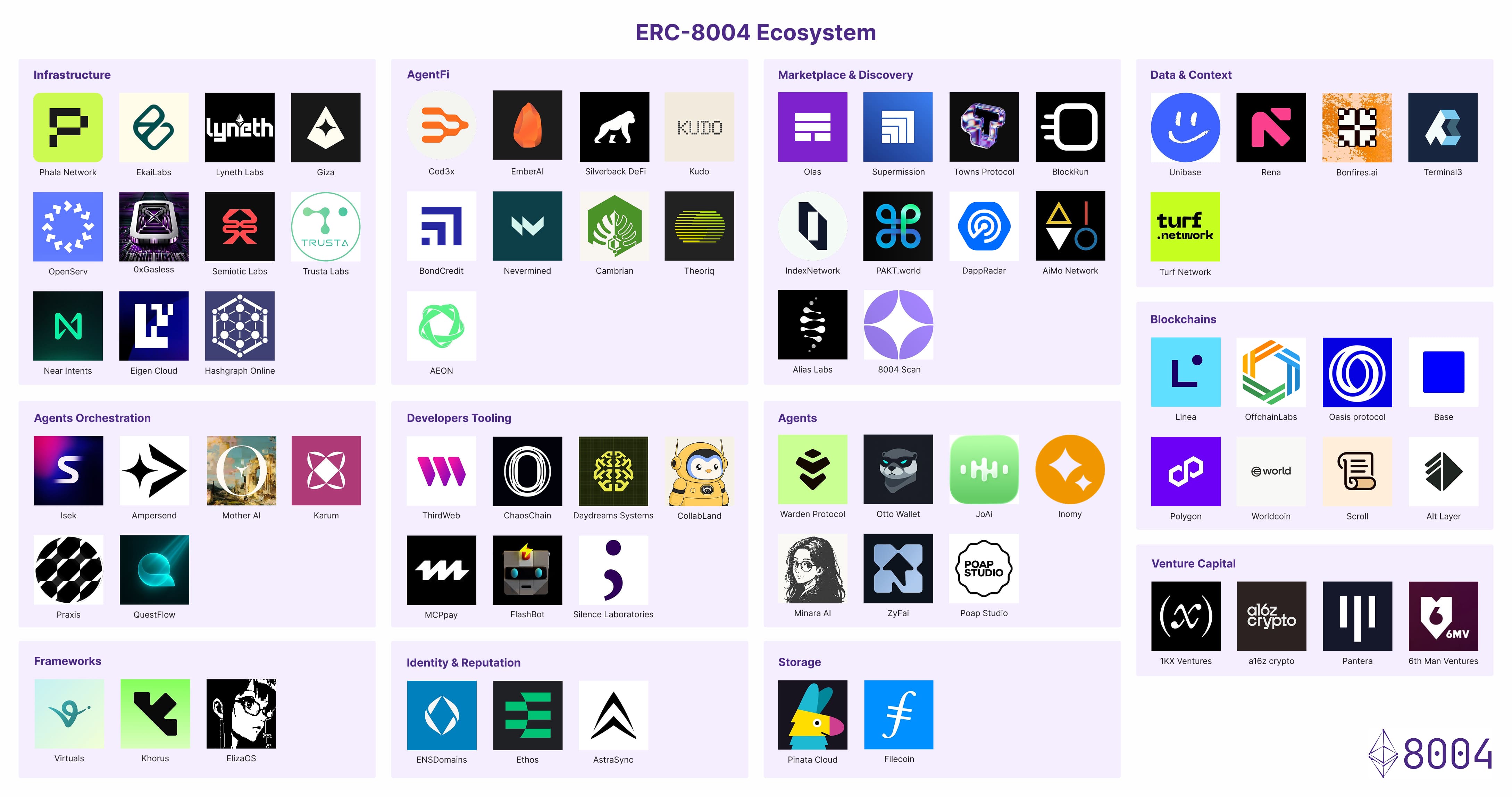
It is worth noting that although born in the Ethereum ecosystem, ERC-8004's goal has never been Ethereum-specific; rather, it is designed as a universal standard for discovering and trusting AI Agents through blockchain.
Currently, this standard has begun to be used or tested on several mainstream EVM networks, including Arbitrum, Base, Monad, etc., and there are clear plans to expand to some non-EVM ecosystems. This means that the issues ERC-8004 aims to address are not just localized needs of a specific chain, but the universal trust issues that AI Agents face in cross-platform and cross-organization collaboration.
2. What Problems Can ERC-8004 Solve?
Looking back at the evolution of AI over the past two years, a very clear dividing line can be observed.
In the stage where AI primarily exists as a "tool," all problems can be reduced to model capabilities, computational costs, and product experiences. However, when by 2025 AI Agents can independently take on tasks, call resources, execute operations, and be accountable for results, people suddenly realize that in this seemingly logical evolution, a long-ignored issue has been magnified infinitely.
On what basis can AI Agents trust each other?
It is important to note that a single Agent cannot complete all tasks; it must, like human society, improve efficiency through division of labor, outsourcing, and reusing others' capabilities. This means that within this structure, AI must actively call upon other AIs, forming a highly automated collaborative network.
Of course, in today's Web2 or platform-based AI applications, this problem does not exist. After all, trusting an AI essentially means trusting the platform, company, and brand behind it; if something goes wrong, responsibility can be traced back to a centralized entity. But in an open, permissionless, decentralized world of Agents, this logic no longer holds: an AI Agent may come from individuals, DAOs, research institutions, or even completely anonymous deployers; it may perform well today but suddenly act maliciously tomorrow; it may claim to possess certain capabilities, but you cannot verify its true source.
This means that when AI Agents begin to truly participate in economic activities, especially those involving assets, transactions, settlements, and authorizations, "trust" will become a scarcer resource than "capability." Without a set of queryable, verifiable, and accountable infrastructure, large-scale collaboration between AI Agents cannot be established.
It is in this context that ERC-8004 was proposed. It is not designed to solve the question of what AI can do, but rather to address a more fundamental proposition: in a world without centralized guarantors, how can AI be treated as a "trustworthy entity"? Therefore, from a design perspective, ERC-8004 is not a complex technological breakthrough; it even deliberately maintains extreme simplicity:
As mentioned above, within the framework of ERC-8004, each AI Agent is no longer just a vague program instance but has a recognizable, citable on-chain identity. This identity is not for trading or speculation but serves as a long-term anchor for binding capability claims, historical behavior, and future responsibilities.
More importantly, this identity does not depend on any platform or application but exists on an open public ledger, meaning that anyone, any protocol, or any Agent can query and verify it under the same standard.
On top of identity, ERC-8004 introduces an on-chain reputation system, which is particularly crucial because it attempts to solve a long-standing problem in decentralized systems: how to build credible historical records without a platform adjudicator. By binding evaluations to real tasks, real payments, or custodial actions, ERC-8004 hopes to bring the common sense of "only those who have used it are qualified to evaluate" from the real world into the economic system of AI Agents. Reputation is no longer a marketing narrative but a long-term accumulation of behavior.
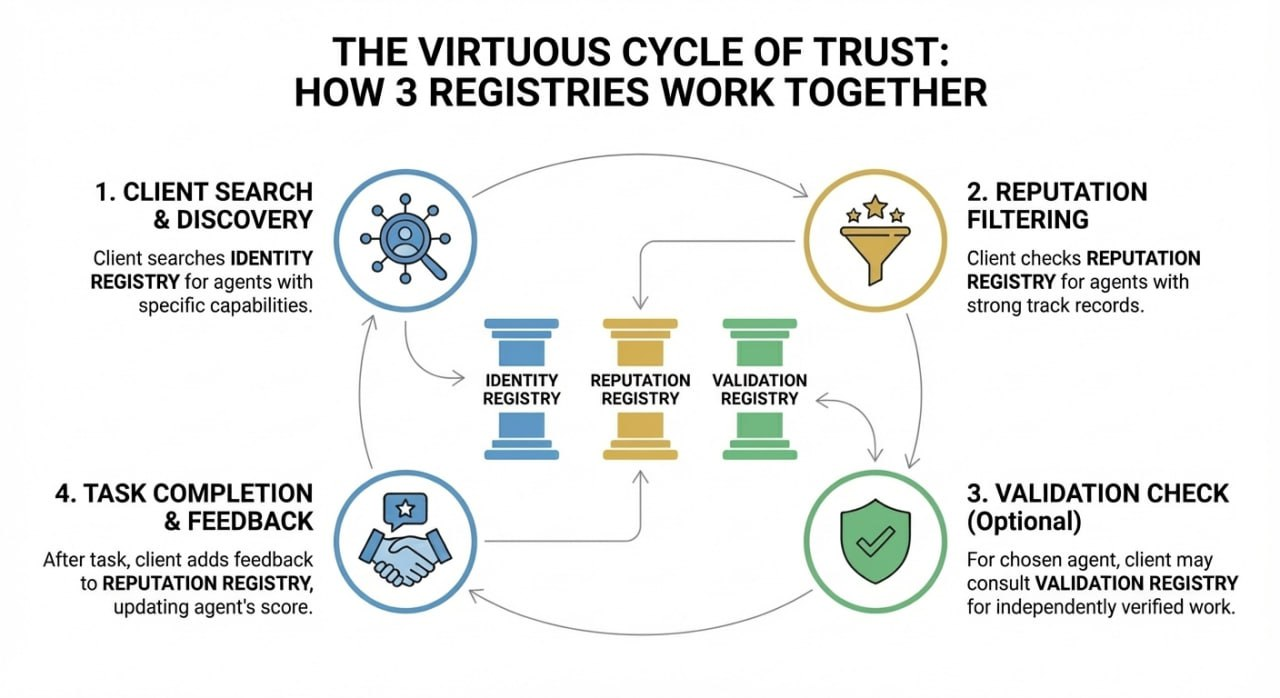
When identity and reputation are still insufficient to cover high-value scenarios, ERC-8004 further reserves interfaces for verification. This is not to prescribe a specific technological path but to allow different forms of third-party verification mechanisms to intervene, such as trusted execution environments, staking guarantees, or even zero-knowledge proofs.
In summary, ERC-8004 is not a standard with a single functional point but is building a minimal viable "social structure" for AI Agents, guiding them to begin collaborating, competing, and taking responsibility like social members, establishing the most basic order.
3. Why Ethereum?
This raises a new unavoidable question: in a future where AI Agents are highly automated and frequently invoked, why would this standard choose Ethereum over faster, cheaper blockchains specifically designed for AI or high-frequency interactions?
The answer may not lie in the technical parameters themselves but in a latent asset that Ethereum has accumulated over the long term: its trusted neutrality as a global settlement layer.
It is important to emphasize that in the collaborative network of AI Agents, what is truly expensive is not the communication cost but the cost of errors. Ultimately, once AI Agents are allowed to directly operate assets, execute transactions, or act on behalf of others, any failure or malicious act could lead to irreversible losses.
In such an environment, participants are undoubtedly more concerned about whether the rules are stable, whether records are immutable, and whether responsibilities can be traced back, rather than how many requests can be processed per second. Ethereum precisely has long-term advantages in these dimensions.
After all, Ethereum does not belong to any company or alliance; its security model, audit culture, and ecological maturity have been repeatedly validated in DeFi, NFTs, and institutional-level applications. Therefore, the proposal of ERC-8004 attempts to extend these existing advantages to this new type of entity: AI Agents.
Furthermore, what Ethereum is vying for here is a more subtle new label: the underlying settlement layer for AI collaboration—in this vision, AI Agents from different platforms, chains, and organizations can operate in their respective environments, but when they need to establish trust, custody value, and settle results, they will ultimately return to a mutually recognized neutral layer.
It can be said that this new role aligns closely with Ethereum's gradually forming position in the global financial system: it does not seek to become the fastest execution layer, nor does it attempt to encompass all application scenarios, but rather occupies a more fundamental position in the long term, that is, a trusted settlement and order layer.
Of course, ERC-8004 will not immediately spawn explosive applications; it addresses a problem that has not yet fully arrived. However, from a longer time scale, when AI Agents evolve from mere "functional modules" to autonomous economic entities capable of taking orders, collaborating, and settling, when wallets no longer serve only human individuals but begin to carry the boundaries of AI permissions, responsibility attribution, and risk isolation, this foundational order regarding identity, reputation, and verification may very well become a prerequisite for whether the AI economy can truly scale.
In this sense, ERC-8004 is not an attempt at a short-term narrative but a clear bet by Ethereum on its own future: in an economic system jointly participated in by humans and AI, order and settlement still require a trusted, long-term neutral foundation.
Although at this moment, amidst the bear market and low sentiment, people may not be interested in Ethereum's technological iterations, or may find it hard to maintain enough patience.
But it is undeniable that as new production relationships are quietly taking shape, Ethereum is striving to capture this yet-to-be-fully-emerged but sufficiently transformative new direction for the future.
免责声明:本文章仅代表作者个人观点,不代表本平台的立场和观点。本文章仅供信息分享,不构成对任何人的任何投资建议。用户与作者之间的任何争议,与本平台无关。如网页中刊载的文章或图片涉及侵权,请提供相关的权利证明和身份证明发送邮件到support@aicoin.com,本平台相关工作人员将会进行核查。


