Author: momo, ChainCatcher
As infrastructure gradually becomes homogenized, a more realistic issue begins to emerge: what is truly scarce is no longer the chain, but the developers and the real ecosystem.
Amidst the changing tides of the industry, who continues to gather Builders? Who supports projects from 0 to 1 in achieving localized implementation? Who brings together technical talent, entrepreneurial teams, and capital resources? Within the encircled city, the value of a type of "developer infrastructure platform" has returned to the public eye.
I believe that in the Asia-Pacific region, TinTinLand has been one of the most notable examples of growth over the past year. This community, which initially started with developer education, has gradually upgraded from a "content and course platform" to an "ecosystem growth service provider"—not only engaging in grounded developer learning and exchange but also becoming a guiding force for many project ecosystems entering the Asian market, facilitating cold starts, developer recruitment, and resource integration.
This year, TinTinLand has been a driving engine, as well as an accelerator for the development of the Web3 industry ecosystem.
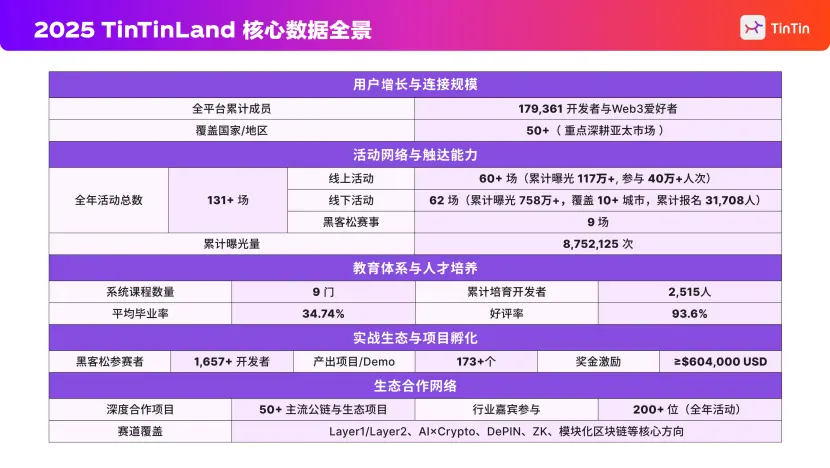
By the end of 2025, the TinTinLand community will have over 179,000 members, covering more than 50 countries and regions; it has collaborated with over 200 Web3 projects, becoming an important partner for more than 50 mainstream public chains, including Starknet, Injective, 0G, and Sentient, in entering the Asia-Pacific market. Throughout the year, it has hosted 131 online and offline events, promoting the output of over 170 Demo projects, and distributing over $600,000 in prizes and resource support.
In the context of the gradually maturing Asia-Pacific Web3 ecosystem, a regional hub centered around developers is taking shape.
Starting from Content Entry: Becoming the Information Hub for Developers
For any developer community, "continuous reach" is always the first threshold.
Whether information is stable, opportunities are concentrated, and resources are accessible often determines whether the community can retain true Builders.
In 2025, TinTinLand will build a bilingual content matrix in Chinese and English, covering WeChat public accounts, Xiaohongshu, and X accounts, with high-frequency output focused on developer education, project interpretation, industry trends, event opportunities, and recruitment information.
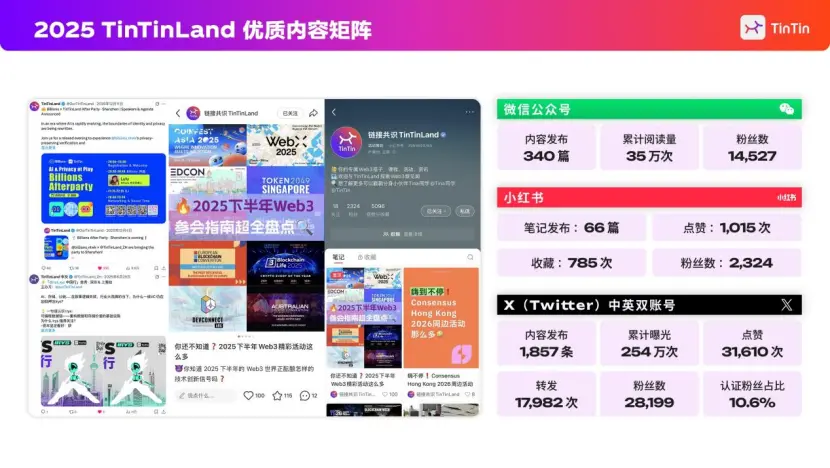
Throughout the year, nearly 2,000 pieces of content will be updated, reaching over 2.5 million reads and interactions, with several tweets exceeding 100,000 exposures. Specifically:
In the WeChat ecosystem, its public account will publish about 340 in-depth articles throughout the year, accumulating over 350,000 reads, gradually solidifying 14,000 core subscribers, becoming a long-term entry point for many Chinese-speaking developers to obtain event information, course updates, and industry interpretations.
Xiaohongshu will publish over 60 notes throughout the year, focusing on practical content such as Web3 job paths, hackathon participation experiences, and technical popularization, accumulating nearly 2,000 interactions (likes and saves), attracting over 2,000 young and student audiences, continuously bringing new developer groups to the community.
On the X platform, the bilingual accounts will maintain high-frequency synchronized updates, publishing nearly 1,800 posts throughout the year, accumulating over 2.5 million exposures, receiving over 30,000 likes and over 17,000 retweets, with the follower count growing to 28,000, of which about one-tenth are verified accounts and industry practitioners, gradually forming an open discussion space and information hub for global developers.
Unlike general information media, its content structure is more "tool-oriented": not only explaining what has happened but also directly providing "how to participate"—course registrations, hackathon entries, project collaborations, job information, etc.
This strategy of "actionable content" has gradually made it an important entry point for Chinese-speaking developers to access industry opportunities, rather than just an information channel.
In an era where fragmented information is increasingly rampant, such a stable and trustworthy resource hub has become a scarce asset.
High-Frequency Online Activities: Building Cognition and Connecting Trends
If content addresses the issue of reach, then online activities fulfill the function of cognitive construction.
Over the past year, TinTinLand has gradually built an online activity system composed of AMAs, Twitter Spaces, and Workshops, with different formats serving different roles, forming a progressive learning path from "understanding projects—grasping trends—mastering practical skills."
Among them, AMAs are more inclined towards project dialogues and ecosystem introductions. By inviting founders, ecosystem leaders, or core technical members of public chains to engage in real-time Q&A with developers, they break down project technical routes, product positioning, and incentive mechanisms, helping the community quickly understand whether a new ecosystem is "worth participating in and how to participate." These activities serve as the first entry point for project cold starts and developer recruitment.
Twitter Spaces, on the other hand, take on the role of industry trend discussions and public roundtables. The format is primarily multi-party dialogues, focusing on track changes, technological paradigm evolution, and market opportunity assessments, inviting investors, researchers, developers, and project parties to participate, emphasizing the collision of ideas and co-construction of cognition, resembling an open discussion space for the industry.
Workshops emphasize technical practice and method accumulation. The content revolves around specific toolchains, SDK usage, development processes, and case breakdowns, leaning towards "hands-on" in-depth teaching, helping developers turn knowledge into operational projects, representing the highest technical density among activities.
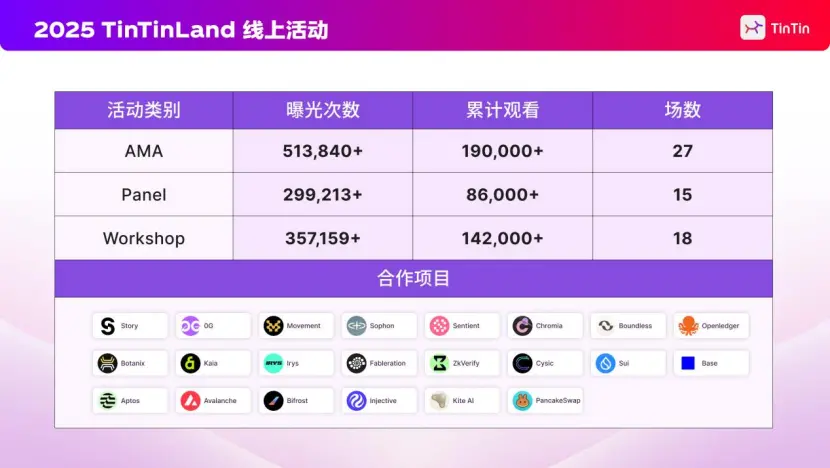
Through the collaborative operation of these three formats, TinTinLand is gradually building a lightweight yet high-frequency developer learning network online.
Over the year, more than 60 online activities will be held, with a total exposure exceeding 1.17 million people and over 400,000 online participants.
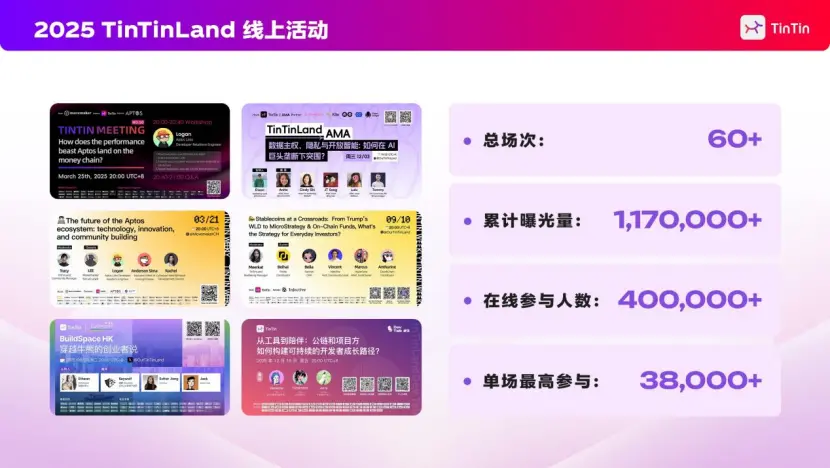
Discussion topics will cover popular tracks such as AI × Crypto, ZK, modular blockchain, DePIN, and infrastructure security, including both mature public chains and rapidly growing emerging ecosystems, with project teams and core members from Billions, 0G, Story, Aptos, Injective, Sentient, Fableration, Chromia, Botanix, PancakeSwap, Kaia, Irys, ZKVerify, Cysic, Openledger, Boundless, Sophon, and many others participating in sharing.
From an industry observation perspective, the value of such activities lies not only in traffic but also in "continuous education."
In a rapidly evolving technological industry, high-frequency dialogues can help developers quickly understand new paradigms and provide project parties with direct channels to recruit contributors.
In the long run, this lightweight yet high-frequency connection method resembles an "online public classroom," continuously enhancing the overall cognitive density of the community.
Offline Activity Network: Rooting the Ecosystem in Asia
However, the connections in Web3 ultimately need to return to offline. Face-to-face communication, impromptu team formations, and real collaboration are often the starting points for many projects. Compared to online traffic, offline scenarios are more conducive to establishing trust and catalyzing long-term cooperation.
In 2025, TinTinLand will prioritize offline operations, gradually establishing stable nodes in over 10 cities, including Beijing, Shanghai, Shenzhen, Hong Kong, Hangzhou, and Chengdu.
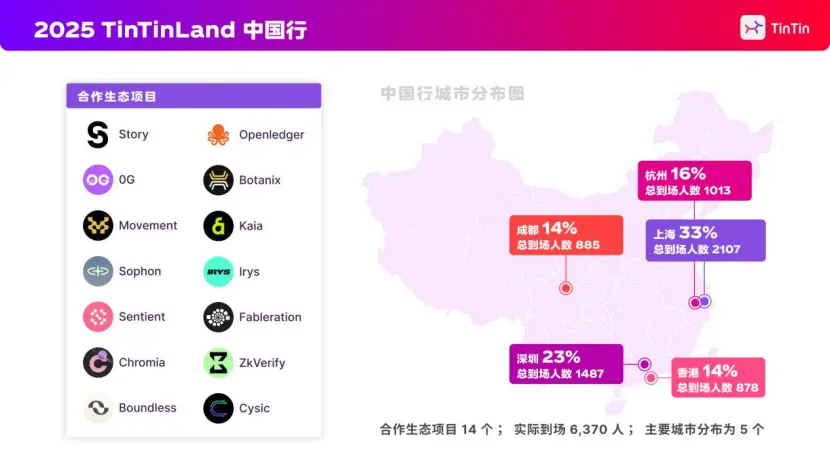
Throughout the year, 62 offline activities will be held, with over 31,000 registrations and total exposure exceeding 7.5 million, maintaining a high frequency of activity density and coverage within the Asia-Pacific developer community.
Structurally, its offline system is not a single format but is layered with various activity forms, each serving different functions.
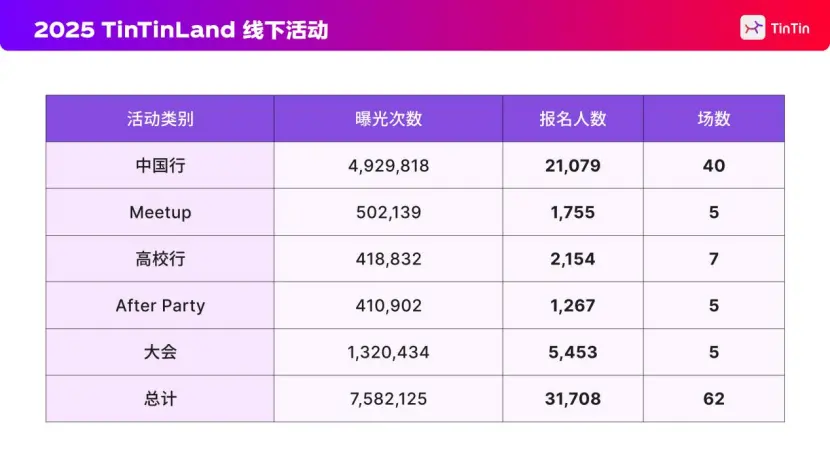
Among them, the "China Tour" series is more focused on ecosystem implementation and market cold starts.
By bringing public chains or new projects into local cities and engaging in face-to-face communication with developers, entrepreneurs, and potential partners, it helps projects establish early brand recognition and recruit core builders. For many overseas teams, this is the first stop in entering the Chinese-speaking market.
The university tour focuses on the earlier talent supply side. By visiting universities to conduct sharing sessions and workshops, it systematically introduces Web3 technology paths, job structures, and career opportunities, helping students build industry awareness and continuously supplying the ecosystem with a new generation of Builders. To some extent, these activities play a role in "talent enlightenment."
Vertical-themed Meetups emphasize technical depth and small-scale exchanges. Discussions revolve around sub-tracks such as AI × Web3, DePIN, modular blockchain, and infrastructure, with participants primarily being developers and practitioners, emphasizing practical experience sharing and problem breakdown. These activities resemble technical salons, conducive to solidifying a stable core community.
After Parties provide a more relaxed informal connection space. In an environment without agendas or labels, developers, project parties, and investors find it easier to establish genuine dialogues, with many recruitment, collaboration, and entrepreneurial ideas naturally occurring in such scenarios. Compared to formal meetings, these light social settings often have greater stickiness.
If the aforementioned activities build ongoing daily connections, then conferences serve as periodic "consensus amplifiers."
In 2025, TinTinLand will initiate and deeply participate in landmark industry conferences such as the AI Agent Summit, ETH Hangzhou, WaytoAGI Tokyo Conference, and ETHShanghai, covering key directions such as AI × Web3, Agent systems, Ethereum ecosystems, and developer innovation.
In these node-type activities, discussions are no longer limited to individual projects but focus more on long-term industry issues: How do technological paradigms evolve? How do AI and blockchain integrate? Where are the opportunities for the next stage of the ecosystem?
These topics are brought to the stage and returned to the community, continuously influencing subsequent collaborations and actions.
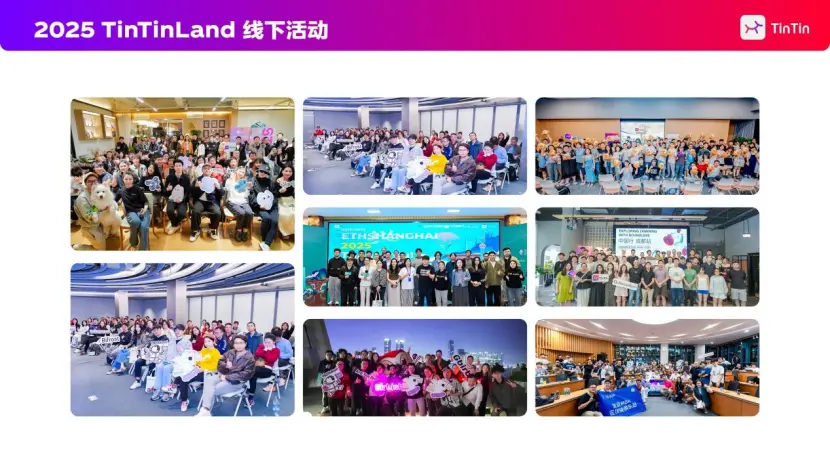
From high-frequency small Meetups to city tour activities, and then to annual conferences, TinTinLand is gradually forming a multi-layered offline network. This "high-frequency, small-scale, continuously occurring" connection method is more conducive to solidifying long-term relationships than one-time large summits. Many developers and projects collaborate after gradually building trust through repeated meetings.
For the Web3 industry, which emphasizes community and collaboration, such genuine offline connections often hold more long-term value than mere online traffic.
Education System Upgrade: Systematic Cultivation of Builders
On the developer supply side, systematic cultivation remains a key capability.
In 2025, TinTinLand will further improve its curriculum system, launching 9 systematic courses around the three-stage path of "cognitive establishment—skill deepening—practical incubation," gradually forming a clear talent growth ladder. Over the year, it will attract more than 2,500 developers to participate in learning, with an overall approval rate exceeding 93%.
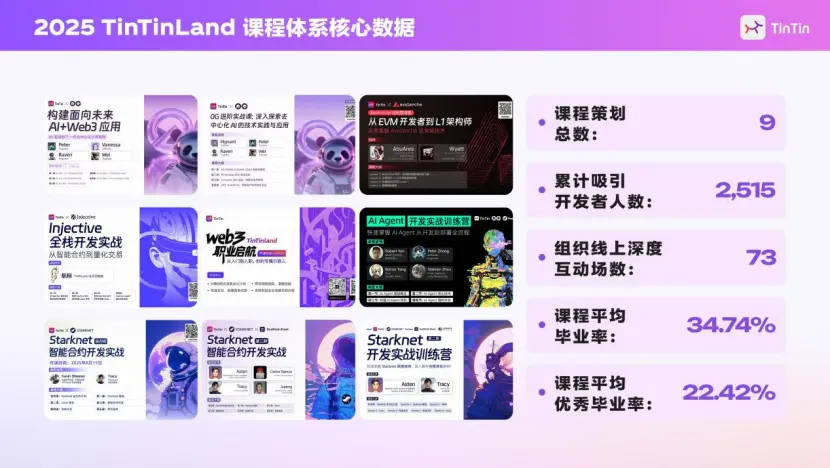
At the introductory level, the courses focus on addressing "information gaps and directional sense." For example, courses such as the Web3 Career Launch Course for newcomers, Introduction to Modular Chains and Decentralized AI, and Basic Courses on Public Chain Ecosystems help students quickly understand the industry landscape, mainstream technology stacks, and participation paths, lowering the entry barrier.
At the advanced level, the focus shifts to "real development capabilities." Course content covers smart contracts, front-end interaction, SDK integration, and complete application architecture design, emphasizing end-to-end development processes rather than isolated knowledge. Some courses revolve around high-performance DeFi, modular blockchain, and decentralized storage/computing, helping developers transition from single engineering capabilities to full-stack capabilities.
At the practical level, the teaching logic further aligns with real entrepreneurial and delivery scenarios. Multiple courses directly adopt the "learn and compete" or "course + hackathon" model, allowing students to complete runnable demos or complete on-chain applications within a limited time, directly transforming learning outcomes into project outputs.
For example, in the Starknet direction, multiple practical courses have driven students to build over ten fully functional on-chain applications; AI Agent-themed courses directly connect to hackathons at the end of the course, catalyzing over 30 runnable and reviewable project prototypes, significantly shortening the cycle from knowledge acquisition to product landing.
The course content is clearly aligned with industry trends: from public chain development and DeFi to AI Agents and decentralized AI infrastructure, gradually extending into new technology crossover fields.
Notably, the courses are deeply integrated with practical applications. Some classes adopt the "learn and compete" model, directly connecting to hackathons or Demo Days, shortening the path from learning to output.
From the student profile, over one-third have more than five years of development experience, nearly half are proficient in Solidity or Python, and over 80% hold a bachelor's degree or higher.
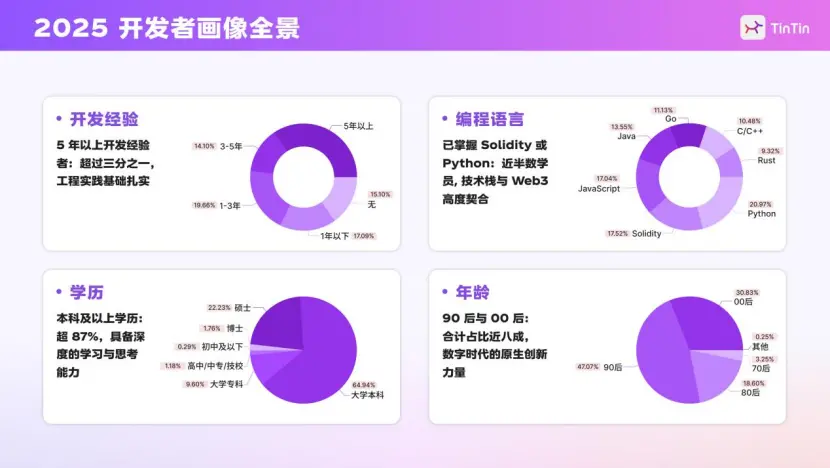
This means that the target audience is not a general interest group but rather technical backbones with real output capabilities. This high-density talent pool has also become the foundation for the platform's subsequent incubation capabilities.
Hackathons and Incubation: From Demos to Projects
If the courses address capability building, then hackathons directly point to results.
In TinTinLand's activity system, practical activities are often the "hottest" segment.
This heat does not come from the stage or publicity but from those real co-creation moments—
strangers sitting together discussing unformed ideas, working overnight to refine demos, and continuously correcting product logic under the scrutiny of judges. Many projects that continue to iterate later take their first steps in these moments.
In 2025, TinTinLand will build a multi-layered practical matrix around "gathering developers → high-density co-creation → Demos taking the stage → continuous connection":
Throughout the year, it will host 5 hackathons, 2 Hacker Houses, and multiple online bounties, attracting over 1,600 developers to participate, driving 173+ projects to complete demos or stage presentations, and supporting teams to continuously refine products with over $600,000 worth of incentive resources (excluding cloud services and ecosystem subsidies).
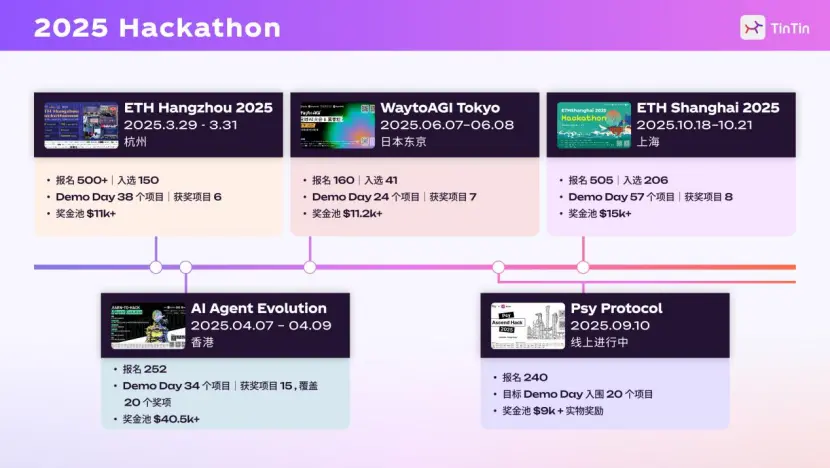
From the results, these activities are no longer just competitions but are gradually taking on the functions of early incubators.
Structurally, the three types of activities each serve different roles.
Hackathons emphasize "high-density creative collisions." They gather developers from different backgrounds under the same theme in a short time, promoting rapid team formation and prototype validation, serving as the most typical creative accelerator.
Over the past year, TinTinLand has hosted multiple regional hackathons in cities such as Hangzhou, Hong Kong, Tokyo, and Shanghai, focusing on themes like the Ethereum ecosystem, AI Agents, and DeFi infrastructure.
Each event often attracts hundreds of registrants, ultimately selecting core developers for concentrated creation, producing dozens of demos, and completing evaluations and connections on-site.
Many teams are "seen" by ecosystem projects or investors during a judge's question or presentation exchange, subsequently receiving further funding or joining long-term plans.
Hacker Houses provide a deeper co-creation space. Compared to the fast-paced hackathons, this format resembles a closed workshop—fewer people, longer time, and more immediate feedback.
Developers collaborate continuously in the same space for several days, focusing on refining functions and architecture, suitable for producing more mature, sustainably iterative seed projects.
In multiple Hacker Houses held in Shenzhen, Hong Kong, and other locations, many teams have directly completed the leap from prototype to usable product, with some projects continuing to receive ecosystem grants or technical support after the competition.
Online Bounties take on the role of "long-term display and review." Through online task systems and Demo Day formats, developers can repeatedly refine their results and allow their projects to be seen by more people. This replayable and accumulative mechanism ensures that works do not disappear with the end of the event but become publicly available results that can be sustainably disseminated.
From the participant profile, TinTinLand's practical activities also show significant professional characteristics.
Engineers and technical personnel account for over one-third, serving as the main output force;
students make up over 20%, providing a continuous influx of fresh blood to the ecosystem;
at the same time, a considerable proportion of product managers, entrepreneurs, and creators join, making team structures more complementary.
In terms of project types, application layer innovations are the most active. Games, consumer applications, and general dApps account for over half, followed by infrastructure, development tools, and protocol integration directions.
This reflects a trend: developers' focus is shifting from "purely technical implementation" to "real user scenarios and product landing."
Over a longer period, the significance of hackathons is also changing. They are no longer just short-term competitions driven by prizes but resemble a pathway into the mainstream industry—developers meet partners, engage with project parties, and receive their first resource support, giving an idea the opportunity to evolve into a real product.
To some extent, these high-frequency practical activities have already formed the early incubation layer of TinTinLand:
starting from demos, allowing projects to gain exposure, feedback, and connections, and then entering a longer-term ecological cooperation track.
If content and courses address cognition and capability, then what hackathons solidify is the true "co-creation soil" of the ecosystem.
For startup teams lacking resources and channels, this may be the most realistic and direct path into the Web3 industry.
Empowerment Network from Technology to Ecosystem
Compared to the number of activities, what is more noteworthy is its resource integration capability.
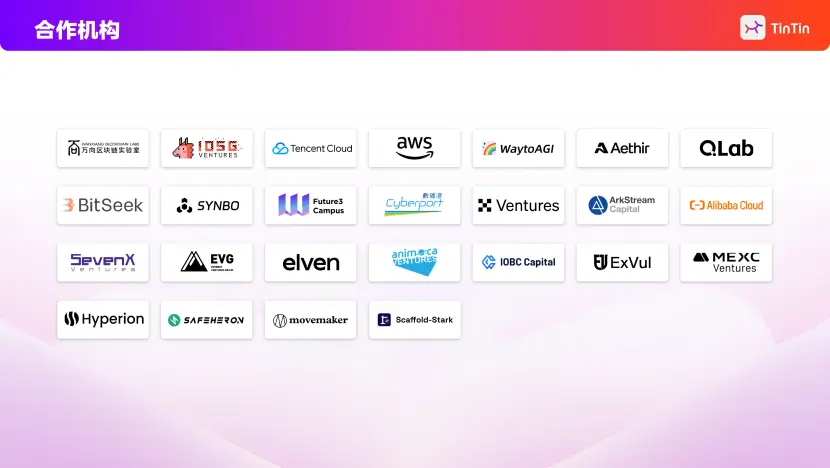
Currently, TinTinLand has established deep cooperation with over 50 mainstream public chains, while connecting with more than 20 investment institutions such as a16z, IOSG, and OKX Ventures, as well as government park resources like Hong Kong Cyberport and Shanghai Jing'an.
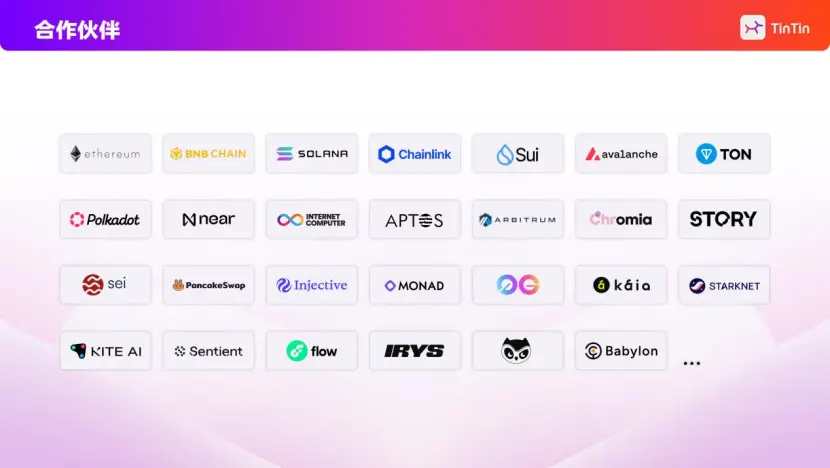
In addition, infrastructure providers such as Tencent Cloud, Alibaba Cloud, and AWS also offer technical and computing support.
This cross-ecosystem collaboration has gradually upgraded it from a "community operator" to a "growth service provider."
For overseas projects hoping to enter the Asia-Pacific market, localization often involves multiple challenges such as community building, policy alignment, developer recruitment, and market communication.
A platform that already has developer density and resource networks can significantly reduce entry costs.
In this regard, TinTinLand resembles a regional infrastructure.
Looking Ahead to 2026: Building the Asia-Pacific Web3 Innovation Growth Engine
Reflecting on 2025, the rhythm of TinTinLand can be summarized in two words: connection and sedimentation.
Over the past year, its platform has connected 179,361 developers and Web3 practitioners, covering over 50 countries and regions; 131 online and offline activities have unfolded across different cities and time zones, reaching 8.75 million people, allowing this developer network to continue to grow.
Courses, hackathons, Hacker Houses, and bounty mechanisms have advanced in parallel, with over 2,000 developers entering the system for learning, over 1,600 participating in practical collaboration, and more than 170 projects completing demos or stage landings.
At the same time, TinTinLand has also established cooperative relationships with over 50 mainstream public chains and ecological projects, continuously playing a bridging role in localized promotion, developer recruitment, and ecological co-construction.
These numbers are not ostentatious but outline a more solid path—not short-term noise, but long-term companionship; not a one-time gathering, but repeated connections.
Thus, TinTinLand's role is gradually shifting from a content community and event organizer to a more foundational position: becoming a connecting node between developers, project parties, and ecological resources.
Entering 2026, this "warm" construction is beginning to take clearer next steps.
On one hand, it is about truly retaining the people who have already gathered. By improving the alumni system, core contributor mechanisms, and long-term collaboration networks, it aims to enhance the return and co-creation efficiency among developers, transforming relationships from "participating in one event" to "continuing to walk together."
On the other hand, it is about deepening service capabilities. Surrounding the real needs of projects entering the Asia-Pacific market, it will provide a more complete growth support path, helping teams shorten cold start cycles and allowing regional resources to flow more smoothly.
At the same time, emerging nodes in South Korea and Southeast Asia are gradually being illuminated. More cross-regional collaborations are occurring—people, projects, and opportunities are no longer limited to a single market but are being rearranged in a larger landscape.
For the developer community, true value often does not manifest in a single highlight moment but in the daily connections and those seemingly small yet ongoing collaborations.
In a sense, this long-term companionship and support is an attitude in itself—not standing in the spotlight but choosing to stand beside developers.
It is foreseeable that as more regional nodes are illuminated and more cross-community collaborations naturally occur, this network will continue to extend. The role of TinTinLand will also continue to evolve as a connector and companion, moving forward with the Builders of the Asia-Pacific region, accumulating layer upon layer of soil for this ecosystem in a less noisy but more enduring rhythm.
免责声明:本文章仅代表作者个人观点,不代表本平台的立场和观点。本文章仅供信息分享,不构成对任何人的任何投资建议。用户与作者之间的任何争议,与本平台无关。如网页中刊载的文章或图片涉及侵权,请提供相关的权利证明和身份证明发送邮件到support@aicoin.com,本平台相关工作人员将会进行核查。


