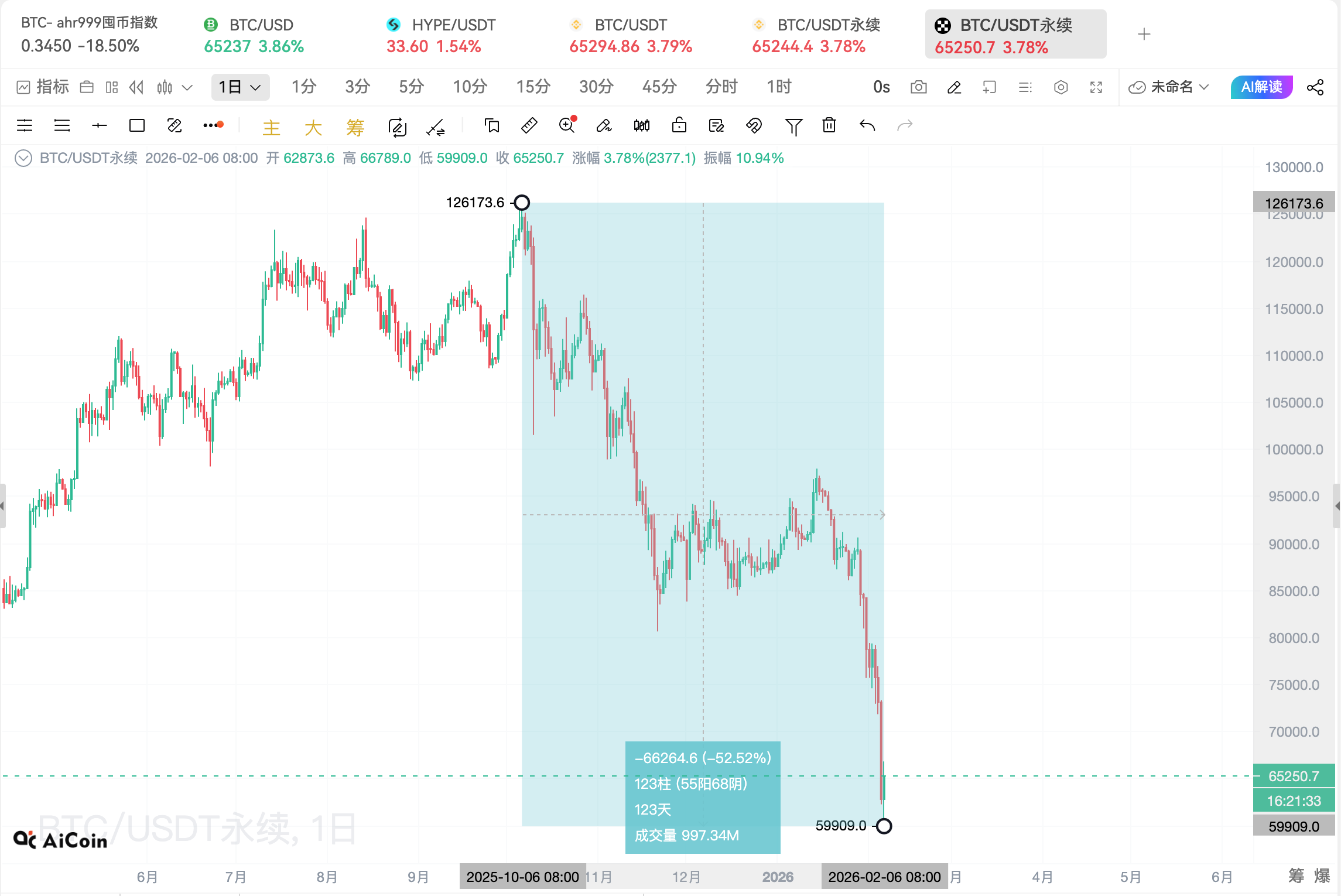
From February 5 to 6, 2026, in the East 8 Time Zone, Trend Research, under Yi Lihua, continuously transferred ETH to Binance and sold it on the spot market amid a market turmoil, aiming to complete active deleveraging before Aave's positions were passively liquidated. During the same period, the prices of Bitcoin and Ethereum plummeted sharply, with bearish sentiment dominating the derivatives market, while Binance's SAFU fund chose to go against the trend and bought approximately 3600 BTC (about $233 million), forming a stark contrast. On one side, heavily invested institutions were dumping to protect themselves, while on the other, the platform's security fund was stepping in to stabilize the market during the downturn. The bearish pricing in the options market further amplified panic expectations, turning this self-rescue action around the liquidation line into a high-pressure game between "institutional deleveraging" and "overall market stability."
Positions Approaching Dangerous Zones: Why Institutions Acted to Save Themselves Early
● Potential Large Leverage Structure: From publicly available information, Trend Research's operations on Aave represent a typical high-leverage institutional position of borrowing other assets against collateralized ETH, with specific collateral size and leverage ratios yet to be disclosed, only defined by the market as "potential large leverage exposure." Such structures, when the market trends downward, amplify liquidation pressure with each price drop, causing position management to switch from "profit optimization" to "survival priority" in an instant.
● Liquidation Range Still Estimated: Multiple on-chain analysts have provided a liquidation range of $1509-1800, widely referred to as the "danger zone" of this risk cycle, but this figure comes from various calculations and is considered unverified information rather than confirmed fact. In the absence of accurate collateral parameters, the market can only provide a vague range based on price paths and known on-chain fragment data. This "estimated cognition" itself reinforces traders' imaginations and fears regarding the liquidation price.
● Active Dumping for Deleveraging: As ETH rapidly declined from February 5 to 6, approaching the dangerous range estimated by analysts, the margin buffer on Aave was quickly eroded. Faced with the high risk of passive liquidation, Trend Research chose to concentrate large amounts of ETH into Binance and dump it on the spot market in a short time, actively selling to obtain liquidity and reduce on-chain leverage positions. For high-leverage institutions, "self-selling," though harsh, is often seen as the only choice better than "systematic forced liquidation."
Panic Selling and Contrarian Buying
● Chain Reaction of Selling Pressure on Prices: Trend Research's continuous selling of ETH on Binance added extra concentrated selling pressure to an already fragile liquidity environment. Such institutional-level sell-offs can amplify slippage in a short time, triggering order withdrawals and thinning depth, thereby accelerating price declines. For other participants in the market, seeing institutions unhesitatingly dumping on the spot often signals a negative indication that "internal risks are greater than market conditions."
● SAFU Fund's Contrarian BTC Accumulation: In stark contrast to Trend Research's self-rescue selling, the Binance SAFU fund was reported by multiple sources to have purchased approximately 3600 BTC, worth about $233 million during the same period. This action is based on publicly available information confirmed through multiple channels, rather than external speculation. From its positioning, the SAFU fund plays a role in platform security and market confidence buffering, and its contrarian accumulation of BTC during the downturn aims more to stabilize the ecosystem and risk expectations rather than engage in short-term speculation.
● Different Roles, Different Temporal Perspectives: On one side are leveraged institutions forced to sell ETH to avoid liquidation lines, while on the other side is the platform security fund, which, from a long-term safety reserve and ecological stability perspective, is accumulating BTC during the downturn. The simultaneous "dumping and buying" reflects completely different risk preferences, debt structures, and temporal perspectives. The former prioritizes immediate liquidity survival, while the latter is more concerned with stabilizing sentiment and smoothing volatility to ensure future business continuity.
Options Market on the Bearish Side: How Bearish Sentiment Amplifies Panic
● Bearish Tone in the Derivatives Market: According to data from Greeks.live, when Bitcoin and Ethereum experienced sharp declines in early February, put options dominated absolutely, becoming a hallmark of market sentiment at that time. The institution pointed out that BTC and ETH are still in a severe downward trend, and options traders are more willing to pay premiums for downside protection and directional shorting. This sentiment reflected from the derivatives side often shapes the expectations and behaviors of spot participants in reverse.
● Single Source of Put/Call Ratio: According to data disclosed by Greeks.live, the Put/Call ratio in the Bitcoin options market is about 0.54, while the Put/Call ratio in the Ethereum options market is about 0.9, both coming from the same source, which is an observational indicator that needs to be clearly cited. Although 0.54 is not considered extremely high in traditional terms, combined with the ratio close to 1 on the ETH side, it indicates that protective put demand was continuously heating up at that time. Such indicators do not constitute conclusions but provide an important reference for understanding market pricing panic.
● Resonance of Bearish Expectations and Spot Selling: When the information from the options market reaches investors inside and outside the market, Trend Research's concentrated selling of ETH on the spot market naturally embeds itself into a narrative framework of "bearish dominance": the pessimistic expectations in the derivatives market reinforce the imagination of Aave's liquidation risk, amplifying the collective fear of "the liquidation price being breached in one go." The result is that more holders choose to reduce their positions early or follow the sell-off to avoid becoming the "last one standing," and this expectation-based rush behavior further exacerbates the downward inertia of spot prices.
The Game in a Sharp Decline: Who Accelerates, Who Stops the Bleeding
● Different Strategies Under the Same Round of Plunge: In this round of severe correction, Trend Research represents the passive to active switch in deleveraging, hedging against the impending on-chain forced liquidation through their sell-off; while other funds view the same wave of decline as an opportunity to "buy the dip," choosing to accumulate in batches amid panic. Macroscopically, this is a position adjustment around the same price range, yet completely opposing: one side is eager to exit the high-leverage game, while the other attempts to embrace long-term risk premiums at lower prices.
● The Double-Edged Sword Effect of Active Dumping: From a systemic perspective, institutions choosing active dumping for deleveraging undoubtedly exacerbates price volatility in the short term and may even trigger a chain reaction. However, compared to passive liquidation on-chain, self-stopping bleeding in advance may allow for risk clearing at higher price levels, thus avoiding larger-scale waterfall liquidations and chain reactions. This choice of "taking the lesser of two evils" means that individual actions may cause more severe short-term impacts on the market, but could potentially reduce the tail risk of systemic risk in the medium to long term.
● Lack of Transparency Amplifies Panic Discounts: Whether it is the specific collateral size of Trend Research on Aave or the precise amount of ETH sold and its corresponding dollar value, currently, these cannot be accurately quantified by the market. In the absence of complete on-chain and market data, participants can only describe real risk exposure with "estimates" rather than "confirmations." This lack of complete transparency makes any rumors about liquidation prices and selling volumes more likely to be amplified, prompting funds to rush to escape early, adding extra "panic discounts" to prices amid panic and rush behavior.
Will the Market Be More Rational Next Time When Institutions Deleverage?
The recent deleveraging storm surrounding Trend Research has exposed the misalignment of three forces: first, leveraged institutions were forced to sell ETH significantly on the spot to avoid potential liquidation on Aave; second, the platform security fund chose to accumulate BTC contrarily at the same time, with the SAFU fund increasing its holdings by about 3600 BTC, investing about $233 million, providing some support for market sentiment; third, the options market, as indicated by the Put/Call ratio from Greeks.live, saw bearish sentiment dominating price expectations, guiding more people to price panic using derivatives. When these three forces intertwine at the same moment, market prices resemble a "liquidation prophecy amplified by emotions."
However, since the true scale of Trend Research's collateral positions, specific leverage ratios, and the precise amount of ETH sold remain obscured by information black boxes, the real "depth" of this round of volatility is still difficult to define. We can only observe the severe fluctuations in market prices but find it challenging to accurately dissect how much of it comes from passive risk clearing and how much is merely self-fulfilling emotions and expectations. For participants attempting to review this chain reaction, this uncertainty itself is a systemic variable that needs to be accounted for.
In the future, when similar large-scale deleveraging events occur again, higher transparency, more refined risk management tools, and standardized references for options and liquidation data are expected to help the market price panic more rationally. On-chain position disclosures, liquidation risk warnings, and cross-platform data aggregation, if they can form a more mature infrastructure, will prevent institutional self-rescue dumping from easily evolving into a "stampede script" for the entire market, allowing ordinary participants to follow less emotional responses amid volatility and make more data-driven calm judgments.
Join our community to discuss and become stronger together!
Official Telegram community: https://t.me/aicoincn
AiCoin Chinese Twitter: https://x.com/AiCoinzh
OKX Welfare Group: https://aicoin.com/link/chat?cid=l61eM4owQ
Binance Welfare Group: https://aicoin.com/link/chat?cid=ynr7d1P6Z
免责声明:本文章仅代表作者个人观点,不代表本平台的立场和观点。本文章仅供信息分享,不构成对任何人的任何投资建议。用户与作者之间的任何争议,与本平台无关。如网页中刊载的文章或图片涉及侵权,请提供相关的权利证明和身份证明发送邮件到support@aicoin.com,本平台相关工作人员将会进行核查。