From the early morning to daytime on February 6, on-chain monitoring showed that Trend Research concentrated on transferring and selling a large amount of ETH to exchanges, quickly becoming the focus of the entire market. Within just a few hours, the institution sold tens of thousands of ETH, including a key operation of transferring 20,000 ETH to Binance, which many observers regarded as the most representative institutional deleveraging action in this round of ETH's sharp decline. This event, combined with the sharp drop in Bitcoin prices and a drastic deterioration in sentiment during the same period, amplified the impact on ETH bulls into a chain reaction-like "deleveraging storm."
Selling 47,000 in Six Hours: Demonstration Effect of Institutional Speed and Scale
● The pace of concentrated selling was extremely tight. According to on-chain analysts, Trend Research sold a total of 47,000 ETH in about 6 hours, equivalent to approximately $89.29 million at the time, with the single transfer of 20,000 ETH to Binance seen as a turning point in sentiment. The combination of time and scale allowed the market to clearly feel that institutions could complete hundreds of millions of dollars in position adjustments in a very short time during extreme volatility.
● Part of the ETH transferred to exchanges was used for direct selling, while part was used to repay related loans and reduce collateral positions, forming a typical risk control path of "first replenishing margin, then cutting leverage." For institutions holding high-leverage positions, this rapid migration of on-chain assets to centralized exchanges highlights the priority of actively deleveraging and self-rescuing before system liquidation during a sharp market downturn.
● Media outlets like Planet Daily described Trend Research's actions as "the most indicative case of institutional deleveraging" in this round of ETH's decline, and this description itself amplifies the demonstration effect of the event. For other high-leverage participants, this is not just a case but more like a public signal that "it's time to reduce leverage," reinforcing the market narrative of chain liquidation and collective deleveraging.
Liquidation Price of $1,500: Overlap of On-Chain Liquidation Band and Psychological Defense Line
● Information from multiple on-chain monitoring sources indicates that Trend Research's liquidation range on Aave is roughly between $1,509–$1,800, but its actual leverage ratio and overall debt scale have not been publicly disclosed. In other words, the market can only see "where the liquidation band is roughly located," but cannot accurately assess how much passive selling pressure would hang overhead once liquidation is triggered.
● As the ETH price continued to decline and gradually approached the aforementioned liquidation range, the pressure on Aave-related positions suddenly intensified. Waiting for system liquidation not only risks facing worse transaction prices but could also trigger a waterfall-like sell-off on-chain. Therefore, from a risk control perspective, Trend Research's accelerated transfer of ETH and active deleveraging is a proactive move to hand over chips in advance under the shadow of liquidation, reducing the uncertainty brought by passive liquidation.
● Several on-chain analysts pointed out that the area around $1,500 is being viewed by the market as a key psychological defense line, and the game between the price curve and the liquidation line directly affects the emotions of bulls and bears. Once mainstream funds believe that "the liquidation zone will definitely be breached," it will create a self-fulfilling expectation for further shorting or reducing positions; conversely, it may attempt to support near that range, forming a fragile and sensitive short-term balance.
Bitcoin Falls Below $65,000: Resonance Deleveraging Under Macro Shock
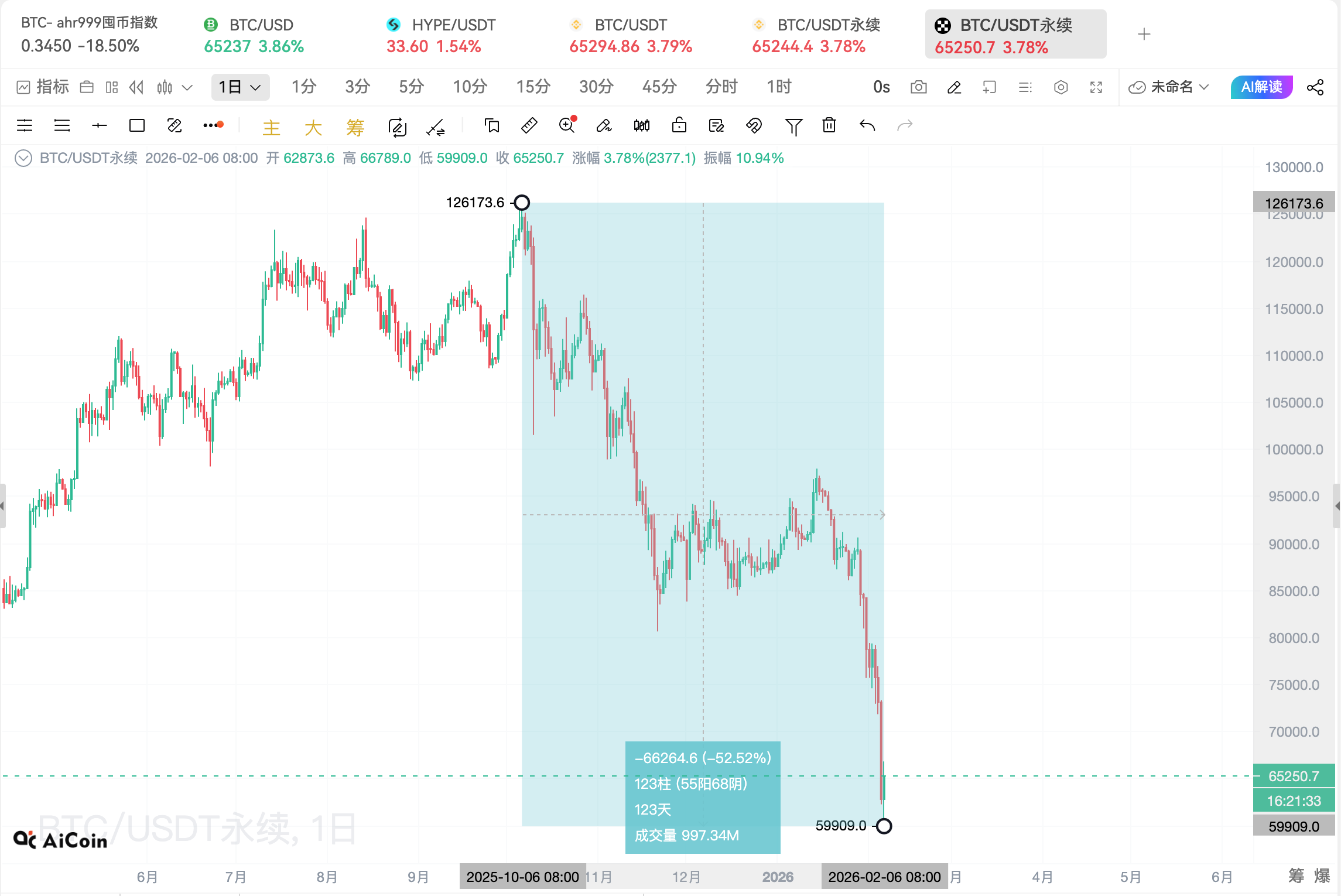
● On the same day that Trend Research concentrated on selling ETH, Bitcoin prices also suffered a heavy blow. According to HTX market data, BTC once dropped to $64,996.03, with a 24-hour decline of 8.31%, directly breaching the key psychological and technical support level of $65,000. The simultaneous weakness of leading assets provided the "macro background noise" for this round of deleveraging storm.
● The sharp drop in BTC not only suppressed ETH's absolute price performance but also significantly dragged down the ETH/BTC exchange rate, increasing the risk of leveraged positions established using ETH as collateral. When ETH continues to weaken relative to BTC, many risk models priced in BTC will require higher margins or reduced exposure, forcing related accounts to adjust positions either passively or actively.
● In this environment, Trend Research's deleveraging behavior is not an isolated case but a link in the entire market risk transmission chain. BTC breaking down support—sentiment turning bearish, funds retracting—ETH and other long-risk assets simultaneously under pressure—staking and collateral positions facing stress—institutions and large accounts collectively reducing leverage; this chain greatly weakens the possibility of any single institution "independently pricing."
Deep Green on Exchanges, Prophecy Market Turns Bearish: On-Chain Transparency and Emotion Amplifier
● The action of Trend Research concentrating a large amount of ETH into exchanges like Binance was quickly captured by on-chain tracking accounts and spread on social media like X in the form of fund flow screenshots. As data such as "single transfer of 20,000 ETH to Binance" and "selling 47,000 ETH in 6 hours" were amplified and disseminated, the deep green declines on exchange order books and the emotional resonance on social media turned what was originally a technical risk control operation into a symbolic event interpreted as "whales dumping."
● At the same time, the on-chain narrative and derivative pricing mutually reinforced each other. According to Polymarket's prediction data, during the event's fermentation period, the market gave a probability of Bitcoin dropping to around $55,000 of about 74%, meaning a considerable portion of participants were betting real money that "it hasn't dropped enough yet." This overall downward shift in expected price centers further stimulated short positions and reduced long positions, forming a typical negative feedback loop.
● It is important to note that on-chain transparency does indeed provide risk warnings, allowing the market to gain early insight into the intentions of large funds; on the other hand, it also continuously amplifies narrative labels such as "whales dumping," "chain liquidations," and "the end of bulls." When these labels are bound to real-time data and repeatedly shared, panic can easily self-fulfill emotionally before systemic liquidation actually occurs.
From Typical Cases to Collective Lessons: Leverage Boundaries in the Next Round of Volatility
Trend Research's high-intensity, short-cycle deleveraging operation clearly demonstrates the risk control logic of institutions "self-rescuing before liquidation" during extreme volatility: once prices approach the on-chain liquidation band, they prefer to actively shrink leverage through concentrated selling and loan repayment rather than completely entrust their fate to the protocol's automatic liquidation mechanism. However, this hedging self-rescue also exposes the fragility of the leverage chain during severe market fluctuations—once one link begins to significantly reduce positions, its liquidity shock can quickly transmit along the funding network.
In terms of results, the accelerated liquidation of large positions does not inherently have a "disaster-level" or "negligible" impact on the market; it highly depends on the depth of funds and risk aversion in the entire market at that time: if buy orders are thick enough and risk appetite remains, massive selling pressure may be relatively smoothly absorbed; but in an environment where both BTC and ETH plunge and the prophecy market's price expectations shift downward, the same scale of selling is more likely to trigger a cascade and chain liquidation. In the future, both institutions and retail investors need to reassess their leverage boundaries and liquidation price configurations—once liquidation risks are "lit up" online, under the dual effects of on-chain transparency and social media amplification, the buffer time for position adjustments will only get shorter.
Join our community to discuss and grow stronger together!
Official Telegram community: https://t.me/aicoincn
AiCoin Chinese Twitter: https://x.com/AiCoinzh
OKX Benefits Group: https://aicoin.com/link/chat?cid=l61eM4owQ
Binance Benefits Group: https://aicoin.com/link/chat?cid=ynr7d1P6Z
免责声明:本文章仅代表作者个人观点,不代表本平台的立场和观点。本文章仅供信息分享,不构成对任何人的任何投资建议。用户与作者之间的任何争议,与本平台无关。如网页中刊载的文章或图片涉及侵权,请提供相关的权利证明和身份证明发送邮件到support@aicoin.com,本平台相关工作人员将会进行核查。